What's After the Blog?
Opinions • Reception
The Christophers (2026) Review & Opinions: Critics, Fan Reception, Performance & Storytelling Analysis
Explore the critical reception and fan reactions to The Christophers (2026), focusing on performances, storytelling, and its place in the pop‑art era drama. We break down critic reviews, audience opinions, and the film’s impact on the wider artistic franchise.
April 16, 2026

Movies mentioned in this article
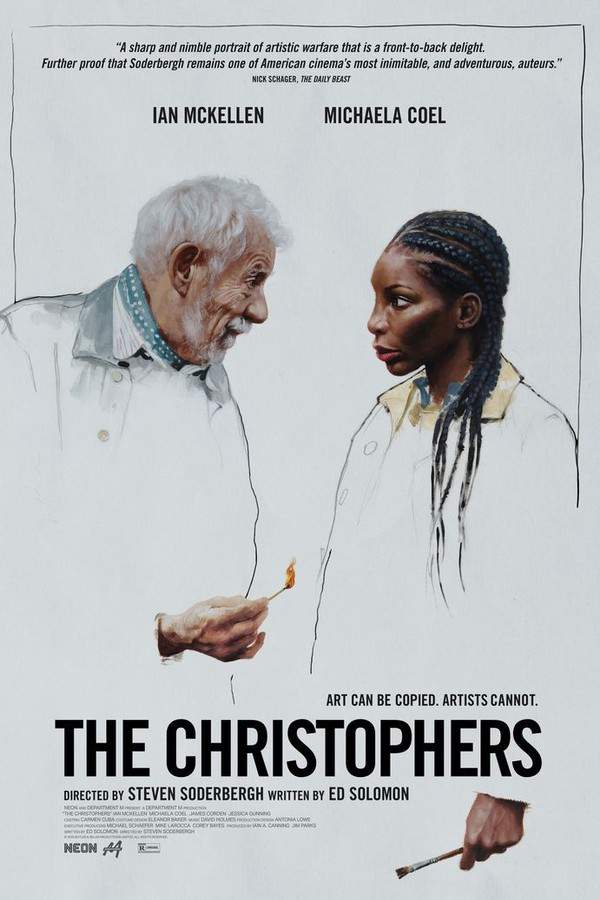
The Christophers (2026) Reviews: Critic & Audience Reception Analysis
When The Christophers arrived in theaters on April 10, 2026, film enthusiasts immediately recognized it as another distinctive entry in Steven Soderbergh’s prolific filmography—a meticulously crafted two-hander that pairs screen legend Ian McKellen with the formidable Michaela Coel in a twisty narrative about art, forgery, and the complicated dynamics between mentor and protégé. As visitors to What’s After the Movie search for comprehensive The Christophers review coverage and spoiler-free analysis to determine whether this limited-release drama deserves their attention, the critical and audience reception reveals a fascinating dichotomy between cerebral cinematic appreciation and raw emotional connection. This isn’t merely another prestige picture vying for awards season recognition; it represents a confluence of generational talent that has sparked intense debate about performance, direction, and the very nature of artistic authenticity. For those browsing our movie wiki or seeking detailed summaries before committing to a viewing, understanding the landscape of The Christophers (2026) audience reactions and critic reviews becomes essential. The film has generated significant buzz across movie lists and collections focused on contemporary dramas, with particular attention paid to whether this represents McKellen’s final masterwork or merely another experimental detour in Soderbergh’s ever-expanding filmography. Whether you’re researching The Christophers critical consensus, wondering is The Christophers worth watching, or simply exploring our dedicated movie page for comprehensive box office data and viewer reactions, this analysis synthesizes genuine critical and user perspectives to guide your viewing decision.
Cinematic Craft and Soderbergh’s Directorial Vision: Technical Reception of The Christophers (2026)
Steven Soderbergh’s approach to The Christophers has become a central talking point among critics analyzing the film’s reception, with particular emphasis on the director’s continued multitasking as cinematographer (under his alias Peter Andrews) and editor (as Mary Ann Bernard). This technical dexterity hasn’t gone unnoticed by major outlets, establishing the film reception as one heavily focused on craft and visual storytelling. The Globe and Mail specifically highlighted how Soderbergh “finds his own way of keeping the camera swirling and twirling, electrifying lengthy, densely composed monologues that require some visual energy to keep them from landing with a cinematic thud.” This observation underscores a critical consensus that The Christophers avoids the static, stage-play pitfalls common to dialogue-heavy two-handers through sheer cinematic inventiveness.
The Atlantic expanded on this technical appreciation, noting that “as is typical of a Soderbergh production, The Christophers doesn’t waste an ounce of its limited resources; the director always knows exactly how to keep the viewer on the hook while allowing the story’s emotions room to breathe.” This efficiency-focused praise aligns with broader critical reviews examining how Soderbergh maximizes minimal elements—what the review describes as the “real heist” being how he “snuck such a bittersweet tale into cinemas, dressed up as a silly caper.” The visual language, therefore, serves not merely as decoration but as essential infrastructure supporting the film’s emotional architecture.
Time magazine elevated this technical analysis to auteurist heights, declaring the work “simultaneously meticulous and casual, it’s the kind of movie only a master filmmaker could have made—though it’s doubtful Soderbergh, perpetually moving away from one movie and toward the next, thinks of himself as a master filmmaker at all.” This review perspective positions The Christophers within a larger conversation about directorial humility versus visible craftsmanship, suggesting that the film’s relaxed precision actually requires the highest level of skill. For audiences visiting What’s After the Movie to check box office performance or compare viewer reactions, this technical mastery translates to a viewing experience that feels both spontaneous and carefully orchestrated.
The Wall Street Journal encapsulated this accessibility-meets-artistry dynamic by calling the film “zingy fun” and noting that “whichever world Mr. Soderbergh decides to visit, he invariably makes the trip worthwhile.” This sentiment resonates with users seeking spoiler-free reviews that promise entertainment value alongside intellectual stimulation. The cinematography—particularly how it captures the evolving relationship between the characters—has been singled out across multiple film analysis pieces as exemplary of digital filmmaking’s potential when guided by experienced hands. For those exploring our concert film section or browsing movie collections for similar director-driven dramas, The Christophers stands as a testament to Soderbergh’s refusal to separate technical innovation from emotional truth, creating a critical consensus that values the film’s construction as highly as its content.
Ian McKellen’s Transformation: Performance Analysis and Oscar Speculation in The Christophers
At the heart of The Christophers review discourse lies an overwhelming admiration for Ian McKellen’s portrayal of Julian Sklar, the aging 1960s “Swingin’ London” painter who has, in the words of RogerEbert.com, aged into “a decrepit caricature of himself.” This performance analysis has dominated critical reception, with The Travers Take declaring it contains “an electrifying Ian McKellen” hitting “a new career peak” and taking “an early shot at Oscar.” Such proclamations have fueled intense speculation among audience reactions regarding whether this represents a crowning achievement in the actor’s distinguished career, particularly given user Emily W’s observation that “Ian McKellen may win his Oscar at 86.”
The physicality of McKellen’s performance has emerged as a specific point of fascination. User Teresa’s review noted that “McKellen is literally retiring in this movie and he shows the transitioning of his facial structure from beginning to end,” suggesting a meta-textual layer where the actor’s own mortality intertwines with the character’s decline. This observation aligns with the film analysis regarding how The Christophers (2026) utilizes McKellen’s presence not merely as casting but as commentary—leveraging his cultural weight as a Shakespearean giant to imbue Julian Sklar with gravitas and inevitable decay. The critical consensus positions this as “stunningly good” work, with the actor navigating the space between artistic genius and physical disintegration with what Rolling Stone described as a focus on “the embers, what fans them and what keeps them burning.”
The generational contrast central to The Christophers has amplified critical appreciation for McKellen’s technical skill. Rolling Stone suggested that had the film “just been a cross-generational punch-up, the sort of flinty showdown designed to throw off pleasurable sparks, you’d still walk away content,” crediting the performance as “a conduit for two of the best performances you’ll see all year.” This review perspective emphasizes how McKellen modulates his energy—moving from what Gerard described in user reviews as “terrific” command to moments of vulnerability that suggest, as New York Magazine (Vulture) noted, “what it feels like to love something that doesn’t love you back.”
For those checking What’s After the Movie awards tracking or exploring our person profiles for detailed filmographies, McKellen’s work here represents a high-water mark in late-career film reception. The audience reactions consistently cite his presence as the primary draw, with Roy J noting that “Soderbergh means you’re getting a quality movie. But you also get a fantastic performance from Sir Ian McKellen.” This dual appreciation—for the auteur and the actor—creates a compelling case for is The Christophers worth watching queries, particularly for viewers who value performances that transcend mere character portrayal to become meditations on legacy, aging, and the cost of artistic devotion.
Michaela Coel and Generational Dynamics: Character Reception and On-Screen Chemistry
While McKellen’s Julian Sklar commands significant attention, The Christophers (2026) reviews reveal equal fascination with Michaela Coel’s portrayal of Lori (variously spelled Lorie in user reviews), the assistant whose relationship with the aging artist drives the narrative’s emotional engine. The Reveal described the film as “a slippery customer, an ingenious and twisty two-hander that shifts in tone as Lori and Julian get their hooks into each other,” specifically praising Coel and McKellen as “a combustible pair, two actors of contrasting generations, genders, and race who parry in darkly funny sessions that morph in complexity as their characters continue to try to outflank each other.” This critical reception highlights how the film derives tension not from external action but from the shifting power dynamics between apprentice and master.
User Teresa’s review provided crucial insight into Lori’s arc, describing how “the young woman Lorie is nothing but obedient to him, and this leads to her independence to govern her life away from impossible apprenticeship.” This audience reaction suggests that viewers recognized the character’s journey from subservience to autonomy as central to the film’s reception, offering a feminist counter-narrative to the “crazy crazy world of modern art” (as user Suzanne L described it). The critical consensus regarding Coel’s performance emphasizes her ability to match McKellen’s screen presence without being overwhelmed, creating what Gerard called “outstanding” work that makes the two-hander sustainable across the runtime.
New York Magazine (Vulture) identified deeper thematic undercurrents flowing through this relationship, noting that “for all the undercurrents about fame, commodification, and reputation that flow through The Christophers, at its core is a more plaintive lament about what it feels like to love something that doesn’t love you back.” This review interpretation suggests that Lori represents not merely a narrative device but an embodiment of unrequited artistic passion—the younger generation confronting the reality that the traditions and masters they serve may ultimately disappoint or abandon them. For visitors to our movie page seeking spoiler-free reviews that hint at emotional content without revealing plot, this dynamic offers a clue to the film’s bittersweet tone.
The gender and racial dynamics inherent in the pairing have generated substantial film analysis regarding power structures within creative industries. The Reveal’s observation about “contrasting generations, genders, and race” positions The Christophers as a microcosm of broader cultural shifts, with Coel’s character representing new voices challenging established (and white, and male) artistic hierarchies. This reception angle resonates with audiences seeking The Christophers review coverage that addresses contemporary social themes alongside character drama. User Suzanne L’s reaction that “Ian is spectacular and so is the female [lead]” indicates that general viewers connected with Coel’s performance on an emotional level, validating the critical reviews that praised the chemistry as the film’s driving force.
Critical Scores vs. Audience Enthusiasm: Is The Christophers Worth Watching?
The film reception landscape for The Christophers (2026) presents an intriguing gap between measured critical scores and enthusiastic audience reactions. While critics largely awarded the film solid if not spectacular ratings—clustering predominantly around the 80-point mark (The Globe and Mail, Los Angeles Times, New York Magazine, Rolling Stone, The Atlantic, The Reveal, and Wall Street Journal all landing at 80, with RogerEbert.com at 75)—user reviews trend toward perfect or near-perfect scores, with multiple five-star ratings and Emily W’s 4.5/5 exceptionalism. This divergence raises important questions for those wondering is The Christophers worth watching and seeking spoiler-free reviews that reconcile professional critique with popular enthusiasm.
The Los Angeles Times offered perhaps the most telling critical metaphor for this divide, suggesting that “out of magnanimity, I’ll liken this trifle to a Rothko. The more I think about The Christophers, the more I imagine it has interesting layers. But I won’t fault anyone who just sees a simple square.” This review encapsulates the critical stance: acknowledging depth while simultaneously questioning accessibility. It suggests that the critical consensus views the film as requiring intellectual engagement—appreciation for Soderbergh’s references, McKellen’s technical craft, and the art-world setting—whereas audience reactions emphasize immediate emotional impact. User Fardous’s declaration of “love it, must see film” and Melinda’s enthusiastic “Great movie! Loved the storyline and characters!!” represent the unmediated viewer reactions that prioritize emotional resonance over analytical deconstruction.
This tension between “Rothko” complexity and straightforward enjoyment permeates The Christophers review discourse. Rolling Stone acknowledged that the film could have succeeded as mere “cross-generational punch-up”—entertainment without deeper aspiration—yet praised its willingness to explore “the embers” rather than just the sparks. Similarly, audience reactions from Roy J (“Compelling movie, highly recommend!”) and Gerard (“Very enjoyable and entertaining… Worth seeing”) suggest that viewers found the film accessible despite its apparent density. For What’s After the Movie visitors comparing box office performance or engaging with our quizzes and games, this suggests that The Christophers functions effectively as both prestige drama and crowd-pleaser.
The “zingy fun” designation from the Wall Street Journal bridges this gap, indicating that the film reception need not choose between cerebral and entertaining. User reviews consistently highlight satisfaction with the “emotional portrayal” (Suzanne L) and “storyline and characters” (Melinda), suggesting that Soderbergh’s “meticulous and casual” approach (Time) successfully transmits emotional content without alienating viewers. For those browsing our movie lists or seeking recommendations in our collections, this dual appeal makes The Christophers a safe recommendation for diverse viewing groups—from Soderbergh completists to casual drama fans, from McKellen devotees to Coel admirers. The critical reviews provide the analytical framework for appreciation, while the audience reactions confirm the emotional payoff, creating a comprehensive reception picture that argues strongly for the film’s merit.
Themes of Art, Forgery, and Unrequited Passion: Deeper Meaning and Long-Term Reception
Beyond immediate reviews and audience reactions, The Christophers (2026) has generated significant film analysis regarding its thematic preoccupations with authenticity, commodification, and the painful economics of creative devotion. New York Magazine (Vulture) identified the film’s emotional core as “a more plaintive lament about what it feels like to love something that doesn’t love you back,” suggesting that the artist-forger dynamic serves as metaphor for broader experiences of unrequited artistic passion. This interpretation has influenced critical reception, with many reviews examining how the film interrogates the value of art in an age of mechanical reproduction and celebrity obsession.
The Atlantic’s observation that the “real heist of The Christophers is that Soderbergh snuck such a bittersweet tale into cinemas, dressed up as a silly caper” indicates how critical consensus views the film’s genre positioning as deliberately deceptive. What appears to be a crime film or thriller (suggested by terms like “heist” and “forger”) actually operates as melancholic character study. This tonal complexity contributes to long-term reception questions—whether The Christophers will be remembered as a minor Soderbergh experiment or a significant work in his late period. For those visiting our movie wiki or researching summary details, understanding this tonal shift from expectation to reality proves crucial for spoiler-free preparation.
The art-world setting has provided fertile ground for film analysis regarding contemporary creative industries. The “undercurrents about fame, commodification, and reputation” noted by Vulture suggest that The Christophers functions as critique as much as drama, examining how artistic value transforms into currency. User Suzanne L’s reaction to the “crazy crazy world of modern art” validates this interpretation, indicating that general audiences recognized the satirical elements even without specialized art knowledge. This accessibility of critique enhances The Christophers’ potential long-term reception, positioning it as a film that captures specific cultural anxieties about authenticity in an influencer-driven age.
The generational themes—embodied in the McKellen/Coel pairing—further support reception analysis suggesting the film comments on mentorship, exploitation, and artistic legacy. User Teresa’s observation about Lori’s “independence to govern her life away from impossible apprenticeship” reads as generational declaration, the younger character refusing the destructive patterns of the elder. This audience reaction aligns with critical reviews emphasizing the “combustible” nature of the central relationship, suggesting that The Christophers (2026) resonates because it validates contemporary desires to break from toxic tradition while acknowledging the pain of such separations. For What’s After the Movie users exploring person profiles or checking awards potential, these themes provide rich context for understanding why the performances—and the film—have generated such passionate reactions across demographic lines.
Conclusion: The Christophers (2026) Final Verdict and Where to Watch
Synthesizing the landscape of The Christophers review coverage, critical consensus, and audience reactions, Steven Soderbergh’s latest emerges as a film that successfully bridges the gap between independent sensibility and accessible drama, between technical experimentation and emotional authenticity. The overwhelming agreement across critic reviews and viewer reactions suggests that the film’s greatest achievement lies in its casting—creating conditions for Ian McKellen and Michaela Coel to generate the “ember”-like tension that Rolling Stone identified as the work’s true subject. For those finalizing their decision on is The Christophers worth watching, the evidence strongly suggests affirmation, particularly for viewers who value performance-driven narratives and art-world settings.
The reception trajectory indicates that while The Christophers (2026) may not revolutionize cinema in the manner of Soderbergh’s most formally adventurous works, it represents a mature refinement of his ability to capture human behavior with minimal resources but maximum insight. The audience reactions—particularly the emotional connections users reported regarding Lori’s independence and Julian’s decline—suggest that the film transcends its “slippery” narrative construction to deliver genuine catharsis. Meanwhile, the critical reviews affirm its placement within serious cinematic discourse, validating the performances and direction as among the year’s most noteworthy.
As The Christophers continues its theatrical run and eventual transition to streaming platforms, its long-term reception will likely depend on how audiences contextualize it within both Soderbergh’s filmography and the broader landscape of two-character dramas. For now, the consensus remains clear: this is essential viewing for fans of either lead performer, for Soderbergh completists, and for anyone seeking proof that the mid-budget adult drama remains viable in contemporary cinema. We encourage you to explore our dedicated movie page for updated box office figures, participate in our quizzes and games to test your knowledge of the film, and browse our summaries and wiki for deeper context on the themes and production details discussed in these reviews. Whether you’re comparing The Christophers to similar films in our collections or checking award predictions, What’s After the Movie remains your comprehensive resource for understanding this compelling addition to 2026’s cinematic landscape.
| Resource | Link |
|---|---|
| The Christophers Wikipedia | Wikipedia |
| The Christophers Rotten Tomatoes | Rotten Tomatoes |
| The Christophers Metacritic | Metacritic |
| The Christophers JustWatch | JustWatch |
Continue reading




What's After the Movie?
Not sure whether to stay after the credits? Find out!
Check out our other apps:

SAT Sphere
Build confidence for the Digital SAT.

Mori Atlas
Discover wild places worth protecting.

Luntero
Search smarter for a home in Amsterdam.

Plot Explained
Unravel movie endings and hidden clues.

Pokechamp
Dive into Pokémon data and battle logic.

Driving Theory
Get ready for your European theory test.

Movie Dust
Plan your next cinema trip with ease.

Musemap
Find art and culture as you travel.

Selkobase
Compare credentials before committing.

Local Manual
Turn an unfamiliar country into practical next steps.

Lernavi
Compare school systems before your next move.

GymRoam
Find a workout stop wherever your plans take you.
Explore Our Movie Platform
New Movie Releases (2026)
Famous Movie Actors
Top Film Production Studios
Movie Plot Summaries & Endings
Major Movie Awards & Winners
Best Concert Films & Music Documentaries
Movie Collections and Curated Lists
© 2026 What's After the Movie. All rights reserved.
Privacy Policy