What's After the Blog?
Opinions • Reception
Power Ballad (2026) Review, Opinions & Reception – Critics, Fans, and Performance Analysis
Explore the mixed fan reactions and critic reviews for Power Ballad (2026), dissecting the film’s performances, storytelling, and its place in contemporary music‑drama cinema. We break down how the movie’s themes resonate with audiences and what critics say about its soundtrack and character dynamics.
June 3, 2026

Movies mentioned in this article
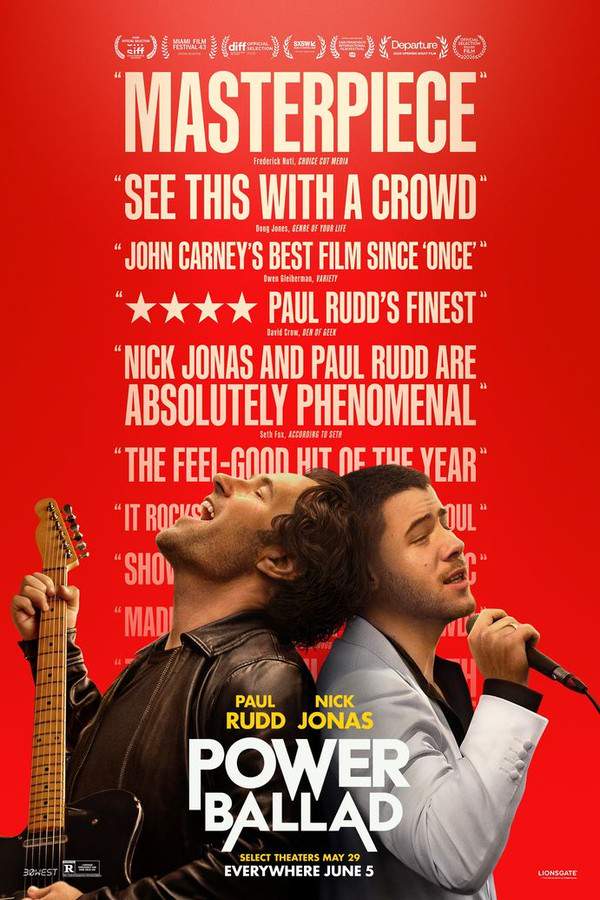
Power Ballad 2026 Reviews: Critical Reception, Audience Reactions, and Is It Worth Watching?
When John Carney releases a new musical drama, the film community listens. Following the cultural resonance of Once, Begin Again, and Sing Street, the Irish writer-director returned in May 2026 with Power Ballad, a film that promised to blend the director’s signature acoustic authenticity with the unexpected casting of Paul Rudd and Nick Jonas. As viewers searched for spoiler-free reviews and critical consensus before heading to theaters, questions loomed: Would this follow the established Carney formula of reluctant musicians finding connection through songwriting? Could Rudd transcend his comedic persona to deliver the emotional rawness the genre demands? And would Nick Jonas convince as a serious dramatic actor alongside an established star?
The search volume for Power Ballad 2026 reviews skyrocketed in the weeks following its Memorial Day weekend release, driven by a fascinating divergence between critic scores and audience reactions. While professional reviewers displayed mixed-to-positive reception ranging from tepid approval to genuine enthusiasm, early viewer reactions suggested a warmer, more appreciative embrace of the film’s comfort-food cinema approach. This disconnect between critical analysis and fan opinions creates exactly the kind of reception landscape that demands deeper investigation. Whether you’re debating if Power Ballad is worth watching during your next movie night, or you’re a die-hard Carney completist wondering how this compares to his previous work, understanding the nuanced spectrum of reactions—from Stephanie Zacharek’s melancholic interpretation to the enthusiastic user scores on major platforms—provides essential context. For complete movie details, cast information, and box office performance, visit the Power Ballad movie page on What’s After the Movie, where you can also explore our movie wiki for comprehensive filmographies and our concert films section for similar musical cinema recommendations.
Critical Consensus and Divided Opinions on Power Ballad 2026
The critical reception of Power Ballad reveals a fascinating schism between those who view Carney’s latest as a welcome return to form and those who find it operating on autopilot, delivering a “sitcom” version of the director’s typically transcendent musical narratives. With scores ranging from a disappointing 42 to a enthusiastic 80, critics seem to be asking whether familiarity breeds comfort or contempt when it comes to the filmmaker’s established patterns.
Simon Abrams delivered one of the harsher assessments, noting that while Power Ballad functions as “a good enough hang, especially during its opening half, its sitcom humor never rises to its stars’ level.” This criticism of tonal limitation finds echo in Katie Walsh’s observation that the film is “so light, it feels like it might blow away with a puff of wind,” suggesting that unlike the emotionally weighty Once or the soul-searching Begin Again, this entry lacks the gravitational pull to keep viewers emotionally anchored once the credits roll. Elizabeth Weitzman perhaps best summarized this critique through her metaphor of the film as “a crowd-pleasing wedding band of a movie,” acknowledging the professional competence while questioning whether professional competence alone satisfies audiences seeking the profound emotional catharsis that Carney’s best work delivers.
However, this critical consensus is far from monolithic. Alex Saveliev directly contradicts the “lightness” criticism by celebrating the narrative predictability as “a warm, cozy blanket of familiarity that’s expertly stitched together,” arguing that knowing exactly where the story leads doesn’t diminish the pleasure of the journey. This defense of comfort viewing finds powerful support in Ian Freer’s declaration that the film represents “another catchy Valentine to the transcendent properties of music,” specifically praising how Power Ballad feels “a little more grounded than your average John Carney playlist.” The film’s generosity and “native wit” apparently compensate for any perceived lack of innovation.
The most intellectually intriguing film analysis comes from Stephanie Zacharek, who interprets the movie not as a simple failure or success, but as a potentially unintentional meditation on “the preciousness and fragility of human creativity.” Her haunting observation that “its belief that everything can be put to rights with a happy ending is a fantasy too sad to bear” suggests a reading of the film as more melancholic than its surface warmth indicates—a meta-commentary on the very escapism audiences seek. Meanwhile, Richard Brody identifies “an unusually strong current of authentic (if narrow) emotion” running through the narrative, though he laments how “wilder ideas and feelings” remain trapped beneath the surface, implying that a more adventurous film lurks within this crowd-pleasing exterior.
Christian Zilko offers perhaps the most nuanced critic review, noting that the film wisely avoids “fantasies of overnight success” in favor of something “richer”—a meditation on songwriting as an end in itself rather than merely a vehicle for stardom. This interpretation aligns with Tim Robey’s appreciation of the film’s “seen-it-all take on the music biz that’s refreshingly acerbic” and its honest acknowledgment that “fame and fairness are practically banned from sharing a bed.” For viewers seeking in-depth movie analysis and critic review aggregations, our summary page offers detailed breakdowns of professional critical perspectives, while our awards tracking monitors potential year-end recognition for films like this.
Audience Reception and Fan Reactions to Power Ballad
Where critics saw formula, audiences largely found fulfillment. The viewer reactions to Power Ballad demonstrate a significant enthusiasm gap between professional reviewers and everyday filmgoers, with user scores clustering in the 4-5 star range (or 8-10/10) suggesting that the “wedding band” qualities critics dismissed as minor actually constitute the film’s primary appeal for general audiences seeking feel-good movie recommendations.
Bill E established the essential frame of reference immediately, declaring: “If you loved previous James Carney music based films like Once, Begin Again, Flora & Son, and Sing Street you will love this film.” This comparative film reception analysis appears repeatedly across user reviews, with Richard H providing a measured assessment that “If you enjoyed Begin Again, you’ll probably enjoy this…but it’s not quite as good,” specifically noting that while “‘the song’ is good, it’s not Lost Stars and it certainly isn’t Falling Slowly.” This acknowledgment of the film’s place in the Carney hierarchy—respectable but not revolutionary—characterizes much of the thoughtful fan opinion surrounding the release.
The audience reactions highlight a appreciation for the film’s emotional accessibility that critics sometimes overlooked. Jen C described it as “a feel good movie with great performances,” while Lou H praised it as an “Easy enjoyable movie to watch, with plenty of wit, charm and warmth.” See A offered simple, emphatic validation: “A very good and enjoyable movie.” These reactions suggest that for viewers uninterested in deconstructing Carney’s thematic evolution, Power Ballad delivers exactly the chill watch experience promised by its marketing—a comfort film for uncertain times.
However, the audience reviews also reveal fascinating demographic fault lines. Kerby C provided one of the most detailed negative viewer reactions, drawing on personal experience with musicians to critique the film’s authenticity: “My Dad was in a wedding band and my husband is a musician. I was yearning for something emotionally recognizable, but was left bereft.” Her specific complaints—questioning the Irish setting for American hits, criticizing the lack of personality for female characters, and finding the songwriting sequences “like watching paint dry”—demonstrate how film reception varies drastically based on viewer background and expectations. For those seeking movie recommendations tailored to specific tastes, our movie lists allow you to discover films based on your preferences, while our movie collections group similar titles for marathon viewing.
The most enthusiastic user reviews celebrated specific elements that critics merely noted. ROThornhill appreciated how “Rudd and Jonas get to stretch beyond their usual personas,” while ingrid F expressed being “quite surprised by Nick Jonas’ performance,” suggesting that the casting succeeded in its goal of expanding both actors’ ranges. Graham M offered perhaps the most colorful endorsement, praising Rudd for going “far deeper than the words” and declaring that “Him and his guitarist should have their own movie. The best duo I’ve seen in a while.” This appreciation for chemistry and subtle acting choices indicates that audiences engaged with the performances on a level that transcended the screenplay’s perceived limitations.
Paul Rudd and Nick Jonas: Performance Analysis in Power Ballad 2026
Central to any Power Ballad review must be an examination of its unconventional leading pair, a casting choice that generated significant film analysis regarding whether a comic everyman and a pop star could anchor a serious musical drama. The critic reviews and audience reactions reveal a surprising consensus: while the film itself may divide viewers, the performances of Rudd and Jonas largely succeed in legitimizing their dramatic credentials, even when the material surrounding them falters.
Peter Travers captured the dual achievement succinctly, noting that “Paul Rudd and Nick Jonas sing and act their hearts out in this ode to the power of music,” though he shared the common criticism that “there’s a thornier, more emotionally raw movie hiding under the crowdpleasing surface.” This assessment—that the actors deliver more than the script requires—resonates throughout the critical reception. Rudd, typically associated with affable comedy and the Marvel Cinematic Universe’s Ant-Man, reportedly abandons his “effortless humor” and “charming soft side” (as Kerby C missed them) in favor of a more desperate, yearning quality that Graham M described as going “far deeper than the words.”
The viewer reactions suggest that audiences appreciated this stretching of personas. ROThornhill specifically highlighted how both leads “get to stretch beyond their usual personas - Rudd as a singer and Jonas as an actor,” framing the film as a dual transformation narrative both on and off screen. This performance analysis indicates that Power Ballad functions partially as a star vehicle allowing established entertainers to demonstrate unexpected range. ingrid F’s surprise at Jonas’s dramatic capabilities suggests that the former Jonas Brother successfully transcended the “pop star trying to act” stigma that has plagued similar transitions.
However, the critical consensus regarding the performances isn’t universal praise. Kerby C’s dissenting view characterized Rudd as “so cheesy and obvious,” missing his usual charm and questioning why “his wife and daughter [were] lacking personality and back story.” This criticism points to a potential disconnect in the film’s direction—while the leads may commit fully to their roles, the screenplay’s construction of the surrounding world (particularly its female characters, as noted by multiple observers) may undermine their efforts. For detailed cast information and filmographies, explore our person profiles, where you can track Rudd and Jonas’s evolving careers and upcoming projects.
The chemistry between the two leads generated particular interest in fan opinions. The dynamic between Rudd’s wedding band veteran and Jonas’s character (presumably a younger or more successful musician, based on context clues) creates the film’s central tension and, according to Graham M, produces “The best duo I’ve seen in a while.” Whether this bromance transcends the film’s “sitcom humor” limitations (as Simon Abrams described them) remains a matter of spoiler-free review debate, but the performances themselves seem to have convinced even skeptical viewers that the pairing was worthwhile.
The John Carney Formula: Power Ballad vs Once and Begin Again
Any film analysis of Power Ballad must contend with the weight of John Carney’s filmography, specifically the holy trinity of Once (2007), Begin Again (2013), and Sing Street (2016). The critical reception suggests that Carney’s latest functions as both homage to and potentially tired repetition of his established musical storytelling formula, creating a reception landscape where comparison is inevitable and, for some, damning.
Richard H provided the most direct comparative movie review, offering a roadmap for Carney fans: “If you are familiar with John Carney’s previous works Once and Begin Again, you’ll have a fair idea what to expect here.” His verdict that it offers “a sweet enjoyable 90 or so minutes, but it doesn’t quite hit the highs of those prior two movies” encapsulates the disappointment of viewers hoping for another masterpiece rather than a solid entry. The specific comparison of Power Ballad’s central song to “Lost Stars” and “Falling Slowly” (the latter receiving “a very brief cameo in this movie”) establishes a hierarchy that places this 2026 release firmly in the “minor Carney” category for many film critics.
Alex Saveliev’s defense of the film’s predictability—that it serves as “a warm, cozy blanket of familiarity”—directly addresses the déjà vu that both delights Carney loyalists and frustrates those seeking evolution. The critical consensus seems to ask: at what point does a director’s consistent thematic obsession with the redemptive power of music-making become self-parody? Christian Zilko suggests that Power Ballad avoids this trap by narrowing its focus, replacing “fantasies of overnight success with something richer”—specifically, the idea that songwriting carries intrinsic value regardless of commercial validation. This represents a maturation of the Carney worldview, even if the narrative packaging remains familiar.
The wedding band setting—Elizabeth Weitzman’s metaphor for the film itself—distinguishes Power Ballad from the busking authenticity of Once or the polished pop production of Begin Again. Tim Robey highlighted this distinction by praising the film’s “seen-it-all take on the music biz that’s refreshingly acerbic,” suggesting that the specific subculture of professional wedding musicians (presumably Rudd’s character’s milieu) provides a grittier, more working-class perspective on musical labor than Carney’s previous protagonists, who typically occupied the hopeful amateur or disillusioned professional songwriter categories.
For viewers wondering is Power Ballad worth watching if they’ve seen Carney’s previous films, Bill E’s user review offers reassurance that the familiar formula still works: the presence of “Believable characters and a catchy main song” that “keep this film in your head for days” suggests that while the film may not reinvent the wheel, it keeps it spinning smoothly. Those seeking to explore Carney’s complete filmography or find similar concert films and music-driven cinema should visit our dedicated concert films section and browse our movie collections for curated thematic groupings.
Tone, Pacing, and Emotional Resonance in Power Ballad 2026 Reviews
The film reception of Power Ballad ultimately hinges on questions of tone and emotional authenticity—whether the movie successfully balances its crowd-pleasing instincts with genuine depth, or whether it settles for easy sentimentality. The critic reviews and audience reactions reveal a fascinating tension between those who find the film “acrbic” and grounded versus those who find it disappointingly superficial.
Simon Abrams’ critique of “sitcom humor” establishes one pole of the debate, suggesting that the film’s comedic beats undermine its potential gravitas. This reading finds support in Kerby C’s user complaint that “Musicians are hilarious. Not in this film,” and that the bandmates were “supposed to be funny but again, so basic and obvious.” When viewers with personal connections to the subject matter find the portrayal lacking in authentic personality, it suggests that Carney’s tone may have defaulted to broad accessibility rather than specific truth.
Yet Richard Brody offers a compelling counter-interpretation, identifying “an unusually strong current of authentic (if narrow) emotion” that saves the film from complete triviality. Stephanie Zacharek’s melancholic reading—that the film unintentionally reveals the “sadness” of happy ending fantasies—suggests that the emotional resonance may operate on a subconscious level, rewarding viewers willing to engage with the film’s meta-textual implications about creative fulfillment and aging.
The pacing of the film generated specific viewer reactions, particularly regarding the depiction of the creative process. Kerby C’s observation that “Watching people write songs is like watching paint dry” and that “That scene could have been cut in half” indicates that the middle section of the film may drag for viewers seeking narrative momentum rather than process-oriented realism. This criticism contrasts with Graham M’s enthusiasm for the central duo’s interactions, suggesting that pacing preferences vary based on investment in the character relationships.
Ultimately, Peter Travers’s assessment that the film hides “a thornier, more emotionally raw movie” beneath its polished surface encapsulates the critical consensus regarding Power Ballad’s tone: it plays the hits when it could have improvised a more challenging solo. Whether this constitutes a flaw or a feature depends entirely on what viewers seek from their film analysis—comfort or challenge. For those ready to test their own opinions against the critical consensus, our quizzes and games offer interactive ways to engage with cinema, while our box office tracking reveals how audience reception translates to commercial performance.
Is Power Ballad Worth Watching? Final Verdict on Reception
As the dust settles on the initial Power Ballad 2026 reviews, a complex portrait emerges of a film that satisfies without spectacularly thrilling, comfortingly familiar without breaking new ground. The critical consensus positions the movie as a solid, middle-tier entry in John Carney’s filmography—neither the transcendent experience of Once nor the misstep that some feared, but rather a “high-quality wedding band” (Elizabeth Weitzman) playing covers of the director’s greatest hits with professional competence if not revolutionary inspiration.
For audiences asking is Power Ballad worth watching, the answer largely depends on alignment with the viewer reactions that emphasize warmth and charm over innovation. If you approach the film seeking the specific alchemy of music, melancholy, and muted optimism that Carney perfected in his earlier work, tempered by the Paul Rudd and Nick Jonas review consensus that both actors deliver committed performances, then the film likely justifies a viewing. However, those seeking the emotional devastation of Once or the star-making chemistry of Begin Again may find themselves agreeing with Katie Walsh that this entry “doesn’t have the staying power of Carney’s other hits.”
The film reception suggests that Power Ballad functions best as a feel-good movie for viewers who don’t demand their comfort cinema also challenge them. The spoiler-free review consensus indicates that while the film may not reward deep film analysis with hidden complexities, it succeeds as a “chill watch” (Jen C) that “keeps this film in your head for days” (Bill E) through catchy music and likable performances.
Ultimately, Power Ballad seems destined for a comfortable afterlife on streaming platforms, where audience reactions typically prove more forgiving than opening weekend critic reviews, and where viewers can appreciate the “warm, cozy blanket of familiarity” (Alex Saveliev) without the pressure of theatrical expectations. Whether it achieves the cult status of Carney’s best work remains to be seen, but for now, it stands as a pleasant, if not essential, addition to the musical drama landscape of 2026.
For complete movie details, cast information, and to share your own Power Ballad review, visit the Power Ballad movie page on What’s After the Movie. Test your knowledge of film trivia with our quizzes and games, explore comprehensive summaries of your favorite films, and discover new favorites through our curated movie lists.
External Links and Resources
| Site | Link |
|---|---|
| Power Ballad IMDB | IMDB |
| Power Ballad TMDB | TMDB |
| Power Ballad Wikipedia | Wikipedia |
| Power Ballad Rotten Tomatoes | Rotten Tomatoes |
| Power Ballad Metacritic | Metacritic |
| Power Ballad JustWatch | JustWatch |
| Power Ballad Box Office Mojo | Box Office Mojo |
Continue reading



What's After the Movie?
Not sure whether to stay after the credits? Find out!
Check out our other apps:

SAT Sphere
Build confidence for the Digital SAT.

Mori Atlas
Discover wild places worth protecting.

Luntero
Search smarter for a home in Amsterdam.

Plot Explained
Unravel movie endings and hidden clues.

Pokechamp
Dive into Pokémon data and battle logic.

Driving Theory
Get ready for your European theory test.

Movie Dust
Plan your next cinema trip with ease.

Musemap
Find art and culture as you travel.

Selkobase
Compare credentials before committing.

Local Manual
Turn an unfamiliar country into practical next steps.

Lernavi
Compare school systems before your next move.

GymRoam
Find a workout stop wherever your plans take you.
Explore Our Movie Platform
New Movie Releases (2026)
Famous Movie Actors
Top Film Production Studios
Movie Plot Summaries & Endings
Major Movie Awards & Winners
Best Concert Films & Music Documentaries
Movie Collections and Curated Lists
© 2026 What's After the Movie. All rights reserved.
Privacy Policy