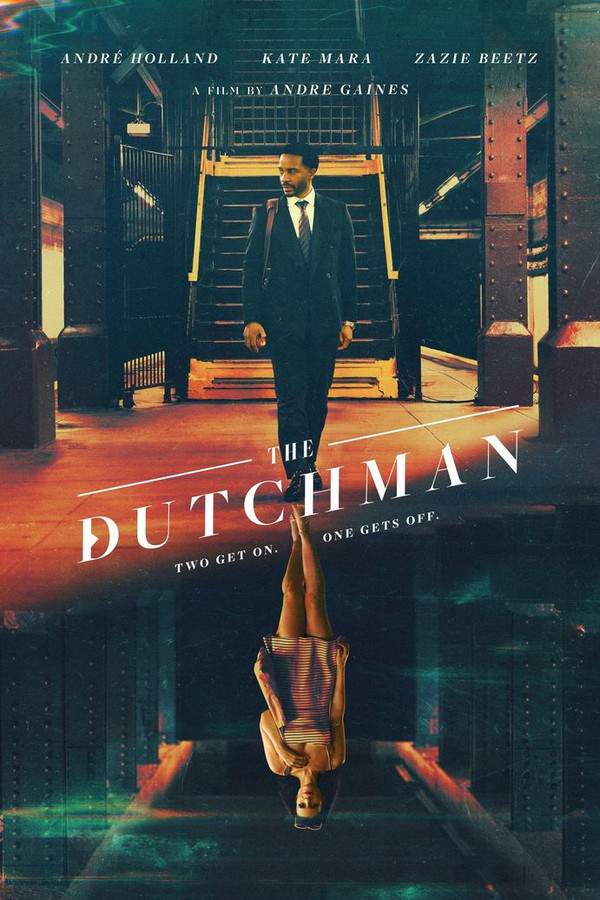
What Is The Dutchman About?
The premise of The Dutchman in 256 words, with nothing given away. The full story and the ending follow below.
a New York City charged with unspoken tensions, Clay, a successful but deeply troubled Black businessman, tries to hold his life together one therapy session at a time. Alongside his wife Kaya, he seeks to repair a marriage strained by the weight of expectations, identity, and quiet resentments. Their sessions feel like a fragile refuge, until the boundary between therapy and reality begins to blur in unsettling ways.
The film moves with a slow, hypnotic rhythm, capturing the hum of subway cars, the glare of city lights, and the watchful silences between strangers. Clay’s daily routines are shadowed by an increasingly intrusive presence — a mysterious figure whose appearances seem designed to unravel the careful order he has built around himself. Each encounter tightens the atmosphere, turning ordinary moments into charged exchanges filled with psychological friction.
Rooted in the textures of mid-century New York, the story leans into dreamlike imagery and theatrical flourishes that blur the line between performance and lived experience. Clay finds himself caught between two worlds: the polished, rule-following life he has constructed and a rawer, more chaotic undercurrent that refuses to stay buried. Race, desire, and self-deception simmer beneath every conversation, creating a mood that is as seductive as it is uneasy.
As Clay navigates these strange intrusions, the film poses questions about authenticity, vulnerability, and the masks required to move through the world. It is less a mystery to be solved than an atmosphere to be felt — one where every glance and whispered word carries the potential to shift everything.
What Happens in The Dutchman?
The complete story of The Dutchman, from the first scene to the last, in 496 words (about 2 minutes). Spoilers throughout. Names in the text link to 4 cast member pages.
Spoilers ahead
In New York City, Dr. Amiri Baraka gives Clay, André Holland a copy of his play Dutchman, with the advice that understanding struggle can lead to freedom. When Clay talks on the phone with his friend Warren while entering the Subway, Amiri uses a magical theater model to transport him into a world where racism is more open and unflinching. The story unfolds with themes from the play, yet unfolds in fresh settings that keep the tension personal and immediate.
At the next station Lula, Kate Mara stares at Clay, enters his subway car, and strikes up a conversation. Clay remains unsure if anything she says is true, such as her guessing he has a friend named Warren who looks like him. Lula invites herself to the party he’s attending. They exit together and go to her apartment where she seduces him. After they have sex, Clay notices the same theater model in Lula’s apartment that he saw earlier at Amiri’s place. They get into an argument, and when Clay walks out the door, she screams loudly enough for the neighbors to hear. She then threatens to use the contents of a condom to accuse him of rape if he doesn’t take her to the party.
Lula, the only white person at the party, insults the guests with racist comments. When Clay asks one of them, his wife Kaya, Zazie Beetz about the conversation, they end up rehashing an argument about her infidelity. As Lula spirals further, Warren, Aldis Hodge, asks Clay to remove her for “murdering the vibe.” Instead, Clay experiences an existential crisis, questioning what he gained by living a life planned and never truly messing up.
Clay introduces city councilor Warren, who plans a project to improve Harlem. When Lula threatens to interrupt the speech, Clay runs away. She follows, screams for the police, and gets him arrested. In jail, Amiri, in the next cell, offers guidance before Kaya bails him out. They argue and she leaves.
On the way home, Clay finds himself in a full-scale version of the theater, with a shelf stuffed with copies of the play, and realizes that Lula’s words are embedded in the text verbatim. Amiri appears and explains that she is his darkest thoughts made manifest. They discuss whether Clay must die as the character in the play does.
Clay steps back onto the subway to continue the story. Lula magically reappears and tries to have sex with him. When he refuses, she makes a scene. He asserts that he will not be diminished and demands to be the black man he is. When he tries to get off the train, she attacks him with a knife. In a departure from the play, Clay stabs her instead. Two police officers board and arrest him, despite a black eyewitness proclaiming his innocence. When Lula shows a video of the attack on her phone, the cops relent. Clay walks home in the sunshine and makes up with Kaya.
The Dutchman Timeline: Every Key Event in Order
12 key events in the order they happen, from “Amiri Baraka hands Clay Dutchman and offers a warning about struggle” to “Resolution: Clay walks home in the sunshine after reconciliation with Kaya”. 12 events name a place, across 10 locations.
- 1
Amiri Baraka hands Clay Dutchman and offers a warning about struggle
In New York City, the author Amiri Baraka gives Clay a copy of his play Dutchman and tells him that understanding struggle can lead to freedom. The moment sets up a theme that personal hardship can reveal deeper truths. Clay contemplates this idea as the spark for what’s to come.
When:early in the day Where:Amiri Baraka's apartment, New York City
- 2
Clay is pulled into a racially charged world via a magical theater model
While on the phone with his friend Warren, Clay is transported by Amiri's theater model into a world with more open racism. The shift bridges the real world and a heightened, threatening alternate reality. The experience foreshadows the confrontations ahead.
When:during the subway ride Where:subway car, New York City
- 3
Lula enters Clay's subway car and proposes to join him at the party
Lula stares at Clay, enters the subway car, and initiates a conversation that feels both intimate and unsettling. She audaciously invites herself to the party he’s attending, testing his boundaries. Clay remains unsure whether her words carry truth or deception.
When:later on the subway ride Where:subway car, New York City
- 4
Clay and Lula go to her apartment; the night deepens and the theater repeats
They go to Lula's apartment where they have sex, and Clay notices the same theater model he saw earlier. A heated argument erupts, and Lula threatens to use the contents of a condom to accuse him of rape if he won’t take her to the party. The tension reveals the power dynamic at play.
When:later that night Where:Lula's apartment
- 5
At Lula's party, racial tensions surface and old accusations resurface
Lula is the only white guest at the party and she spits racist remarks that unsettle everyone. When Clay questions Kaya about the overheard conversations, they revisit a fight over infidelity. The party becomes a backdrop for simmering conflicts and blame.
When:during the party Where:Lula's party
- 6
Warren enlists Clay to remove Lula; Clay flees a presidential-style rally
As Lula grows more disruptive, Warren asks Clay to eject her for 'murdering the vibe', pushing him toward action he cannot take. Clay instead experiences an existential crisis about living by a plan and never messing up. He introduces Warren, who is planning a Harlem project, but Lula’s threats derail the moment, and Clay runs away.
When:during the council speech Where:Harlem event/location where the speech is held
- 7
Lula pursues, police are summoned, and Clay is arrested
Lula relentlessly follows, screams for the police, and Clay is arrested in the ensuing chaos. The pursuit escalates into a clash between fear, control, and the structure of authority. The arrest compounds Clay's sense of being trapped by the simulation of his life.
When:immediately after the pursuit Where:outside the Harlem venue / street
- 8
In jail, Amiri offers guidance while Kaya bails him out
In the jail cell, Amiri sits beside Clay and imparts advice about facing the consequences of his choices. Kaya posts bail and retrieves Clay, but their reunion leads to a harsh confrontation and her decision to leave. The tension between them mirrors the play's deeper conflicts.
When:during detention Where:jail cell, New York City
- 9
The theater inside the journey reveals Lula as Clay's darkest thoughts
On the way home, Clay steps into a full-scale theater with shelves of Dutchman copies and realizes Lula's lines appear verbatim in the text. Amiri materializes to explain that Lula embodies his darkest thoughts. They debate whether Clay must die as the play’s tragedy dictates.
When:on the walk home Where:mind's theater / inner journey
- 10
Clay re-enters the subway; Lula reappears and initiates again
Clay returns to the subway to continue the story and Lula magically materializes, intent on repeating the sexual encounter. He refuses, asserting his true self as a Black man and demanding autonomy. The tension escalates as the world seems to bend around their choices.
When:mid-journey Where:subway car
- 11
A knife, a stabbing, and a police take-down
When Clay tries to exit, Lula attacks with a knife and he responds by stabbing her, deviating from the play's ending. Two officers board the train and arrest him, despite a Black eyewitness insisting his innocence. Lula later shows a video that sways the cops toward a reluctant stance.
When:immediately after the stabbing Where:subway car
- 12
Resolution: Clay walks home in the sunshine after reconciliation with Kaya
With the video exonerating him and the arrest behind him, Clay walks home in the sunshine and makes amends with Kaya. The day’s trials resolve into a fragile peace, echoing the play's themes about truth, perception, and freedom. The city’s light contrasts with the earlier darkness of the journey.
When:end of the sequence Where:city streets / home
Who Are the Main Characters in The Dutchman?
6 characters, among them Clay — André Holland, Lula — Kate Mara and Kaya — Zazie Beetz: who each one is and the part they play in the story. Every profile links to the actor’s page.
- C—
Clay — André Holland
Played by André Holland
Clay is a cautious, plans-driven man whose life is shaped by a system that treats him as a racialized subject. The theater-model intrusion pushes him into moral and existential conflict, forcing him to choose between a prewritten path and a self-defined fate. He grapples with whether personal freedom can survive in a world governed by prejudice and violence.
- 🧠 Intense
- 🗽 Race
- 🧩 Identity
-

Lula — Kate Mara
Played by Kate Mara
Lula is volatile, manipulative, and provocative, using sexuality and fear to destabilize Clay. She embodies a projection of Clay's insecurities and racist anxieties, pushing events to a breaking point. Her threats and unpredictable behavior culminate in a violent confrontation and legal jeopardy.
- 🔥 Volatile
- 🗣️ Manipulative
- 💥 Tension
-

Kaya — Zazie Beetz
Played by Zazie Beetz
Kaya is a sharp, morally complex figure who challenges Clay and reflects the complicated dynamics of trust, fidelity, and power in intimate relationships. Her confrontation with Lula and the party's social dynamics escalate the conflict, while her later support helps Clay navigate consequences. She embodies resilience amid provocative social games.
- 💔 Relationship
- 🌆 City life
- 🕊️ Trust
-

Warren — Aldis Hodge
Played by Aldis Hodge
Warren is a city councilor with a political project to reshape Harlem, representing ambition, diplomacy, and the lure of progress. He serves as Clay’s ally and a conduit to public life, while also illustrating how political goals intersect with personal and racial tensions. His presence grounds the story in real-world power structures.
- 🏛️ Politics
- 🤝 Alliance
- 🗺️ City planning
- DA
Dr. Amiri — Stephen McKinley Henderson
Played by Stephen McKinley Henderson
Dr. Amiri Baraka appears as a mentor-like figure who introduces the magical theater model and spurs Clay's introspection. He frames the narrative as a dialogue between art and life, offering guidance while revealing the darker edge of Clay’s psyche. His appearances anchor the existential questions at the story’s core.
- ✍️ Intellectual
- 🧭 Guidance
- 🧩 Theater
- G—
Gina — Lauren E. Banks
Played by Lauren E. Banks
Gina is a party guest whose presence and conversation expose the social dynamics around infidelity, loyalty, and rumor. She contributes to the escalating tension in the social circle and helps mirror the broader themes of trust and betrayal. Her interactions underscore how communal judgments shape individual choices.
- 💬 Social dynamics
- 🗣️ Gossip
- 🧪 Tension
Where and When Is The Dutchman Set?
The Dutchman is set in New York City and Harlem. Here is why the place matters to the story.
Where
New York City, Harlem
Set in New York City, the story unfolds largely around the subway and urban locales. Harlem emerges as a political backdrop with community tensions and projects in the works. The subway car becomes a recurring stage where power, fear, and prejudice collide, reflecting the city’s layered social dynamics.
- 🗽 Urban setting
- 🚇 Subway-centered
- 🏙️ Dense cityscape
What Are the Themes of The Dutchman?
4 ideas the story keeps returning to, among them Racism, Identity and Freedom & Consequence.
-
01
Racism
The film uses subway encounters and social gatherings to expose how racism informs behavior and choices. Public spaces become pressure cookers where stereotypes, entitlement, and fear shape interactions between Clay, Lula, Kaya, and bystanders. The theatrical conceit externalizes prejudice, making it a tangible force with consequences.
-
02
Identity
Identity is performed and questioned as theater and reality blur. Clay confronts the pressure to fit a scripted role while Lula projects his darkest thoughts as if they were his own. The model of theatre reveals how perception and self-conception can determine actions and outcomes.
-
03
Freedom & Consequence
Clay seeks personal agency in a world quick to judge and constrain him. The pursuit of emancipation clashes with violence, surveillance, and social expectations, highlighting that freedom often carries costs. The ending implies agency exists, but not without hard choices and repercussions.
-
04
Reality vs Illusion
The magical theater model collapses boundaries between art and life, forcing characters to distinguish scripted lines from real danger. Lula's rhetoric appears as a crafted script that becomes a dangerous truth on the train and at the party. The story challenges what is real when a narrative can be used to control and justify acts.
How Does The Dutchman End?
The last act of The Dutchman and what it means, in 375 words. The ending lands as mixed. Big spoilers: read the plot summary first if you have not seen it.
The final act, in full
The ending of Andre Gaines’ The Dutchman transforms the tragedy of Amiri Baraka’s original 1965 play into a story of empowerment and self-discovery. In a significant departure from the source material, Clay survives his encounter with the demon Lula and breaks the cycle of violence that had claimed so many men before him. Throughout the film, Lula represents an ancient evil that preys on Black men who remain silent in the face of racism and humiliation. She is both a literal demon and a metaphor for the persistent, shape-shifting nature of racism in America—an old evil that continually reinvents itself. For decades, she has hunted young Black men on the subway, and each time, they chose to look away, to swallow their anger, and ultimately to become her victims.
Clay, however, refuses to follow that path. Guided by his therapist, Dr. Amiri—who is revealed to be the architect of this psychological journey—Clay confronts Lula not with the violence she provokes, but with something far more powerful: his voice. When Lula attacks him with a knife, Clay defends himself, and in the ensuing struggle, Lula is killed. The arrival of two white police officers who immediately assume Clay’s guilt underscores the film’s sharp critique of systemic bias, but a Black woman on the train, the Mystic Lady, captures video evidence that proves Clay acted in self-defense. This act of kindness from a stranger is what ultimately saves Clay, demonstrating that community and compassion are just as vital as individual courage.
The film’s final scenes reveal that the entire subway ordeal may have unfolded within Clay’s subconscious. Dr. Amiri had orchestrated this internal journey to help Clay resolve his crisis of identity and find his voice. When Clay returns home to his wife, Kaya, he is no longer the silent, conflicted man who could not articulate his pain. He holds a copy of Dutchman that is now completely blank inside, symbolizing that he has broken free from the script others had written for him. The past, as Dr. Amiri tells him, is prologue—but Clay understands that it does not have to define his future. He has reclaimed his narrative, choosing to face his fears, speak his truth, and forge a new path forward on his own terms.
What Kind of Film Is The Dutchman?
Tense in tone, with variable pacing and a complex story, going by the plot summary.
- Tone
- Tense
- Pacing
- Variable
- Story
- Complex
- Intensity
- High
- Ending
- Mixed
A suffocating, psychologically intense drama that drags a Black man through a surreal subway nightmare where racial hostility and his own insecurities blur into an inescapable, dreamlike trap of manipulation and violence.
- oppressive
- unsettling
- claustrophobic
- paranoid
- psychological
- existential
- racial tension
- psychological manipulation
- identity crisis
- marriage
Content notes: threatened sexual assault accusation, knife violence, stabbing, infidelity, psychological manipulation, racial violence.
Quiz
How well do you remember The Dutchman? Test yourself on the story.