What Is Radioactive About?
The premise of Radioactive in 272 words, with nothing given away. The full story follows below.
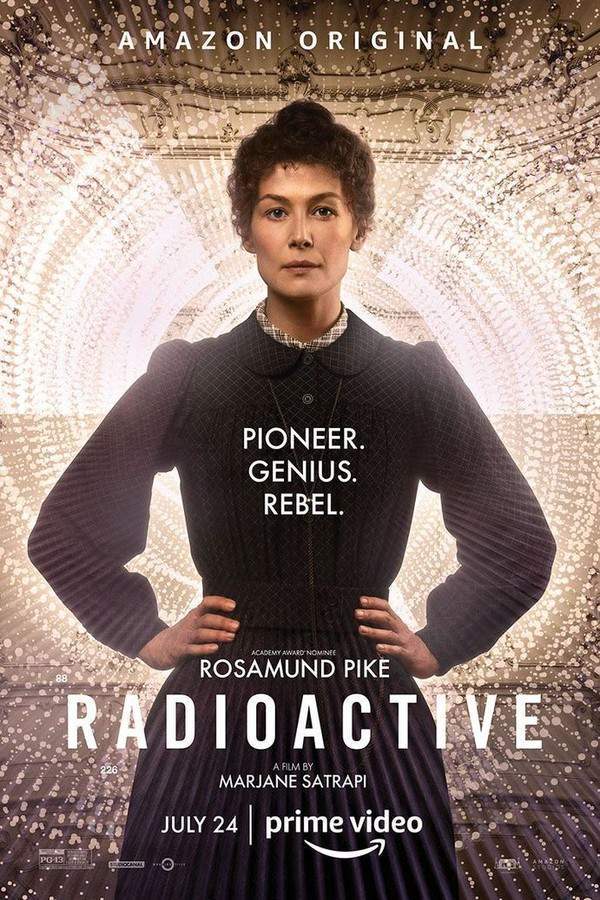
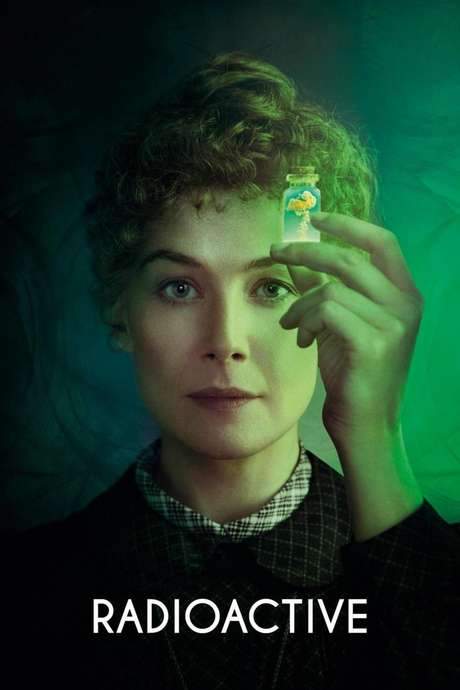
Radioactive offers an intimate portrait of Marie Curie, one of history’s most brilliant and determined scientists, whose work would forever alter humanity’s understanding of the physical world. Set against the backdrop of late 19th and early 20th century Europe, the film captures the atmosphere of a scientific community on the brink of transformation, where curiosity, skepticism, and ambition collide in smoke-filled lecture halls and cluttered laboratories. Marie navigates this world as a woman of fierce intellect and unyielding resolve, confronting the quiet resistance of an academic establishment not yet ready to accept her.
At the heart of the story is her partnership with Pierre Curie, a fellow researcher whose unconventional thinking mirrors her own. Together, they form an inseparable bond—both romantic and intellectual—as they embark on a journey into the mysterious phenomenon they will name radioactivity. Their shared laboratory becomes a space of wonder and relentless inquiry, where the slow, painstaking process of discovery unfolds with the rhythm of devotion. The film captures the electricity of their collaboration, the small triumphs and quiet frustrations, painting a portrait of two minds utterly consumed by the pursuit of knowledge.
As their findings begin to ripple beyond the laboratory, the world takes notice. Commercial interests, medical possibilities, and public fascination all converge on the element they isolate, opening doors to applications neither could have fully anticipated. Radioactive weaves this scientific awakening with Marie’s personal reflections, suggesting that every great discovery carries within it a shadow—a duality that will echo through generations. The film carries a contemplative, almost prophetic tone, balancing the intimate textures of Marie’s daily life with the vast, unfolding consequences of her work.
What Happens in Radioactive?
The complete story of Radioactive, from the first scene to the last, in 550 words (about 2 minutes). Spoilers throughout.
Spoilers ahead
In 1934, Marie Curie collapses in her laboratory in Paris. As she is rushed to the hospital, she remembers her life. In 1893 she was frequently rejected for funding due to her attitude, which she had in common with Pierre Curie. This joint attitude issue with the leading academic authorities led her to share a laboratory with Pierre Curie.
Before Marie discovers polonium and radium, the two fall in love, marry, and have two children. Soon, Marie announces the discovery of radioactivity, revolutionizing physics and chemistry. Radium is soon used in a series of commercial products. Pierre takes Marie to a séance where it is used to attempt to contact the dead, but Marie disapproves of spiritualism and the idea of an afterlife after the death of her mother in Poland.
Although Pierre rejects the Légion d’honneur for not nominating Marie and insists that they jointly share their Nobel Prize in Physics, she becomes agitated that he accepted the Prize in Stockholm without her. Soon afterwards Pierre becomes increasingly sick with anemia as a result of his research and is trampled to death by a horse and cart.
Marie initially dismisses concerns that her elements are toxic, but increasing numbers of people die from serious health conditions after exposure to radium. Depressed, she begins an affair with her colleague Paul Langevin. Although she receives Pierre’s professorship at the Sorbonne, the French nationalist press reports the details of her affair with Langevin and she is harassed by xenophobic mobs due to her Polish origins.
Marie returns to the house where she attended the seance and tearfully begs her friend, Loie Fuller, who was there to try to use radium to contact Pierre. When she is awarded the Nobel Prize in Chemistry in 1911, she defies the committee’s instructions not to travel to Stockholm and at her award ceremony receives a standing ovation from the entire audience.
In 1914, when World War I starts, Marie’s daughter Irene convinces her to run an X-ray unit on the Western Front in order to determine whether or not amputation is needed for wounded soldiers. Irene begins dating Frédéric Joliot, and Marie initially disapproves of that relationship because of their joint research into induced radioactivity, later asking Irene not to take part in Frédéric’s future work on this because of possible effects on her health. Although Irene does not heed her mother, together they go to the Western Front to run the X-ray machine.
Scenes of Marie’s life are interwoven with scenes depicting the future impact of her discoveries, including external beam radiotherapy at a hospital in Cleveland in 1956, the atomic bombings of Hiroshima and Nagasaki, a nuclear bomb test in Nevada in 1961, and the Chernobyl disaster in 1986. As she dies in 1934, she sees visions of these events before awakening in a hospital room. Pierre arrives and they leave the hospital together.
Before the film’s credits, the Curies’ accomplishments are detailed, including their mobile unit which X-rayed more than a million men during the war “saving countless lives”, their research would be used to create radiotherapy, and the Joliot-Curies would discover artificial or induced radioactivity in 1935.
The movie’s last image is of a photo showing Marie Curie’s attendance at the 1927 Solvay Conference with many other celebrated physicists, including Albert Einstein.
Radioactive Timeline: Every Key Event in Order
15 key events in the order they happen, from “Marie Collapses in Her Laboratory” to “Legacy and the Solvay Conference”. 6 events name a place, across 3 locations.
- 1
Marie Collapses in Her Laboratory
In 1934, Marie Curie collapses while working in her laboratory in Paris. As she is rushed to the hospital, her life flashes before her eyes, and she begins to remember the key events of her past.
When:1934 Where:Paris, France
- 2
Rejection and a Shared Laboratory
Marie is repeatedly rejected for research funding due to her blunt attitude, one she has in common with Pierre Curie. Their mutual conflict with the leading academic authorities leads Marie to share a laboratory with Pierre, beginning their famous scientific partnership.
When:1893 Where:Paris, France
- 3
Love, Marriage, and Family
Before making their groundbreaking discoveries, Marie and Pierre fall in love and marry. The couple has two children together, building a family life while continuing their scientific work side by side.
- 4
The Discovery of Polonium and Radium
Marie discovers the elements polonium and radium and announces the discovery of radioactivity, revolutionizing the fields of physics and chemistry. Radium is soon used in a series of commercial products, making the Curies world-famous.
- 5
The Séance
Pierre takes Marie to a séance where radium is used in an attempt to contact the dead. Marie disapproves of spiritualism and the idea of an afterlife, still grieving the death of her mother in Poland.
- 6
The Nobel Prize in Physics Controversy
Pierre rejects the Légion d'honneur for failing to nominate Marie alongside him and insists that they jointly share their Nobel Prize in Physics. However, Marie becomes agitated when Pierre accepts the Prize in Stockholm without her by his side.
Where:Stockholm, Sweden
- 7
The Death of Pierre Curie
Pierre becomes increasingly sick with anemia as a result of his research. He is then tragically trampled to death by a horse and cart, leaving Marie without her partner both in life and in science.
- 8
Radium's Deadly Toll
Marie initially dismisses concerns that her discovered elements are toxic. However, increasing numbers of people begin dying from serious health conditions after exposure to radium, revealing the dark consequences of her discovery.
- 9
Affair and Press Scandal
Depressed after Pierre's death, Marie begins an affair with her colleague Paul Langevin. Although she receives Pierre's professorship at the Sorbonne, the French nationalist press reports the details of the affair and she is harassed by xenophobic mobs because of her Polish origins.
Where:Paris, France
- 10
Desperate to Contact Pierre
Marie returns to the house where the séance had taken place and tearfully begs her friend Loie Fuller to try using radium to contact Pierre. Overcome with grief, she is willing to believe in the afterlife she once rejected.
Show the other 5 events of Radioactive Hide the last 5 events
- 11
Winning the Nobel Prize in Chemistry
When Marie is awarded the Nobel Prize in Chemistry in 1911, the committee instructs her not to travel to Stockholm due to the scandal surrounding her. She defies their instructions, and at her award ceremony she receives a standing ovation from the entire audience.
When:1911 Where:Stockholm, Sweden
- 12
X-Rays on the Western Front
When World War I begins, Marie's daughter Irene convinces her to run an X-ray unit on the Western Front. The unit is used to determine whether amputation is needed for wounded soldiers, bringing medical imaging directly to the battlefield.
When:1914 Where:Western Front
- 13
Irene and Frédéric Joliot
Irene begins dating Frédéric Joliot, whom Marie initially disapproves of because of the couple's joint research into induced radioactivity. Marie asks Irene not to take part in Frédéric's future work on the subject due to possible effects on her health, but Irene does not heed her mother and together they operate the X-ray machine on the Western Front.
- 14
Visions of the Future and Final Farewell
As Marie dies, she sees visions of the future impact of her discoveries, including external beam radiotherapy at a hospital in Cleveland in 1956, the atomic bombings of Hiroshima and Nagasaki, a nuclear bomb test in Nevada in 1961, and the Chernobyl disaster in 1986. She then awakens in a hospital room, where Pierre arrives and the two leave the hospital together.
When:1934
- 15
Legacy and the Solvay Conference
Before the film's credits, the Curies' accomplishments are detailed: their mobile unit X-rayed more than a million men during the war, saving countless lives, and their research would be used to create radiotherapy. The film's last image is a photograph of Marie Curie at the 1927 Solvay Conference alongside celebrated physicists such as Albert Einstein.
Who Are the Main Characters in Radioactive?
3 characters, among them Marie Curie, Pierre Curie and Paul Langevin: who each one is and the part they play in the story. Every profile links to the actor’s page.
-

Marie Curie
Played by Rosamund Pike
Marie Curie is portrayed as a brilliant yet conflicted scientist battling societal prejudice and personal loss. Her determination to pursue her scientific passion often clashes with the expectations placed upon her as a woman in a male-dominated field. As the film progresses, she evolves from an ambitious researcher to a significant figure emblematic of both scientific progress and the emotional toll of such a journey.
- 👩🔬 Scientist
- ❤️ Passion
- 💔 Grief
-

Pierre Curie
Played by Sam Riley
Pierre Curie is depicted as a supportive yet troubled husband as he grapples with his own health issues and struggles against societal norms regarding recognition in science. His partnership with Marie is both a source of strength and a point of contention, particularly regarding their shared legacy and the Nobel Prize. His untimely death profoundly impacts Marie, shaping her work and emotional state.
- 🔬 Pioneer
- 💔 Supportive
- ⚖️ Conflict
-

Paul Langevin
Played by Aneurin Barnard
Paul Langevin enters Marie's life as a colleague and later as a romantic interest, highlighting her vulnerability amidst personal tragedy. His character brings depth to the themes of love and betrayal, representing the complicated nature of her relationships during moments of profound loss and media scrutiny. Langevin's role contrasts with the legacy of Pierre, creating tension around Marie's choices.
- 💔 Affair
- 🧫 Colleague
- 🔍 Scrutiny
Where and When Is Radioactive Set?
Radioactive is set in Paris, Poland, Western Front, Cleveland, Hiroshima, Nagasaki, Nevada, Chernobyl (1893 - 1986). Here is why the time and place matter to the story.
When
1893 - 1986
The movie spans a vital period from 1893, when Marie Curie struggles for recognition, to 1986, showcasing the long-term effects of her scientific contributions. This era includes significant events such as her discoveries of polonium and radium, her experiences during World War I, and the catastrophic developments related to nuclear energy, including Hiroshima, Nagasaki, and the Chernobyl disaster. The shifts in societal attitudes toward women in science and the evolution of nuclear research also shape the narrative across these decades.
Where
Paris, Poland, Western Front, Cleveland, Hiroshima, Nagasaki, Nevada, Chernobyl
The film primarily takes place in Paris, where Marie Curie conducts her groundbreaking research. Poland also plays a significant role, serving as Marie's homeland and a base for her memories. The Western Front during World War I is depicted as a critical location where Marie applies her X-ray techniques, while Cleveland appears as a center for modern medical advancements influenced by her discoveries. Additionally, the historical contexts of Hiroshima, Nagasaki, Nevada, and Chernobyl illustrate the profound impact of her work on nuclear science.
- 🏙️ City
- 🌍 Country
- ⚔️ War Zone
- 🏥 Hospital
- 💣 Historical Event
What Are the Themes of Radioactive?
3 ideas the story keeps returning to, among them Science, Loss and Legacy.
-
01
Science
At its core, 'Radioactive' explores the theme of scientific discovery and innovation. Marie Curie's groundbreaking research leads to the revelation of radioactivity, fundamentally changing the fields of physics and chemistry. The film delves into the moral dilemmas faced by scientists as they navigate the potential consequences of their discoveries, particularly as they relate to public health and warfare.
-
02
Loss
The theme of loss permeates the narrative, seen through Marie's struggles with personal tragedies, including the death of her mother and husband. This profound sense of grief also extends to the ramifications of her scientific work, as she grapples with the unintended consequences of her discoveries on human health and life. Her emotional journey reflects the intersection of personal grief with the broader implications of scientific advancement.
-
03
Legacy
The film highlights the theme of legacy, illustrating how Marie Curie's contributions extend far beyond her lifetime. Her pioneering work has lasting implications on medicine, physics, and the societal role of women in science. The narrative frames her achievements within the context of historical events that followed, reminding viewers of the weight of legacy borne by those who innovate and challenge societal norms.
What Kind of Film Is Radioactive?
Bittersweet in tone, with variable pacing and a complex story, going by the plot summary.
- Tone
- Bittersweet
- Pacing
- Variable
- Story
- Complex
- Intensity
- Medium
- Ending
- Bittersweet
A contemplative biographical epic weaving Marie Curie's personal triumphs and tragedies with the long shadow of her discoveries, moving between intimate romance and the devastating scale of nuclear history.
- melancholic
- reflective
- somber
- contemplative
- romantic
- wistful
- biographical
- scientific discovery
- grief and loss
- women in science
Content notes: death of spouse, illness, nuclear disaster, war violence, infidelity, toxic exposure.
Quiz
How well do you remember Radioactive? Test yourself on the story.