What's After the Blog?
Opinions • Reception
Hoppers (2026) Review, Critics Opinions & Audience Reception – Disney-Pixar Adventure Analysis
Explore how fans and critics responded to Disney-Pixar's 2026 adventure Hoppers, examining performance, storytelling, and the innovative animal-consciousness concept. This post breaks down audience reactions, critic reviews, and the film's place within the studio's franchise legacy.
April 6, 2026

Movies mentioned in this article
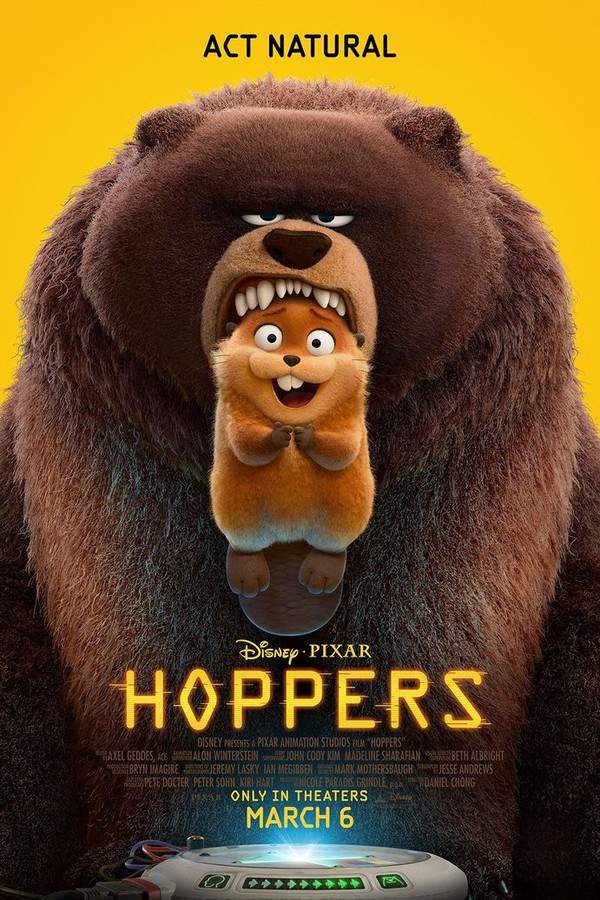
Hoppers (2026) Reviews and Reception: Is Pixar’s Latest Worth Watching? A Deep Dive into Critic and Audience Reactions
Pixar Animation Studios has spent the latter half of the 2020s navigating a complex landscape of franchise fatigue, streaming pivots, and the challenging quest to recapture the magic of its original storytelling golden age. When Hoppers (2026) arrived in theaters on March 6, 2026, it carried the weight of enormous expectations—not merely as the studio’s 30th feature film, but as the most expensive original animated production since Coco (2017), reportedly commanding a budget of $150 million. Directed by Daniel Chong, creator of the beloved Cartoon Network series We Bare Bears, this ecological sci-fi adventure promised a return to the studio’s roots of high-concept original storytelling, following a college sophomore who transfers her consciousness into a robotic beaver to save a wetlands ecosystem from development.
The reception landscape for Hoppers reveals a fascinating dichotomy between critical appreciation for its thematic ambition and audience anxiety regarding its commercial viability. While early marketing emphasized goofy animal hijinks and plush-toy merchandising potential, critics quickly identified something more subversive lurking beneath the surface—a mordant political allegory about environmental activism, community organizing, and the messy reality of predator-prey dynamics. Meanwhile, viewers have responded to the film’s unique tonal blend of Chong’s signature absurdist humor and Pixar’s traditional emotional sincerity, though questions persist about whether this represents a true return to form or another entry in the studio’s recent pattern of underperforming originals.
For those seeking comprehensive coverage of this animated release, including detailed plot breakdowns and character guides, visit the Hoppers movie page on What’s After the Movie or check out our detailed summary and ending explained. As we analyze the critical consensus, viewer reactions, and long-term reception prospects, we’ll explore whether Hoppers delivers on its promise as Pixar’s most adventurous original since Soul, or if it falls into the trap of wasted potential that some fans have lamented in recent years.
Critical Consensus and Critic Reviews: Environmental Themes and Political Subtext in Hoppers (2026)
The critical reception for Hoppers has generated one of the most intellectually engaging conversations surrounding a Pixar film in recent memory, with reviewers divided not merely on quality, but on interpreting the film’s fundamental intentions. The Atlantic offered one of the most provocative Hoppers film analysis pieces, arguing that the movie subverts its own advertising promises. Where marketing materials suggested “goofy hijinks amid an enclave of diverse species,” the publication noted that “the movie, in actuality, is refreshingly mordant about what might really happen if prey and predators were to try banding together: Their efforts would immediately devolve into a despairing, even political quagmire.” This interpretation positions Hoppers not as a simple ecological fable, but as a sophisticated examination of coalition-building and the friction inherent in environmental activism.
The Los Angeles Times echoed this sentiment with even greater enthusiasm, declaring Hoppers “the first great animated movie of the year” in their Hoppers critic review. Their analysis focused heavily on the film’s timely political resonance, describing it as “a sci-fi yarn [that] exalts the way an individual’s conviction can plant seeds of change, leading to a stronger sense of community.” At a time when, as the review notes, “our right to protest is under siege,” the film’s celebration of activism through the metaphor of Mabel’s (Piper Curda) consciousness transfer into a mechanical beaver body reads as overtly topical rather than safely allegorical.
However, this thematic weight has not universally translated to acclaim. Film Threat delivered a notably dissenting Hoppers movie opinion, offering a blunt assessment that “in the end, the film and its storytelling is meh.” This critique suggests that despite the ambitious premise involving Dr. Sam’s (Kathy Najimy) “Hoppers” program—which allows human consciousness to inhabit animal robots—the execution failed to coalesce into compelling cinema for all viewers. Movie Nation similarly struggled with the film’s comedic elements, noting that “the slapstick doesn’t slap — not that often, anyway. And the one-liners don’t land. Even the ‘funny’ voices aren’t funny, and the wacky character design seems lacking in the wacky.”
Contrasting these Hoppers viewer reactions are publications like Slate, which praised the film for feeling “a little less sanded-down than most of the studio’s recent movies, less content to coast on formula and hew to expectations about what Pixar movies do and don’t do.” This speaks to the Hoppers critical consensus recognizing director Daniel Chong’s influence—his background in the more anarchic, absurdist comedy of We Bare Bears apparently permeating Pixar’s typically polished aesthetic. The Telegraph captured this visual distinction perfectly, remarking with nostalgic appreciation that “the film actually looks funny. Remember when animations always did.”
For readers interested in exploring how Hoppers compares to other entries in Pixar’s catalog or navigating the studio’s complete filmography, What’s After the Movie offers comprehensive summaries and detailed movie wiki entries that contextualize where this ecological adventure fits within the larger animation landscape.
Audience Reactions and Viewer Reception: Is Hoppers Worth Watching for Families?
While critics dissected the political subtext, Hoppers audience reactions revealed a more personal, emotional connection to the material, particularly regarding the film’s family appeal and environmental messaging. User Carlossamu25 provided a representative Hoppers fan opinion, praising it as “muy buena película para toda la familia” (a very good movie for the whole family) and noting that “desde hace tiempo no veía una película que de verdad me hiciera pensar un poco de la naturaleza” (I hadn’t seen a movie in a long time that really made me think a little about nature). This sentiment captures the core question for potential viewers: Is Hoppers worth watching for those seeking Pixar’s trademark blend of entertainment and education?
The response from user davidlovesfilm offers perhaps the most comprehensive Hoppers spoiler-free review and analysis available, awarding the film an 8/10 and declaring it “wild funny clever and one of Pixar’s stronger overall originals.” Their detailed account highlights how Chong “uses his irreverent nature he learned from Cartoon Network to give us an environmental adventure for kids and adults,” specifically praising the cast led by Piper Curda and Bobby Moynihan. This reviewer contextualized Hoppers within Pixar’s 2026 release strategy, noting that while Toy Story 5 would arrive later in the summer, this original offering represented the studio’s “last good original” since Soul for many viewers—a sentiment echoed by arvind100, who wrote that “Hoppers gives me hope again, hope that Pixar is back to doing what they do well!”
However, the Hoppers reception hasn’t been universally enthusiastic. User Silkaire offered a more cynical take, categorizing it as “just another animated movie” with “the same story that every animated film uses, the same predictable everything is unicorn and rainbows ending.” This criticism of predictability was joined by pupen’s lament about “wasted potential,” asking plaintively, “why don’t the creators want it to be good? You have everything needed to create magic, but I guess they just don’t care anymore.” These Hoppers movie opinions suggest that for viewers fatigued by Pixar’s narrative formulas, the consciousness-transfer premise and beaver-robot protagonist weren’t sufficient to overcome familiar story beats.
One fascinating element emerging from Hoppers viewer reactions involves the film’s tonal shifts. User dharma2 warned parents about “a particularly scary plot point on the final third that really caught me off guard, bordering on ‘horror,’” while Simon_Appleton similarly noted that “the villain may prove a bit much at times for some children.” This darkness, potentially inherited from Chong’s willingness to explore uncomfortable territory, distinguishes Hoppers from lighter Pixar fare, potentially affecting its Hoppers film reception among families with younger children.
For those interested in testing their knowledge of the film’s voice cast or Pixar trivia, What’s After the Movie offers engaging quizzes and games, while our person profiles provide detailed filmographies for stars like Jon Hamm, Bobby Moynihan, and Piper Curda.
Storytelling, Tone, and Visual Analysis: Absurdist Comedy vs Emotional Depth in Hoppers
The narrative architecture of Hoppers represents perhaps the most ambitious structural experiment in Pixar’s recent catalog, attempting to balance the anarchic, internet-age humor of We Bare Bears with the solemn environmental reverence of WALL-E or Finding Nemo. This tension creates the film’s most distinctive quality—what The New Yorker described as “a hoot but also a more soulful film than some will give it credit for,” noting that “it knows that, for humans and animals alike, seeing and understanding are one and the same.”
The Hoppers film analysis must contend with Chong and co-writer Jesse Andrews’ (of Luca fame) approach to the “Hoppers” technology itself. When Mabel amusingly declares Dr. Sam’s invention “is nothing like Avatar,” the film acknowledges its own outlandish premise while committing to its internal logic. The mechanics of consciousness transfer serve not merely as a sci-fi MacGuffin, but as a literal metaphor for environmental empathy—Mabel must literally become the beaver to understand the ecosystem she fights to preserve. This metaphorical heavy lifting extends to the Animal Council sequences, where the Bird King (Isiah Whitlock Jr.), Fish Queen (Ego Nwodim), and Insect Queen (Meryl Streep) provide both bureaucratic comedy and genuine pathos regarding displacement.
The Playlist captured this duality in their Hoppers review, noting that “amidst all the noise and nonsense, Hoppers makes a winning case for the enduring value of dignity and respect for all creation.” The “noise and nonsense” refers to Chong’s absurdist tendencies—exemplified by characters like Loaf (Eduardo Franco), the “mellow beaver with a chill vibe,” and Ellen, the “very hungry bear” voiced by Melissa Villaseñor who oscillates “between grumpy and nonchalant.” These characters embody the Hoppers critical consensus that the film succeeds comedically when embracing chaos, particularly in Dave Franco’s performance as Titus, the “unhinged son of the Insect Queen.”
Yet the film’s pacing has generated Hoppers movie opinions regarding its structural integrity. Arvind100 noted that “Hoppers starts out a little slow and predictable,” a common criticism of Pixar’s first-act worldbuilding, though they added that “once things are set in motion… we are pulled into and invested in the world.” This slow-burn approach contrasts with the visual immediacy praised by The Telegraph—the film’s aesthetic successfully bridges the gap between merchandising-friendly character design (Status magazine noted its “vibrant feel of a plush-toy merchandising bonanza waiting to happen”) and the photorealistic environmental details that allow Chong to “slow down in between the laughs… soaking in the beauty of nature.”
The comparison to Avatar—both explicit in the dialogue and implicit in the body-transfer narrative—places Hoppers in conversation with James Cameron’s epic, though as a more intimate, character-driven exploration of ecological preservation. For viewers interested in how Hoppers fits into broader animated film collections or want to explore similar environmental narratives, What’s After the Movie’s curated collections and specialized movie lists offer excellent starting points for discovery.
Voice Cast Performances and Character Reception: Standout Roles in Pixar’s Hoppers
Any Hoppers review must ultimately grapple with the film’s ensemble cast, which represents one of Pixar’s most eclectic and comedically stacked rosters in recent memory. The chemistry between Piper Curda’s Mabel and Bobby Moynihan’s King George forms the emotional backbone of the narrative, with Moynihan’s performance as the head beaver particularly singled out for balancing authority with absurdist humor. When King George explains the pond rules with “matter-of-fact glee”—including the pragmatic survivalist creed “If you gotta eat, eat!”—he embodies the film’s willingness to acknowledge nature’s harsh realities while maintaining family-friendly charm.
Jon Hamm’s Mayor Jerry serves as the primary antagonist, though reviews suggest his characterization walks a fine line between topical commentary and potential excess. Simon_Appleton’s observation that “the villain may prove a bit much at times for some children” speaks to Hamm’s performance, which reportedly channels the smarmy entitled energy of certain real-world political figures in his determination to pave over Beaverton’s “abandoned glade” for a freeway. This casting represents Pixar’s continued willingness to code political messaging through recognizable character archetypes, though the effectiveness remains debated among Hoppers audience reactions.
The supporting cast provides the film’s most meme-worthy moments and likely merchandising opportunities. The late Isiah Whitlock Jr.’s contributions as the Bird King, alongside Ego Nwodim’s Fish Queen and Steve Purcell’s Amphibian King, create a United Nations of species that, as The Atlantic noted, quickly devolves into “political quagmire” when attempting to organize against human encroachment. The triple casting of Nichole Sakura as the Reptile Queens and Meryl Streep’s presence as the Insect Queen lend prestige to the voice work, though Movie Nation’s criticism that “the ‘funny’ voices aren’t funny” suggests that not all viewers appreciated the vocal characterizations.
Perhaps the most divisive element in Hoppers fan opinions involves the film’s treatment of Tom (Tom Law), the “lizard that went viral online.” This meta-textual nod to internet culture represents Chong’s background in contemporary comedy, though it risks dating the film for future audiences. Similarly, the “beady-eyed versions” of the animals—mentioned by arvind100 as a detail they loved—provide visual distinction between when characters are in “robot mode” versus their natural states, a design choice that facilitates the film’s exploration of communication and understanding across species lines.
For detailed information about the entire cast and their other projects, visit What’s After the Movie’s person profiles, and don’t forget to check the main Hoppers movie page for complete character guides and voice actor details.
Box Office Performance and Long-Term Reception: The Financial Reality of Hoppers (2026)
No analysis of Hoppers would be complete without addressing the elephant—or rather, the robotic beaver—in the room: its commercial performance. User Leydorn’s sobering assessment that this represents “the most expensive Disney-Pixar movie since 2017 and Coco” and “will alas not meet its $150M budget” casts a long shadow over the Hoppers reception narrative. This financial context fundamentally alters how we interpret the film’s place in Pixar’s history, transforming it from a potential franchise-starter into perhaps another casualty of the post-pandemic theatrical animation market.
The Hoppers box office trajectory invites inevitable comparisons to Elemental, Pixar’s 2023 original that opened softly but demonstrated remarkable legs through word-of-mouth, eventually becoming profitable and earning a sequel announcement. However, Leydorn’s prediction that “it’s box-office failure will likely stop it” from receiving a sequel suggests that Hoppers may not enjoy similar fortune. This commercial struggle seems particularly tragic given the Hoppers critical consensus that the film “feels like the first great animated movie of the year” (Los Angeles Times) and represents “Pixar… back” to form (The Travers Take).
This disconnect between quality and commerce has generated significant Hoppers movie opinions regarding the state of original animation. Xyf2024’s analysis, noting that this is “皮克斯继coco以来的非续集/IP长片中最不掺杂主创私人表达,议题最为普世(生态保护)的一部” (Pixar’s most universally themed non-sequel/IP feature since Coco), suggests that even when the studio produces accessible, topical original content, audiences may not respond. The comparison to Avatar—which similarly dealt with environmental themes through body-transfer science fiction but became the highest-grossing film of all time—highlights the different commercial expectations for live-action epics versus animated family films.
The long-term Hoppers film reception will likely depend on its streaming afterlife. As with Luca, Turning Red, and Elemental, Disney+‘s eventual hosting of the film may introduce it to audiences who missed theatrical windows, potentially cultivating the cult following suggested by davidlovesfilm’s praise and arvind100’s “hope that Pixar is back.” The Travers Take’s declaration that “Pixar is back, baby” may prove prophetic if streaming numbers demonstrate sustained interest, even if theatrical receipts disappointed.
For real-time box office tracking and financial analysis of animated features, visit What’s After the Movie’s box office section. Those interested in awards season potential for Hoppers can explore our awards coverage, while fans of musical performances in film might enjoy our concert film section for alternative viewing options.
Conclusion: The Divided Legacy of Hoppers (2026) - Final Verdict and Viewer Takeaways
As the dust settles on the theatrical run of Hoppers (2026), the film’s reception reveals a complex portrait of a studio in transition, an auteur injecting irreverent energy into corporate animation, and an audience hungry for original storytelling yet resistant to theatrical experiences. The Hoppers reviews and audience reactions collectively suggest a film that succeeds on nearly every artistic level—boasting memorable voice performances, stunning environmental animation, genuine emotional resonance regarding grief and activism, and the boldness to be “refreshingly mordant” about political realities—while struggling to find the mass audience necessary to justify its substantial budget.
For viewers asking “Is Hoppers worth watching?” the answer appears to depend on one’s tolerance for tonal whiplash and narrative familiarity. If you seek Pixar’s glory days of Inside Out or Coco-level originality, the Hoppers critical consensus suggests this may not reach those heights, though it represents a significant step above immediate predecessors like Elio. However, if you appreciate Daniel Chong’s absurdist sensibilities, the environmental messaging, and the chemistry between Piper Curda and Bobby Moynihan, this “delightfully madcap adventure” offers substantial rewards.
The Hoppers film analysis ultimately positions the movie as a noble failure or a cult classic in the making—a film that dared to be weird, political, and visually distinct in an era of animated homogenization. Whether it joins the pantheon of underrated Pixar originals or fades into the Disney+ catalog remains to be seen, but the passion evident in fan opinions from viewers like davidlovesfilm and arvind100 suggests it has found its audience, even if that audience proved too small for theatrical profitability.
For complete coverage of Hoppers, including detailed plot summaries, character breakdowns, ending explanations, and where to stream, visit What’s After the Movie and explore our comprehensive movie page. Whether you’re seeking spoiler-free reviews, detailed film analysis, or simply trying to decide if this environmental sci-fi adventure deserves your time, our database provides the resources to enhance your viewing experience.
External Resources and Reference Links
| Site | Link |
|---|---|
| Wikipedia | Hoppers (film) on Wikipedia |
| Rotten Tomatoes | Hoppers on Rotten Tomatoes |
| Metacritic | Hoppers on Metacritic |
| Media Stinger | Hoppers After Credits on Media Stinger |
| JustWatch | Hoppers on JustWatch |
| Box Office Mojo | Hoppers on Box Office Mojo |
Continue reading




What's After the Movie?
Not sure whether to stay after the credits? Find out!
Check out our other apps:

SAT Sphere
Build confidence for the Digital SAT.

Mori Atlas
Discover wild places worth protecting.

Luntero
Search smarter for a home in Amsterdam.

Plot Explained
Unravel movie endings and hidden clues.

Pokechamp
Dive into Pokémon data and battle logic.

Driving Theory
Get ready for your European theory test.

Movie Dust
Plan your next cinema trip with ease.

Musemap
Find art and culture as you travel.

Selkobase
Compare credentials before committing.

Local Manual
Turn an unfamiliar country into practical next steps.

Lernavi
Compare school systems before your next move.

GymRoam
Find a workout stop wherever your plans take you.
Explore Our Movie Platform
New Movie Releases (2026)
Famous Movie Actors
Top Film Production Studios
Movie Plot Summaries & Endings
Major Movie Awards & Winners
Best Concert Films & Music Documentaries
Movie Collections and Curated Lists
© 2026 What's After the Movie. All rights reserved.
Privacy Policy