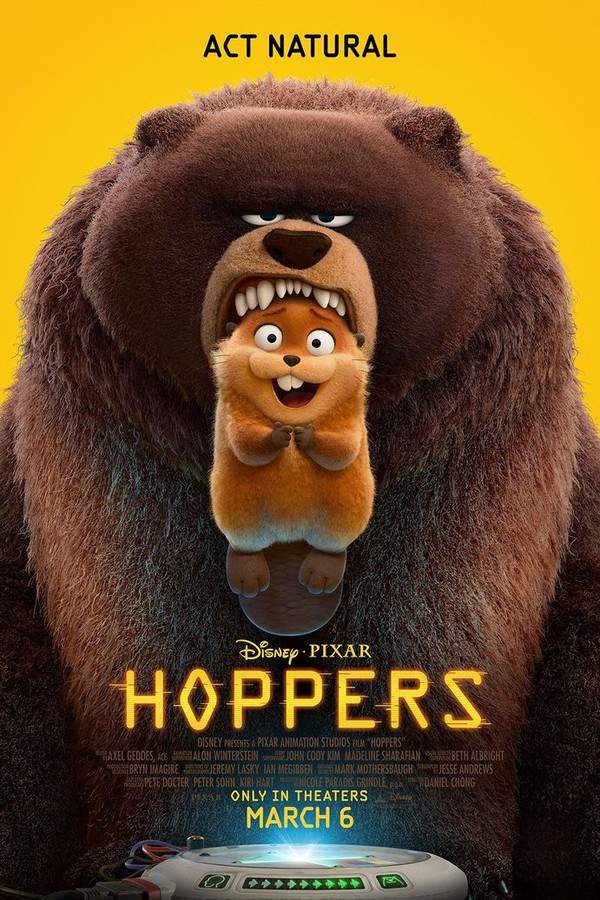
Hoppers 2026


Directed by

Tom Law
Made by

Walt Disney Pictures
Where to Watch Hoppers
See current US streaming, rental, and purchase options for Hoppers (2026) via JustWatch.







Hoppers Plot Summary
Read the complete plot summary and ending explained for Hoppers (2026). From turning points to emotional moments, uncover what really happened and why it matters.
A young Mabel, Piper Curda, tries to free a clutch of classroom animals by slipping them into her backpack, but the plan unfolds with a sudden commotion and a fire alarm that lands her in trouble. After the incident, she is dropped off at her grandmother’s house, where Karen Huie plays a warm, guiding presence who teaches her to pause, listen, and observe the world of nature. On a quiet walk through a local forest glade, Mabel sits on a rock and discovers a surprising sense of calm and connection as animals begin to appear around her. The visit plants a seed in her heart: a future spent protecting the creatures and places she loves.
As the years pass, that seed grows into a lifelong devotion. Mabel chooses to stay near Beaverton rather than head off to college, devoting herself to helping animals alongside her grandmother. When illness finally takes her grandmother, she leaves Mabel a jacket and a message of resilience, a tangible link to a simpler, more hopeful time. Grief gives way to purpose, and Mabel finds herself living alone in her grandmother’s house, determined to defend the glade against encroaching danger.
The central threat comes from Mayor Jerry Generazzo, a charismatic figure seeking to win re-election by expanding the road network and bulldozing the glade. Jon Hamm embodies Jerry’s political calculus—promises of progress masking a disregard for the living world that depends on the glade. From a dam where dynamite has been placed to an escalating signature drive, Jerry and Mabel find themselves locked in a stubborn confrontation. After a day of rejections on the streets, Mabel’s campaign trails into a moment of awkward humor when she discovers that an elderly listener with a hearing aid misreads her petition as a grocery list.
Back at Beaverton University, she interrupts a class led by Dr. Sam, whose gravitas and passion for conservation become a new focal point in her mission. Kathy Najimy embodies Dr. Sam, whose Hoppers program—a radical leap into the possibility of shared consciousness with robotic animal proxies—opens a doorway to a world where humans can communicate with wildlife in intimate, experiential ways. Mabel learns that the beaver she has been tracking is not a real creature but a robot designed to study and protect the glade. Undeterred, she climbs into the beaver body herself, embracing the chance to see the glade through animal eyes.
Her leap leads to a breathtaking night of discovery in the glade, where she meets a lazy beaver named Loaf and is briefly pulled into a world where animals talk, share rules, and live together in a community. Eduardo Franco gives Loaf a charming mix of mischief and loyalty as Mabel saves him from a bear and learns about “pond rules” that govern this unusual society. Among the first to welcome her is King George, a monarch among the mammals who rules from a grand, communal lodge. Bobby Moynihan lends George a blend of gruff practicality and surprising warmth as he explains how the animal society has formed its own order, with residents ranging from a frog chorus to a close-knit council.
Conner, one of Dr. Sam’s colleagues, slips into a robotic bird to observe Mabel and the glade from a new angle, a reminder that the scientists’ reach into nature is both inspiring and unsettling. Sam Richardson brings a cautious, curious presence to this dynamic, highlighting the tension between curiosity and intrusion. As Mabel learns more about the glade’s inhabitants, she uncovers the truth behind the animals’ departure: Jerry’s construction of hollow, noise-emitting trees designed to disrupt wildlife, a scheme that silences the glade’s voice and movement.
In a climactic sequence, Mabel confronts the dam and the tree that is splitting the community, and the assembly of animal monarchs— including a Fish Queen, a trio of Snake queens, and an Insect Queen—gathers in the wake of these revelations. The Insect Queen is portrayed with regal presence, and her role deepens the political intrigue of the glade’s leadership. Meryl Streep lends a ceremonial intensity to this queenly figure, underscoring the stakes of the council’s deliberations. The Insect Queen’s son Titus, played by Dave Franco, steps into a more defiant role as he seeks to empower the insect realm with brutal certainty, prompting a clash that tests Mabel’s resolve and the possibility of peaceful coexistence.
What follows is a tense braid of alliances and betrayals. Titus and the council push for a drastic plan: vice-clamp the human world with an apex predator squad, while the council’s manipulations threaten to erupt into violence. Vanessa Bayer contributes a calculating menace as Diane, a shark-turned-assassin who becomes the violent face of the council’s retaliation. The consequences of these plans ripple through the glade, complicating Mabel’s relationship with George as she tries to balance advocacy with the power to enact real change.
The crisis escalates when a dramatic car ambush and a high-stakes political rally push all sides toward a breaking point. The council’s push for domination collides with Mabel’s plea for cooperation, and a twist of fate forces Mabel and Jerry to confront the human cost of the glade’s struggle. As events unfold, the trees begin to fall and the city’s plans threaten to overwhelm the community. Titus’s schemes come to a head in a star-crossed moment that ends with a surprising, brutal turn of fate, including a fierce confrontation with a rival king of the animal world—an encounter that leaves the glade’s future suddenly uncertain.
In the aftermath, a wildfire sweeps through the glade, testing every creature’s resolve. With the transmitter damaged and the animals momentarily silenced, King George steps into a leadership role and orchestrates a coordinated response: tear down the dam, flood the glade, and extinguish the blaze. Jerry recalibrates his plan, declaring the glade a protected preserve and pledging to work with Mabel to repair the damage. The political landscape shifts as the Hoppers program is exposed, and Dr. Sam’s team is brought to account, clearing the way for brighter, safer collaboration between humans and animals.
The story returns to the quiet, hopeful cadence of early days. Mabel graduates from college, eyes bright with a future of study and stewardship, and asks Dr. Sam for a job, joining the lab as an assistant in the evolving exploration of robotic wildlife and ecological resilience. She also returns to the glade, where she finds George still perched on the same rock that began it all. Their friendship endures even as words become scarce—George texting with Mabel’s phone to keep in touch—and a shared conviction that nature’s voice deserves to be heard, protected, and celebrated by all who listen. The glade is saved, the freeway reimagined, and a new era of cooperation between people and creatures begins, rooted in memory, respect, and a stubborn, hopeful faith in the power of small acts to change a world.
Hoppers Timeline
Follow the complete movie timeline of Hoppers (2026) with every major event in chronological order. Great for understanding complex plots and story progression.
Mabel smuggles animals and gets caught
In an early attempt to free classroom animals, Mabel hides them in her backpack. She is caught and a chaotic fire alarm is triggered, landing her in trouble.
Grandmother leads Mabel to the glade and nature inspires her
Mabel is taken to her grandmother’s house where she sits on a rock in a nearby forest glade. Her grandmother teaches her to be still and listen to nature. Animals begin to appear, sparking Mabel’s lifelong connection with the wild.
Over years, Mabel stays with grandmother and helps animals
Rather than going to college, Mabel stays to help animals and learn from the forest. She spends years visiting the glade with her grandmother and becomes deeply invested in conservation. When her grandmother grows ill, their routine remains focused on protecting wildlife.
Grandmother falls ill and dies; jacket becomes keepsake
Mabel’s grandmother falls sick and eventually passes away, leaving her with a sense of responsibility for the glade. During a final walk, the grandmother gives Mabel her jacket as a token of guidance. The loss marks a turning point as Mabel returns to the community alone.
Mayor Jerry plans the freeway; glade under threat
Mayor Jerry Generazzo declares that the animals have left and pushes to build a freeway through the glade. Mabel becomes the main voice opposing the development and works to halt the project. The conflict pits her against the city’s political interests.
Mabel campaigns for signatures and faces rejection
Mabel tries to gather signatures, campaigning across the town. Many residents reject her petition, haunted by apathy and distraction. She learns that obtaining support may be more difficult than expected.
Mabel interrupts Beaverton University class; seeks beaver solution
Mabel interrupts her professor Dr. Sam’s class to argue for protecting the glade. She resolves to find a beaver to persuade the community. This marks a shift toward seeking unconventional, tech-assisted wildlife advocacy.
Robotic beaver search leads to Hoppers program and a lab
A beaver used for the beaver mission arrives, but it’s revealed to be a robot created by the Hoppers program. Dr. Sam and colleagues have developed multiple robotic animals to study consciousness in the lab. Mabel hops into the robotic beaver to escape, fueling her mission.
Mabel enters the glade and discovers King George and pond rules
Mabel ends up in the glade after a chase, discovers she can understand animals, and meets King George, the self-proclaimed King of the Mammals. She learns about the pond rules and how the animal community lives together. Conner, one of Sam’s colleagues, secretly watches from a robotic bird.
False trees, noise devices, and animal exodus overturned
Mabel uncovers that Mayor Jerry erected false trees that emit noises to keep animals away. She destroys the tree to bring the animals back, and the glade begins to recover as the community rebuilds the dam and resumes life. George becomes King and invites her to advise the realm.
Council of animal monarchs and Titus’s revenge
A council of animal monarchs forms, including a Frog King, a Fish Queen, Snake Queens, and the Insect Queen—whose caterpillar Titus soon becomes Insect King. Mabel’s passionate speech exposes the danger of Mayor Jerry’s plans, leading to tensions and a fatal mistake when the Insect Queen is killed. Titus targets Mabel and George as threats.
Final showdown: cloning plot, wildfire, and restoration
Titus engineers a plan to clone Mayor Jerry and use the fake trees to massacre humans at a rally, but the plan collapses when the clone is betrayed and Titus is neutralized. A wildfire spreads through the glade, and George leads the animals to tear down the dam to flood and extinguish the fire. Jerry agrees to reroute the freeway and protect the glade, while Mabel graduates and joins Dr. Sam’s lab as an assistant.
Ending: Mabel and George maintain friendship through text-to-speech
After the resolution, Mabel returns to the glade and finds George still on the rock where they once sat. They can no longer speak, but they stay connected through his phone’s text-to-speech. The restored glade and their friendship mark a quiet, hopeful closure.
Hoppers Characters
Explore all characters from Hoppers (2026). Get detailed profiles with their roles, arcs, and key relationships explained.
Mabel (Piper Curda)
A compassionate, inquisitive girl who grows into a determined defender of the glade. She learns to pause, listen, and observe nature, eventually stepping into a robotic beaver to see the world from an animal’s perspective. Her resolve deepens after experiencing loss and facing encroaching development, fueling a lifelong commitment to wildlife protection.
Mayor Jerry Generazzo (Jon Hamm)
A charismatic politician whose promise of progress masks a plan to expand roads and bulldoze the glade. He relies on electoral maneuvering and public persuasion to advance his development agenda. His clashes with Mabel set the stage for a high-stakes battle between growth and preservation.
Dr. Sam (Kathy Najimy)
A passionate conservation scientist who leads the Hoppers program. She embodies scientific zeal and a commitment to wildlife, serving as a mentor to Mabel. Her work explores new ways humans might communicate with nature, while facing accountability for its implications.
Conner (Sam Richardson)
A colleague of Dr. Sam who experiences the glade through a robotic bird. His presence highlights the tension between scientific curiosity and the intrusion such experiments can cause. He embodies a cautious but open-minded approach to exploring nature with technology.
King George (Bobby Moynihan)
A pragmatic and warm monarch of the mammal residents who guides the glade’s council. He balances tough decisions with a sense of community, helping to coordinate responses to threats from development and manipulation.
Insect Queen (Meryl Streep)
A regal, ceremonial leader whose presence heightens the political stakes within the insect realm. Her leadership deepens the glade’s political intrigue as diverse species seek alliance and protection.
Titus (Dave Franco)
The Insect King’s son, bold and defiant, eager to empower the insect realm. He pushes for strong, sometimes brutal measures that challenge Mabel’s peaceful coalition-building and test the boundaries of the glade’s governance.
Loaf (Eduardo Franco)
A laid-back beaver with loyalty and charm who becomes a key member of the glade community. His antics mask a deeper bond with the group and a willingness to stand up for his home when danger arises.
Diane (Vanessa Bayer)
A shark-turned-assassin who embodies calculating violence used by the council as retaliation. Her presence adds a menacing edge to the conflict and underscores the lengths some factions will go to control the glade.
Bird King (Demetri Martin)
A wise, observant monarch among avian residents who contributes to the glade’s leadership. His perspective helps coordinate the avian response to human encroachment and interspecies tensions.
Fish Queen (Ego Nwodim)
A regal figure among aquatic inhabitants who participates in the glade’s broader leadership council. Her voice adds balance to discussions about how water, land, and air intersect in protecting the ecosystem.
Reptile Queens (Nichole Sakura)
A group of queenly reptile leaders who contribute to the glade’s governance and interspecies diplomacy. Their presence reinforces the diverse coalition necessary to defend the ecosystem.
Tom Lizard (Tom Law)
A reptile faction representative who participates in glade decision-making. Tom contributes a pragmatic, agile perspective to the council’s debates.
Grandma Tanaka (Karen Huie)
A warm, guiding presence who teaches Mabel to listen to nature. Her later passing leaves a tangible legacy—a jacket and a message of resilience that anchors Mabel’s future work.
Ellen (Melissa Villaseñor)
A human ally who participates in the community’s response to the glade’s challenges, providing support and creative perspectives within the lab and beyond.
Nisha (Aparna Nancherla)
A researcher connected to the Hoppers program, contributing to the scientific discourse surrounding robotic wildlife and ecological resilience.
Young Mabel (Lila Liu)
The younger version of Mabel, whose quiet moment on a forest rock seeds her lifelong connection to nature and the gentle calm that nature affords.
Eman (Eman Abdul-Razzak)
A community member whose presence reflects the neighborhood’s everyday support and curiosity about the glade’s fate.
Hoppers Settings
Learn where and when Hoppers (2026) takes place. Explore the film’s settings, era, and how they shape the narrative.
Time period
Contemporary
The events unfold in a contemporary setting where modern science and local politics intersect with environmental activism. Robotic proxies, a dam, and road expansion are central to the conflict, reflecting present-day concerns about development and ecological balance. The narrative tracks Mabel from childhood into adulthood, culminating in a hopeful future where humans and wildlife strive to coexist.
Location
Beaverton, Beaverton University, The Glade
Beaverton sits beside a cherished forested glade that acts as a sanctuary for diverse wildlife. The glade becomes the story’s central sanctuary and political flashpoint as development pressures loom, threatening the homes of its animal residents. Beaverton University hosts the Hoppers program, a scientific venture into robotic wildlife that links the town's research interests with the glade’s fragile future.
Hoppers Themes
Discover the main themes in Hoppers (2026). Analyze the deeper meanings, emotional layers, and social commentary behind the film.
🌿
Conservation
Mabel’s journey centers on protecting the glade and its animal residents. The story examines the costs and rewards of defending a natural sanctuary against development. The narrative emphasizes listening to nature and acting with care, showing how care can translate into action. The resolution suggests that conservation requires courage, patience, and collaboration.
🤖
Technology & Nature
Robotic proxies enable humans to observe and interact with wildlife in new ways. The Hoppers program raises questions about ethics, empathy, and stewardship when humans inhabit animal perspectives. Mabel’s experiences inside the robot beaver challenge assumptions about humanity’s relationship with the natural world. Tech becomes both a bridge and a battleground for the glade’s future.
🗳️
Politics & Power
Mayor Jerry leverages promises of progress to gain support for road-building and dam projects. The film explores how political calculus can threaten or protect ecological communities, depending on who holds influence. A climactic convergence of council intrigue and public rallying reveals how power can shape the fate of an entire ecosystem. Cooperation vs. domination becomes the core political tension.
👥
Community & Leadership
Leadership emerges across species, with King George and the insect queen guiding a multilateral council. The glade’s governance evolves into a cooperative model that mirrors real-world ecological stewardship. Mabel’s advocacy, paired with animal leadership, demonstrates how communities can unite across differences. The story celebrates memory, trust, and a shared commitment to safeguarding home.

Coming soon on iOS and Android
The Plot Explained Mobile App
From blockbusters to hidden gems — dive into movie stories anytime, anywhere. Save your favorites, discover plots faster, and never miss a twist again.
Sign up to be the first to know when we launch. Your email stays private — always.
Explore the mobile appHoppers Ending Explained
Unravel the ending of Hoppers (2026) with our detailed explanation. Understand the final scenes, character fates, and unresolved questions.
The conclusion of Hoppers shifts the focus from a standard environmental conflict to a more complex lesson about the consequences of unchecked action. While Mabel spends much of the film fighting Mayor Jerry’s construction plans, the finale reveals that her own chaotic approach to activism has inadvertently paved the way for a much darker threat. The true antagonist emerges in Titus, the ambitious Insect King who rises to power after Mabel accidentally kills his mother, the Queen. Unlike Mabel, whose destructive tendencies are born of carelessness, Titus is calculating; he seeks to turn Jerry’s sonic technology into a weapon of mass murder against humanity. This distinction forces Mabel to evolve from a reckless agitator into a leader who understands that how one fights is just as important as what they are fighting for.
The climax brings these threads together when Mabel stops Titus, leading to a forest fire that threatens to destroy the very Glade she aimed to protect. In a pivotal moment of unity, the humans and animal kingdoms come together to save Beaverton, proving that genuine community is forged through cooperation rather than coercion. The resolution offers a nuanced truce: Jerry abandons his destructive highway project after developing a respect for Mabel’s tenacity, while Mabel learns to temper her drive with empathy and restraint. By the time the Hopper technology is shut down, severing her ability to speak with the animals, Mabel’s bond with George remains intact, symbolizing that true connection relies on understanding rather than technology. Ultimately, Hoppers argues that while passion is necessary to inspire change, it must be balanced with a respect for others to avoid creating new cycles of destruction.
Hoppers Spoiler-Free Summary
Discover the spoiler-free summary of Hoppers (2026). Get a concise overview without any spoilers.
In a world where cutting‑edge science lets people “hop” their consciousness into lifelike robotic beasts, everyday reality is suddenly tinged with the wild chorus of the forest. The Hoppers program, a playful blend of imagination and technology, promises an unprecedented closeness to nature—allowing a human mind to experience the world through the eyes, ears, and instincts of another species. This premise sets a bright, whimsical tone that feels both futuristic and heart‑warmingly earthy, inviting audiences to wonder what it would be like to truly listen to the thoughts of the creatures that share our planet.
At the story’s core is Mabel, a spirited animal lover whose curiosity has always reached beyond the classroom. Raised by her grandmother, whose gentle guidance taught her to sit still and hear the forest’s subtle language, Mabel carries a fierce devotion to the natural world. When the chance arises to volunteer for the experimental hopping process, she sees it as a chance to bridge the gap she’s always felt between humanity and the animal kingdom, hoping to protect the places and beings she cherishes.
Stepping into the bodies of robotic creatures, Mabel begins an adventure that blurs the line between human and animal perspective. The film follows her as she navigates unfamiliar senses, forms unlikely friendships with the forest’s denizens, and discovers that understanding another species can be both exhilarating and deeply moving. The journey is infused with Pixar’s signature blend of humor, heartfelt moments, and visual splendor, painting a vivid tapestry of leaf‑dappled glades, bustling animal communities, and the quiet wonder of a world seen through new eyes.
The tone remains uplifting and adventurous, balancing the awe of high‑tech marvels with the timeless magic of nature. It asks viewers to consider what it means to truly listen, to empathize across species, and to find one’s place in a world where the boundary between human ingenuity and wild instinct is delightfully porous.
Featured on this page

What's After the Movie?
Not sure whether to stay after the credits? Find out!
Check out our other apps:

SAT Sphere
Build confidence for the Digital SAT.

Mori Atlas
Discover wild places worth protecting.

Luntero
Search smarter for a home in Amsterdam.

Plot Explained
Unravel movie endings and hidden clues.

Pokechamp
Dive into Pokémon data and battle logic.

Driving Theory
Get ready for your European theory test.

Movie Dust
Plan your next cinema trip with ease.

Musemap
Find art and culture as you travel.

Selkobase
Compare credentials before committing.

Local Manual
Turn an unfamiliar country into practical next steps.

Lernavi
Compare school systems before your next move.

GymRoam
Find a workout stop wherever your plans take you.
Explore Our Movie Platform
New Movie Releases (2026)
Famous Movie Actors
Top Film Production Studios
Movie Plot Summaries & Endings
Major Movie Awards & Winners
Best Concert Films & Music Documentaries
Movie Collections and Curated Lists
© 2026 What's After the Movie. All rights reserved.
Privacy Policy