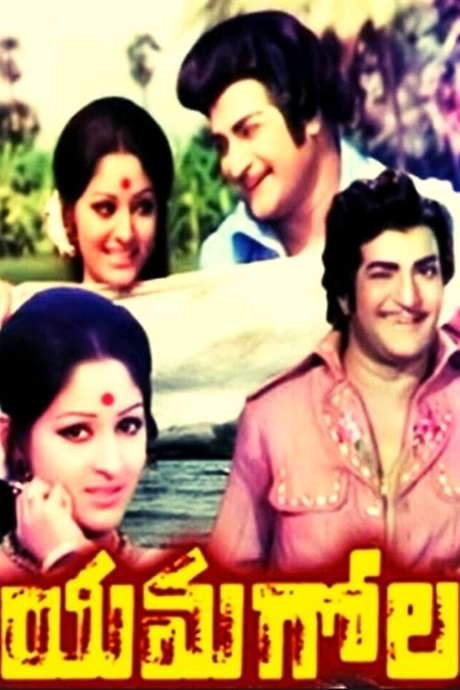
What Is Yamagola About?
The premise of Yamagola in 299 words, with nothing given away. The full story follows below.
In a tranquil village where community ties run deep, Satyam serves as the earnest president, tirelessly championing progress and fairness for his neighbors. His heartfelt devotion to the people quickly places him at odds with the powerful landowner Rudrayya, whose grip on the region feels as unyielding as the earth itself. Amid this clash of ideals, a tender romance blossoms between Satyam and Savithri, the spirited daughter of his formidable adversary, adding a layer of hope and tension to an already charged atmosphere.
The story balances its grounded rural setting with a vibrant, larger‑than‑life imagination. When Satyam’s journey takes an unforeseen turn beyond the mortal realm, he finds himself wandering celestial corridors where myth and bureaucracy intertwine. There, the imposing figure of Yama Dharma Raju presides over the flow of souls, while his meticulous deputy Chitragupta keeps careful accounts of every life. Their presence injects a playful yet reverent humor, turning the afterlife into a stage for clever commentary on justice, duty, and the absurdities of human ambition.
Throughout the film, the tone swings effortlessly between spirited comedy, whimsical fantasy, and sincere drama. The villagers’ warm, earthy simplicity contrasts sharply with the glittering, rule‑bound domains of heaven and hell, creating a visual and emotional palette that feels both familiar and fantastical. Satyam’s innate optimism and innate sense of fairness become the anchor that draws these disparate worlds together, promising that even the most lofty deities might be swayed by genuine compassion and a dash of mischief.
At its core, the tale explores how steadfast conviction and love can ripple far beyond village borders, nudging the very forces that govern life and death. The audience is invited to wonder how a humble leader’s resolve might reshape not only his community but also the grand, often opaque mechanisms of the cosmos.
What Happens in Yamagola?
The complete story of Yamagola, from the first scene to the last, in 611 words (about 3 minutes). Spoilers throughout. Names in the text link to 6 cast member pages.
Spoilers ahead
In a peaceful village, N.T. Rama Rao stars as Satyam, a dedicated village president committed to uplifting his community’s prosperity. He often finds himself standing up to Rao Gopal Rao’s character, Rudrayya, a ruthless local landlord who wields significant power and influence over the area. Despite the oppressive environment, Satyam remains resilient, inspiring the villagers and working tirelessly for their benefit. His life takes a romantic turn when he falls deeply in love with Savitri, played by Jaya Prada, who is Rudrayya’s daughter. Their budding relationship faces immediate opposition from Rudrayya, who disapproves of Satyam and begins to see him as a threat to his authority.
Rudrayya, furious upon discovering Satyam and Savitri’s love, devises a sinister plan to eliminate Satyam. He hires a professional killer, Ram Sastry, to murder Satyam under the pretense of a traditional ritual, making the deed appear as part of a ceremonial act. The assassin successfully kills Satyam, but before leaving, Ram Sastry warns Rudrayya to wait until his demonic prayers are complete. Wanting to expedite his plans, Rudrayya grows impatient and, in a cruel act, buries Satyam’s body in his backyard, believing the deed to be finalized.
However, Satyam’s soul, by mistake, is transported to heaven. There, he causes chaos among the celestial beings and eventually catches the attention of Kaikala Satyanarayana as Yama Dharma Raju, the god of death. His disruptive antics earn him a transfer to hell, where he continues creating trouble. In hell, Satyam organizes a rebellion among the hell soldiers and directly challenges the authority of Yama and Chitragupta, played by Manju Bhargavi and Allu Ramalingaiah respectively. After some negotiations, Yama agrees to reform the strict laws governing the afterlife, and both Yama and Chitragupta descend to Earth in human form to implement the new rules.
Yama and Chitragupta’s efforts lead to a temporary “lockout” of hell, and during this time, Satyam is resurrected with the promise that he must return to the afterlife once Yama and Chitragupta complete their reforms. Meanwhile, the police begin investigating Satyam’s mysterious disappearance and start suspecting Rudrayya’s involvement. In a clever twist, Satyam, now alive again, disguises himself as Sundaram. Rudrayya, unaware of the fake identity, hires Sundaram to impersonate Satyam, who then begins to mock and tease Rudrayya, creating humorous chaos.
As Yama and Chitragupta face several challenges on Earth, they are eventually arrested by the police. Satyam, stepping in, helps free them, showcasing his loyalty and bravery. Just as they prepare to return to the afterlife, Satyam’s life becomes a matter of urgency; he invites Yama and Chitragupta to his home under the pretenses of seeking a blessing for his marriage to Savitri. His bride, unaware of the celestial visitors, treats Yama and Chitragupta with utmost respect. She requests their blessings, leading Yama to grant her wish for a long and happy marriage.
However, this request unintentionally prolongs Satyam’s life, as the blessings inadvertently extend his lifespan. At the wedding, Satyam cleverly hides under the bridal veil, and during the ceremony, Yama blesses him and Savitri with a long life, allowing Satyam to evade death. Just as Rudrayya attempts to attack Satyam with a gun, the hero wakes up—revealing that it was all a vivid dream. Rudrayya’s subsequent attack is thwarted, and Satyam calmly explains that Ram Sastry is actually his good friend, Ramana Murthy, and that everything he experienced was part of an elaborate plan.
In the end, Rudrayya seeks forgiveness for his misdeeds, and the story concludes joyfully with the marriage of Satyam and Savitri. This film blends elements of comedy, fantasy, and morality, highlighting themes of justice, love, and redemption, all woven together with vibrant performances and a memorable storyline.
Yamagola Timeline: Every Key Event in Order
13 key events in the order they happen, from “Satyam works to improve the village” to “Rudrayya seeks forgiveness and reconciliation”. 5 events name a place, across 5 locations.
- 1
Satyam works to improve the village
The film opens in a village where Satyam, the village president, dedicates himself to improving the area's prosperity. He actively confronts the tyranny of Rudrayya, a powerful local landlord. His efforts highlight his commitment to justice and the welfare of his community.
Where:village
- 2
Satyam falls in love with Savitri
Satyam develops a romantic relationship with Savitri, who is revealed to be Rudrayya's daughter. Their love story begins amidst ongoing conflicts with Rudrayya's oppressive regime. Their relationship faces immediate danger once Rudrayya discovers it.
- 3
Rudrayya plots to eliminate Satyam
Upon learning about Satyam's relationship with his daughter, Rudrayya schemes to eliminate him. He hires Ram Sastry, a professional killer, to carry out Satyam's murder under the pretext of a traditional ritual. Rudrayya’s malicious intent threatens Satyam's life.
- 4
Satyam’s murder and body burial
Ram Sastry executes the murder, but Rudrayya impatiently demands the killer wait for demonic prayers to complete. As time passes, Rudrayya grows restless and buries Satyam's body in his backyard, believing the task is finished.
- 5
Satyam's soul mistakenly sent to heaven
Satyam’s soul is mistakenly transported to heaven, where he causes chaos among the celestial beings. He encounters Indra and original causes of his confusion, leading to a series of divine disturbances and adventures.
Where:heaven
- 6
Satyam is transferred to hell and stirs rebellion
After causing trouble in heaven, Satyam is sent to hell, where he organizes a rebellion among the underworld soldiers. His defiant act challenges the authority of Yama Dharma Raja and Chitragupta, leading to necessary reforms.
Where:hell
- 7
Yama and Chitragupta agree to reforms and descend to Earth
Yama and Chitragupta negotiate with Satyam and decide to implement reforms to their laws, leading them to incarnate in human form and declare a lockout of hell. Their divine intervention sets new rules for the afterlife.
Where:Earth
- 8
Satyam is restored to life and disguised as Sundaram
Satyam is brought back to life with the condition that he must return to the afterlife when Yama and Chitragupta do. He then approaches Rudrayya disguised as Sundaram, sowing confusion and beginning his plan to unmask Rudrayya's treachery.
- 9
Yama and Chitragupta face challenges on Earth
Yama and Chitragupta face various obstacles and are ultimately arrested by the police, but Satyam intervenes to free them. Their presence on Earth becomes crucial in resolving the ongoing conflicts and maintaining cosmic order.
- 10
Satyam invites divine guests for his marriage
To prevent his early death, Satyam secretly invites Yama and Chitragupta to his wedding with Savitri. She serves them reverent blessings, unknowingly asking for divine favor, which inadvertently extends Satyam’s lifespan.
Where:Rudrayya’s house
Show the other 3 events of Yamagola Hide the last 3 events
- 11
The wedding celebration and divine blessing
During the wedding, Yama and Chitragupta bless the couple, granting a long life to Satyam. Satyam hides under the veil, and the divine blessing seems to secure their happiness, but Rudrayya attempts to attack him.
- 12
Satyam wakes up from the dream
Satyam suddenly wakes up, revealing that the entire series of divine interventions and divine blessings was a vivid dream. Rudrayya’s attack resumes, but Satyam reveals Ram Sastry is actually his friend, and everything was part of a plan.
- 13
Rudrayya seeks forgiveness and reconciliation
In the final moments, Rudrayya seeks forgiveness from Satyam, acknowledging his past misdeeds. The movie concludes with Satyam and Savitri happily married, symbolizing harmony and resolution.
Who Are the Main Characters in Yamagola?
4 characters, among them Satyam (played by N.T. Rama Rao), Rudrayya and Yama Dharma Raju (Kaikala Satyanarayana): who each one is and the part they play in the story. 3 of them link to the actor’s page.
- S(
Satyam (played by N.T. Rama Rao)
Played by N.T. Rama Rao
Satyam starts as a village leader fighting oppression and falls in love with Savitri. His journey involves divine encounters, accusations, and clever schemes, showcasing his bravery, integrity, and resilience. He is central to the film's moral and narrative progression.
- 🌾 Village Leader
- 💪 Hero
- 🎭 Protagonist
- R
Rudrayya
Rudrayya is a corrupt landlord and antagonist who seeks to eliminate Satyam due to his love for Savitri. His ruthless nature and greed drive much of the conflict, making him a symbol of tyranny and evil.
- 🏢 Antagonist
- 👹 Villain
- 💰 Corrupt landlord
- YD
Yama Dharma Raju (Kaikala Satyanarayana)
Played by Kaikala Satyanarayana
Yama Dharma Raju is the divine lord of death who becomes involved in mortal affairs to reform the underworld’s laws. His role emphasizes justice and divine governance, often cloaked in authority and compassion.
- 👑 Divine
- ⚖️ Justice
- 💀 Death
- S(
Savitri (Jaya Prada)
Played by Jaya Prada
Savitri is the love interest of Satyam, depicted as a devout and caring woman. Her support is crucial in trusting divine blessings for her marriage, representing love and faith.
- 💖 Romantic
- 🙏 Faithful
- 🎭 Supporting character
Where and When Is Yamagola Set?
Yamagola is set in village, heaven, hell and Earth. Here is why the place matters to the story.
When
The story appears to be set in a mythological or timeless period, blending elements of ancient celestial worlds with rural village traditions. The absence of specific historical references suggests a fantastical universe that exists outside a concrete time frame.
Where
village, heaven, hell, Earth
The movie primarily takes place in a rural village, representing simple village life. It also features celestial realms like heaven and hell, emphasizing mythological and spiritual elements. Additionally, parts of the story unfold in urban settings on Earth, where human drama and law enforcement occur.
- 🏡 Rural
- ☁️ Celestial
- 🔥 Underworld
- 🌍 Mortal
What Are the Themes of Yamagola?
3 ideas the story keeps returning to, among them Justice, Good vs Evil and Love.
-
01
Justice
Justice is central to the plot, with characters challenging corrupt authority and divine laws being reformed for fairness. The film explores moral righteousness, the balance between good and evil, and divine intervention to restore order.
-
02
Good vs Evil
The movie depicts the battle between good characters like Satyam and divine beings, against the villainous Rudrayya and evil forces. Themes of morality, righteousness, and divine justice are emphasized through supernatural and human conflicts.
-
03
Love
Love plays a vital role in the story, especially romantic love between Satyam and Savitri. Their relationship motivates much of the plot's action and resolution, highlighting commitment and sacrifice.
What Kind of Film Is Yamagola?
Whimsical in tone, with variable pacing and a moderate story, going by the plot summary.
- Tone
- Whimsical
- Pacing
- Variable
- Story
- Moderate
- Intensity
- Medium
- Ending
- Happy
A whimsical and humorous fantasy romance blending earthly village politics with a celestial rebellion in the afterlife, creating a playful and ultimately uplifting experience.
- fantastical
- humorous
- rebellious
- playful
- uplifting
- dreamlike
- afterlife
- class struggle
- true love
- redemption
Content notes: murder, burial.
Quiz
How well do you remember Yamagola? Test yourself on the story.