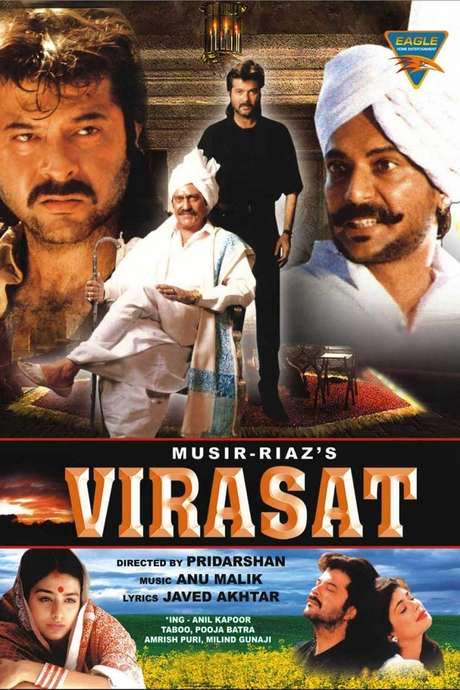



Where to Watch Virasat
See current US streaming, rental, and purchase options for Virasat (1997) via JustWatch.

Streaming availability powered by 
Virasat Plot Summary
Read the complete plot summary and ending explained for Virasat (1997). From turning points to emotional moments, uncover what really happened and why it matters.
Shakti Thakur [Anil Kapoor] returns to his ancestral village after completing his studies in London, bringing along his girlfriend, Anita [Pooja Batra], whom he deeply loves and intends to marry, despite his family’s disapproval. The village, however, feels more like a stage for old feuds than a homecoming, and Shakti quickly senses that nothing has truly changed. He voices a bold plan: to sell his share of the family property and open a chain of restaurants, hoping to bring opportunity beyond the fields and temples that define the land. But his vision clashes with the advice of his father, Raja Thakur [Amrish Puri], the imposing zamindar who believes in duty over flight, reminding his son that education is meant to uplift uneducated brothers and society, not merely indulge personal ambitions. > A man gets an education not to become a selfish being but to uplift his uneducated brothers and society.
The stubborn rift between Raja Thakur and Zamindar Birju [Govind Namdeo], Shakti’s disabled uncle, plus Birju’s son Bali Thakur [Milind Gunaji], poisons any chance of harmony. The village splits along their lines, turning neighborly streets into potential battlegrounds as each faction guards its own piece of land and pride. Bali, obsessed with dominance, keeps pushing to outdo Raja Thakur, feeding a cycle of petty provocations that escalate into violence.
During a troubling excursion with his friends, Shakti revisits childhood memories and stumbles upon an old temple that Bali Thakur has ordered sealed. A reckless act by Bali’s men breaks the lock, and a brutal riot erupts between the two factions. Raja Thakur, determined to quell the flames, contemplates apologizing to his opponents, but Shakti insists that Surkhiya [Neeraj Vora], his ally, should be the one to seek reconciliation. The tension fractures quickly: Surkhiya loses a hand at the hands of Bali Thakur’s men, and homes in Bali’s village are set ablaze in retaliation. To prevent a broader bloodshed, Shakti, with his father’s permission, seeks to legitimize the temple’s opening through government channels, restoring access for all villagers.
Bali Thakur responds with calculated vengeance, hiring goons to sabotage a dam that protects a portion of the village loyal to Raja Thakur. The resulting flood devastates the area, leaving many dead, including infants, and sending a wave of sorrow through Shakti. A goon who placed the explosives is spotted again, and Shakti pursues him, ultimately handing him over to the police. Yet fear for his family keeps the truth about Bali’s involvement from coming out.
In a parallel struggle over land access, Bali uses intimidation to keep a crucial route closed, making travel a daily hardship for many. To break the deadlock, Shakti and his father invite the antagonists to a village Panchayat. The accusations fly with neither side presenting solid evidence, and Bali lashes out at Raja Thakur, insulting him and deepening a wound that proves fatal when Raja Thakur collapses from a heart attack that very night. With his father gone, Shakti steps into the role of lead in the family’s affairs, trying to steer a fragile peace.
Time moves on, and the community negotiates a way to reopen the blocked land path, essential for shorter travel times. The landowner fears Bali’s backlash, especially because his daughter Gehna [Tabu] is involved. Shakti reassures him and even arranges a marriage pact with a well-to-do villager to secure safe passage. Eventually, the owner agrees to open the land, and Shakti proposes to Gehna’s family so the village can move forward. On the day of the wedding, the groom abandons the match under Bali’s intimidation; in a bold turn, Shakti marries Gehna himself, offering stability and acceptance to a cautious home. Anita, the original love of Shakti’s life, learns of the new arrangement, feels sorrow, and chooses to leave—understanding the complexities of duty and choice.
Bali, enraged by the land’s reopening, detonates a bomb during a village festival, causing fresh devastation and deaths on both sides. Shakti protects Bali Thakur’s innocent family, earning a reluctant respect from Birju Thakur, who finally begins to let go of his rancor. The hunt for Bali ends when Shakti finds him and urges surrender to the police to halt the bloodshed once and for all. Bali rejects the offer, and in the ensuing struggle, Shakti unintentionally decapitates him. Although others are willing to shoulder the blame, Shakti accepts responsibility and surrenders, choosing to break the cycle of violence.
In the end, the film presents a layered meditation on education—not as a mere credential but as a tool to uplift and unite a community fractured by pride, fear, and long-held grudges. It elevates the idea that knowledge should empower everyone, especially those who have been overlooked, and suggests that true leadership lies in choosing peace over vengeance.
Virasat Timeline
Follow the complete movie timeline of Virasat (1997) with every major event in chronological order. Great for understanding complex plots and story progression.
Shakti returns to the ancestral village
Shakti Thakur travels back from London after completing his studies and reunites with his girlfriend Anita in his ancestral village. He faces opposition from his family who disapprove of their relationship and his modern ambitions. The return rekindles memories of a divided village and the looming family feud.
Plans and clash with tradition
Shakti tells his father he wants to sell his share of the family property and open a chain of restaurants. Raja Thakur urges him to stay and uplift the village with his education. The disagreement foreshadows the widening rift between the two camps.
Temple breach sparks a riot
Shakti and his friend Surkhiya break open an old temple against Bali Thakur's orders to look around. Bali's men ignite a brutal riot between the rival village factions. In retaliation, Surkhiya loses a hand, and Raja Thakur's men burn homes belonging to Bali's supporters.
Temple re-opened and dam threat
To prevent further escalation, Shakti, with his father's permission, opens the temple legally for everyone. Bali Thakur responds by hiring goons to sabotage a dam that protects part of the village, escalating the conflict. The looming flood threatens lives and livelihoods.
Dam sabotage and flooding
Explosives planted by Bali's goons damage the dam, flooding half the village and causing numerous deaths including infants. Shakti is deeply saddened as he witnesses the destruction. He captures one of the goons, but the man refuses to name Bali for fear of his family's safety.
Panchayat clash and patriarch's death
Shakti and Raja Thakur invite both sides to a village panchayat to resolve the standoff, but accusations fly and no clear truth emerges. Bali Thakur relentlessly attacks Raja Thakur, and the elder dies of a heart attack that night. Shakti inherits the responsibilities of the village head.
Open the road and arrange a union
With a long stretch of land closed, villagers fear long detours and isolation. Shakti negotiates with the landowner to reopen the route, despite Bali's looming threat. To secure peace, he arranges a marriage between the landowner's daughter Gehna and a prosperous villager from the same village.
A rebuilt life through marriage
On the wedding day, the groom flees in fear of Bali; Shakti agrees to marry Gehna instead. Anita returns to learn the truth and understands the circumstances, choosing to leave. Shakti begins a new life with Gehna while accepting the change in his personal relationships.
Bomb at the festival and renewed carnage
During the village festival, Bali Thakur plants a bomb that causes deaths on both sides of the feud. Shakti protects the innocent BalI family and helps them escape, while Birju Thakur begins to reconsider his enmity with Shakti. The violence once again tears through the community.
Final confrontation and surrender
Shakti tracks Bali Thakur and asks him to surrender to the police to prevent further bloodshed. Bali refuses, blaming Shakti for his misfortunes and tries to kill him. In the ensuing struggle, Shakti accidentally decapitates Bali and, facing a chorus of blame, surrenders to the police to end the cycle of violence.
End of feud and leadership
With Bali's death and Shakti's surrender, the cycle of violence ends and the village begins to heal. Shakti takes over the duties of village head, guiding the community toward unity and social progress.
Education as upliftment
The film closes with the message that education is a tool to uplift uneducated people and to bridge divides. Shakti's actions embody the ideal, illustrating how knowledge can transform a fractured community.
Virasat Characters
Explore all characters from Virasat (1997). Get detailed profiles with their roles, arcs, and key relationships explained.
Shakti Thakur
A highly educated man who returns from London with modern ideas. He believes education should uplift his uneducated brothers and society, but must navigate fierce family and village rivalries. He champions lawful opening of the temple and later assumes leadership to unite the community.
Anita
Shakti's girlfriend who loves him but faces disapproval from his family. She accepts the reality of a changing village, and eventually steps back when Shakti marries Gehna to secure peace. Her presence highlights romantic tension amid political strife.
Gehna
Daughter of the landowner who becomes Shakti's wife. She is shy and reserved, yet gradually adapts to new circumstances, embodying the private cost of public conflict.
Bali Thakur
The hot-headed rival zamindar who thrives on grudges and uses goons to press his claims. His violence culminates in chaos and tragedy, ultimately leading to his downfall.
Raja Thakur
Shakti's father and the current zamindar who tries to bridge divides. He dies after a heart attack during a heated feud, leaving Shakti to take up leadership and responsibility for the village.
Birju Thakur
Shakti's disabled uncle and rival figure who, over time, recognizes the need to end the enmity with his brother's lineage. He embodies pragmatism and compassion within a feudal system.
Sukhiya
Loyal servant who breaks open a temple door and is punished; later, his fear preserves Bali Thakur's schemes. His loyalty and fear illustrate the personal costs of clan loyalty.
Mausi
A maternal figure in the village who represents traditional values and concerned about family honor, contributing to the social texture surrounding the feud.
Inspector
Law enforcement who becomes involved in the village's conflicts, signaling the state's reach into feudal disputes and the pursuit of justice within the community.
Virasat Settings
Learn where and when Virasat (1997) takes place. Explore the film’s settings, era, and how they shape the narrative.
Time period
Late 20th century
The story unfolds in a period when people could study abroad and return with new ideas. Shakti's stay in London and his decision to challenge the status quo reflect the clash between modern education and rural loyalties. The film uses this era to explore how villages balance tradition with development, governance, and reform.
Location
Indian ancestral village
Virasat unfolds in an Indian ancestral village where a feudal zamindari divides the community between two brothers. The village centers around an old temple, a dam, and a network of families whose loyalties and feuds shape daily life. As education and outside influence arrive, residents must navigate tradition, power, and the possibility of progress.
Virasat Themes
Discover the main themes in Virasat (1997). Analyze the deeper meanings, emotional layers, and social commentary behind the film.
🎓
Education
Education is shown as a powerful tool that can uplift an entire community, not just individuals. Shakti returns with an education that promises progress but also disrupts the village’s established order. The film ties learning to leadership, responsibility, and social improvement, emphasizing that knowledge should elevate others.
⚖️
Conflict and Justice
Two feuding factions trigger a cycle of violence from temple desecrations to dam bombings. The story follows attempts at mediation through the village panchayat, legal action, and police involvement. The climax centers on making accountability visible and preventing further bloodshed.
💞
Love and Duty
Relationships strain under political pressure: Shakti's love for Anita competes with his duty to family and village. A strategic marriage to Gehna is arranged to secure land and peace, testing personal happiness against communal needs. The arc shows how affection, sacrifice, and duty can redefine loyalties.
🕊️
Peace and Reconciliation
Old resentments begin to soften when violence harms innocents and key players seek a lasting settlement. Birju's eventual effort to end the feud signals a turning point toward forgiveness and shared stewardship. The ending presents education, restraint, and governance as paths to durable peace.

Coming soon on iOS and Android
The Plot Explained Mobile App
From blockbusters to hidden gems — dive into movie stories anytime, anywhere. Save your favorites, discover plots faster, and never miss a twist again.
Sign up to be the first to know when we launch. Your email stays private — always.
Explore the mobile appVirasat Spoiler-Free Summary
Discover the spoiler-free summary of Virasat (1997). Get a concise overview without any spoilers.
In the verdant heart of rural India, Shakti Thakur returns after years of study in London, eager to reunite with his family and the familiar rhythms of his ancestral village. Accompanying him is his devoted girlfriend Anita, whose presence adds a gentle promise of a shared future, even as the community watches his homecoming with a mixture of pride and whispered caution. The village itself feels both timeless and tense, its fields and temples echoing with generations of tradition while subtle undercurrents hint at long‑standing rivalries that have never fully faded.
At the center of Shakti’s world stands his father Raja Thakur, a formidable patriarch whose sense of duty binds the family to its land and legacy. Raja’s firm belief that education should serve the broader community places him at odds with Shakti’s more entrepreneurial spirit, which envisions new possibilities beyond the familiar soil—perhaps a chain of restaurants that could usher modern opportunity into the age‑old setting. This clash of ideals sets a thoughtful tone, blending reverence for heritage with the restless energy of youthful ambition.
The village’s social fabric is woven from intertwined families, each holding onto pride and pieces of land that shape daily life. Beneath the surface, subtle disputes and the weight of expectations linger, creating a backdrop where personal dreams must constantly negotiate with collective responsibilities. As Shakti navigates these layered relationships, the story balances moments of quiet introspection with the simmering tension that defines a community caught between the pull of the past and the promise of change. The film invites viewers into a richly textured world where love, duty, and the yearning for progress coalesce, leaving an air of anticipation about how these forces will shape the paths of those who call the village home.
Movies with Similar Twists and Themes
Uncover films that echo the narrative beats, emotional arcs, or dramatic twists of the one you're exploring. These recommendations are handpicked based on story depth, thematic resonance, and spoiler-worthy moments — perfect for fans who crave more of the same intrigue.





Featured on this page

What's After the Movie?
Not sure whether to stay after the credits? Find out!
Check out our other apps:

SAT Sphere
Build confidence for the Digital SAT.

Mori Atlas
Discover wild places worth protecting.

Luntero
Search smarter for a home in Amsterdam.

Plot Explained
Unravel movie endings and hidden clues.

Pokechamp
Dive into Pokémon data and battle logic.

Driving Theory
Get ready for your European theory test.

Movie Dust
Plan your next cinema trip with ease.

Musemap
Find art and culture as you travel.

Selkobase
Compare credentials before committing.

Local Manual
Turn an unfamiliar country into practical next steps.

Lernavi
Compare school systems before your next move.

GymRoam
Find a workout stop wherever your plans take you.
Explore Our Movie Platform
New Movie Releases (2026)
Famous Movie Actors
Top Film Production Studios
Movie Plot Summaries & Endings
Major Movie Awards & Winners
Best Concert Films & Music Documentaries
Movie Collections and Curated Lists
© 2026 What's After the Movie. All rights reserved.
Privacy Policy