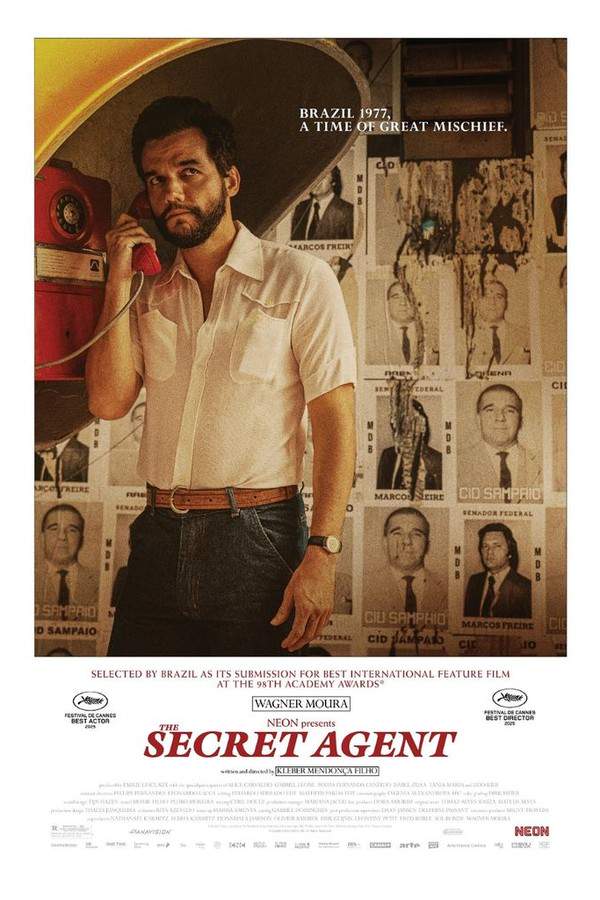
The Secret Agent 2025

Directed by

Kleber Mendonça Filho
Made by

CinemaScópio Produções
Where to Watch The Secret Agent
See current US streaming, rental, and purchase options for The Secret Agent (2025) via JustWatch.








The Secret Agent Plot Summary
Read the complete plot summary and ending explained for The Secret Agent (2025). From turning points to emotional moments, uncover what really happened and why it matters.
In 1977, amid Brazil’s military dictatorship, a former teacher named Armando arrives in Recife during the carnival period and finds shelter at Dona Sebastiana’s home. He is welcomed into a small, precarious refuge alongside Claudia [Hermila Guedes], Haroldo [João Vitor Silva], and Antonio [Licínio Januário], as well as others displaced by the war and political turmoil, including two Angolan Civil War immigrants, Thereza Vitória and Antonio. Nearby, the city is tense: the holiday is interrupted by a grisly mystery—a human leg found inside a captured tiger shark, a discovery that becomes a flashpoint for fear, rumor, and political corruption.
Armando’s presence in the city soon collides with local power dynamics. He is registered under the alias Marcelo in Recife’s social registration archives and is welcomed by the corrupt chief of police, Euclides, whose patronizing attitude gnaws at Armando. The clash reveals a deeper fault line: Hans, a Jewish Holocaust survivor who is mistakenly suspected of Nazi ties, becomes a target of harassment and suspicion, an echo of the era’s paranoia and prejudice. The tension around Armando’s supposed safety grows as violence begins to ripple through the city.
Across the country, in São Paulo, two hitmen, Bobbi and Augusto, are hired by a former Eletrobras president who holds a vendetta against Armando. In Recife, the discovery of the leg triggers a surreal, violent sequence: Sergio and Arlindo throw the limb into the Capibaribe River, where the story takes a bizarre turn as the limb “revives” and lashes out at gay men in a park, fueling a public frenzy and a media storm that swirls around corruption, carnival euphoria, and fear.
As the danger crescendos, Armando receives a warning from Elza, the head of a resistance movement in the Brazilian northeast. He is urged to flee the country in the coming days, and the sense of imminent peril tightens. Anticipating an escape, Armando says goodbye to Dona Sebastiana and the other refugees, while he clings to fragments of memory, particularly a handful of papers about his late mother, India. Vilmar, a local gunman, is hired to locate Armando. The pursuit intensifies: Vilmar identifies Armando but fails to kill him, wounding Arlindo and a fellow officer in the process. Bobbi, watching from a distance, pursues Vilmar and later kills him in a barbershop, sealing a grim chase in the city’s memory.
In the present day, Flavia, a history student, dives into Elza’s resistance network through audio recordings and newspaper archives. Her research reveals that Armando was assassinated, a revelation that challenges the stories told about that turbulent carnival week. Flavia travels to Recife and meets Fernando, now a middle‑aged doctor, who agrees to be interviewed in his hospital after Flavia donates blood. The interview unravels Armando’s political past and murder, yet Fernando confesses he does not hold a single memory of his father or his childhood in 1977, leaving the truth of Armando’s fate enshrouded in silence and memory.
- Claudia [Hermila Guedes] makes her first appearance as a central figure among the refugees, a steady though wary presence in Armando’s circle.
- Hans, [Udo Kier], emerges as a focal point of the story’s tension, a Holocaust survivor who is misread through the lens of fear and prejudice.
- Haroldo [João Vitor Silva] is one of the refugees sheltered with Armando and is part of the fragile network of support and threat.
- Antonio [Licínio Januário] appears as one of the refugees sheltering with Armando, a quiet link to the northern refugee community.
- Fátima [Alice Carvalho] is referenced as Armando’s late wife, whose memory lingers as he searches for documents about India, his mother.
- Doutora Inês [Fabiana Pirro] appears in the narrative through hospital scenes that intersect with Armando’s legacy.
- The present-day arc features Armando’s legend refracted through Flavia’s study, with [Alice Carvalho] and [Fabiana Pirro] occupying routes back to the past through their connections to memory and authority.
The film blends the personal with the political, using a carnival backdrop to explore how a society’s violence, prejudice, and secrecy ripple through generations. Its mood shifts between intimate, character-driven moments and broad, fear‑driven scenes of conspiracy and upheaval, all while tracing the stubborn persistence of memory in the face of erasure.
The Secret Agent Timeline
Follow the complete movie timeline of The Secret Agent (2025) with every major event in chronological order. Great for understanding complex plots and story progression.
Armando arrives in Recife during carnival
In 1977, Armando, a former teacher, arrives in Recife during the carnival holiday seeking refuge. He is sheltered by Dona Sebastiana alongside other political refugees Claudia, Haroldo, Thereza Vitória, and Angolan Civil War immigrants Antonio. The atmosphere mixes festive colors with the undercurrents of political tension.
Armando’s family separated by exile
Armando's son Fernando is being raised by his father-in-law Sr. Alexandre, a cinema projectionist at Cinema São Luiz. The arrangement underscores the personal toll of exile and dictatorship on families left behind. The city becomes both refuge and backdrop for their separation.
The tiger shark leg and policing cover-up
A human leg is found inside a captured tiger shark, triggering alarm among the city authorities. Police chief Euclides and his sons intervene as part of a broader cycle of corruption and cover-ups during carnival week. The leg's disposal in the Capibaribe River leads to a bizarre resurrection that attacks gay men in a park, fueling a sensational public frenzy.
Armando re-registered as Marcelo under police protection
Armando is registered under the alias Marcelo at the city's social registration archive and is warmly welcomed by Euclides, who offers protection. Yet Euclides's protective posture hides arrogance and recurring harassment, even toward Hans, a Jewish Holocaust survivor mistaken for a Nazi fugitive.
Hitmen hired to kill Armando in São Paulo
In São Paulo, hitmen Bobbi and Augusto are hired by a former Eletrobras president to assassinate Armando, driven by political and personal vendettas. The looming threat overlays Armando's exile with a sense that powerful interests will stop at nothing to silence him.
Elza recruits Armando to flee
Armando is contacted by Elza, the leader of a political resistance network in the Brazilian northeast, who urges him to flee the country. He receives warning of imminent danger and begins preparing an escape route.
Vilmar hired to locate Armando
Augusto and Bobbi hire Vilmar, a local impoverished gunman, to locate Armando and bring him down. The arrangement sets in motion a tense manhunt through Recife.
Armando says farewell to his refuges
Anticipating escape, Armando bids farewell to Dona Sebastiana and the other refugees who sheltered him. The departure marks a precarious turning point as the city entangles him with shadowed factions that want him dead.
Armando searches for his mother’s documents
The next morning, Armando searches for documents about his late mother, India, clinging to fragments of memory and hoping for clues to his past. The hunt for identity underscores the personal stakes amid political turmoil.
Vilmar finds Armando but fails to kill him
Vilmar locates Armando but fails to kill him, instead wounding Arlindo and a fellow police officer. Bobbi watches from a distance as the pursuit spills through Recife's streets, heightening the sense of an inescapable trap.
Bobbi finishes Vilmar in a barbershop chase
In a climactic chase, Bobbi pursues the bleeding Vilmar through Recife's downtown and ultimately kills him in a barbershop. The violent confrontation reveals how the era's vendettas reach beyond the battlefield into everyday spaces.
Present-day discovery of Armando’s fate
Decades later, history student Flavia researches Elza's resistance network through audio interviews and newspaper archives, discovering that Armando was assassinated. The revelation reframes the carnival week as a long shadow over Recife.
Flavia visits Recife and interviews Fernando
Flavia travels to Recife and meets Fernando, now a middle-aged doctor, who agrees to be interviewed in the hospital after Flavia donates blood. The conversation delves into Armando's political past and the circumstances of his murder.
Fernando’s memory gaps about his father
During their interview, Fernando reveals he has no memories of his father or his childhood in 1977, underscoring how political violence can erase personal histories and leave surviving relatives with blank spaces.
The Secret Agent Characters
Explore all characters from The Secret Agent (2025). Get detailed profiles with their roles, arcs, and key relationships explained.
Armando
A former teacher who arrives in Recife during carnival under an alias Marcelo. He is a political dissident sheltered by Dona Sebastiana, pursued by corrupt authorities and hired killers. His search for clues about his late mother India and his precarious safety drive the story’s tension.
Dona Sebastiana
A compassionate host who shelters Armando and other refugees during carnival, offering protection and solidarity. Her home becomes a fragile refuge amid political danger and social upheaval.
Cláudia
One of the political refugees sheltered by Dona Sebastiana. She embodies resilience and solidarity within a tight-knit group of newcomers facing dictatorship and exile.
Haroldo
Another refugee taken in by the shelter. He shares the burdens of displacement and the dangers that accompany the carnival period.
Antonio
Angolan Civil War immigrant who joins the refugee community in Recife, carrying memories of a distant conflict and the struggle to find safety.
Hans
A Jewish Holocaust survivor living under suspicion in the city; harassed by the police chief and mistaken for a Nazi fugitive, he endure hostility while seeking safety.
Euclides
Corrupt chief of police whose arrogance and power put Armando and others at risk; his actions illustrate the reach of state-backed violence during the dictatorship.
Sergio
Son of Euclides; involved in disposing a human leg and tied to the period’s violence, highlighting how personal ties to power enable brutality.
Arlindo
Euclides’ son, implicated in the broader web of crime and state-backed manipulation during the carnival turmoil.
Vilmar
Local gunman hired to locate Armando; his pursuit escalates risks for both sides, culminating in a violent confrontation.
Bobbi
Hitman hired to kill Armando by a powerful patron; embodies the reach of private violence funded by political power.
Augusto
Partner of Bobbi in the assassination plot; their actions in pursuit of Armando illustrate the mercenary violence surrounding political risk.
Fernando
Armando’s son, now a middle-aged doctor; he has no memory of his father or childhood, reflecting the lasting gaps caused by the past.
Fátima Nascimento
Armando’s late wife; her memory hovers over the present, as Armando raises their son and the past intrudes in family stories.
Doutora Inês
A doctor involved in the present timeline; her role intersects with the hospital setting where memories of Armando’s era surface.
Clóvis
A figure encountered in the city’s turbulent moments; his presence underscores the everyday people who cross paths with Armando’s story.
The Secret Agent Settings
Learn where and when The Secret Agent (2025) takes place. Explore the film’s settings, era, and how they shape the narrative.
Time period
1977
Set during the Brazilian military dictatorship, the carnival week of 1977 becomes a stage for political arrests, refugee movements, and violent power plays. Armando arrives as dissident, seeking safety while authorities and criminals converge in Recife and São Paulo. The present-day timeline mirrors the past through archives and interviews, underscoring the lasting scars of that era.
Location
Recife, São Paulo, Capibaribe River, Cinema São Luiz
Recife, a coastal city in northeastern Brazil, provides the backdrop for political upheaval during carnival week. The story threads refugees sheltering in the city—Cláudia, Haroldo and Antonio—alongside the tense atmosphere of local police and crime. Capibaribe River and the nearby Cinema São Luiz anchor scenes of violence, conspiracy, and memory in the urban landscape.
The Secret Agent Themes
Discover the main themes in The Secret Agent (2025). Analyze the deeper meanings, emotional layers, and social commentary behind the film.
🗳️
Political Turmoil
The film probes how dictatorship, censorship, and state-backed violence shape everyday life. Armando’s need to hide his identity and the police chief’s corruption reveal a system where power and fear reign. The carnival setting intensifies the tension, exposing subterfuge amid public celebration.
🧭
Identity & Exile
Characters adopt shifting identities—Armando as Marcelo, refugees like Claudia and Haroldo, and various fugitives—just to survive. The story examines belonging, memory, and the personal costs of staying in a country that denies safety. Choices about fleeing or resisting drive relationships and fate.
🕊️
Memory & Legacy
Present-day interviews and archives reveal Armando’s fate, revealing a contested memory of the past. Flavia and Fernando revisit the era, illustrating how communities remember, forget, or reinterpret violence. The film suggests that memory itself is a form of resistance and a burden for future generations.

Coming soon on iOS and Android
The Plot Explained Mobile App
From blockbusters to hidden gems — dive into movie stories anytime, anywhere. Save your favorites, discover plots faster, and never miss a twist again.
Sign up to be the first to know when we launch. Your email stays private — always.
Explore the mobile appThe Secret Agent Spoiler-Free Summary
Discover the spoiler-free summary of The Secret Agent (2025). Get a concise overview without any spoilers.
In the sweltering heat of 1977 Brazil, the streets of Recife pulse with the riotous energy of carnival, a kaleidoscope of music, colour and masked revelry that seems to promise escape from the oppressive weight of the military regime. Beneath the endless samba and confetti, however, an undercurrent of tension ripples through the city, hinting that the festive façade masks deeper currents of unrest. The bustling avenues, crowded beaches and shadowy back‑alleys create a world where joy and danger exist side by side, turning every corner into a place of both possibility and peril.
Marcelo, a seasoned technology expert in his early forties, arrives in the heart of the celebration as a fugitive seeking a brief sanctuary. His purpose is intensely personal: to reconnect with the son he has not seen in years, hoping the anonymity of the crowd will shield him long enough to rebuild a fractured family bond. Marcelo’s expertise and careful pragmatism set him apart from the revelers, yet his guarded demeanor clashes with the open, exuberant spirit of the carnival, underscoring the fragile balance between his inner urgency and the outward chaos that surrounds him.
The film settles into a tone that is simultaneously vibrant and ominous, letting the sensory overload of Recife’s festivities amplify the sense that something unseen is constantly shifting just out of sight. As Marcelo navigates through crowded streets, makes tentative alliances, and searches for traces of his past, the audience is invited to feel the dissonance between the intoxicating rhythm of the celebration and the lurking shadows of a city caught in political turbulence. The story promises a tense, atmospheric journey where personal longing and historical upheaval intertwine, leaving the outcome as open and uncertain as the next drumbeat at midnight.
Featured on this page

What's After the Movie?
Not sure whether to stay after the credits? Find out!
Check out our other apps:

SAT Sphere
Build confidence for the Digital SAT.

Mori Atlas
Discover wild places worth protecting.

Luntero
Search smarter for a home in Amsterdam.

Plot Explained
Unravel movie endings and hidden clues.

Pokechamp
Dive into Pokémon data and battle logic.

Driving Theory
Get ready for your European theory test.

Movie Dust
Plan your next cinema trip with ease.

Musemap
Find art and culture as you travel.

Selkobase
Compare credentials before committing.

Local Manual
Turn an unfamiliar country into practical next steps.

Lernavi
Compare school systems before your next move.

GymRoam
Find a workout stop wherever your plans take you.
Explore Our Movie Platform
New Movie Releases (2026)
Famous Movie Actors
Top Film Production Studios
Movie Plot Summaries & Endings
Major Movie Awards & Winners
Best Concert Films & Music Documentaries
Movie Collections and Curated Lists
© 2026 What's After the Movie. All rights reserved.
Privacy Policy