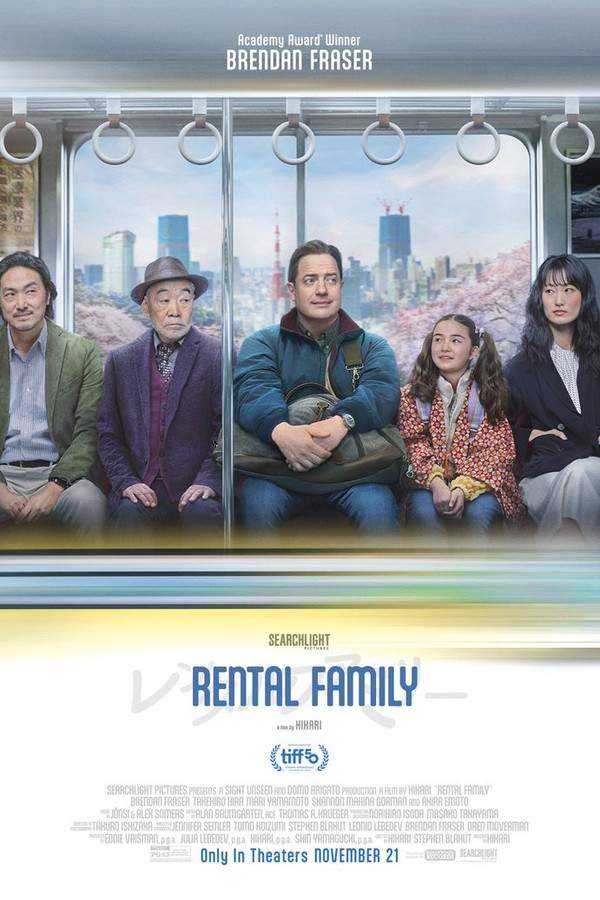
Rental Family 2025


Directed by

HIKARI
Made by

Knockonwood
Where to Watch Rental Family
See current US streaming, rental, and purchase options for Rental Family (2025) via JustWatch.







Rental Family Plot Summary
Read the complete plot summary and ending explained for Rental Family (2025). From turning points to emotional moments, uncover what really happened and why it matters.
American actor Brendan Fraser plays Phillip Vandarpleog, a working American who lives in Japan and keeps chasing solid acting jobs after his moment in a toothpaste commercial. He finds himself stuck in small roles, hustling for gigs, until he lands with Rental Family, a company run by Shinji Ozeki that supplies actors to pose as pretend family members and friends for strangers. The premise is outlandish, almost absurd, but Phillip’s need for money pushes him to join as the company’s “token white guy” and to see what kinds of connections such a gig might offer.
Phillip’s first assignment is to pose as the fiancé of Yoshie, a married lesbian who wants to stage a traditional wedding for her parents before she and her wife depart for Canada. He nearly backs out, unsure about the emotional weight of pretending to be family for a moment that’s meant to be real, but he accepts the job and discovers that even a fabricated commitment can carry real feelings and consequences. The experience leaves him with a sense of purpose he hadn’t felt in his other auditions, a glimmer of how genuine human bonds might emerge from even the most commercially arranged scenarios.
Following that initial success, Phillip takes on two more roles. One has him playing the estranged father to a young Hāfu girl named Mia, whose mother Hitomi is trying to secure a private school placement for her. The other assignment has him as a journalist profiling a retired actor, Kikuo Hasegawa, who is living under constant surveillance by his daughter Masami. These jobs pull Phillip into intimate, fragile spaces where family history, language barriers, and cultural expectations collide, testing his ability to stay detached or to let the roles blend with real life.
As Phillip grows closer to both Kikuo and Mia, he begins to reinterpret what it means to “be there” for someone. Mia initially resents the idea that a stranger could become a father figure, but Phillip’s consistent presence and patient listening slowly win her trust. Kikuo, meanwhile, awakens a nostalgic ache in Phillip as they explore Kikuo’s past and the countryside that once formed the edges of his childhood. In this evolving dynamic, Phillip finds himself weighing the value of genuine connection against the transactional nature of his work for Rental Family.
Aiko Nakajima, Mari Yamamoto in the cast, is another coworker whose assignments reveal the darker side of the job. Her gigs as a pretend mistress—apologizing to wives of unfaithful husbands—often put her in dangerous, abusive situations, illustrating the personal cost of the company’s business model. Phillip becomes aware that for Aiko, the lines between performance and harm are dangerously thin, a realization that deepens his unease about the kind of “trust” Rental Family asks its actors to cultivate. Shinji cautions that endings with clients are a natural part of the work, yet Phillip suspects a deeper pattern of exploitation behind those partings.
After a successful school interview for Mia, Phillip tells her that he must return to the United States. Her progress and their time together inspire him to ask Kikuo to visit his countryside childhood home, a place overtaken by nature and memory. Kikuo discovers a time capsule buried years earlier and, with quiet gratitude, thanks Phillip for bringing him there. The moment briefly shifts Phillip’s view of his role: he’s not just an actor playing a part; he’s helping someone reclaim a piece of their past.
Tensions soon rise as Shinji lashes out, accusing Phillip of “kidnapping” Kikuo, while Phillip pushes back, arguing that Rental Family has been using people to fill hollow spaces rather than to forge real, meaningful bonds. Shinji reveals an unsettling truth: many of the people Phillip has trusted—the “wife” and the teenage “son” who accompany him in certain jobs—are actors hired by the company. The revelation jolts Phillip and drives a wedge between him and the system, prompting a confrontation about whether the work can ever be ethical.
In the wake of that confrontation, Phillip is briefly detained after the incident with Kikuo’s hospitalization, and the line between law, loyalty, and manipulation becomes even blurrier. Mia learns Phillip’s true identity when she spots him in a TV movie, which strains her trust in her mother and tests the bond she’s formed with Phillip. Yet she forgives the deception, recognizing the care that lay behind Phillip’s choices. In a tense sequence, Aiko—for her part—breaks character during a session, tells the wife the truth, and exits. Kota Nakano, Fumiya Kimura in the cast, and Aiko then stage a discreet act as lawyers to coax Kikuo into admitting what happened, while Shinji materializes as a police detective, intensifying the cat-and-mouse dynamic and testing the actors’ loyalties.
Phillip’s release comes with gratitude toward those who helped him uncover truth at the heart of the matter. The story’s emotional core remains Mia’s welfare and Kikuo’s fragile health as he eventually passes away in his sleep. The funeral brings together Phillip, Aiko, Shinji, and Kota to honor the life that became a shared journey rather than a performance. In the aftermath, Phillip visits Mia again; she has been admitted to school, and the two rekindle a friendship rooted in mutual care rather than fabrication.
What remains steady, even as the dust settles, is Phillip’s continued involvement with Rental Family, but with a crucial shift in its culture. The company moves away from the exploitative “apology services” that once underpinned some of Aiko’s abusive experiences, signaling a broader change in the company’s approach to the people it hires. Phillip ends his journey by seeking a quieter, more honest form of connection, spending time at the shrine where Kikuo once prayed, a small gesture of continuity amid the complex, occasionally troubling tapestry of his line of work.
In the end, the story blends bittersweet realism with the possibility of genuine human bonds formed under unusual circumstances. Phillip’s experience with Rental Family reveals the tension between performance and authenticity, while offering a hopeful note: even in a world built on rented identities, there can be moments of real care, real growth, and real closure for the people who allow themselves to be seen.
Rental Family Timeline
Follow the complete movie timeline of Rental Family (2025) with every major event in chronological order. Great for understanding complex plots and story progression.
Becomes Yoshie's fiancé for Rental Family
Phillip agrees to play the fiancé for Yoshie as part of Rental Family's services, despite his preference for real acting work. The unusual gig becomes his path to steady income and a chance to connect with people through the strange arrangement.
Becomes Mia's estranged father
Phillip takes another assignment to act as the estranged father of Hitomi's daughter Mia. He wrestles with the awkward role, but grows to care about Mia as she navigates school and identity.
Forms bonds with Mia and Kikuo
As he visits Mia and Kikuo, Phillip forms close connections with both. Mia resents the idea of a 'father' who is also a hired stranger, while Kikuo’s aging, lucid presence gives Phillip a window into a life beyond acting.
Hitomi warns against closeness
Hitomi warns Phillip that getting too involved could blur the lines of his work. She fears the emotional consequences for Mia and their family, making Phillip question the depth of his new relationships.
Declines a coveted role for Mia's sake
When Phillip learns he won a much-desired role, he chooses to pass in order to continue supporting Mia and her schooling. The decision marks a turning point where personal connections override professional advancement.
Declines taking Kikuo home due to Masami
Masami insists on keeping Kikuo under surveillance and Phillip is pressured to decline taking him to his childhood home. The scene underscores the tension between genuine care and the transactional nature of Rental Family's work.
Aiko's exposure jobs and abuse
Phillip learns that his coworker Aiko's assignments sometimes involve apologizing to wives for unfaithful husbands and can lead to physical abuse. The revelation reveals a darker facet of the industry and its toll on the workers.
Mia's school interview and Phillip's departure plan
Mia has a successful school interview, and Phillip must tell her that he will return to the United States. The moment crystallizes his commitment to Mia's future even as his own plans unravel.
Trip to countryside; time capsule discovery
Phillip and Kikuo take a countryside trip to visit Kikuo's childhood home, now overgrown by nature. They uncover a buried time capsule, and Kikuo thanks Phillip for rekindling a memory from the past.
Shinji confronts Phillip; truth emerges
Shinji confronts Phillip, accusing him of kidnapping and exploiting the elderly actor. Phillip counters that Rental Family is hollow and questions the legitimacy of their business, as Shinji reveals the deceptive nature of the operation.
Mia learns Phillip's true identity; bonds mend
During the aftermath, Mia recognizes Phillip in a TV movie and learns his true identity. She initially resents her mother for the deception but soon forgives her, choosing to move forward.
Aiko and Kota expose truth; Phillip is released; Kikuo's truths disclosed
Aiko breaks character and tells the truth to the wives; Kota and others stage a lawyer-like ruse to coax Kikuo into admitting what happened. Phillip is then released, grateful for the allies who believed in him.
Kikuo dies and funeral; friends mourn
Some time later, Kikuo dies peacefully in his sleep. Aiko, Shinji, Kota, and Phillip attend his funeral, honoring a man who touched Phillip's life.
Phillip reconnects with Mia; rental family reforms; shrine scene
Phillip visits Mia; she is accepted into the school, and they continue spending time as friends. Rental Family discontinues its apology-services, and Phillip ends by praying at the shrine where Kikuo once reflected.
Rental Family Characters
Explore all characters from Rental Family (2025). Get detailed profiles with their roles, arcs, and key relationships explained.
Phillip Vandarpleog (Brendan Fraser)
A lonely actor who has lived in Japan for seven years, Phillip initially views Rental Family work as a questionable way to fill a void in his life. He begins to care deeply for Mia and questions the ethics of selling emotions, leading to a crisis of purpose. His journey blends professional fulfillment with a growing sense of responsibility to the people he imitates. He ultimately seeks genuine connection, even at personal cost.
Mia Kawasaki (Shannon Mahina Gorman)
A mixed-race girl who longs for a stable father figure and real parental attention. Initially angry at Phillip for being a stand-in, she gradually forms a bond with him, asking him to stay and even letting him accompany her to school events. Her warmth and determination reveal the transformative potential of surrogate care. Her progress toward a new school marks a turning point for Phillip’s sense of purpose.
Kikuo Hasegawa (Akira Emoto)
An elderly man kept under watch by his daughter and the Rental Family operation, Kikuo hides a longing for connection and a past he cannot fully reclaim. He shares wisdom about spending time with loved ones, even as dementia erodes his memory. His wandering spirit and eventual decline spark Phillip’s own reflections on what really matters. The jailbroken trip to his old home underscores the fragility of memory and aging.
Aiko Nakajima (Mari Yamamoto)
A rental worker who experiences abuse within the agency's system, pushing her to reveal the darker side of the business. She ultimately plays a crucial role in defending Phillip by confronting the exploitation and aiding Masami in dropping charges. Her stoic resilience and moral growth illuminate the human cost of the emotional-labor economy. She embodies the struggle for agency within a compromised structure.
Shinji Tada (Takehiro Hira)
The pragmatic and often morally ambiguous manager of the Rental Family agency, Shinji builds a business on selling emotional experiences while masking his own loneliness. He reacts with anger when Phillip disrupts the system, exposing the hypocrisy embedded in the operation. His character embodies the tension between business efficiency and genuine human connection. He is revealed to be as isolated as his clients.
Hitomi (Mia's mother)
A single mother who seeks the best future for Mia, Hitomi is forced to confront the consequences of deception when she learns Phillip is not Mia's real father. Her decision to disclose the truth at times reveals the emotional complexity of balancing sacrifice with honesty. She ultimately forgives Mia as she navigates the limits of family and truth.
Rental Family Settings
Learn where and when Rental Family (2025) takes place. Explore the film’s settings, era, and how they shape the narrative.
Time period
Contemporary
The story unfolds in modern-day Japan, where a fading sense of connection drives people to hire others to fill emotional gaps. The world feels current and recognizable, with references to film shoots, commercials, and cross-border moves. It portrays present-day parental aspirations, education systems, and the cash-driven dynamics of media-era life.
Location
Japan
Set primarily in Japan, Rental Family unfolds across a mosaic of everyday spaces—from Phillip's lonely apartment window to the Rental Family office, wedding venues, and Mia's school. The country serves as a modern backdrop where people seek belonging through performative roles. The film traverses public events and private rituals—e.g., a Monster Cat Festival and a shrine visit—highlighting how social façades mask intimate needs.
Rental Family Themes
Discover the main themes in Rental Family (2025). Analyze the deeper meanings, emotional layers, and social commentary behind the film.
🎭
Identity
The Rental Family business turns emotion into a product, forcing Phillip to adopt personas and perform roles to help others. He grapples with whether his authenticity matters when his performances bring real happiness to a client. The movie traces how identity is shaped by circumstance, choice, and the needs of those who hire others to feel complete. Ultimately, Phillip's journey questions what remains when a role ends.
💔
Loneliness
Phillip's loneliness is the throughline that drives him to accept the work of the Rental Family. The film shows how close connections can be manufactured, yet genuine closeness requires risk and vulnerability. Mia's craving for a father figure exposes the ache of being seen and cared for by someone who truly cares. The story suggests that companionship, even when improvised, can heal, but also leaves marks.
⚖️
Ethics
Emotional labor is commodified by the agency, raising questions about consent, exploitation, and manipulation. Aiko's experiences expose the dark side of the business—abuse and power imbalances that people endure for money. Phillip's critique of Shinji's hypocritical model underscores the moral cost of selling sympathy. The narrative probes whether healthy connections can emerge from ethically gray foundations.
👪
Family
The film reframes family as something formed through care rather than biology, with Phillip becoming a quasi-father to Mia and a companion to Kikuo. The bond between Mia and Phillip grows into trust, even as the real families tighten their own ties. Kikuo's longing for a past relationship with his daughter Masami echoes the universal desire for connection. In the end, chosen family members stand in for blood relatives, shaping lives beyond contract.
🕯️
Mortality
The story confronts aging and the fragility of memory through Kikuo's dementia and eventual death. Phillip witnesses the impact of time on relationships and the pain of saying goodbye. The funeral scenes blur the line between performance and authenticity, grounding the emotional stakes in real loss. The arc culminates in a sense of farewell and the enduring memory of those who mattered.

Coming soon on iOS and Android
The Plot Explained Mobile App
From blockbusters to hidden gems — dive into movie stories anytime, anywhere. Save your favorites, discover plots faster, and never miss a twist again.
Sign up to be the first to know when we launch. Your email stays private — always.
Explore the mobile appRental Family Ending Explained
Unravel the ending of Rental Family (2025) with our detailed explanation. Understand the final scenes, character fates, and unresolved questions.
In the film’s closing moments Phillip finally steps out of the role‑play that has defined his work with the Rental Family agency. After Kikuo’s deteriorating health leads to a police complaint that threatens the business, Phillip explodes, telling his boss Shinji that the service exploits people’s loneliness rather than helping them. Shinji, shaken by the accusation and the legal trouble, decides to shut down the more deceitful “apology” schemes and steer the company toward a gentler, more honest purpose, keeping the agency alive but without the morally‑questionable contracts.
Meanwhile, the pretend bond between Phillip and young Mia transforms into something real. When the girl discovers an old TV clip of Phillip’s acting gigs, she confronts the illusion of his “American father” and, with her mother Hitomi’s reluctant blessing, chooses to keep him in her life—not as a paid substitute, but as a genuine friend who can fill the parental gap she has felt. Their relationship settles into an authentic, if unconventional, family‑like connection.
The very last scene finds Phillip alone in the quiet temple where he once accompanied Kuo Kikuo. He bows, folds his hands, and looks into the shrine’s mirror, a symbol that, as Kikuo once said, the divine lives inside each person. The gesture signals Phillip’s full circle: from an isolated outsider to a man who has forged true ties in a place that once felt foreign, carrying forward the love and responsibility he discovered through the rented roles.
Rental Family Spoiler-Free Summary
Discover the spoiler-free summary of Rental Family (2025). Get a concise overview without any spoilers.
In the bustling streets of modern Tokyo, a peculiar service has taken root: a “rental family” agency that supplies actors to stand in as relatives, friends, or even strangers’ confidants. The concept blurs the line between performance and everyday life, turning ordinary moments—weddings, school interviews, quiet evenings—into staged encounters that promise comfort, closure, or simply a momentary illusion of belonging. The city’s neon glow and its subtle undercurrents of loneliness create a backdrop where hired connections feel both absurd and oddly necessary.
Phillip Vandarploeug is an American actor navigating this uncanny marketplace. After a fleeting brush with fame in a toothpaste commercial, he finds himself stuck in a string of minor roles, his career drifting like a leaf in the wind. Desperate for steady work and a foothold in a foreign land, he joins the agency as its “token white guy,” a novelty that both isolates him and makes him uniquely marketable. His background in acting equips him with the tools to inhabit any role, yet the very act of pretending threatens to eclipse his own identity.
The tone of the story balances gentle humor with quiet melancholy, inviting viewers to contemplate how much of ourselves we perform for others and how those performances can shape genuine affection. As Phillip steps into the lives of people who seek temporary familial bonds, the boundaries between his scripted parts and his authentic self begin to soften. The film asks whether the bonds forged in pretense can ever truly become real, and what it means to belong when the only family you have is one you are hired to play.
Around him, the agency’s founder Shinji and his eclectic staff navigate their own moral compasses, offering a mosaic of perspectives on the ethics of invented intimacy. Their interactions hint at a larger conversation about loneliness, cultural expectations, and the yearning for connection in a city that never sleeps. Through Phillip’s journey, the audience is drawn into a world where the line between acting and living is as delicate—and as compelling—as a whispered promise.
Movies with Similar Twists and Themes
Uncover films that echo the narrative beats, emotional arcs, or dramatic twists of the one you're exploring. These recommendations are handpicked based on story depth, thematic resonance, and spoiler-worthy moments — perfect for fans who crave more of the same intrigue.




Featured on this page

What's After the Movie?
Not sure whether to stay after the credits? Find out!
Check out our other apps:

SAT Sphere
Build confidence for the Digital SAT.

Mori Atlas
Discover wild places worth protecting.

Luntero
Search smarter for a home in Amsterdam.

Plot Explained
Unravel movie endings and hidden clues.

Pokechamp
Dive into Pokémon data and battle logic.

Driving Theory
Get ready for your European theory test.

Movie Dust
Plan your next cinema trip with ease.

Musemap
Find art and culture as you travel.

Selkobase
Compare credentials before committing.

Local Manual
Turn an unfamiliar country into practical next steps.

Lernavi
Compare school systems before your next move.

GymRoam
Find a workout stop wherever your plans take you.
Explore Our Movie Platform
New Movie Releases (2026)
Famous Movie Actors
Top Film Production Studios
Movie Plot Summaries & Endings
Major Movie Awards & Winners
Best Concert Films & Music Documentaries
Movie Collections and Curated Lists
© 2026 What's After the Movie. All rights reserved.
Privacy Policy