What Is Privilege About?
The premise of Privilege in 313 words, with nothing given away. The full story follows below.
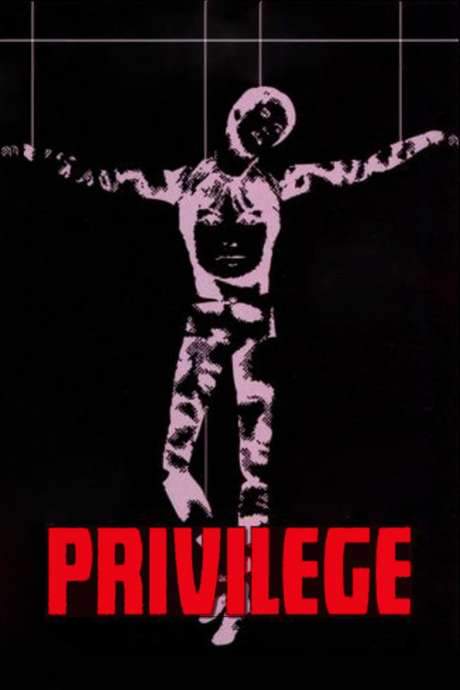
In a stylised, near‑future take on 1970s England, the nation is awash with slick propaganda, glossy consumerism and a political coalition that leans on spectacle to keep the public placid. The film unfolds as a narrated documentary, its tone a blend of cold observation and unsettling satire, inviting viewers to stare at a society that worships image as much as it fears agency. Everywhere—from nightclubs to shopping centres—a single name glitters on billboards, on product packaging and in the headlines, turning a pop idol into a national currency.
At the centre of this glittering apparatus stands Steven Shorter, Britain’s megastar pop singer whose on‑stage persona is both a provocation and a comfort. His performances are theatrical set‑pieces, featuring violent symbolism that draws crowds into a collective trance. Behind the scenes, a tight‑knit team of handlers choreographs his every move, ensuring that his fame dovetails neatly with the state’s agenda. Shorter’s adulation is immense, yet the veneer of his celebrity hints at a deeper loss of autonomy, a puppetry that the public accepts with uncritical devotion.
Enter Vanessa Ritchie, an acclaimed visual artist commissioned to capture Shorter’s likeness on canvas. Her presence introduces a quiet tension; through her creative gaze, the star is forced to confront the distance between the persona sold to the masses and the person hidden behind it. Their interactions suggest an uneasy search for genuine connection amid the machinery of fame, and Ritchie’s artistic curiosity becomes a subtle catalyst for questioning the structures that sustain him.
The film’s atmosphere is one of glossy excess tinged with an undercurrent of unease, where every smiling billboard may conceal a manipulation, and where the line between worship and control blurs. It invites the audience to wonder how far a society will go to preserve its comforting myths, and what cracks might appear when an icon begins to glimpse the strings that bind him.
What Happens in Privilege?
The complete story of Privilege, from the first scene to the last, in 581 words (about 3 minutes). Spoilers throughout. Names in the text link to 7 cast member pages.
Spoilers ahead
The film presents a narrated documentary set in a near-future version of 1970s England, centered on a disillusioned pop star named Steven Shorter. Shorter is the country’s most adored celebrity, and his onstage persona is starkly provocative: he performs in a jail cell, handcuffed and beaten by mock police, a spectacle that both horrifies and captivates the audience. The political backdrop is equally charged, with the two main parties forming a coalition government that uses Shorter’s immense appeal to placate the public and redirect political energy away from real civic involvement.
Shorter’s life is tightly controlled by a cadre of handlers: the manager Martin Crossley, the public relations figure Alvin Kirsch, the record-company boss Julie Jordan, and the financial backer Andrew Butler. Across every facet of culture—nightclubs, shopping centers, brands, and media—Shorter’s name is a currency, a mirror of consumer devotion. An artist, Vanessa Ritchie is commissioned to paint his portrait, and Shorter searches for some human connection in the isolation of his fame, finding it in her.
As demands on Shorter intensify, an official commercial for apple growers asks him to persuade the nation to eat apples in unprecedented quantities to fix a surplus. More ominously, the churches of England strike a deal with the government and Shorter’s expanding empire to mold him into a quasi-messianic figure who could spur church attendance and national unity. An image shift is announced ahead of a gargantuan stadium concert where Shorter will publicly “repent,” abandon the handcuffs, and embrace religious overtones in his songs. The pressure takes a toll on him; at a seaside picnic, he bizarrely orders hot chocolate to drink, and everyone else follows suit, a vivid sign of how his choices shape public behavior.
On the stadium day, attendance is massive and the performance carries a militarized air, with nationalist groups taking the stage in uniform-like costumes. A fiery preacher, Reverend Jeremy Tate, inflames the crowd by urging conformity with cards bearing the words “We Will Conform.” Shorter and his band respond with stage conventions that echo a dark, troubling past, while disabled citizens sit closer to the stage in a bid to “heal” them with his music. Later, Shorter watches the rally footage and feels a deep revulsion, erupting in a furniture-breaking fury. He also confides to Vanessa Ritchie that the old show wasn’t only staged: the bruises and scars he bore on his body were real, a brutal secret behind the marketable mask.
At a formal event honoring his achievements, Shorter’s outward adoration collapses as he voices a raw, ambiguous disgust for a public thatansen’t seen him as a person beyond the brand. The room falls silent, and the public’s reaction quickly turns to anger, threatening the lucrative machine built around him. Andrew Butler announces his own resignation from the Shorter enterprise, signaling the end of a profitable era. The narrative’s verdict is stark: to appease a vindictive, consumer-driven society and to preserve the business interests that depend on him, Shorter’s career is effectively erased—his music banned from airplay, and his voice silenced from public life.
In the postscript, the narrator remarks that little remains of Shorter’s career, overlaying archival footage (its soundtrack removed) as if to underline a prerequiem for the performer. The closing line sums up the film’s paradoxical tone, hinting at a future promised as “a happy time in England,” even as the credits signal the cost of that happiness.
It is going to be a happy time in England, this year in the future.
Privilege Timeline: Every Key Event in Order
14 key events in the order they happen, from “Public jail‑cell stage act” to “Postscript: shards of a career and a hopeful future”. 14 events name a place, across 12 locations.
- 1
Public jail‑cell stage act
Steven Shorter's stage show features him appearing in a jail cell, handcuffed, while police beat him to the shock and sympathy of the audience. The scene is presented as a manufactured spectacle that cements his image as a tormented, vulnerable icon. The act establishes the public’s fascination with his suffering as entertainment.
When:Early in the near-future 1970s England Where:Live stage (England)
- 2
Coalition uses Shorter to placate masses
Two main political parties form a coalition to placate the public and divert political life from active engagement. Shorter's enormous popularity is exploited by the state and corporate interests, while his image is carefully managed to maintain mass support. He becomes a tool of national cohesion rather than a free artist.
When:Early phase Where:England
- 3
Handlers assemble a control team
Shorter's career is tightly managed by a team of handlers: manager Martin Crossley, PR rep Alvin Kirsch, record executive Julie Jordan, and financial backer Andrew Butler. They schedule appearances, shape his image, and shield him from anything that might threaten the facade. The arrangement ensures he remains the country’s most adored celebrity.
When:Early – ongoing Where:Record company offices / private meetings
- 4
Brand empire and consumer reach
Shorter's name and image saturate businesses from nightclubs to product brands and media outlets. His presence becomes a marketing engine that underwrites consumer culture and the political project to keep people content. The public’s attachment to his persona extends beyond music into everyday life.
When:Ongoing Where:Nationwide, England
- 5
Vanessa Ritchie paints his portrait
An artist, Vanessa Ritchie, is hired to paint Shorter's portrait, and he finds himself drawn to her amid loneliness and isolation. The portrait becomes a private counterpoint to the public persona. He seeks quiet connection away from manufactured adoration.
When:Mid-phase Where:Studio
- 6
Apple growers commercial
Shorter films a persuasive commercial urging citizens to eat a surprisingly large amount of apples to reduce a surplus. The campaign exemplifies how his image is weaponized for any national need. The advert contributes to his image as a wholesome, unthreatening national symbol.
When:Mid-phase Where:TV studio
- 7
Churches strike a messianic alliance
England's churches strike a deal with the government and the Shorter empire to position him as a messianic figure who will boost church attendance. His influence is cast as a spiritual unifier rather than a pop star. The move deepens the manipulation of faith and culture for political ends.
When:Mid-phase Where:National churches
- 8
Stadium image change and repentance plan
An image change is announced before a huge stadium concert: Shorter will publicly repent, abandon handcuffs, and embrace religious themes in his music. The shift signals a more overt manipulation of his art for national unity. The crowd is primed for a symbolically redemptive performance.
When:Pre-concert Where:Stadium
- 9
Picnic moment reveals control
At a picnic featuring lobster, Shorter absurdly orders hot chocolate, and others imitate him to demonstrate his control over the public. The moment underscores how his image governs everyday behavior. It foreshadows the fragility of his autonomy within the system.
When:Pre-concert Where:Picnic setting
- 10
Stadium rally with militarised nationalism
The stadium rally draws record attendance and features militarised nationalist groups performing on stage. Reverend Jeremy Tate leads the crowd in conformity slogans, and attendees echo the words as instructed. Shorter's band wears costumes evoking Nazi imagery, while disabled citizens are given preferential seating.
When:During stadium rally Where:Stadium
Show the other 4 events of Privilege Hide the last 4 events
- 11
Shorter watches footage and rebels
Watching footage of the rally on television, Shorter is disgusted by the display. He destroys furniture in a burst of anger and reveals that his old show was not merely an act, but a real experience of beating and coercion. The moment marks a critical turning point from complicity to crisis.
When:Post-rally Where:Home TV room / private space
- 12
Achievement award and collapse
The record company holds an achievement awards event praising Shorter and his public love. He breaks down, expressing disgust at a public that can't see him as an individual. The aftermath shows stunned silence followed by public anger and a sharp drop in his popularity.
When:Immediately after rally Where:Award ceremony
- 13
Butler resigns and economic purge begins
Andrew Butler announces his resignation from the Shorter organization as investors withdraw their support. The ruling powers decide to limit the star's influence to placate the masses and preserve the surviving enterprises. Shorter’s music is banned from airplay and he is forbidden to speak or perform publicly.
When:Immediately after the awards Where:Offices / press announcement
- 14
Postscript: shards of a career and a hopeful future
The narrator muses that little remains of Shorter's career, using archival footage to suggest a future England will find happiness without him. The closing vision contrasts his broken stardom with a declared national optimism. It leaves a melancholic but ironically hopeful note about the country’s direction.
When:Postcrisis future Where:England
Who Are the Main Characters in Privilege?
7 characters, among them Steven Shorter (Paul Jones), Martin Crossley and Alvin Kirsch: who each one is and the part they play in the story. 5 of them link to the actor’s page.
- SS
Steven Shorter (Paul Jones)
Played by Paul Jones
A disillusioned pop star who is the country’s adored celebrity and public morale tool. He is relentlessly guided by handlers and pressured to perform, while privately haunted by real scars from the act. His longing for genuine individuality clashes with a system that treats him as a consumable symbol.
- 🎭 Fame
- 🧠 Manipulation
- 💔 Vulnerability
- MC
Martin Crossley
Shorter’s manager and primary architect of his public persona. He orchestrates appearances, narratives, and image shifts to keep the star in the spotlight. He shows little concern for the personal cost to Shorter, embodying calculated control.
- 💼 Management
- 🗺️ Control
- 🗣️ Manipulation
- AK
Alvin Kirsch
Public relations intermediary who shapes public perception and peddles the star's image. He operates as part of a larger machine, prioritizing audience reaction and marketability over authenticity. His work exemplifies the financial and reputational pressures behind fame.
- 💬 Imagecraft
- 🧪 Experimentation
- 🧾 Corporate influence
- JJ
Julie Jordan (Max Bacon)
Played by Max Bacon
Record company executive driving the commercial viability of Shorter’s career. She choreographs publicity campaigns and partnerships, balancing profit with the star’s public face. Her decisions reveal how profit motives steer celebrity narratives.
- 💼 Profit-driven
- 📣 Public image
- 🧭 Strategic planning
- AB
Andrew Butler (William Job)
Played by William Job
Financial backer steering the Shorter empire. He measures success in returns and is willing to pull the plug if the numbers don’t add up. His stance anchors the economic engine behind the celebrity's rise and fall.
- 💰 Finance
- 🏦 Investor influence
- 🧭 Risk management
- VR
Vanessa Ritchie (Jean Shrimpton)
Played by Jean Shrimpton
Artist hired to paint Shorter’s portrait, offering a rare emotional counterpoint to the machine. She becomes a confidante who glimpses the man behind the image, sharing moments of loneliness and vulnerability. Her presence introduces a humanizing thread amid the spectacle.
- 🎨 Artist
- 🤝 Connection
- 🕊️ Empathy
- RJ
Reverend Jeremy Tate (Malcolm Rogers)
Played by Malcolm Rogers
A firebrand preacher who channels nationalist sentiment into public worship of Shorter. He helps mold the singer into a messianic figure and frames conformity as virtue. His rhetoric anchors the religious dimension of the political project.
- ⛪ Religion
- 🔊 Propaganda
- 🗳️ Mass mobilization
Where and When Is Privilege Set?
Privilege is set in England (Near-future 1970s England). Here is why the time and place matter to the story.
When
Near-future 1970s England
Set in a version of 1970s England where mass media is a dominant force in shaping public life. A coalition government uses celebrity power to pacify the populace and suppress political activity. The period blends spectacle with social control, showing how entertainment becomes a tool of statecraft.
Where
England
England serves as the setting for a nation saturated by media and political theater. The action unfolds across stadiums, television studios, churches, and commercial venues that collectively propel Steven Shorter’s manufactured persona. The near-future 1970s context highlights the collision between pop culture, politics, and consumer capitalism.
- 🏛️ Political system
- 🗞️ Media culture
- 🎭 Celebrity worship
What Are the Themes of Privilege?
3 ideas the story keeps returning to, among them Fame and Control, Religion and State and Commercialization.
-
01
Fame and Control
The narrative reveals how Shorter’s image is manufactured by a web of handlers and institutions. Fame becomes a instrument of political and commercial power rather than true personal expression. The tension between authentic self and managed persona drives the drama.
-
02
Religion and State
Churches are co-opted to bolster Shorter’s image and national unity, turning faith into a social tool. The marriage of church authority and political interests demonstrates how belief systems can be leveraged to control behavior. The messianic veneer hides manipulation and fear.
-
03
Commercialization
A sprawling network of brands, venues, and media outlets monetizes Shorter’s every move. His career becomes a marketed product designed to yield profits and maintain public order. When his authenticity bleeds through, the system retaliates to safeguard its financial interests.
What Kind of Film Is Privilege?
Dark in tone, with steady pacing and a moderate story, going by the plot summary.
- Tone
- Dark
- Pacing
- Steady
- Story
- Moderate
- Intensity
- High
- Ending
- Bleak
A claustrophobic and anxious dystopian drama that steadily builds an oppressive atmosphere of state-sanctioned manipulation, leading to a bleak and isolating conclusion for its disillusioned protagonist.
- oppressive
- dystopian
- anxious
- melancholic
- satirical
- alienating
- political manipulation
- celebrity culture
- propaganda
- loss of identity
Content notes: psychological manipulation, torture (implied), exploitation.
Quiz
How well do you remember Privilege? Test yourself on the story.