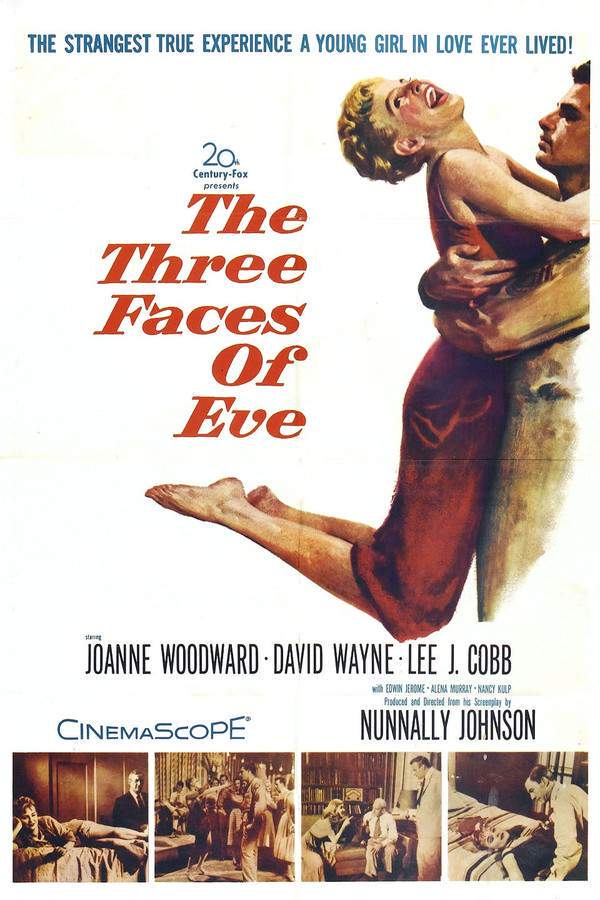
What Is Lizzie About?
The premise of Lizzie in 286 words, with nothing given away. The full story follows below.
Plagued by relentless headaches and sleepless nights, Elizabeth Richmond finds her orderly life unraveling at the seams. The arrival of mysterious letters from a woman named Lizzie—a person Elizabeth has no memory of knowing—adds a layer of unease to her already fragile state. Desperate for clarity and relief, she places her trust in the hands of psychiatrist Dr. Neal Wright, hoping to find a medical explanation for the confusion that clouds her days and nights.
As Dr. Wright delves deeper into Elizabeth’s psyche, he uncovers a startling reality that defies simple diagnosis. Elizabeth is not a singular identity but a complex amalgamation of three distinct personalities: the neurotic and fearful Elizabeth, the wild and wanton Lizzie, and the kind, well-adjusted Beth. The film navigates the shifting sands of this fractured mind, presenting a psychological landscape where three women war for control of one body, each representing a different facet of a fragmented soul.
The narrative creates a tense atmosphere where the clinical setting clashes with the chaotic internal world of the patient. Through hypnosis and careful exploration, the story peels back layers of defense mechanisms and buried memories, hinting at a past that refuses to stay silent. The tone balances the sterile observation of the doctor with the raw, unpredictable emotions of a woman who is essentially a stranger to herself.
Ultimately, the film poses a compelling question about identity: who is the real woman behind the masks? It is a dramatic exploration of trauma and the mind’s capacity to splinter in order to survive. As the doctor works to guide his patient toward wholeness, the audience is invited to witness a profound struggle for integration and peace, where the past looms large over the present.
What Happens in Lizzie?
The complete story of Lizzie, from the first scene to the last, in 220 words (about 1 minute). Spoilers throughout. Names in the text link to 4 cast member pages.
Spoilers ahead
Elizabeth Richmond has recurring headaches and is plagued with insomnia. She begins receiving letters from a woman named Lizzie, yet she cannot recall ever meeting anyone named Lizzie.
Under hypnosis, Dr. Neal Wright discovers that Elizabeth carries three distinct personalities: the shy Elizabeth, the Mr. Hyde-like Lizzie, and the kind, well-adjusted Beth, the woman she has always should have been.* The doctor must guide Elizabeth toward fully becoming Beth.
From the past comes a painful birthday memory: her mother, Elizabeth’s mother, an abusive alcoholic, arrives late with her drunken boyfriend, and a moment of rage triggers events that lead to her mother’s death. Elizabeth blames herself, and Aunt Morgan has known about it, showing little sympathy for years but ultimately feeling genuine sorrow upon the truth coming out.
Another memory reveals that her mother’s boyfriend raped her, a sequence depicted in a prolonged portrayal where he pursues her up the stairs and into her bedroom, ending with a closeup of the girl’s face. She kept this to herself for a long time.
In the present, alone in her bedroom, a three-way mirror becomes the stage on which Beth fights and eventually wins the battle for dominance between the facets of her self. Dr. Wright pledges to continue helping her learn to live with these memories and carry on as Beth.
Lizzie Timeline: Every Key Event in Order
12 key events in the order they happen, from “Elizabeth's symptoms and Lizzie letters” to “Ongoing therapy and hopeful outlook”. 12 events name a place, across 5 locations.
- 1
Elizabeth's symptoms and Lizzie letters
Elizabeth suffers from recurring headaches and insomnia. She begins receiving letters from a woman named Lizzie, a name she cannot recall ever hearing before. The mystery of Lizzie deepens her confusion and hints at a hidden past she cannot access. This setup drives the central question of the film: who is Lizzie, and how does she relate to Elizabeth's identity.
When:present day Where:Elizabeth's home
- 2
Hypnosis begins and memory fragments surface
Hypnosis sessions with Dr. Wright begin, and Elizabeth's subconscious starts to reveal fractured parts of her identity. Under suggestion, she reveals multiple personalities rather than a single, coherent self. The discovery shocks both patient and physician and reframes her symptoms as dissociated identities rather than merely illnesses. The session sets the course for a therapeutic exploration of trauma.
When:present day during therapy session Where:Dr. Wright's office
- 3
Three identities emerge
During hypnosis, three personalities emerge: Elizabeth, the shy, quiet self; Lizzie, a fierce, Hyde-like alter; and Beth, the warm, well-adjusted woman she was meant to be. Each identity displays distinct behavior and memories, complicating the path to integration. Dr. Wright notes their differences as essential pieces of Elizabeth's trauma history. The revelation sharpens the focus of therapy on unifying the self.
When:present day Where:Dr. Wright's office
- 4
Therapist targets Beth as the true self
Dr. Wright frames Beth as the authentic self Elizabeth should become. Beth projects calmness and empathy, offering a model for how Elizabeth might function in life. The therapist emphasizes balancing the other voices rather than eradicating them. The goal is to gradually merge the personalities into a cohesive identity centered on Beth.
When:present day Where:Dr. Wright's office
- 5
Childhood birthday memory surfaces
A childhood birthday memory surfaces, hinting at a troubled home. Elizabeth recalls her mother arriving late with her drunken boyfriend, a scene that unsettles the child and foreshadows abuse. The event reveals the volatile environment that would contribute to her later dissociative states. The memory is painful and fragmented, signaling the roots of her trauma.
When:childhood memory Where:Childhood home
- 6
Elizabeth blames herself for her mother's death
Elizabeth carries guilt over her mother's death, blaming herself for the outburst that ended in tragedy. The realization deepens the sense of responsibility that drives her to dissociate. This guilt becomes a powerful undercurrent in her relationships with authority figures, including her aunt and Dr. Wright.
When:childhood memory Where:Childhood home
- 7
Aunt Morgan's awareness and mixed emotions
Aunt Morgan's awareness surfaces as she confronts the abuse. She reacts with anger and shock, then remorse for not protecting Elizabeth. The scene adds another layer to the family dynamics that shaped Elizabeth's coping mechanisms.
When:childhood memory Where:Family setting
- 8
Memory of the mother's boyfriend's abuse
Elizabeth recalls a memory in which her mother's boyfriend rapes her after pursuing her up the stairs into her bedroom. The scene is shown in a lingering sequence that emphasizes the severity of the trauma she endured. She had never told anyone about it, deepening her isolation.
When:childhood memory Where:Childhood home
- 9
Therapy confronts the full trauma including the rape
Therapy progresses as Dr. Wright helps Elizabeth confront the full scope of her trauma, including the rape memory. The process is painful and destabilizing, but it begins to strip away the power of the dissociated identities. The boundaries between past and present gradually blur in a controlled clinical setting.
When:present day Where:Dr. Wright's office
- 10
Three-way mirror ritual in the present
In the present, a three-way mirror becomes the stage on which Beth fights for dominance. The confrontation is intense as the alternate identities vie for control, and Beth shows resilience. The mirror serves as a symbolic battleground for the battle to arrive at a cohesive self.
When:present day Where:Elizabeth's bedroom
- 11
Beth wins the battle for dominance
Beth asserts control, signaling a shift toward a more integrated and stable self. The other identities yield to the dominant, well-adjusted self she is becoming. The moment marks a hopeful transition rather than a complete resolution.
When:present day Where:Elizabeth's bedroom
- 12
Ongoing therapy and hopeful outlook
Dr. Wright promises to continue helping Elizabeth learn to live with her memories and new sense of self. The therapy is framed as a long journey rather than a quick cure, offering cautious optimism about Elizabeth's future. The ending suggests resilience and ongoing effort to maintain stability.
When:present day Where:Dr. Wright's office
Who Are the Main Characters in Lizzie?
6 characters, among them Elizabeth Richmond (Eleanor Parker), Aunt Morgan (Joan Blondell) and Dr. Neal Wright (Richard Boone): who each one is and the part they play in the story. Every profile links to the actor’s page.
-

Elizabeth Richmond (Eleanor Parker)
Played by Eleanor Parker
Elizabeth is a troubled woman who endures headaches and insomnia, while a memory of Lizzie torments her. Through hypnosis, she confronts three distinct personas—the shy Elizabeth, the fierce Lizzie, and the kind Beth—as she fights to reclaim her true self. Her trauma stems from a painful childhood marked by abuse and loss, which she must confront to heal.
- 🧠 Trauma survivor
- 🎭 Dual personalities
-

Aunt Morgan (Joan Blondell)
Played by Joan Blondell
Aunt Morgan is a stern relative who knows about Elizabeth's suffering but offers only limited sympathy. Her attitude fluctuates between anger and genuine remorse when confronted with the consequences of Elizabeth's past. She embodies the family complexity surrounding Elizabeth's trauma.
- 🏠 Family figure
- 🔐 Secrets
- DN
Dr. Neal Wright (Richard Boone)
Played by Richard Boone
Elizabeth's psychiatrist who uses hypnosis to uncover the split personalities. He acts as a steady, professional guide in her struggle, promising ongoing support and therapy. His approach emphasizes discovery, accountability, and the hope of integration.
- 🧠 Psychiatrist
- 🎯 Therapist
- EM
Elizabeth's Mother (Dorothy Arnold)
Played by Dorothy Arnold
An abusive alcoholic whose volatile behavior contributes to Elizabeth's childhood trauma. Her absence is felt, but her memory persists in Elizabeth's psyche, influencing the present. She looms large as the symbol of hurt that Elizabeth must reckon with to heal.
- 🍷 Abusive
- 🫖 Unstable
- WB
Walter Brenner (Hugo Haas)
Played by Hugo Haas
The mother's drunken boyfriend who embodies the predatory danger of Elizabeth's past. His presence in the backstory intensifies the fear and trauma Elizabeth carries into adulthood. He is revealed in memory as a pivotal source of harm.
- 🧪 Abuser
- 🗝️ Secrets
- RS
Ruth Seaton (Marion Ross)
Played by Marion Ross
A character in Elizabeth's circle who interacts with her amidst the therapy and memory revelations. Ruth represents a potential anchor in Elizabeth's life, offering support within the complicated web of family and past traumas.
- 🤝 Support
- 🧭 Role in recovery
Where and When Is Lizzie Set?
Lizzie is set in Elizabeth's home, Dr. Wright's office and Elizabeth's bedroom. Here is why the place matters to the story.
Where
Elizabeth's home, Dr. Wright's office, Elizabeth's bedroom
The story unfolds across several settings central to Elizabeth's psyche and life. Elizabeth's home is the scene of a painful family history marked by neglect and a volatile mother figure. Dr. Wright's office provides a clinical space where hypnosis and dialogue probe Elizabeth's fractured identity, while her bedroom—lit by the mirror that becomes the battleground for Beth—symbolizes the inner theater of her memories.
- 🏠 Domestic drama
- 🧠 Psychological setting
What Are the Themes of Lizzie?
4 ideas the story keeps returning to, among them Identity, Memory and Healing.
-
01
Identity
The film centers on dissociative identity as Elizabeth's mind fragments into the shy Elizabeth, the Hyde-like Lizzie, and the kind Beth. Each personality surfaces to cope with trauma, revealing how identity can split under pressure. The narrative follows the struggle to integrate these selves into a cohesive sense of self.
-
02
Memory
Memory, especially traumatic remembrance, drives the plot as suppressed events resurface under hypnosis. The past intrudes into the present through unsettling recollections of a mother's abuse and a violent encounter. Recalling these memories is essential to understanding Elizabeth's condition and progress toward healing.
-
03
Healing
Healing centers on the therapeutic process led by Dr. Wright, who guides Elizabeth toward self-control and integration. The journey is cautious and non-linear, with relapses and breakthroughs as she confronts painful memories. The story suggests recovery is possible through insight, support, and time.
-
04
Family
Family dynamics are a driving force, highlighting intergenerational pain and complicity. The abusive mother, the alcoholic partner, and Aunt Morgan's complex concern all shape Elizabeth's vulnerability and eventual resilience. The film probes loyalty, guilt, and the lasting impact of a troubled childhood.
What Kind of Film Is Lizzie?
Dark in tone, with steady pacing and a complex story, going by the plot summary.
- Tone
- Dark
- Pacing
- Steady
- Story
- Complex
- Intensity
- High
- Ending
- Happy
An intense and psychologically claustrophobic drama that delves deep into trauma inflicted by childhood abuse, creating a tense and unsettling atmosphere that ultimately finds a note of cautious hope through therapeutic recovery.
- psychological
- claustrophobic
- anxious
- traumatic
- intense
- unsettling
- dissociative identity disorder
- childhood trauma
- psychological therapy
- repressed memory
Content notes: sexual assault, child abuse, child neglect, alcoholism, attempted suicide, psychological trauma.