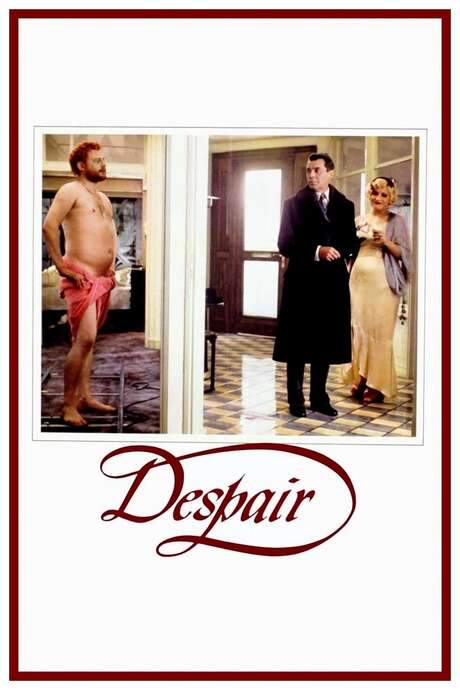
What Is Despair About?
The premise of Despair in 291 words, with nothing given away. The full story follows below.
In the waning days of the Weimar Republic, a restless Berlin teeters between decadent excess and the ominous rise of a new regime. The city’s streets pulse with a nervous energy that turns everyday transactions into theatrical performances, and the looming shadow of political change adds a frantic urgency to even the most mundane conversations. Against this backdrop, the film unfolds as a hysterical comedy, letting absurdity blossom amid the tension of a society on the brink.
Hermann Hermann is a Russian émigré who now runs a modest chocolate factory inherited from his family. A blend of Baltic German discipline and Jewish heritage, he navigates a precarious existence, balancing the pressures of a declining economy, increasingly hostile business climate, and the ever‑present demands of his capricious wife. His temper frays under the weight of workers’ grievances and the relentless march of businessmen who see his sweet‑making trade as an easy target for exploitation.
His marriage to Lydia Hermann is a study in volatile affection; she is vibrant and demanding, sharing an unusually close bond with her bachelor cousin, the painter Ardalion. Their tangled dynamics lend the story a constant undercurrent of domestic comedy, as Lydia’s whims and Ardalion’s artistic pretensions collide with Hermann’s attempts to keep his world intact. The trio’s interactions illuminate both the personal absurdities of the era and the larger, unsettling transformations sweeping through the city.
Amid this chaotic tableau, Hermann encounters a drifter named Felix, whose uncanny physical resemblance to him sparks a wildly imaginative scheme to escape the pretended reality he loathes. Their connection hints at a surreal partnership, inviting the audience to wonder whether identity, chance, or sheer desperation will rewrite the rules of survival in a Berlin that feels simultaneously familiar and wildly distorted.
What Happens in Despair?
The complete story of Despair, from the first scene to the last, in 389 words (about 2 minutes). Spoilers throughout. Names in the text link to 4 cast member pages.
Spoilers ahead
Hermann Hermann Dirk Bogarde lives in Berlin during the Weimar Republic. A refugee from Soviet Russia, with a Baltic German father and a wealthy Jewish mother, he has inherited a business making chocolates. His wife Lydia Hermann Andréa Ferréol, voluptuous but not intelligent, has an over-close relationship with her bachelor cousin, the painter Ardalion Volker Spengler. As the Great Depression bites and Nazi thugs start targeting Jewish businesses, his firm becomes less profitable and Germany feels less hospitable, and Hermann begins to dream of escape. He already experiences moments of leaving his body—watching himself make love to his wife—and he consults a man he believes to be a Viennese psychiatrist but is in fact a life insurance salesman, who sells him a policy.
After watching a film that features a doppelgänger, he spots an unemployed drifter named Felix Klaus Löwitsch, who he decides is his double. Felix, bemused at first by the idea of any resemblance, goes along with the plan when Hermann promises him a job. The work, as it turns out, is to act as Hermann’s double for a substantial lump sum.
Hermann is now ready to finalize his plan to erase all traces of his unwelcome existence. He has Ardalion write a letter that demands money to leave Lydia and go painting in Switzerland, and then shows the letter to the life insurance salesman as evidence that he is being blackmailed. He also tells Lydia that he has a troubled twin brother who is contemplating suicide. He will switch clothes with his brother so that the corpse is taken as his own, and lie low in Switzerland. When Lydia has been paid the insurance money, she is to join him there.
Having lured Felix to a secluded place in the woods, Hermann dresses Felix up in his own clothes, shaves his facial hair, adjusts his hairstyle and files his nails. Hermann then shoots him dead. Dressed as Felix and with Felix’s passport, he goes to a Swiss hotel, where he learns from newspapers that Berlin police are seeking the murderer and suspect it is him. Moving in increasing desperation from village to village, in the end he is spotted by Ardalion and armed police close in. He explains that he is an actor making a film and they must stand aside to let him go on.
Despair Timeline: Every Key Event in Order
12 key events in the order they happen, from “Hermann's life in Weimar Berlin” to “Climax: the actor's film explanation”. 12 events name a place, across 7 locations.
- 1
Hermann's life in Weimar Berlin
Hermann Hermann lives in Berlin during the Weimar Republic. He is a refugee with a Baltic German father and a wealthy Jewish mother, and he inherits a chocolate business. As the Great Depression bites and anti-Jewish hostility grows, his prospects shrink and he dreams of escaping.
When:Weimar Germany / early 1930s Where:Berlin
- 2
A visit to an insurance salesman
Hermann meets a man he believes to be a Viennese psychiatrist but discovers he is actually a life insurance salesman. The salesman persuades him to buy a policy, which will become the financial backbone of Hermann's drastic plan. This encounter plants the seed for a dangerous scheme.
When:early 1930s Where:Berlin
- 3
Out-of-body experiences
Hermann experiences dissociative episodes, sometimes leaving his body to watch himself with his wife Lydia. These experiences foreshadow his willingness to manipulate reality for his escape. They also deepen his sense of detachment from his own life.
When:ongoing Where:Berlin
- 4
Double discovery through film
After watching a film featuring a doppelgänger, Hermann becomes obsessed with the idea of a look-alike who could replace him. He encounters Felix, an unemployed drifter, and suspects he might be his double. Felix agrees to consider the role for payment.
When:pre-plan Where:Berlin
- 5
Felix agrees to be the double
Hermann promises Felix a substantial lump sum if he acts as his double. Felix, though not obviously a perfect match, goes along with the plan, intrigued by the money and the opportunity. The arrangement marks a turning point toward a drastic, criminal scheme.
When:early plan stage Where:Berlin outskirts
- 6
The blackmail and money scheme
Hermann has Ardalion write a letter demanding money to leave Lydia and go painting in Switzerland. He presents the letter to the insurance salesman as proof of blackmail against him. The scheme is designed to justify a dramatic withdrawal from his life.
When:planning stage Where:Berlin
- 7
Lydia and the twin ruse
Hermann tells Lydia that he has a troubled twin brother who is contemplating suicide and that he will switch clothes with him to fake his own death. He plans to lie low in Switzerland while the insurance payout covers their escape. Lydia’s role is to be part of the ruse and the eventual reunion.
When:planning stage Where:Berlin
- 8
Killing Felix to steal his identity
Hermann lures Felix to a secluded woods, dresses him in his own clothes, shaves his facial hair, adjusts his hairstyle, and then shoots him dead. The murder completes the core portion of the impersonation plan. He now must assume Felix's identity and passport to vanish.
When:before departure to Switzerland Where:Secluded woods
- 9
Escaping to Switzerland as Felix
Dressed as Felix and carrying Felix's passport, Hermann travels to a Swiss hotel. He reads newspapers confirming that Berlin police are seeking a murderer and suspect him. The escape hinges on maintaining the deception while on the run.
When:immediately after murder Where:Swiss hotel
- 10
Pursuit across Europe
Hermann moves from village to village, trying to stay ahead of the search for the murder. The net tightens as the police close in and the public begins to doubt his alibi. His desperation grows with each passing day.
When:late escape phase Where:Various villages
- 11
Ardalion's discovery
Ardalion spots Hermann and signals danger, alerting the authorities. The pursuit shifts into a final chase as armed police close in. The hunter becomes the hunted in a tense confrontation.
When:final moments Where:Countryside / village edge
- 12
Climax: the actor's film explanation
Facing capture, Hermann explains that he is an actor making a film and asks the officers to stand aside to let him continue. The film-like ruse collapses under the weight of reality as police close in. The story ends with the outcome left implied rather than neatly resolved.
When:end Where:Final chase scene
Who Are the Main Characters in Despair?
7 characters, among them Hermann Hermann (Dirk Bogarde), Lydia Hermann (Andréa Ferréol) and Felix Weber (Klaus Löwitsch): who each one is and the part they play in the story. Every profile links to the actor’s page.
- HH
Hermann Hermann (Dirk Bogarde)
Played by Dirk Bogarde
A wealthy chocolate-firm owner haunted by despair and a growing sense of his own invisibility. He dreams of escape from his life, fantasizes about a double, and orchestrates a murder-for-hire to erase his existence. His calculated calm masks a volatile interior, as he negotiates between self-preservation and moral compromise.
- 🧠 Calculating
- 🗝️ Ambitious
- 💔 Desperate
-

Lydia Hermann (Andréa Ferréol)
Played by Andréa Ferréol
Hermann’s wife, described as voluptuous yet not very bright, who clings to her cousin Ardalion and resents the threat to her status. She becomes a pawn in Hermann’s plan, with a volatile loyalty to her own security and wealth. Her choices reveal vulnerability and complicity in a world where fear and survival trump morality.
- 💃 Charismatic
- 🧊 Cunning
- 💬 Naive
- FW
Felix Weber (Klaus Löwitsch)
Played by Klaus Löwitsch
An unemployed drifter who Hermann recruits as his double. He seems bemused by the arrangement but agrees to participate for money, becoming an unwitting instrument in a plan to fake a death. His role tests the limits of consent and the ethics of exploitation.
- 🕴️ Naive
- 💼 Manipulated
- 🗡️ Conditional
- A(
Ardalion (Volker Spengler)
Played by Volker Spengler
Lydia’s bachelor cousin and painter, who is part of the scheme and a witness to Hermann's manipulation. He writes the supposed letter to create leverage, and becomes a link between the family and the outside world of crime and consequence.
- 🎨 Artist
- 🕵️♂️ Observer
- 🌀 Complicit
- IB
Inspector Braun (Roger Fritz)
Played by Roger Fritz
A police inspector pursuing the murderer, whose investigation escalates as clues point toward Hermann. He embodies suspicion and procedural drive, gradually closing in as the truth about the double life emerges.
- 🕵️ Investigator
- 🔎 Persistent
- 🧭 Rational
- D(
Doctor (Hark Bohm)
Played by Hark Bohm
The man Hermann mistakes for a Viennese psychiatrist but is actually a life-insurance salesman. He represents manipulation through deception and the commodification of fear, underscoring the theme that people capitalize on others’ vulnerabilities.
- 🧩 Trickster
- 🗣️ Persuasive
- 🧠 Cunning
- IS
Inspector Schelling (Adrian Hoven)
Played by Adrian Hoven
Another law-enforcement figure who features in the investigation, adding to the sense of search and interrogation around Hermann’s claims and actions. His presence heights the atmosphere of surveillance and risk.
- 🧭 Authority
- 🕰️ Stoic
- 🗝️ Insightful
Where and When Is Despair Set?
Despair is set in Berlin and Switzerland (Weimar Republic (late 1920s–early 1930s)). Here is why the time and place matter to the story.
When
Weimar Republic (late 1920s–early 1930s)
The film places its drama in the final years of the Weimar era, when economic hardship and political extremism threatened ordinary lives. The Great Depression intensifies wealth loss and social anxieties, pushing characters to extreme decisions. The era’s cultural vitality contrasts with growing persecution and fear. The time frame anchors the thriller in a historical context of upheaval and uncertainty.
Where
Berlin, Switzerland
Berlin during the Weimar Republic is depicted as a bustling but precarious cosmopolis on the edge of upheaval. The story follows a fading bourgeois world, where Jewish-owned business faces pressure from the rising Nazi menace. Later the action shifts to Switzerland as Hermann plans a final escape, seeking neutrality and safety away from persecution. The setting highlights a split between urban desperation and aspirational escape.
- 🏙️ Urban setting
- 🗺️ Travel and escape
What Are the Themes of Despair?
4 ideas the story keeps returning to, among them Duality, Despair & Survival and Illusion vs Reality.
-
01
Duality
The film centers on the fragile boundary between self and other, with Hermann fantasizing about a double and later enabling a murder-for-hire to erase his existence. Felix’s reluctant participation but true similarity in outward appearance drives the plot’s moral ambiguity. The doppelgänger motif probes whether identity is a construct or a fixed essence.
-
02
Despair & Survival
Economic collapse and social hostility press hard on Hermann’s family, eroding security and forcing desperate measures. The plot dwells on how individuals cling to fragile schemes to survive—insurance policies, fake deaths, and promises of escape. The mood is bleak, underscored by a sense of unavoidable tragedy.
-
03
Illusion vs Reality
Characters engage in role-play: Hermann as producer of a life, the insurance salesman as deceiver, and Felix as an unwitting Trump card. The claim of filming a real murder blurs lines between cinema and crime, suggesting life imitates art and vice versa. The narrative repeatedly reveals what people pretend to be, and what they fear they are.
-
04
Escape
Hermann’s plan hinges on a hopeful door out of danger: a staged death, a relocation to Switzerland, and a new identity. Yet every escape route collapses under police pursuit and the suspicion of those close to him. The pursuit of safety becomes a chase that exposes the fragility of freedom.
What Kind of Film Is Despair?
Dark in tone, with steady pacing and a complex story, going by the plot summary.
- Tone
- Dark
- Pacing
- Steady
- Story
- Complex
- Intensity
- High
- Ending
- Bleak
A dark and unsettling descent into psychological turmoil, following a man's desperate and ultimately tragic attempt to escape his oppressive reality through a murderous doppelgänger scheme in 1930s Berlin.
- unsettling
- paranoid
- claustrophobic
- desperate
- melancholic
- anxious
- psychological disintegration
- doppelganger
- false identity
- nazism
Content notes: murder, psychological breakdown, suicide theme, nazism.
Quiz
How well do you remember Despair? Test yourself on the story.
Where to Watch Despair
. US availability and prices from JustWatch.
Streaming availability in the US, powered by