What's After the Blog?
Opinions • Reception
Project Hail Mary (2026) Review & Opinions: Critics, Fan Reactions, Storytelling, Performance and Overall Reception
Explore the critical reception and fan reactions to Project Hail Mary (2026), examining how reviewers assess Ryan Gosling’s performance, the film’s storytelling, and its place in the sci‑fi franchise landscape. This post breaks down audience sentiment, critic scores, and what the buzz means for the movie’s legacy.
March 15, 2026

Movies mentioned in this article
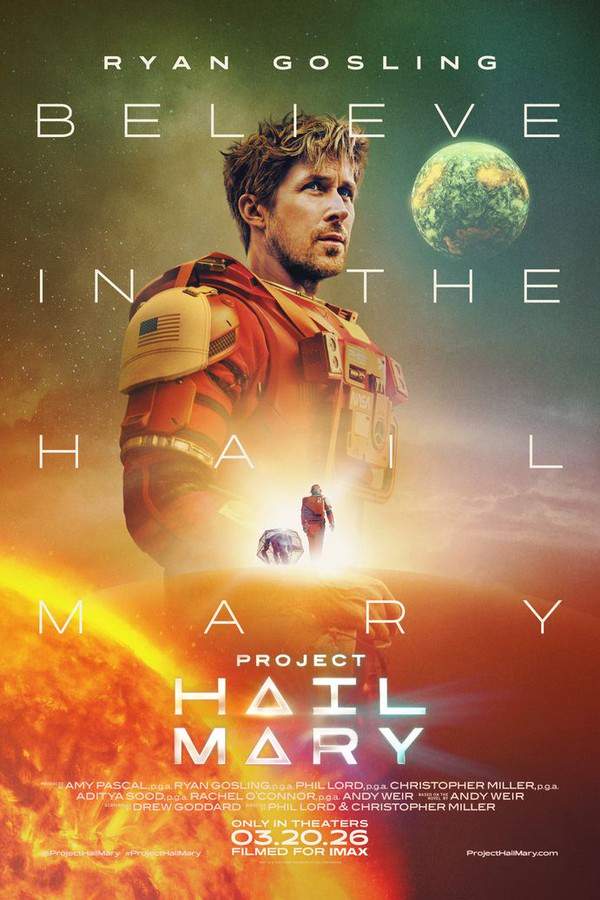
Project Hail Mary (2026) Reviews & Reception: Is This Ryan Gosling Sci-Fi Epic Worth Watching?
When Phil Lord and Christopher Miller announced they would be adapting Andy Weir’s bestselling novel Project Hail Mary for the big screen, expectations immediately skyrocketed. Following their success with The Lego Movie and Spider-Man: Into the Spider-Verse, the directing duo brought their signature blend of irreverent humor and heartfelt storytelling to the science fiction genre, casting Ryan Gosling as Ryland Grace, an amnesiac astronaut on a desperate mission to save Earth. As the film hit theaters on March 20, 2026, audiences and critics alike scrambled to determine whether this ambitious space epic could balance complex scientific problem-solving with genuine emotional resonance. The search for authentic Project Hail Mary reviews, critic consensus, and audience reactions has dominated film discourse, with viewers eager to know: does this adaptation honor Weir’s meticulous source material while carving its own cinematic identity? At What’s After the Movie, we’ve analyzed the full spectrum of Project Hail Mary reception—from glowing five-star user ratings to measured critical assessments—to provide you with the definitive breakdown of whether this interstellar journey deserves your time and ticket money.
Critical Consensus and Divisions: How Critics Received Project Hail Mary (2026)
The critical reception of Project Hail Mary reveals a fascinating schism between those who embrace Lord and Miller’s tonal tightrope walk and those who find themselves disoriented by the film’s shifting registers. On one end of the spectrum, outlets like IndieWire (91/100) delivered rapturous praise, suggesting that to write extensively about the film’s pleasures would be “a disservice to what’s most entertaining and satisfying about the film: watching it unfold, enjoying the process, accepting the mission, asking the big questions.” This sentiment captures the essence of what many defenders celebrate—a blockbuster that trusts its audience’s intelligence while delivering crowd-pleasing entertainment.
Next Best Picture (90/100) went even further, declaring it “a near-perfect crowd-pleaser” that succeeds as “both an epic journey to save humanity and an intimate story of friendship.” Their analysis highlights the “clear, confident direction” and Ryan Gosling’s “flawless turn” that manages to be “both hilarious and heartbreaking”—a duality that sits at the heart of the film’s appeal. Similarly, Screen Rant (90/100) succinctly labeled it “a remarkable achievement,” while The Playlist (83/100) appreciated how the film “cycles through many phases, including a survival thriller, a buddy comedy, and a sci-fi adventure,” noting that Lord and Miller “build appropriately toward this more serious pivot.”
However, the Project Hail Mary critic reviews aren’t universally effusive. The New Yorker (50/100) offered a measured critique, observing that “the directors… and the screenwriter, Drew Goddard, clearly want us to shed a few of our own [tears]. They also want to make us laugh, and their instincts are often at lumpy cross-purposes.” This assessment of tonal inconsistency finds echoes in The Guardian (60/100), which characterized the film as “a Hail Mary pass that Gosling just about manages to catch”—suggesting the execution doesn’t quite match its ambition. Slant Magazine (63/100) noted that Lord and Miller “put a comedic spin on Andy Weir’s more straightforward 2021 novel,” recasting “the author’s hopeful vision of productive communication with extraterrestrials as an unlikely buddy comedy.”
What emerges from this Project Hail Mary film analysis is a picture of a movie that dares to ask whether hard science fiction can coexist with karaoke-fueled emotional catharsis. The BBC (80/100) perhaps best articulated the high-wire act, praising how the directors crafted “a sci-fi epic which is more than two-and-a-half hours long, and which is a one-man show for much of that time,” filling it with “mind-stretching concepts, painstaking laboratory research and knotty technical puzzles” while keeping things “zippily entertaining throughout.” For viewers seeking detailed movie summaries or exploring our comprehensive movie wiki, understanding this critical divide is essential—Project Hail Mary demands that you embrace its peculiar rhythm of scientific jargon and slapstick humor, or risk finding yourself alienated by its refusal to commit to pure genre conventions.
Audience Reactions and Viewer Sentiment: Why Fans Are Calling It a Masterpiece
While critics debated the film’s tonal coherence, Project Hail Mary audience reactions have been overwhelmingly positive, with many viewers declaring it an instant classic of the science fiction genre. The disparity between professional critics and general moviegoers highlights how the film’s emotional authenticity resonates more profoundly with those experiencing it as a communal theatrical event rather than an analytical exercise. User erikzin T delivered perhaps the most effusive Project Hail Mary review, proclaiming: “A NEW SCIENCE FICTION MASTERPIECE IS BORN! The new Project Hail Mary is simply sensational, a grand intergalactic adventure with perfect humor, impressing with its wit, scientific debates, soundtrack and, above all, its stunning cinematography.” This sentiment captures the enthusiasm driving the film’s word-of-mouth momentum.
The emotional impact appears to be the primary driver of audience satisfaction. User Gavin E shared a particularly moving testimony: “First movie I’ve felt worth a trip to the cinema to see in a couple of years. Had I known that this movie would reduce a 46yr old man to tears in front of my partner and daughter, not once, or even twice, but no less than six occasions, I would maybe have waited until home cinema release, but then I would have missed out on the most visually impressive, profoundly emotional, thought provoking movie that I’ve seen since Interstellar.” This comparison to Christopher Nolan’s Interstellar appears repeatedly in Project Hail Mary viewer reactions, with many positioning it as the first film since 2014 to capture that same blend of cosmic wonder and intimate human connection.
Adrian P succinctly summarized the audience consensus: “A surprisingly amazing movie! Makes you laugh, it’s heartfelt, the stakes are real and the buddy dynamic works amazing. Great score, especially the classic rock nostalgia and visually stunning. Was not expecting to enjoy this movie as much as I did. If you love Interstellar and The Martian, this is for you.” This observation about the film’s musical choices—particularly its use of classic rock—points to how Lord and Miller’s sensibilities transform what could have been a dry scientific procedural into something with pop-cultural vitality.
The IMAX experience specifically generated significant buzz, with Antonella noting they “will most likely watch again in IMAX,” while erikzin T described their screening as “an unforgettable experience.” For those tracking box office performance or wondering about the financial success of this adaptation, these repeat viewing intentions suggest strong legs beyond opening weekend. The film’s ability to function as both a spectacle-driven blockbuster and a deeply personal story of friendship has created the kind of passionate fanbase that drives long-term cultural conversation. Visitors to our Project Hail Mary movie page consistently report that the film exceeds expectations, particularly for those familiar with Weir’s novel who were concerned about adaptation fidelity.
Ryan Gosling’s Performance and Character Analysis in Project Hail Mary
At the center of every Project Hail Mary review—whether praising or critiquing the film—lies an acknowledgment of Ryan Gosling’s commanding presence as Ryland Grace. The role demands an extraordinary range: Grace must be simultaneously a brilliant scientist solving existential puzzles, a comedic foil to an alien companion, and a vessel for profound loneliness and redemption. The A.V. Club (75/100) noted that “over two-and-a-half hours, the duo’s film gazes in wonder at alien engineering, opens its heart to human vulnerability through karaoke, and makes the case that inspiring the next generation… is alluring enough to shake the smarmiest manchildren from their self-imposed exile.” This transformation—from arrogant isolation to selfless connection—rests entirely on Gosling’s shoulders.
The BBC highlighted the performance as essentially “a one-man show for much of that time,” requiring Gosling to carry extended sequences of solitary problem-solving without losing the audience’s engagement. What distinguishes this work from other solitary astronaut performances (think Matt Damon in The Martian or Sandra Bullock in Gravity) is the specific brand of humor Gosling brings to the role. The Film Maven (67/100) observed that while the film “tries to have the dark human emotion, and ask the big questions, that movies like Arrival and Interstellar have done,” there are also moments where “it just wants to be a fun space film,” and that “Gosling is gold” in navigating these shifts.
This assessment aligns with Next Best Picture’s praise for Gosling’s “flawless turn” that manages to be “both hilarious and heartbreaking.” The actor’s ability to find vulnerability in arrogance—and vice versa—allows the film’s more sentimental moments to land with genuine force rather than manipulation. For fans interested in exploring Gosling’s complete filmography or discovering profiles of other cast members, his work here represents a career highlight that synthesizes the comedic timing of The Nice Guys with the brooding intensity of Drive.
The character of Ryland Grace also serves as an entry point for viewers who might otherwise find the film’s scientific density intimidating. Through Gosling’s expressive reactions—whether puzzling through astrophysics equations or bonding with his extraterrestrial counterpart—the audience receives an emotional translator for the complex concepts. This accessibility explains why Project Hail Mary reviews from general audiences emphasize feeling “surprisingly” moved or entertained; they expected a cold technical exercise and discovered a warm character study. Those looking to test their knowledge of the film’s details can visit our movie quizzes and games section to challenge themselves on Grace’s various scientific breakthroughs and personal revelations throughout the narrative.
The Rocky Relationship: Examining the Film’s Emotional Core and Alien Chemistry
If Project Hail Mary (2026) has a secret weapon that elevates it beyond standard space survival narratives, it is undoubtedly the relationship between Ryland Grace and Rocky, the alien creature he encounters. This unlikely friendship has generated some of the most passionate responses in both Project Hail Mary critic reviews and audience testimonials. Slant Magazine characterized the dynamic as an “unlikely buddy comedy,” while user Dylan emphasized that “the unlikely duo of Grace and Rocky was the highlight” of the entire film.
The brilliance of this relationship lies in how it subverts expectations for alien encounter narratives. Rather than positioning the extraterrestrial as a threat or a mere plot device, Lord and Miller treat Rocky as a fully realized character with distinct personality traits, communication methods, and emotional depth. User erikzin T specifically highlighted that “the relationship that forms between Ryland Grace and Rocky is incredibly touching,” suggesting that the film succeeds in making audiences invest in a friendship that transcends species, language barriers, and even planetary origins.
This emotional investment pays dividends in the film’s climax, which several Project Hail Mary reviews describe as genuinely tear-inducing. Gavin E’s observation about crying “no less than six occasions” likely stems from the cumulative weight of this central relationship, which builds through shared problem-solving, mutual rescue, and the gradual revelation of Rocky’s own stakes in the mission. The film asks whether communication and cooperation are possible across the vast divides of biology and culture, and answers with an emphatic, tearful yes.
The Playlist noted that Lord and Miller “build appropriately toward this more serious pivot,” suggesting that the comedic elements serve as necessary setup for the profound emotional payoff. This structure—laughter leading to tears—represents the filmmakers’ signature approach, but applied to cosmic stakes. For viewers seeking curated movie collections featuring similar unlikely friendships or our specialized movie lists highlighting the best sci-fi buddy films, Project Hail Mary earns immediate inclusion.
The technical achievement of bringing Rocky to life—whether through puppetry, CGI, or performance capture—has also drawn praise, with Gavin E noting that this is “definitely not the usual generic, overly obvious CG claptrap being churned out by Hollywood.” The tangible reality of the alien character allows the emotional beats to land with authenticity, creating the kind of movie magic that prompts viewers to declare, as Eiden did, “Holy molllyyy, honestly speechless what a beautiful piece of work wow!!”
Visual Spectacle and Scientific Authenticity: Technical Reception of Project Hail Mary
Beyond its emotional narrative, Project Hail Mary (2026) has garnered significant attention for its technical achievements, particularly regarding its visual effects and commitment to scientific realism. The film’s reception among science fiction enthusiasts hinges largely on whether it respects the genre’s demand for both intellectual rigor and sensory wonder. erikzin T’s praise for “stunning cinematography” and the “unforgettable experience” of IMAX viewing reflects a broader consensus that the film delivers spectacle worthy of its cosmic setting.
The visual approach appears to prioritize clarity over chaos—a refreshing choice in an era of rapid-cut action sequences. By focusing on the methodical process of scientific discovery, the film allows audiences to marvel at the “alien engineering” (The A.V. Club) and the intricate details of space travel. This patience with exposition, rather than rushing to the next action beat, has earned appreciation from viewers who value the “scientific debates” and “painstaking laboratory research” (BBC) that characterize the narrative.
Adrian P specifically mentioned the film being “visually stunning” while praising the “classic rock nostalgia” of the score, indicating that the audiovisual elements work in concert to create a specific atmosphere—one that honors the 1970s and 80s science fiction tradition while utilizing modern technology. This synthesis of retro sensibility and cutting-edge effects helps distinguish Project Hail Mary from other contemporary space films that often default to sterile, minimalist aesthetics.
The scientific authenticity, drawn from Weir’s meticulously researched novel, has also generated discussion among viewers who appreciate when films respect their intelligence. What t (3.5/5) noted that the film “does exactly what a good space film should: it gives you the suspense, the problem-solving, and the moral stakes,” suggesting that the technical accuracy serves the drama rather than overwhelming it. For those interested in the intersection of science and cinema, our concert films section and technical analyses provide additional context for how films like Project Hail Mary balance entertainment with education.
The comparison to The Martian—Weir’s previous adaptation—inevitably arises in discussions of the film’s technical approach, but Project Hail Mary appears to operate on a grander visual scale, involving interstellar travel rather than planetary survival. This expansion of scope while maintaining narrative clarity represents a significant achievement for Lord and Miller, who are better known for animated features than hard science fiction. The Project Hail Mary movie page on our site provides additional technical details for those interested in the specific production challenges and solutions employed by the filmmakers.
Genre Expectations and Tone Balancing: Does Project Hail Mary Stick the Landing?
The most contentious aspect of Project Hail Mary reception concerns its tonal architecture—specifically, whether the film successfully merges comedy and drama, or whether these elements remain in uncomfortable tension. This debate cuts to the heart of modern blockbuster filmmaking: can a film make you laugh and cry without undermining either emotion? The New Yorker’s critique of “lumpy cross-purposes” represents the skeptical view, suggesting that the film’s desire to entertain and its desire to move the audience exist in unresolved conflict.
The Film Maven (67/100) articulated this tension explicitly, noting that “there are moments where Project Hail Mary tries to have the dark human emotion, and ask the big questions, that movies like Arrival and Interstellar have done. There are also moments where it just wants to be a fun space film. The two tones don’t gel smoothly.” This comparison to Denis Villeneuve’s Arrival and Nolan’s Interstellar establishes the high bar against which serious science fiction is judged—films that maintain consistent tonal gravity throughout their runtime.
However, defenders of the film argue that this tonal hybridity is precisely the point. The A.V. Club celebrated how the film “sees a personal sense of humor shine through the bludgeoning grandeur of a AAA sci-fi,” suggesting that the comedy humanizes the spectacle rather than diminishing it. What t offered a measured but positive assessment, noting that the film is “more sarcastic than The Martian, which is either a feature or a bug depending on your tolerance, but it never crosses into parody.” They emphasized that “the self-sacrifice at the heart of the story is what keeps it grounded.”
This question of tone ultimately determines whether viewers find Project Hail Mary worth watching. Those approaching it expecting the solemnity of 2001: A Space Odyssey or the dread of Gravity may find the karaoke scenes and witty banter jarring. Conversely, those who found The Martian too light or Interstellar too heavy may discover that Project Hail Mary occupies a perfect middle ground. Yolanda H’s simple declaration that it’s a “Feel good movie. Made me laugh, cry and cheer” suggests that for many general audiences, the tonal shifts feel like features rather than bugs—varied emotional textures that prevent the lengthy runtime from becoming monotonous.
The film’s willingness to take “creative swings,” as What t noted regarding the alien life concept, indicates a confidence that has become rare in risk-averse Hollywood. Whether these swings connect depends largely on the viewer’s openness to genre-blending. For those still uncertain about whether to see the film, checking the latest awards and nominations might provide additional context regarding its critical standing, or you can explore our movie lists to find similar films that match your specific tonal preferences.
Final Verdict: Is Project Hail Mary (2026) Worth Watching?
Synthesizing the full spectrum of Project Hail Mary reviews and reception, the verdict emerges as cautiously enthusiastic for discerning viewers and wholeheartedly positive for general audiences. The film represents a rare adaptation that honors its source material while allowing its filmmakers’ distinct voices to shine through—sometimes to the detriment of tonal consistency, but always in service of emotional authenticity. Ryan Gosling’s performance provides the gravitational center around which all other elements orbit, grounding the spectacular visuals and complex science in recognizable human frailty and resilience.
For fans of Andy Weir’s novel, the adaptation appears to satisfy the core requirements while making necessary cinematic adjustments. For newcomers to the story, the film offers an accessible entry point into hard science fiction that doesn’t sacrifice entertainment value for accuracy. The overwhelming positivity of user reviews—particularly those highlighting the emotional impact and visual splendor—suggests that Project Hail Mary succeeds in its primary mission: moving audiences while making them think.
The critical reservations regarding tone should not be dismissed, as they point to legitimate questions about whether the film’s comedic impulses sometimes undercut its dramatic stakes. However, the consensus suggests that Lord and Miller’s approach, while divisive, creates a unique entry in the space film canon—one that dares to suggest saving humanity might require both rigorous scientific thinking and the willingness to sing badly at karaoke. As the film continues its theatrical run and moves toward streaming availability, its reputation appears poised to grow, particularly among viewers who discover it expecting a standard sci-fi thriller and finding instead a surprisingly intimate story about friendship across impossible distances.
Whether you’re seeking a spoiler-free review before buying tickets or looking to dive deep into the film’s scientific concepts via our comprehensive wiki, Project Hail Mary (2026) demands consideration as one of the year’s most ambitious blockbusters. The question isn’t whether the film is perfect—it’s whether its imperfections are the kind that make it memorable, or the kind that make it frustrating. Based on the tear-stained testimonials of viewers like Gavin E and the enthusiastic recommendations of fans like erikzin T, the answer leans heavily toward the former.
External Resources and Movie Database Links
For additional information about Project Hail Mary (2026), including cast details, technical specifications, and streaming availability, explore these trusted movie database resources:
| Site | Link |
|---|---|
| The Movie Database (TMDB) | Project Hail Mary TMDB |
| Wikipedia | Project Hail Mary Wikipedia |
| Rotten Tomatoes | Project Hail Mary Rotten Tomatoes |
| Metacritic | Project Hail Mary Metacritic |
| JustWatch | Project Hail Mary JustWatch |
| Box Office Mojo | Project Hail Mary Box Office Mojo |
| Letterboxd | Project Hail Mary Letterboxd |
Continue reading




What's After the Movie?
Not sure whether to stay after the credits? Find out!
Check out our other apps:

SAT Sphere
Build confidence for the Digital SAT.

Mori Atlas
Discover wild places worth protecting.

Luntero
Search smarter for a home in Amsterdam.

Plot Explained
Unravel movie endings and hidden clues.

Pokechamp
Dive into Pokémon data and battle logic.

Driving Theory
Get ready for your European theory test.

Movie Dust
Plan your next cinema trip with ease.

Musemap
Find art and culture as you travel.

Selkobase
Compare credentials before committing.

Local Manual
Turn an unfamiliar country into practical next steps.

Lernavi
Compare school systems before your next move.

GymRoam
Find a workout stop wherever your plans take you.
Explore Our Movie Platform
New Movie Releases (2026)
Famous Movie Actors
Top Film Production Studios
Movie Plot Summaries & Endings
Major Movie Awards & Winners
Best Concert Films & Music Documentaries
Movie Collections and Curated Lists
© 2026 What's After the Movie. All rights reserved.
Privacy Policy