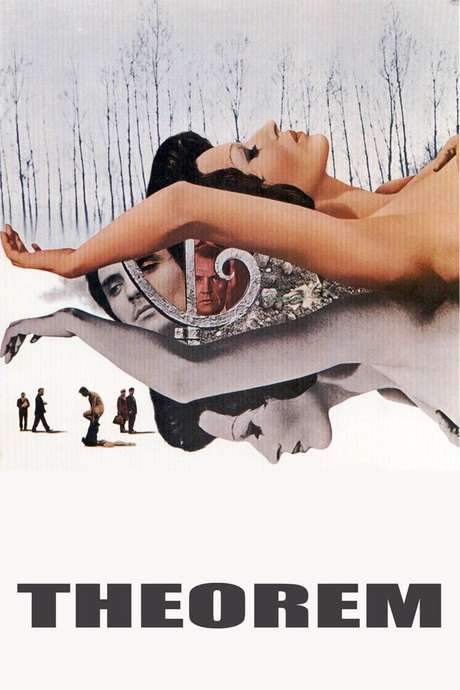
Theorem 1968



Where to Watch Theorem
See current US streaming, rental, and purchase options for Theorem (1968) via JustWatch.







Theorem Plot Summary
Read the complete plot summary and ending explained for Theorem (1968). From turning points to emotional moments, uncover what really happened and why it matters.
In Milan’s bourgeois landscape, a mysterious figure known as The Visitor appears at the gates of a refined family’s estate, announced by a flustered postman who seems to know something about the stranger’s unsettling arrival. This outsider unsettles the rhythms of the household, moving through its rooms with a calm insistence that unsettles the air and opens doors to places that had long been kept private. The interloper’s presence is at once generous and invasive, a paradox that sets the stage for a study of longing, fear, and the fragile boundaries of propriety.
From the moment he enters, the visitor engages in intimate encounters with each member of the family, weaving a complex web of desire and momentary solace. The devoutly religious Emilia is drawn into an unsettling closeness, while the sensitive Pietro finds a confidant and a doorway to self-assurance in the stranger’s attention. The sexually repressed Lucia experiences a liberating, if disruptive, rush of pleasure; the timid Odetta discovers a different, more perilous kind of awakening; and the tormented Paolo is touched by a tenderness that also unsettles the foundations of his identity as a husband and father. The visitor’s generosity appears boundless—he offers comfort, companionship, and a kind of emotional invitation that unsettles the household’s carefully maintained balance.
Across these encounters, the stranger’s influence is singular: he halts a moment of suicide, consoles, reassures, and excites, becoming physically and emotionally intimate with each member in turn. The maid Emilia is pulled from despair and given a sense of purpose; Pietro gains confidence and a new lens through which to view the world; Lucia experiences a release she had not known; Odetta’s world begins to tilt toward a more perilous edge, and Paolo’s life is altered by a presence that challenges conventional duties and duties’ consequences. The family’s lifeworld—its rituals, routines, and façades—begins to crack under the weight of this intimate intrusion, revealing the hidden yearnings and unspoken fears that lie beneath the surface of a prosperous life.
And then, as abruptly as he arrived, the herald returns with the news that the visitor will depart, leaving behind a vacuum no one is prepared to fill. The family faces the sudden emptiness and the responsibility of negotiating the truths they have kept at bay within the framework of their comfortable routine. The consequences are not the same for each member, but they are equally profound.
When the stranger is gone, the aftermath unfolds in deeply personal ways. Old Peasant returns to a rural village life and is seen to perform miracles, a move that culminates in a symbolic, ecstatic renunciation of self as she is buried in dirt and sheds tears of regeneration. The Odetta sinks into a catatonic state and is ultimately institutionalized, a stark transformation from the girl who once met the world with guarded curiosity. Pietro leaves the family home to pursue art, obsessively drawing the stranger’s face as if it could be a key to understanding what he felt but could not name. Lucia seeks out new sexual experiences with younger men, attempting to recapture the thrill or meaning that the visitor briefly stirred. And Paolo, stripped of material ties, hands his factory to the workers, disrobes at a railway platform, and wanders naked across the slopes of Mount Etna, crying out in a primal mix of rage and despair as if confronting the fragility of the life he built.
In the quiet that follows, the family members must navigate the consequences of a visit that revealed both the tenderness and the danger embedded in intimate connection. The narrative lingers not on sensationalism but on the ways in which a single, enigmatic encounter exposes the core of each character’s humanity, forcing them to confront truths about desire, power, and the price of exposing one’s inner self to the gaze of others. The Visitor remains unnamed and almost mythic, a catalyst whose presence continues to haunt the family long after he has left, reminding us that the boundaries we curate can be the very things that trap us in our own ordinary lives.
- A lingering, uneasy portrait of a family destabilized by a mysterious guest, told with a measured, observational tone and a careful eye for the emotional landscapes of each character. The performance-driven dynamics and the stark, almost operatic arc of the story invite thoughtful reflection on how vulnerability, attraction, and the demand for authenticity can distort the comforts of wealth and tradition.
Theorem Timeline
Follow the complete movie timeline of Theorem (1968) with every major event in chronological order. Great for understanding complex plots and story progression.
The Visitor arrives at the Milanese estate
A mysterious figure known as The Visitor appears at the gates of a bourgeois Milanese estate, heralded by an arm-flapping postman. The family watches in mix of curiosity and unease as this enigmatic stranger steps into their orderly life. He offers himself without demanding anything in return, unsettling the household with his presence.
The Visitor's first intimate tie with the maid
The Visitor begins an intimate relationship with the maid, drawing her into a forbidden closeness that unsettles her devout conscience. He stops her from attempting suicide with a gas hose and instead offers comfort and relief. The episode marks the first of several disruptive liaisons that unsettle the family’s moral surface.
The Stranger bonds with the frightened son
He befriends and sleeps with the frightened son, easing his doubts and giving him confidence. The boy’s mind opens to new possibilities as the stranger becomes a mentor and lover. This bond deepens despite the family’s disquiet.
The Stranger seduces the mother
The Visitor seduces the mother, awakening desires she has long suppressed. Their affair provides her with sexual fulfilment and a sense of liberation from religious and social constraints. The family’s balance begins to tilt as her world expands beyond its former confines.
The Visitor comforts the father
He cares for and comforts the despondent father, offering a tenderness that replaces his loneliness. Their relationship becomes emotionally intimate as the father’s faith in bourgeois security erodes. The visitor’s influence stretches across the entire household.
The Stranger draws close to the daughter
He becomes emotionally intimate with the daughter, gradually removing her childish innocence about men. Her perceptions widen as she experiences a dangerous awakening and attachment. The family’s careful self-containment begins to crack under his pressure.
Herald announces the Stranger's imminent departure
A herald returns to announce that the stranger will depart as suddenly as he arrived. His impending exit unsettles each member, foreshadowing a void that will force them to confront hidden truths. The estate itself seems to tremble at the thought of losing him.
The void left behind: family confronts hidden truths
In the absence of the visitor, the family confronts what has been kept hidden by their bourgeois trappings. Old resentments, desires, and fears surface, revealing the fragile surface of their orderly lives. Each member must decide what kind of person they will become without the stranger’s gravitational pull.
The maid returns to her village and performs miracles
The maid returns to the rural village where she was born and is seen performing miracles. Word of these feats spreads, challenging the boundaries of ordinary life. Her actions mark a mysterious turn in her fate after leaving the estate.
The maid immolates herself
She sacrifices herself by burying her body in dirt, tears of regeneration streaming down her face in ecstatic surrender. Her act becomes a transformative rite that defies conventional sense and signals an end to her earthly ties. The village mourns yet is left with an uncanny sense of renewal.
The daughter sinks into a catatonic state
The daughter’s psyche collapses into catatonia and she is institutionalized. The absence of the Stranger deepens her withdrawal, and the family watches as her world narrows to isolation and routine. Her confinement mirrors the family's own disintegration.
The son becomes an artist, drawn to the Stranger
The son leaves the family home to pursue art, obsessively drawing the Stranger’s face. His fixation becomes a lifelong project, a way to keep the memory of the visitor alive. The act suggests a search for identity outside the bourgeois world they inhabited.
The mother seeks new sexual encounters
The mother continues to redefine her life by seeking sexual encounters with young men. Her behavior signals a further erosion of the conventional family order. The household’s equilibrium collapses under the weight of her desires.
The father relinquishes wealth and identity
He strips himself of all material possessions, handing the factory over to its workers. He removes his clothes at a railway station, choosing naked exposure as a radical break with his former life. The act embodies a dramatic rejection of bourgeois security.
The father’s final act: naked escape across Mount Etna
He wanders naked across the slopes of Mount Etna, screaming in primal rage and despair. The journey marks the ultimate eruption of the father’s inner turmoil as the family’s world crumbles around him. The film closes on a note of unresolved anguish and profound transformation.
Theorem Characters
Explore all characters from Theorem (1968). Get detailed profiles with their roles, arcs, and key relationships explained.
The Visitor (Terence Stamp)
A mysterious, alluring figure whose presence disrupts the family's routines. He engages in sexual affairs with every member, offering tenderness and attention without seeking anything in return. His arrival exposes hidden desires and unsettles the moral order of the household.
Paolo, the Father (Massimo Girotti)
A tormented patriarch who witnesses the stranger's influence. He gradually sheds material ties and, in a climactic gesture, strips at a railway station and wanders naked across Mount Etna, screaming in primal rage and despair. His journey marks the breakdown of bourgeois stability and the search for existential release.
Odetta, the Daughter (Anne Wiazemsky)
The daughter forms a deep, intimate connection with the Visitor, losing her childish innocence about men. Her emotional awakening destabilizes the family dynamics and culminates in a catatonic state institutionalized outside the home. Her arc probes how desire can alter perception and selfhood.
Lucia, the Mother (Silvana Mangano)
The mother becomes sexually liberated through the Stranger's influence, seeking new encounters and fulfillment beyond domestic boundaries. Her transformation challenges traditional maternal roles and exposes the fragility of conventional morality. Her change emphasizes the film's critique of bourgeois propriety.
Emilia, the Servant (Laura Betti)
The devoutly religious maid experiences the Visitor's effect and is drawn into profound, paradoxical miracles. After a dramatic arc, she returns to her rural village and performs miracles, culminating in a ritual self-sacrifice that signals regeneration through suffering.
Pietro, the Son (Andrés José Cruz Soublette)
The son becomes an artist, forming an obsessive fixation on the Stranger and drawing his portrait repeatedly. He eventually leaves the family home to pursue art, embodying a rebellious move away from conventional family life toward personal creation.
Lucia's First Lover (Carlo De Mejo)
One of the visitors in the household’s intimate web, his arrival further unsettles the family’s sense of loyalty and desire. He participates in the unfolding sexual dynamics that erode established boundaries.
Lucia's Second Lover (Giovanni Ivan Scratuglia)
Another companion in the Stranger’s constellation of relationships, his presence adds to the mosaic of desire that challenges the family’s repressed norms.
Angelino, the Messenger (Ninetto Davoli)
Acts as a herald, signaling the Stranger's arrival and its eventual departure. His presence links the mundane to the uncanny, emphasizing the story's fateful rhythm.
Emilia, the Second Servant (Adele Cambria)
Part of the household staff, contributing to the texture of servitude and social dynamics that frame the central events. Her role helps illustrate the wider reach of the Visitor’s influence across the domestic sphere.
Old Peasant (Susanna Pasolini)
Uncredited role representing rural roots and the pull of traditional life away from the bourgeois milieu. Her presence contrasts with the urban sophistication of the estate.
Doctor (Alfonso Gatto)
A professional figure who appears in the tapestry of the household’s crisis, providing medical or moral commentary within the unfolding drama.
Boy at the Station (Luigi Barbini)
A minor character who embodies the ordinary world outside the estate’s walls, a reminder of everyday life intersecting with the extraordinary events inside.
Interviewer (Cesare Garboli)
An uncredited figure who hints at external commentary or inquiry about the events, underscoring the public gaze upon private turmoil.
Theorem Settings
Learn where and when Theorem (1968) takes place. Explore the film’s settings, era, and how they shape the narrative.
Location
Milan, Italy, Milanese estate
Set in a Milanese estate in Milan, Italy, the story unfolds within a polished, affluent bourgeois household. The opulent home and its orderly routines provide a stark contrast to the stranger's disruptive presence. The setting functions as a microcosm of postwar Italian society, where appearances mask deeper tensions and desires.
Theorem Themes
Discover the main themes in Theorem (1968). Analyze the deeper meanings, emotional layers, and social commentary behind the film.
💫
Desire Invasion
The Visitor's arrival punctures the family's surface, exposing repressed longing and erotic curiosity. Each encounter unsettles established roles, blurring the lines between host and guest, lover and family. The film uses these charged interactions to critique the rigid codes of mid-century bourgeois life.
🌀
Identity and Freedom
As affections awaken, characters confront who they are beyond social masks. The Father, Mother, Son, Daughter, and Servants test the limits of propriety and personal fulfillment. The dissolution of established identity becomes a path to brutal honesty, for better or worse.
🔥
Rupture and Release
With the Stranger's departure, each member faces the void left behind. Miracles, artistic awakening, or madness follow, revealing a society unable to contain unbridled desire. The film ends in stark, primal outbursts that shake the foundations of their world.

Coming soon on iOS and Android
The Plot Explained Mobile App
From blockbusters to hidden gems — dive into movie stories anytime, anywhere. Save your favorites, discover plots faster, and never miss a twist again.
Sign up to be the first to know when we launch. Your email stays private — always.
Explore the mobile appTheorem Spoiler-Free Summary
Discover the spoiler-free summary of Theorem (1968). Get a concise overview without any spoilers.
In the refined neighborhoods of Milan, a prosperous Italian family lives behind well‑kept façades of tradition and comfort. The household moves with the rhythm of bourgeois rituals—a spacious estate, a diligent maid, and the quiet expectations that come with wealth. Beneath the orderly surface, each member carries hidden longings: a devout mother, a tentative father, a restless son, and a guarded daughter, all navigating the polite constraints of their privileged world.
Their routine is unsettled the day a charismatic outsider arrives at the gate, announced only by a flustered postman who seems to sense something unspoken about the newcomer. The Visitor moves through the rooms with a calm insistence, offering a blend of generosity and intrusion that feels both inviting and disquieting. He engages each family member—Emilia, the devout maid who yearns for purpose; Pietro, the sensitive son seeking confidence; Lucia, the repressed daughter craving liberation; Odetta, the timid mother caught between duty and desire; and Paolo, the patriarch whose identity is rooted in responsibility. Their encounters with him awaken dormant emotions, prompting questions that the family’s polished exterior can no longer ignore.
The film unfolds in a measured, observational tone, allowing the elegance of the setting to contrast with the simmering tension beneath. Light filters through marble corridors while quiet conversations hint at deeper currents of longing, fear, and the fragile boundaries of propriety. As the enigmatic guest lingers, the family is drawn into a delicate dance of intimacy and mystery, leaving the audience to wonder who he truly is and what purpose his presence serves. The lingering presence of The Visitor becomes a subtle catalyst, exposing the hidden layers of each character and inviting viewers to contemplate the cost of unspoken desire.
Movies with Similar Twists and Themes
Uncover films that echo the narrative beats, emotional arcs, or dramatic twists of the one you're exploring. These recommendations are handpicked based on story depth, thematic resonance, and spoiler-worthy moments — perfect for fans who crave more of the same intrigue.








Featured on this page

What's After the Movie?
Not sure whether to stay after the credits? Find out!
Check out our other apps:

SAT Sphere
Build confidence for the Digital SAT.

Mori Atlas
Discover wild places worth protecting.

Luntero
Search smarter for a home in Amsterdam.

Plot Explained
Unravel movie endings and hidden clues.

Pokechamp
Dive into Pokémon data and battle logic.

Driving Theory
Get ready for your European theory test.

Movie Dust
Plan your next cinema trip with ease.

Musemap
Find art and culture as you travel.

Selkobase
Compare credentials before committing.

Local Manual
Turn an unfamiliar country into practical next steps.

Lernavi
Compare school systems before your next move.

GymRoam
Find a workout stop wherever your plans take you.
Explore Our Movie Platform
New Movie Releases (2026)
Famous Movie Actors
Top Film Production Studios
Movie Plot Summaries & Endings
Major Movie Awards & Winners
Best Concert Films & Music Documentaries
Movie Collections and Curated Lists
© 2026 What's After the Movie. All rights reserved.
Privacy Policy