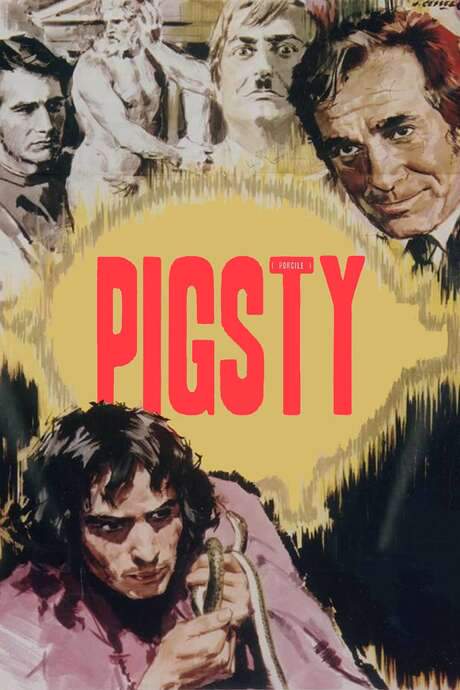



Where to Watch Pigsty
See current US streaming, rental, and purchase options for Pigsty (1969) via JustWatch.

Streaming availability powered by 
Pigsty Plot Summary
Read the complete plot summary and ending explained for Pigsty (1969). From turning points to emotional moments, uncover what really happened and why it matters.
The film unfolds through two parallel narratives that probe the darkest corners of human nature, tracing a thread between ancient violence and modern complicity.
In the first tale, set around 1500 on the windswept slopes of Etna in Sicily, a young man wanders a volcanic landscape with almost no dialogue until a final, solitary line. The Cannibale, Pierre Clémenti, begins by killing and eating insects and small animals, fleeing garrisons, and approaching only the remains of others. As his hunger intensifies, he dares to taste human flesh, and soon other travelers—some women among them—join his feral journey. The raids trigger fear in a nearby village, which eventually encircles the cannibals. During the capture, Clémenti’s character utters a chilling tagline:
I killed my father, I ate human flesh and I quiver with joy.
The prisoners are bound to poles and left to be devoured by stray dogs, a stark tableau of collective fear and brutality.
This story probes the raw, unshaped potential for destruction that lies within individuals when social norms are stripped away, and it questions how communities react when faced with acts that defy civilization itself.
In the second narrative, set in 1967 in a villa at Godesberg, Germany, a very different type of confinement unfolds. Julian, Jean-Pierre Léaud, lives a narrow, almost monastic life that keeps his radical fiancée Ida, Anne Wiazemsky at arm’s length as she pursues her own political commitments. Julian’s father, Herr Klotz, Alberto Lionello, is a successful industrialist who presses his son toward marriage and social acceptance, while Julian harbors a secret obsession: he sneaks into a pigsty to lie with the pigs whenever the chance arises.
The atmosphere at the villa thickens as two men arrive. Hans Günther, Marco Ferreri, introduces Mr. Herdhitze, Ugo Tognazzi, a rival and old comrade whose macabre past hints at dark experiments and a chilling detachment from human norms. The elder Klotz is tempted to leverage Herdhitze’s presence for his own ends after hearing rumors of Herdhitze’s grim background, including alleged dealings with corpses. Herdhitze’s proposal to join the family business tests the father’s willingness to compromise, but the revelation about Julian’s pig-life drives him toward a sobering, if reluctant, reconsideration.
As the drama unfolds, Julian reaches a moment of frank confrontation with Ida about love, even as his personal alliances crumble. Ida ultimately leaves to marry someone else, and the two men continue negotiating power and partnership as the house becomes a stage for moral compromise. Soon after, Julian returns to the pigsty and allows himself to be devoured by the animals. His fate is implied rather than shown, as Herdhitze and the villa’s gardener, Maracchione, played by Ninetto Davoli, discuss his end in quiet, knowing terms: with nothing left of Julian, the scandal is to be kept secret.
This second thread weaves a deliberate link between the Third Reich and postwar Wirtschaftswunder Germany, presenting a meditation on how the consequences of parental choices reverberate through the next generation. Both stories juxtapose rebellion and apathy, suggesting that the actions or indifference of parents can steer their children toward extremes, whether through direct violence or through choices that normalize brutality in everyday life.
Across both narratives, the film builds a meditation on power, complicity, and human capacity for destruction, all rendered with a restrained, observational style that invites reflection rather than sensationalism. The stark contrast between the historical cruelty of the early tale and the postwar German milieu of the second story underscores a broader inquiry: how societies remember past horrors and what they permit in the name of progress, security, or prosperity.
Pigsty Timeline
Follow the complete movie timeline of Pigsty (1969) with every major event in chronological order. Great for understanding complex plots and story progression.
Opening sequence: Bonn vs Hitler
The film opens with narration contrasting the Germany of Bonn with the Germany of Hitler. The opening credits play over images of a pigsty, underscored by an instrumental version of the Horst-Wessel-Lied.
Cannibal tale begins on Etna
A young man wanders the volcanic slopes of Etna, Sicily, killing and eating insects and small animals. The harsh landscape sets a tone of isolation and predation that frames his later acts.
Fleeing garrisons and contemplates corpses
He flees from garrisons, fearful of being spotted, and only approaches corpses. This period of avoidance shows his obsession taking shape.
First act of cannibalism: soldier killed
Not long after, he is no longer satisfied with animal flesh and desires human flesh. Seeing the same garrison again, he lures and kills a soldier, beginning his cannibalistic rampage.
Others join the cannibals
Following the initial kill, more people join the transformed journey, including some women. The group expands the scope of violence and predation.
Cannibal raids reach a village
News of the cannibal raids reaches a nearby village, provoking fear and a response from locals. The community begins to mobilize to confront the threat.
Capture and proclamation
The cannibals are surrounded and captured by the villagers. During the capture, one of the cannibals speaks a famous line about his acts, underscoring the brutality of the moment.
Punishment and display
Poles are erected and the cannibals are bound to them, left to be devoured by stray dogs. The grim spectacle serves as a stark moral statement about destruction.
The German story begins: 1967 in Godesberg
In 1967, a villa at Godesberg becomes the center of Julian's claustrophobic life. His radical fiancée Ida is neglected as he isolates himself.
Julian's pigsty secret
Julian secretly sneaks into a pigsty and lies with the pigs whenever he can. This secret act marks his radical rebellion against normal social constraints.
Trance and apathy
Julian slips into a trance, lying in an armchair and becoming indifferent to the world around him. His detachment deepens as external pressures mount.
Guenther and Herdhitze arrive; the plan forms
Two men arrive at the villa: Guenther introduces Herdhitze to Klotz, Julian's father figure. Herdhitze hints at a macabre background involving Jewish bodies used for experiments, unsettling Klotz.
Blackmail and reconsideration
Herdhitze's revelation pressures Klotz to reconsider joining his company. Klotz initially refuses, but the possibility of leveraging the scandal forces him to hesitate.
Ida's departure and business alliance
Julian tries to discuss his ideas about love with Ida, though not about the relationship itself. Meanwhile, Ida leaves the villa to marry someone else as Klotz and Herdhitze solidify a company.
Julian's end: devoured by pigs
Julian goes to the pigsty and allows himself to be devoured by the pigs. His end is not shown on screen and is instead revealed through a dialogue between Herdhitze and the gardener Maracchione.
Pigsty Characters
Explore all characters from Pigsty (1969). Get detailed profiles with their roles, arcs, and key relationships explained.
Julian Klotz — Jean-Pierre Léaud
A privileged young man living in a secluded German villa who masks his detachment with courtesy. He harbors a disturbing secret in a pigsty and pursues a radical, detached outlook that strains his relationship with Ida. His indecision and aloofness propel the tension between private appetites and public expectations.
Ida — Anne Wiazemsky
Julian’s politically charged fiancée, whose idealism and commitment contrast with Julian’s apathy. She represents a competing current of social awareness and reform, challenging the void of meaning in Julian’s world. Her engagement and eventual choices illuminate the pressures of love within a morally complex milieu.
Signore Klotz — Alberto Lionello
A wealthy industrialist and father figure who pushes his son toward marriage and social advancement. He becomes entangled in corporate intrigue when Herdhitze presents a disturbing opportunity, testing his willingness to compromise his values for profit and status.
Herdhitze — Ugo Tognazzi
A formidable rival and former associate who arrives with a chilling history of macabre experiments. He proposes a partnership that forces the Klotz family to confront hidden sins and the price of ambition. His presence links the postwar arc to the earlier brutal impulses at the heart of the story.
Cannibale — Pierre Clémenti
The central figure of the Etna sequence, a wanderer who advances from killing insects to cannibalizing humans. He catalyzes a cascading cascade of violence as others are drawn into his path, culminating in a public execution of their group.
Maracchione — Ninetto Davoli
The gardener and narrator figure who observes the climactic acts and conveys the story’s grim verdicts. His presence helps bridge two eras, underlining themes of memory, silence, and the consequences of what is left unsaid.
Secondo Cannibale — Franco Citti
An ally of the Cannibale who participates in the brutal acts during the Etna sequence. His involvement highlights the collective nature of the early carnage and the spreading of violence among groups.
Madame Klotz — Margarita Lozano
A figure within the Klotz household whose presence underscores the domestic sphere’s complicity in the unfolding drama. Her role helps to illustrate how private life can harbor dark truths beneath a veneer of propriety.
Pigsty Settings
Learn where and when Pigsty (1969) takes place. Explore the film’s settings, era, and how they shape the narrative.
Time period
1500s and 1967
Two timelines anchor the narrative: a 1500s Sicily setting on Etna where mythic violence erupts, and a 1967 Germany setting within a bourgeois villa where business, marriage, and secrecy intertwine. The film contrasts a distant, legendary past with postwar Wirtschaftswunder Germany, linking ancient impulses to modern consumer society. Across both eras, parental influence and social expectations shape the characters’ fates and moral choices.
Location
Etna, Sicily, Godesberg, Germany
The action unfolds in two places: the volcanic slopes of Mount Etna in Sicily, where a young man begins by killing insects and evolves into cannibalism; and a secluded villa in Godesberg, Germany, where a privileged family hides a private, morally fraught world. The Etna setting presents a barren, primal landscape that mirrors brutality, while the German villa provides a pristine backdrop for power games and hidden appetites. Together, these locations frame a meditation on civilization, violence, and the limits of social order.
Pigsty Themes
Discover the main themes in Pigsty (1969). Analyze the deeper meanings, emotional layers, and social commentary behind the film.
🔥
Destruction & Rebellion
The story probes humanity’s capacity for destruction when social limits crumble. In the Etna arc, violence erupts as a radical rejection of civilization; in the German arc, power struggles and taboo desires surface within a polished domestic world. The film asks whether rebellion frees individuals or destroys them, highlighting the seductive danger of breaking taboos.
⚖️
Moral Ambiguity
Across two timelines, characters make morally gray choices that defy simple judgment. Authority, wealth, and family legacy corrupt or empower different figures, showing that ethics are slippery within both savage and civilized contexts. The narrative suggests that clean lines between good and evil rarely exist in the social world it portrays.
👪
Family Influence
The film emphasizes how parental behavior shapes the next generation’s actions. The Klotz family environment becomes a microcosm for broader societal currents, where pressure to conform clashes with individual longing and rebellion. These dynamics drive the protagonists toward tragic choices and a destabilizing culmination.

Coming soon on iOS and Android
The Plot Explained Mobile App
From blockbusters to hidden gems — dive into movie stories anytime, anywhere. Save your favorites, discover plots faster, and never miss a twist again.
Sign up to be the first to know when we launch. Your email stays private — always.
Explore the mobile appPigsty Spoiler-Free Summary
Discover the spoiler-free summary of Pigsty (1969). Get a concise overview without any spoilers.
In Pigsty the film is divided into two stark, interwoven tales that explore isolation and the raw edge of human nature. One strand unfolds on the wind‑scarred slopes of Etna in an indeterminate 16th‑century Sicily, the other in a polished 1967 German villa perched above Godesberg. The visual style is deliberately restrained, letting the bleak landscapes and quiet interiors speak louder than dialogue. A muted, almost observational tone invites the audience to linger on atmosphere, feeling the weight of history pressing against contemporary anxieties.
The first narrative follows a solitary wanderer known only as Cannibale. Haunted by the act of killing his own father, he drifts through volcanic terrain surviving on whatever the earth offers, his existence growing ever more primal. The world around him is a harsh, volcanic wilderness where the remnants of civilization are sparse and the line between need and savagery blurs. With minimal speech, the film paints his inner turbulence through lingering shots of barren rock, restless animals, and the silent, oppressive heat that seems to echo his own internal fire.
The second thread introduces Julian, the son of a prosperous post‑war industrialist. He lives in a carefully kept villa where expectations of marriage, business success, and social conformity loom large. Yet Julian withdraws from human connection, seeking an odd, almost ritualistic comfort in the farm’s pigsty, where he can lie among the animals and escape the pressures of his lineage. Around him, his motherly father Herr Klotz pushes for conventional stability, while his radical fiancée Ida pursues a political path that keeps her at a distance. Visitors—Hans Günther and the enigmatic Mr. Herdhitze—add an undercurrent of unease, hinting at hidden histories and the moral compromises that linger in the shadows of prosperity.
Together, the two periods form a meditation on how societies remember, ignore, or repeat past violences. By juxtaposing ancient brutality with the quiet complicity of modern affluence, the film cultivates a mood of lingering dread and introspection, urging viewers to contemplate the inherited capacities for both rebellion and apathy that shape each generation.
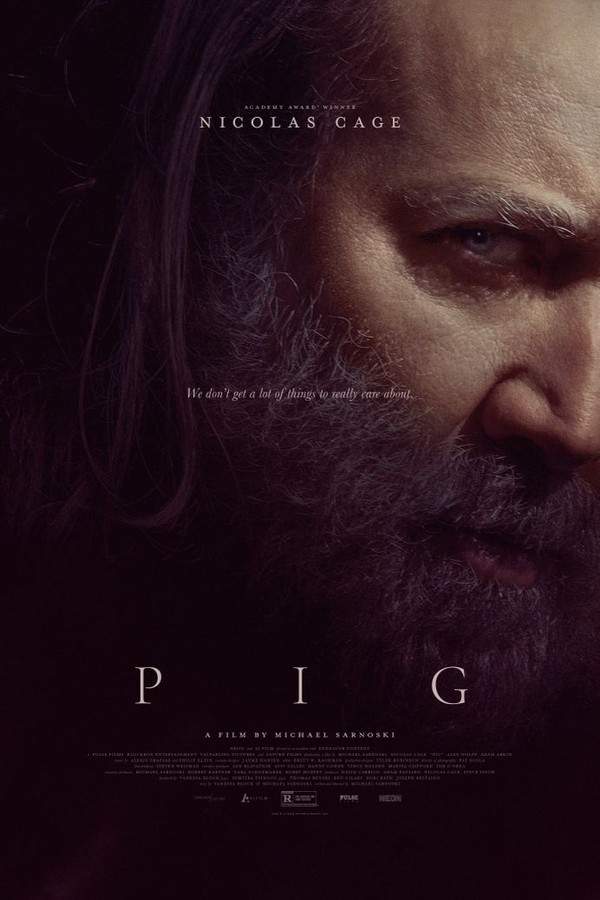
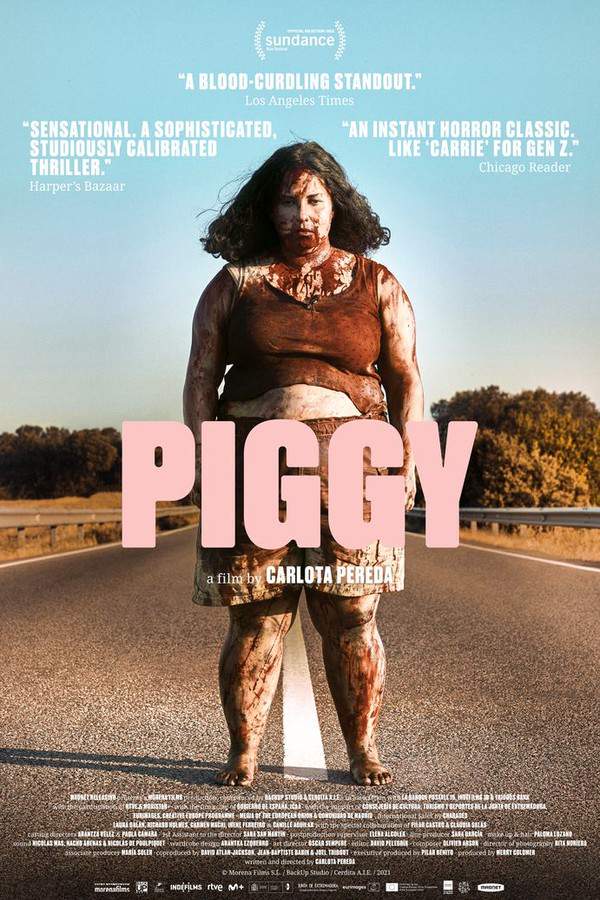
Movies with Similar Twists and Themes
Uncover films that echo the narrative beats, emotional arcs, or dramatic twists of the one you're exploring. These recommendations are handpicked based on story depth, thematic resonance, and spoiler-worthy moments — perfect for fans who crave more of the same intrigue.



Featured on this page

What's After the Movie?
Not sure whether to stay after the credits? Find out!
Check out our other apps:

SAT Sphere
Build confidence for the Digital SAT.

Mori Atlas
Discover wild places worth protecting.

Luntero
Search smarter for a home in Amsterdam.

Plot Explained
Unravel movie endings and hidden clues.

Pokechamp
Dive into Pokémon data and battle logic.

Driving Theory
Get ready for your European theory test.

Movie Dust
Plan your next cinema trip with ease.

Musemap
Find art and culture as you travel.

Selkobase
Compare credentials before committing.

Local Manual
Turn an unfamiliar country into practical next steps.

Lernavi
Compare school systems before your next move.

GymRoam
Find a workout stop wherever your plans take you.
Explore Our Movie Platform
New Movie Releases (2026)
Famous Movie Actors
Top Film Production Studios
Movie Plot Summaries & Endings
Major Movie Awards & Winners
Best Concert Films & Music Documentaries
Movie Collections and Curated Lists
© 2026 What's After the Movie. All rights reserved.
Privacy Policy