Pigsty 1969


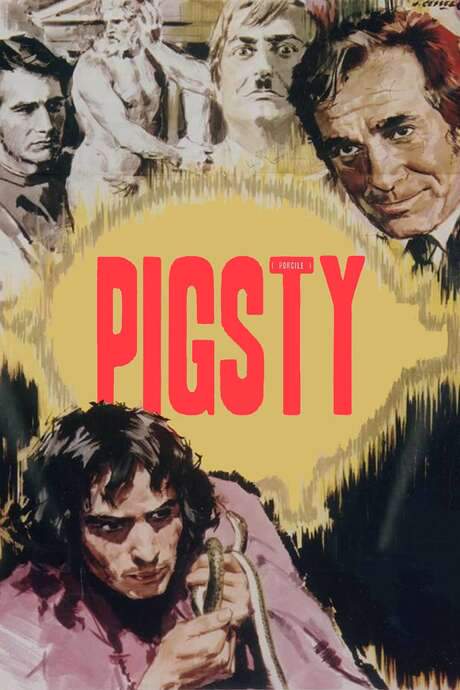
Two stark, interwoven tales of isolation and brutality. In an indeterminate past a young cannibal, who killed his father, is condemned to be torn apart by feral beasts, reveling in his triumph. In a later era, Julian, the son of a post‑war German industrialist, rejects human connection, choosing instead to lie down among his farm’s pigs.

Does Pigsty have end credit scenes?
No!
Pigsty does not have end credit scenes. You can leave when the credits roll.
Where to Watch Pigsty
See current US streaming, rental, and purchase options for Pigsty (1969) via JustWatch.

Streaming availability powered by 
Meet the Full Cast and Actors of Pigsty
Explore the complete cast of Pigsty, including both lead and supporting actors. Learn who plays each character, discover their past roles and achievements, and find out what makes this ensemble cast stand out in the world of film and television.

Ugo Tognazzi
Herdhitze

Anne Wiazemsky
Ida

Margarita Lozano
Madame Klotz

Ninetto Davoli
Maracchione
Pier Paolo Pasolini
Pierre Clémenti
Cannibale
Jean-Pierre Léaud
Julian Klotz
Marco Ferreri
Hans Günther
Franco Citti
Secondo Cannibale
Antonino Faà di Bruno
Vecchio (Scena della Sentenza) (uncredited)
Alberto Lionello
Signore Klotz
Luigi Barbini
Soldato nel Deserto (uncredited)
Camillo Besenzon
Sergio Elia
Servo (uncredited)
External Links and Streaming Options
Discover where to watch Pigsty online, including streaming platforms, rental options, and official sources. Compare reviews, ratings, and in-depth movie information across sites like IMDb, TMDb, Wikipedia or JustWatch.





Take the Ultimate Pigsty Movie Quiz
Challenge your knowledge of Pigsty with this fun and interactive movie quiz. Test yourself on key plot points, iconic characters, hidden details, and memorable moments to see how well you really know the film.
Pigsty (1969) Quiz: Test your knowledge of the dual narratives, characters, and themes of Marco Ferreri's 1969 film *Pigsty*.
Which actor portrays the cannibal known as “the Cannibale” in the 1500 storyline?
Full Plot Summary and Ending Explained for Pigsty
Read the complete plot summary of Pigsty, including all major events, twists, and the full ending explained in detail. Explore key characters, themes, hidden meanings, and everything you need to understand the story from beginning to end.
The film unfolds through two parallel narratives that probe the darkest corners of human nature, tracing a thread between ancient violence and modern complicity.
In the first tale, set around 1500 on the windswept slopes of Etna in Sicily, a young man wanders a volcanic landscape with almost no dialogue until a final, solitary line. The Cannibale, Pierre Clémenti, begins by killing and eating insects and small animals, fleeing garrisons, and approaching only the remains of others. As his hunger intensifies, he dares to taste human flesh, and soon other travelers—some women among them—join his feral journey. The raids trigger fear in a nearby village, which eventually encircles the cannibals. During the capture, Clémenti’s character utters a chilling tagline:
I killed my father, I ate human flesh and I quiver with joy.
The prisoners are bound to poles and left to be devoured by stray dogs, a stark tableau of collective fear and brutality.
This story probes the raw, unshaped potential for destruction that lies within individuals when social norms are stripped away, and it questions how communities react when faced with acts that defy civilization itself.
In the second narrative, set in 1967 in a villa at Godesberg, Germany, a very different type of confinement unfolds. Julian, Jean-Pierre Léaud, lives a narrow, almost monastic life that keeps his radical fiancée Ida, Anne Wiazemsky at arm’s length as she pursues her own political commitments. Julian’s father, Herr Klotz, Alberto Lionello, is a successful industrialist who presses his son toward marriage and social acceptance, while Julian harbors a secret obsession: he sneaks into a pigsty to lie with the pigs whenever the chance arises.
The atmosphere at the villa thickens as two men arrive. Hans Günther, Marco Ferreri, introduces Mr. Herdhitze, Ugo Tognazzi, a rival and old comrade whose macabre past hints at dark experiments and a chilling detachment from human norms. The elder Klotz is tempted to leverage Herdhitze’s presence for his own ends after hearing rumors of Herdhitze’s grim background, including alleged dealings with corpses. Herdhitze’s proposal to join the family business tests the father’s willingness to compromise, but the revelation about Julian’s pig-life drives him toward a sobering, if reluctant, reconsideration.
As the drama unfolds, Julian reaches a moment of frank confrontation with Ida about love, even as his personal alliances crumble. Ida ultimately leaves to marry someone else, and the two men continue negotiating power and partnership as the house becomes a stage for moral compromise. Soon after, Julian returns to the pigsty and allows himself to be devoured by the animals. His fate is implied rather than shown, as Herdhitze and the villa’s gardener, Maracchione, played by Ninetto Davoli, discuss his end in quiet, knowing terms: with nothing left of Julian, the scandal is to be kept secret.
This second thread weaves a deliberate link between the Third Reich and postwar Wirtschaftswunder Germany, presenting a meditation on how the consequences of parental choices reverberate through the next generation. Both stories juxtapose rebellion and apathy, suggesting that the actions or indifference of parents can steer their children toward extremes, whether through direct violence or through choices that normalize brutality in everyday life.
Across both narratives, the film builds a meditation on power, complicity, and human capacity for destruction, all rendered with a restrained, observational style that invites reflection rather than sensationalism. The stark contrast between the historical cruelty of the early tale and the postwar German milieu of the second story underscores a broader inquiry: how societies remember past horrors and what they permit in the name of progress, security, or prosperity.

Coming soon on iOS and Android
The Plot Explained Mobile App
From blockbusters to hidden gems — dive into movie stories anytime, anywhere. Save your favorites, discover plots faster, and never miss a twist again.
Sign up to be the first to know when we launch. Your email stays private — always.
Explore the mobile appWatch Trailers, Clips & Behind-the-Scenes for Pigsty
Watch official trailers, exclusive clips, cast interviews, and behind-the-scenes footage from Pigsty. Dive deeper into the making of the film, its standout moments, and key production insights.
Pigsty Themes and Keywords
Discover the central themes, ideas, and keywords that define the movie’s story, tone, and message. Analyze the film’s deeper meanings, genre influences, and recurring concepts.
Pigsty Other Names and Titles
Explore the various alternative titles, translations, and other names used for Pigsty across different regions and languages. Understand how the film is marketed and recognized worldwide.
Similar Movies To Pigsty You Should Know About
Browse a curated list of movies similar in genre, tone, characters, or story structure. Discover new titles like the one you're watching, perfect for fans of related plots, vibes, or cinematic styles.



Quick Links: Summary, Cast, Ratings, More

What's After the Movie?
Not sure whether to stay after the credits? Find out!
Check out our other apps:

SAT Sphere
Build confidence for the Digital SAT.

Mori Atlas
Discover wild places worth protecting.

Luntero
Search smarter for a home in Amsterdam.

Plot Explained
Unravel movie endings and hidden clues.

Pokechamp
Dive into Pokémon data and battle logic.

Driving Theory
Get ready for your European theory test.

Movie Dust
Plan your next cinema trip with ease.

Musemap
Find art and culture as you travel.

Selkobase
Compare credentials before committing.

Local Manual
Turn an unfamiliar country into practical next steps.

Lernavi
Compare school systems before your next move.

GymRoam
Find a workout stop wherever your plans take you.
Explore Our Movie Platform
New Movie Releases (2026)
Famous Movie Actors
Top Film Production Studios
Movie Plot Summaries & Endings
Major Movie Awards & Winners
Best Concert Films & Music Documentaries
Movie Collections and Curated Lists
© 2026 What's After the Movie. All rights reserved.
Privacy Policy