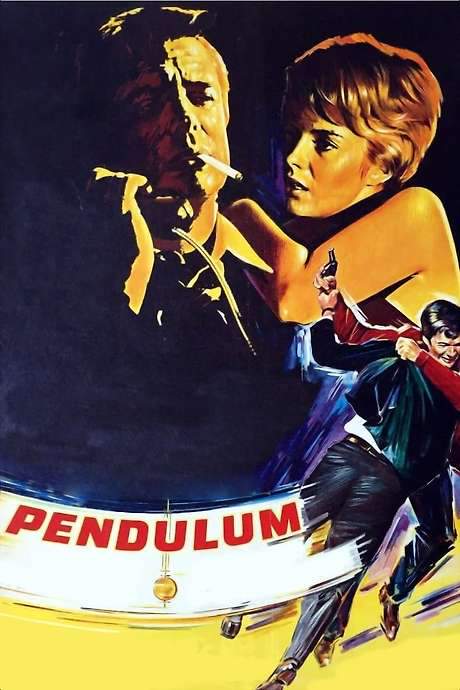
Pendulum 1969

Directed by

George Schaefer
Made by

Pendulum Productions
Pendulum Plot Summary
Read the complete plot summary and ending explained for Pendulum (1969). From turning points to emotional moments, uncover what really happened and why it matters.
In Washington, D.C., police captain Frank Matthews George Peppard is climbing the career ladder, recently tapped as a consultant to a powerful U.S. senator, and his professional future looks bright. Yet his home life is far from steady: he suspects his wife Adele Matthews Jean Seberg of sharing more than a few late-night secrets with an old flame. After attending a political function in Baltimore, Matthews decides to stay out overnight, a choice that will quietly unravel the world he knows. The next day, a chilling discovery rocks the capital: his wife has been shot to death in bed with her lover, who is also dead. Suddenly, the man who once seemed poised for influence learns that his police colleagues have branded him the prime suspect in the brutal crime. The shift from esteemed officer to potential killer happens with a cold deflation, as the very people he has trusted begin to scrutinize his alibis and motives.
Amid this personal catastrophe runs a tense, morally charged side plot involving a death row inmate, Paul Martin Sanderson Robert F. Lyons. Convicted of rape and murder, Sanderson is released on a technicality that Matthews once helped secure, a fact that Matthews views as a grave injustice. The release of Sanderson muddles the line between law and vengeance, and the film pivots on the idea that justice can be both righteous and corrupted by procedure. The irony intensifies as Matthews, now pursued by his own colleagues, seeks to clear his name even as the system he once helped uphold seemed to fail him.
As the drama unfolds, Matthews enlists Sanderson’s own lawyer, Woodrow Wilson King Richard Kiley, a decision that binds the fates of the two men in a treacherous legal game. The hiring of King signals a broader critique of power and due process, showing how legal maneuvering can become a weapon when a man’s reputation is on the line. The relationship between Matthews and King becomes a central tension in the narrative, highlighting themes of loyalty, guilt, and the slippery slope between upholding the law and finding the truth at any cost. The courtroom and the streets both become arenas where truth clings to the smallest of details, and every choice reverberates through the lives of those connected to the case.
The cast also threads in a supporting web of characters who populate the investigation and the political sphere. Adele Matthews’s world is touched by the uneasy presence of those around her, including the sharp eyes of Deputy Chief John P. Hildebrand Charles McGraw and the persistent investigations of Det. J.J. “Red” Thornton Dana Elcar. In the backdrop, the film introduces figures such as Mrs. Eileen Sanderson Madeleine Sherwood and Liz Tennant Marj Dusay, each adding layers to a story where personal history and public duty collide. The legal machinery is personified by U.S. Attorney Grady Butler Jock Mackelvie and Judge Kinsella S. John Launer, whose interactions with the central characters push the narrative toward its climactic resolution.
As the plot threads converge, Pendulum deftly maintains a cool, analytical tone while letting the suspense build through the mounting questions: Who is really in control of the truth, and who is willing to bend the rules to seize it? The film’s momentum comes from the precarious balance between a man accused and a system that may be guilty of its own shortcuts. The intersecting storylines—Matthews’s fall from grace and Sanderson’s startling release—drive the action toward a dramatic and violent conclusion, leaving the audience to ponder the costs of justice when pride, fear, and ambition collide.
Throughout the film, the tension never eases, and the characters’ motivations are laid bare with careful, measured reveals. The result is a taut, morally complex thriller that keeps a steady pulse even as it widens its scope from personal tragedy to institutional critique. Pendulum invites viewers to weigh the line between protector and suspect, the ethics of legal strategy, and the high price paid when assumptions harden into certainty. The ending lands with a blunt finality, a reminder that in systems built on law and order, the pendulum can swing with devastating force.
Pendulum Timeline
Follow the complete movie timeline of Pendulum (1969) with every major event in chronological order. Great for understanding complex plots and story progression.
Career on the rise
In Washington, D.C., Captain Frank Matthews is riding a wave of professional advancement after being appointed as a consultant to a powerful U.S. senator. The move elevates his status within the police force and political circles. He is juggling high-stakes duties while private life feels increasingly unsettled.
Suspicion at home
Matthews begins to suspect his wife is having an affair with an old flame. The nagging doubt strains their marriage and colors his view of the world. He keeps his suspicions close as the personal and professional pressures mount.
Baltimore political function
After appearing at a political function in Baltimore, Matthews makes a decision that will shape the nights to come. He chooses not to return home that night, seeking distance from the mounting tension. The trip marks a turning point between his public duties and private life.
Tragic morning discovery
The next day, authorities inform him that his wife has been shot to death in bed with her lover, who is also killed. The double tragedy rocks his world and suddenly places him at the center of a hotly watched investigation. The revelation frames his reputation and tests his innocence.
Prime suspect
Matthews learns that his own police colleagues have made him the prime suspect in the murder case. Accusations and questions swirl as the investigation closes in from all sides. He becomes a man hunted as much by suspicions as by the truth.
Sanderson's release
Meanwhile, death row inmate Paul Sanderson is freed on a technicality. The decision reverberates through the system and feeds Matthews's sense of injustice. Sanderson's release becomes a critical new strand in the unfolding drama.
Injustice seen by Matthews
Matthews recalls that Sanderson was originally tracked down and arrested by him, deepening his worry that a flawed process could ruin lives. The memory reinforces his vulnerability as his own case comes under scrutiny. He sees the parallels between Sanderson's fate and his own predicament.
A lawyer for hire
Facing mounting pressure, Matthews hires Woodrow Wilson King, Sanderson's lawyer, to defend him. The move ties the two cases together and introduces a weaponized legal alliance. King's presence promises a complicated, interwoven battle over truth and justice.
Intersecting narratives
As the investigation continues, the Sanderson storyline intersects with Matthews's case, reshaping motives and possible alibis. The courtroom and the streets become a single arena where past actions collide with present accusations. The two threads reinforce each other in a tightly wound suspense structure.
Legal and personal pressure
King’s defense strategy complicates the investigation, forcing authorities to reassess what they think they know about guilt and innocence. Matthews struggles to navigate a system that seems determined to convict him. The pressure builds toward a breaking point.
Closing in
With accusations intensifying, the film tightens its focus on Matthews as more evidence and contradictions emerge. The audience is drawn into a spiraling sense of doubt about who is really responsible. The inner conflict mirrors the outer chase for truth.
Violent culmination
All threads converge in a violent conclusion as the intertwined fates of Matthews and the cases collide. The truth comes at a cost, leaving nothing untangled and leaving the audience with a final, shocking moment. The film ends on a brutal note that resolves the central tensions.
Pendulum Characters
Explore all characters from Pendulum (1969). Get detailed profiles with their roles, arcs, and key relationships explained.
Captain Frank Matthews (George Peppard)
A rising police captain who suddenly finds himself the prime suspect in his wife’s murder. He projects calm efficiency, yet his personal life becomes a battlefield of jealousy and mistrust. Throughout the story, Matthews wrestles with the tension between duty and the fear of ruin, forcing him to confront how others perceive him. His moral center is tested as the system he serves seems to turn against him.
Adele Matthews (Jean Seberg)
The wife of Captain Matthews, her alleged affair becomes the spark that sets off the plot. Her murder and the surrounding rumors complicate Matthews’s control over his life and career. Adele’s role underscores how personal relationships bleed into public scandal. Her presence (or memory) haunts the investigation and adds a layer of motive to the crime.
Paul Martin Sanderson (Robert F. Lyons)
A death row inmate freed on a legal technicality, whose release exposes the fragility of guilt and justice. Sanderson becomes a central figure of the plot as he connects with the lawyer handling Matthews’s case. His presence marks the intersection of criminal fate and legal loophole. He embodies the idea that justice can be paradoxically both unjust and necessary.
Woodrow Wilson King (Richard Kiley)
A sharp lawyer who represents Sanderson and then crosses paths with Matthews in a web of legal strategy. He embodies strategic ambiguity, using legal cleverness to manipulate outcomes. King's role shows how law can be used as a tool for both protection and manipulation. His allegiance remains a question as the plot tightens.
Senator Augustus Cole (Paul McGrath)
A powerful senator who looms over the investigation with his political influence. His presence provides the noir backdrop of Washington’s political machinery. The senator’s interests shape which side of the law is supported or challenged. He symbolizes how political power can drive legal outcomes.
Det. J.J. 'Red' Thornton (Dana Elcar)
A detective tasked with solving the case while navigating a maze of competing agendas. He approaches the investigation with skepticism and a steady drive for truth. His perspective highlights the procedural side of the noir, contrasting Matthews’s personal struggle. Thornton embodies the methodical pursuit of justice amid pressure.
Pendulum Settings
Learn where and when Pendulum (1969) takes place. Explore the film’s settings, era, and how they shape the narrative.
Location
Washington, D.C., Baltimore
Washington, D.C. is the political heart of the United States, where cops, senators, and the media collide in a high-stakes noir setting. The film places Captain Matthews within federal institutions and a volatile power dynamic, underscoring themes of trust and betrayal. Baltimore appears as a secondary locus for a political function that punctuates the investigation, adding contrast between national power and city life.
Pendulum Themes
Discover the main themes in Pendulum (1969). Analyze the deeper meanings, emotional layers, and social commentary behind the film.
⚖️
Justice
Pendulum casts doubt on the reliability of legal institutions when suspicion falls on the very person who leads them. The narrative pivots on how due process can be compromised by politics, grudges, or fear. The release of a killer on a technicality and Matthews's own designation as a suspect blur lines between innocence and guilt. The film deliberately questions whether justice can survive in a system under pressure.
🔎
Truth vs Deception
The story thrives on shifting loyalties and hidden motives, with both colleagues and lovers concealing secrets. Matthews must confront a web of appearances that mask real intentions. The pursuit of truth is complicated by a case that grows more tangled as more pieces of the puzzle surface. Deception drives the tension, forcing characters to choose sides under scrutiny.
🏛️
Power
The presence of a powerful senator and the police leadership backdrop reveals how ambition shapes decisions more than conscience. Political maneuvering intersects with law enforcement, turning every choice into a potential leverage point. The narrative uses this backdrop to show how authority can shield or endanger individuals. The outcome hinges on who controls the narrative as much as who commits the crime.

Coming soon on iOS and Android
The Plot Explained Mobile App
From blockbusters to hidden gems — dive into movie stories anytime, anywhere. Save your favorites, discover plots faster, and never miss a twist again.
Sign up to be the first to know when we launch. Your email stays private — always.
Explore the mobile appPendulum Spoiler-Free Summary
Discover the spoiler-free summary of Pendulum (1969). Get a concise overview without any spoilers.
In the polished corridors of Washington, D.C., police captain Frank Matthews stands at the peak of a career built on instinct, discipline, and an unwavering belief in the system he serves. Handpicked to advise a powerful U.S. senator and celebrated for his recent accomplishments, Frank embodies the promise of law enforcement done right. Yet beneath the commendations and the upward trajectory, his personal life frays at the edges. His marriage to Adele Matthews carries an uneasiness he cannot quite name, a quiet distance that hints at secrets kept in the shadows of long nights.
The city around him hums with political ambition and institutional weight, a landscape where reputation is currency and trust is a commodity easily spent. Colleagues like Deputy Chief John P. Hildebrand and Det. J.J. “Red” Thornton move through a world where every case carries the potential to elevate or unravel. When Frank’s professional triumph is shadowed by a sudden, devastating turn of events, the equilibrium he carefully maintained begins to fracture. The machinery of justice, once his arena of expertise, shifts beneath his feet with a cold, relentless logic. The line between accuser and accused becomes uncomfortably thin, and those he once counted as allies transform into skeptics, their eyes now turned toward him.
As the narrative unspools, Pendulum captures a mood of simmering dread, where procedural detail meets moral complexity. Themes of loyalty, institutional integrity, and the human cost of due process emerge, threading through the story’s fabric. The atmosphere is taut, the stakes deeply personal and far-reaching, and the questions it poses linger long after the final frame. Frank Matthews must navigate a world where certainty is elusive, and the truth — much like the pendulum itself — swings with devastating, unpredictable force.
Movies with Similar Twists and Themes
Uncover films that echo the narrative beats, emotional arcs, or dramatic twists of the one you're exploring. These recommendations are handpicked based on story depth, thematic resonance, and spoiler-worthy moments — perfect for fans who crave more of the same intrigue.











Featured on this page

What's After the Movie?
Not sure whether to stay after the credits? Find out!
Check out our other apps:

SAT Sphere
Build confidence for the Digital SAT.

Mori Atlas
Discover wild places worth protecting.

Luntero
Search smarter for a home in Amsterdam.

Plot Explained
Unravel movie endings and hidden clues.

Pokechamp
Dive into Pokémon data and battle logic.

Driving Theory
Get ready for your European theory test.

Movie Dust
Plan your next cinema trip with ease.

Musemap
Find art and culture as you travel.

Selkobase
Compare credentials before committing.

Local Manual
Turn an unfamiliar country into practical next steps.

Lernavi
Compare school systems before your next move.

GymRoam
Find a workout stop wherever your plans take you.
Explore Our Movie Platform
New Movie Releases (2026)
Famous Movie Actors
Top Film Production Studios
Movie Plot Summaries & Endings
Major Movie Awards & Winners
Best Concert Films & Music Documentaries
Movie Collections and Curated Lists
© 2026 What's After the Movie. All rights reserved.
Privacy Policy