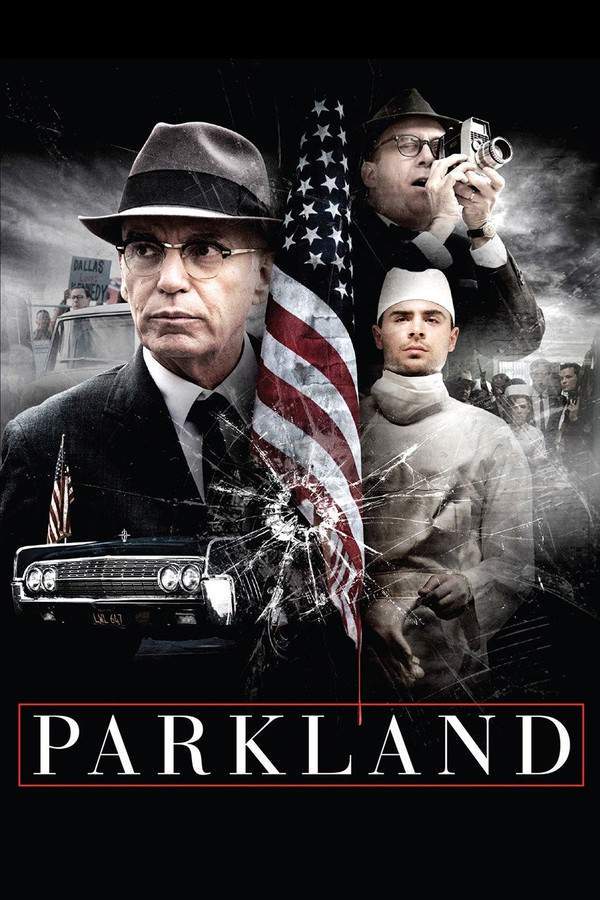
Parkland 2013


Directed by

Peter Landesman
Made by

Open Road Films
Where to Watch Parkland
See current US streaming, rental, and purchase options for Parkland (2013) via JustWatch.

Amazon Prime Video
HD
Amazon Prime Video with Ads
HD
Hulu
HD
Philo
HD
Starz
HD
Starz Amazon Channel
HD
Starz Apple TV channel
HD
Hoopla
SD
Kanopy
HD
The CW
SD
Plex
HD
Plex Channel
HD
The Roku Channel
HD
YouTube Free
HD
Amazon Video
SD
Apple TV Store
HD
Fandango At Home
SD
Google Play Movies
SD
YouTube
SD Streaming availability powered by 
Parkland Plot Summary
Read the complete plot summary and ending explained for Parkland (2013). From turning points to emotional moments, uncover what really happened and why it matters.
On November 22, 1963, United States president John F. Kennedy embarks on a political swing through Texas with his wife, Jackie, and Vice President Lyndon B. Johnson. After delivering a speech in Fort Worth, the group flies to Dallas for a high‑stakes motorcade that aims to project confidence and continuity in the nation’s capital. As the crowd gathers along the route, a routine day in Dallas begins to tilt toward tragedy, and the day’s events unfold with a heavy sense of fate.
In the busy morning that precedes the ride, Dr. Jim Carrico, the resident surgeon at Parkland Memorial Hospital, wakes to a call that foreshadows the hospital’s central role in what follows. Dressmaker Abraham Zapruder arrives at his offices, buzzing with the anticipation of filming the motorcade, while FBI agent James Hosty discusses ongoing concerns with his boss. Nearby, Robert Oswald enters his office, unaware that his world will quickly collide with national history. Kennedy lands at Dallas Love Field, greeted by Dallas Secret Service agent‑in‑charge Forrest Sorrels, and the motorcade moves toward downtown amid a mix of pride, caution, and tension.
In Dealey Plaza, Zapruder begins filming the presidential procession, capturing the moment the motorcade passes by. Then, the unthinkable happens: three gunshots ring out, and Kennedy is fatally struck. The scene erupts into chaos as the motorcade speeds away, leaving Zapruder stunned and the city in shock. Parkland Memorial Hospital receives the emergency call, and Carrie and colleagues rush to prepare for the unthinkable—an operation to save the nation’s leader. Jackie Kennedy, overwhelmed by shock, resists the doctors’ efforts to move her husband, a moment that underscores the human scale of the tragedy.
Inside Trauma Room One, Dr. Carrico and Chief Resident Dr. Malcolm Perry face the grim task of saving Kennedy. Perry performs a critical tracheotomy as the team fights to stabilize the president, while the hospital staff, clergy, and Secret Service stand by in a circle of anxious anticipation. As the life drain continues, a priest is called to administer last rites, a stark reminder of the vulnerability of the public figure under such intense scrutiny.
The pursuit of the truth behind the assassination quickly widens beyond the hospital doors. Zapruder, pressed by authorities for his footage, is urged by Secret Service to share the film for national security reasons. The process of handling and interpreting the evidence becomes a tense race against time; the film is eventually developed at a Kodak lab near Love Field, where copies are ordered and the gravity of what’s captured is realized in real time. Kennedy’s heart stops, the CPR continues in a valiant effort, and the room’s gravity breaks as the president is pronounced dead. Jackie’s grief is matched by the collective sorrow of the staff and security detail who have watched a nation lose its leader.
As the crisis unfolds, Johnson is alerted to Kennedy’s death and prepares for the tense transition of power aboard Air Force One. The plane, a symbol of continuity and control, carries the coffin as it departs Parkland, with seats removed and a wall reorganized to accommodate the ceremonial transfer of power. The oath is administered, and the jet climbs away toward Washington, taking with it a nation’s sense of normalcy suddenly shattered.
Back on the ground, Robert Oswald wrestles with the implications of the day’s events as he learns through the radio that his brother might be implicated in the assassination and remains a person of interest to authorities. The emotional fallout intensifies as the investigation expands beyond the Dallas area, and the reality of Lee Harvey Oswald’s possible complicity begins to take hold.
Months later, Zapruder’s footage surfaces in the public eye, and the authorities seek to manage the narrative surrounding one of history’s defining moments. The country watches and waits as the investigation and public response unfold, with the handling of the film becoming a focal point of debate and national introspection. In a chilling sequence broadcast to a wider audience, Lee Harvey Oswald is shot on live television by Jack Ruby and is rushed to Parkland, where medical teams work to save him but ultimately fail. The probe into the shooting of Oswald becomes another layer of the day’s unresolved questions, as the FBI and Secret Service contend with the shifting sands of information and accountability. Oswald’s death adds another layer of sorrow and confusion to a day already saturated with grief and political consequence.
Hosty is directed to discard the Oswald file as the case’s immediate relevance wanes, and the surrounding institutions begin to absorb the shock of what has transpired. Three days after Kennedy’s and Oswald’s funerals, the people who lived through the crisis return to their routines, carrying with them the weight of the events that forever altered their lives and the nation’s trajectory. The Parkland staff, Zapruder, and the federal agencies observe a solemn quiet after the storm, a silence that belies the continued questions and unresolved tensions that have become an integral part of the nation’s collective memory.
An epilogue provides a quiet, human look at the people touched by the day’s events. Robert Oswald remains in Dallas, resisting any attempt to erase the memory of what happened, choosing to face the truth rather than retreat. Zapruder continues to bear the trauma of that single, defining day, while Dr. Carrico forges a career marked by resilience, eventually rising to prominent leadership within the medical community as president of the American Association for the Surgery of Trauma. The film closes on a note that blends memory, consequence, and the enduring impact of a day that reshaped a nation.
“you did this to all of us”
Parkland Timeline
Follow the complete movie timeline of Parkland (2013) with every major event in chronological order. Great for understanding complex plots and story progression.
Presidential Texas trip begins with Fort Worth stop
President John F. Kennedy, Jacqueline Kennedy, and Vice President Lyndon B. Johnson begin a political trip through Texas. After a speech in Fort Worth, the entourage flies to Dallas for a high-profile motorcade. The day is marked by security preparations and media buzz as the convoy readies to roll.
Dallas morning routine of key figures
In Dallas, several people start their day with routine duties that will intersect the events to come. Dr. Jim Carrico wakes and responds to a trauma call at Parkland Hospital. Dressmaker Abraham Zapruder arrives at his office and tells his staff to assemble for the motorcade. FBI Agent James Hosty discusses matters with Gordon Shanklin, while Robert Oswald goes to his office.
Kennedy lands at Love Field; Secret Service readiness
Kennedy lands at Dallas Love Field with Forrest Sorrells ensuring Secret Service coverage. The motorcade is prepared to depart for the downtown route. The stage is set for what will become a defining moment of the day.
Motorcade departs toward downtown; Dealey Plaza filming begins
The motorcade moves toward downtown Dallas, passing through Dealey Plaza where cameras capture the procession. Zapruder’s camera begins rolling as the dignitaries pass by, freezing the moment in film for history.
Shots ring out; Kennedy wounded; chaos ensues
Three gunshots echo from the street, and Kennedy is fatally wounded. The motorcade speeds away toward Parkland Hospital as witnesses react in shock. Zapruder is approached by reporter Harry McCormick, confirming he filmed the motorcade.
Kennedy rushed to Parkland; emergency surgery begins
Arriving at Parkland Memorial Hospital, Kennedy is placed in Trauma Room One as doctors attempt to save him. Carrico and Perry perform life-saving procedures, including a tracheotomy, while a priest is summoned for rites. The medical team fights to turn back the irreversible damage.
Zapruder's footage becomes a focal point for authorities
Newsroom officials press Zapruder to provide his footage for broadcast. Sorrells coordinates with the media to process the film privately before any public release. Zapruder then heads to the Kodak lab near Love Field to help secure copies.
Kennedy dies; Johnson is sworn in aboard Air Force One
Kennedy’s condition deteriorates and he is pronounced dead after ongoing CPR. Johnson is rushed to Air Force One at Love Field and takes the presidential oath of office during the flight to Washington, the nation absorbing the shock of the moment.
Film processing and controlled releases
Zapruder’s film is processed under tight supervision at the Kodak lab near Love Field, and copies are ordered for distribution. Life Magazine editor Dick Stolley requests access, but the release is carefully managed to avoid showing the fatal shot to the public in order to protect Kennedy’s dignity.
Oswald arrest and growing suspicion
Robert Oswald realizes his brother Lee is involved in a high-profile crime and is being investigated for Tippit’s murder. Hosty briefs Shanklin, while Marina receives a prior lead about the investigation. Lee denies involvement when confronted by Robert, who vows to secure him a lawyer.
Oswald shot on live television; Oswald dies after surgery
Lee Harvey Oswald is shot by Jack Ruby on live television and is rushed to Parkland, where he is denied entry to Trauma Room One. In another operating room, doctors continue treatment until Oswald succumbs to his wounds, disappointing Robert and Marguerite.
Funerals and the national mood
Three days after the assassination, both Kennedy and Oswald have their funerals, marking a national pause in the wake of tragedy. Parkland staff, Zapruder, the FBI, and the Secret Service return to work while memories of the day linger.
Epilogue: enduring scars and legacies
In the aftermath, Robert remains in Dallas and does not deny Lee’s involvement, while Marguerite holds a contrasting view. Zapruder continues to grapple with the trauma of that day, and Carrico goes on to lead trauma medicine. The events leave a lasting imprint on all who experienced them.
Parkland Characters
Explore all characters from Parkland (2013). Get detailed profiles with their roles, arcs, and key relationships explained.
Dr. Jim Carrico (Zac Efron)
A skilled, pressured resident surgeon whose work in the chaotic Parkland ER drives the medical response to Kennedy's injury. He navigates the moral weight of life-and-death decisions in a nationally scrutinized moment. Carrico embodies clinical precision under extraordinary stress while the outcome remains uncertain.
Forrest Sorrels (Billy Bob Thornton)
Dallas Secret Service agent-in-charge coordinating security and crisis management. He negotiates the tension between protecting the president and the implications of rapid information dissemination. Sorrels makes difficult calls, including the tension around footage and files, under intense public scrutiny.
James Hosty (Paul Giamatti)
FBI agent tracking Oswald and coordinating with other agencies. He faces scrutiny and interagency friction as the case unfolds, reflecting the challenges of early 1960s counterintelligence. Hosty grapples with how much to reveal and how to act under orders.
Robert Oswald (Tom Welling)
Lee Harvey Oswald's brother who becomes entangled in the aftermath of the assassination. He confronts suspicion, family crisis, and the burden of a brother's alleged actions while seeking clarity in a chaotic city.
Abraham Zapruder
Amateur filmmaker who captures the motorcade and becomes a pivotal link to the event for history. He endures trauma from what he witnessed and ultimately hands over his footage to authorities, shaping how the assassination would be seen.
Lee Harvey Oswald
The central suspect in the assassination whose actions set off a national crisis. He is confronted by investigators and family, and his fate in Dallas shapes the emotional and political aftermath.
Parkland Settings
Learn where and when Parkland (2013) takes place. Explore the film’s settings, era, and how they shape the narrative.
Time period
1963
The story unfolds on and around November 22, 1963, as the nation reels from Kennedy's assassination. The era is defined by Cold War tensions, intense media coverage, and sudden shifts in national security priorities. The time frame emphasizes the immediacy of events and the quiet, personal toll on those involved.
Location
Dallas, Texas, Parkland Memorial Hospital, Dealey Plaza, Love Field, Air Force One
Dallas, Texas serves as the setting for Kennedy's fateful motorcade and the immediate aftermath. Parkland Memorial Hospital becomes the central stage for medical drama and national mourning, while Dealey Plaza marks the scene of the shooting and Zapruder's famous footage. Love Field and Air Force One symbolize the rapid, unprecedented political response and the scramble to shape the tale for history.
Parkland Themes
Discover the main themes in Parkland (2013). Analyze the deeper meanings, emotional layers, and social commentary behind the film.
🕊️
Loss
The film centers on personal grief in the wake of tragedy, from Jackie Kennedy and families to hospital staff. It portrays how individuals process sudden death in a public, monumental moment. The narrative anchors the national sorrow in intimate, human scenes within Parkland.
🔒
Secrecy
Government secrecy and the control of information drive much of the tension, as agencies weigh what to reveal versus what to protect. The pursuit of national dignity clashes with transparency as footage and evidence are contested. Characters face moral dilemmas over masking truth to preserve the image of the nation.
🗞️
Media
The Zapruder film and press coverage become central to how the event is remembered, revealing editorial and public pressures. Journalists, editors, and investigators negotiate access to the footage while balancing public interest with sensitivity. The media’s role shapes collective memory and the political narrative.

Coming soon on iOS and Android
The Plot Explained Mobile App
From blockbusters to hidden gems — dive into movie stories anytime, anywhere. Save your favorites, discover plots faster, and never miss a twist again.
Sign up to be the first to know when we launch. Your email stays private — always.
Explore the mobile appParkland Spoiler-Free Summary
Discover the spoiler-free summary of Parkland (2013). Get a concise overview without any spoilers.
In the restless heat of Dallas, November 22 1963 unfolds as a nation watches a historic motorcade glide toward the heart of a city that feels both ordinary and monumental. Within the sprawling corridors of Parkland Memorial Hospital, the ordinary rhythm of daily emergency work is suddenly poised on the edge of history, as the institution becomes the unexpected center of a moment that will ripple through the country. The film captures this charged atmosphere with a blend of documentary‑like immediacy and careful, moody composition, letting the viewer feel the weight of a day that teeters between routine and revelation.
At the core of the story is the tight‑knit team of caregivers pressed into a surreal urgency. Jim Carrico, a seasoned surgeon whose steady hands mask a torrent of pressure, leads a group that includes Malcolm Perry, a resident eager to prove his worth, and a young nurse whose compassion fuels the frantic effort to keep everything together. Their interactions crackle with a mix of professional focus and personal vulnerability, each character wrestling with the enormity of the task while trying to preserve the humanity that defines their calling. The hospital’s sterile walls become a crucible where confidence, fear, and an unspoken camaraderie collide.
Parallel to the medical drama, Forrest Sorrels, a Dallas Secret Service agent, navigates a maze of protocols, secrecy, and an ever‑changing flow of information. As he moves through the hallways and the chaotic periphery of the trauma bay, his presence draws the young nurse into a subtle partnership that hints at deeper, unsettled currents beneath the surface. Their tentative alliance suggests that truth in this moment is fragmented, filtered through conflicting accounts and the rush of adrenaline that grips everyone present.
The tone remains taut and introspective, inviting the audience to linger on the uneasy quiet between breaths, the half‑spoken doubts that linger in the corridors, and the lingering question of what will emerge from a day that reshapes a nation’s memory. The film’s style balances historical gravity with intimate, almost breath‑by‑breath observations, leaving viewers poised on the brink of discovery without ever revealing the exact outcome.
Movies with Similar Twists and Themes
Uncover films that echo the narrative beats, emotional arcs, or dramatic twists of the one you're exploring. These recommendations are handpicked based on story depth, thematic resonance, and spoiler-worthy moments — perfect for fans who crave more of the same intrigue.

Featured on this page

What's After the Movie?
Not sure whether to stay after the credits? Find out!
Check out our other apps:

SAT Sphere
Build confidence for the Digital SAT.

Mori Atlas
Discover wild places worth protecting.

Luntero
Search smarter for a home in Amsterdam.

Plot Explained
Unravel movie endings and hidden clues.

Pokechamp
Dive into Pokémon data and battle logic.

Driving Theory
Get ready for your European theory test.

Movie Dust
Plan your next cinema trip with ease.

Musemap
Find art and culture as you travel.

Selkobase
Compare credentials before committing.

Local Manual
Turn an unfamiliar country into practical next steps.

Lernavi
Compare school systems before your next move.

GymRoam
Find a workout stop wherever your plans take you.
Explore Our Movie Platform
New Movie Releases (2026)
Famous Movie Actors
Top Film Production Studios
Movie Plot Summaries & Endings
Major Movie Awards & Winners
Best Concert Films & Music Documentaries
Movie Collections and Curated Lists
© 2026 What's After the Movie. All rights reserved.
Privacy Policy