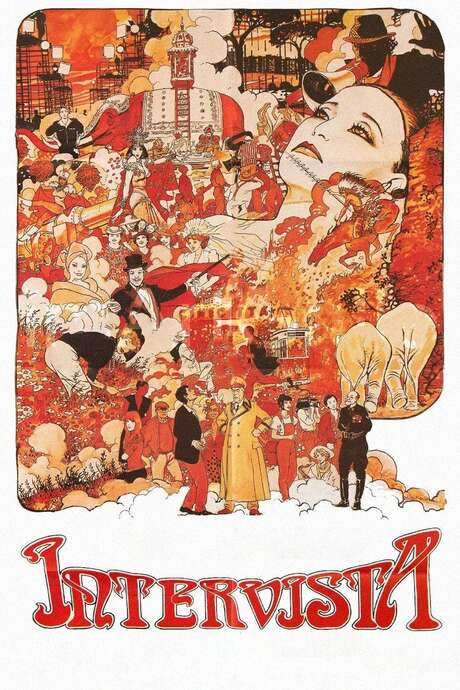
Intervista 1987

Directed by
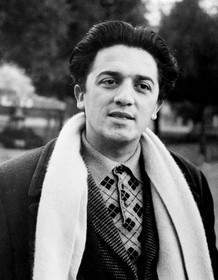
Federico Fellini
Made by

Fernlyn
Where to Watch Intervista
See current US streaming, rental, and purchase options for Intervista (1987) via JustWatch.

Streaming availability powered by 
Intervista Plot Summary
Read the complete plot summary and ending explained for Intervista (1987). From turning points to emotional moments, uncover what really happened and why it matters.
Federico Fellini invites viewers behind the scenes at Cinecittà, where a nighttime set is readied for a sequence he dubs “the prisoner’s dream.” In this moment, his hands search for a way out of a dark tunnel, mirroring the aging director’s own sense of time catching up with him. As night gives way to morning, the tour resumes and the mood shifts from dreamlike hazard to documentary curiosity. The crew walks past glossy, ever-moving TV commercials in production, while the casting director introduces four young actors chosen to embody Karl Rossmann, the lead from the studio’s imagined adaptation of Kafka’s Amerika. On-screen, the famed Nadia Ottaviani appears as the custodian of Cinecittà, a brief and charming distraction as she slips away to pick dandelions for herbal tea, adding a touch of whimsy to the earnest hustle of film-making. The assistant director, Maurizio Mein, corrals the team on location at the Casa del Passeggero, a once-cheap hotel transformed into a drugstore set, a location Fellini longs to reclaim from a past visit to Cinecittà in 1938 during the Fascist era.
The narrative then folds time upon itself as Fellini interacts with his younger self, played by the rising actor Sergio Rubini. Their dialogue and staging dramatize the tension between memory and invention, as the team rebuilds the Casa del Passeggero façade elsewhere in Rome and a fake tramway whisks Fellini’s younger self from an imagined American West, through a moment with Indian warriors on a cliff, to a herd of elephants off a distant Ethiopian coast. This dreamlike travelogue leads to Cinecittà proper, where Fellini seeks out Katya, a stand-in for Greta Gonda, and conducts a casting encounter that blurs the lines between memory, performance, and reality.
What follows is a seamless drift into two separate feature films that function as tyrannical mirrors of the filmmaking process. For a stretch, Fellini and his on-set arranger scramble to assemble the correct cast and construct the necessary sets for Amerika, a fictive adaptation that serves as a pretext for filming what is already in progress. The narrative vaults between eras and personas, letting Marcello Mastroianni reprise a telegenic role in a TV commercial as Mandrake the Magician, while a sudden bomb threat punctures the illusion. A pivotal scene unfolds at Anita Ekberg’s house, where she and Mastroianni revisit moments from La Dolce Vita, underscoring how cinema constantly revisits its own history. Screenshots of Kafka’s Brunelda appear, caressed in a bathtub by two young men, before a violent thunderstorm signals the collapse of the Amerika production, culminating in a surreal assault by bogus Indians riding horseback and brandishing television antennas as if they were spears.
Back inside Studio 5, the film-within-a-film experiment circles toward a close. Fellini’s voiceover cuts in with a stark, almost clinical honesty: “So the movie should end here. Actually, it’s finished.” When producers push back against his somber endings, the Maestro counters with a fleeting glimmer of light—igniting an arc lamp to cast a final, hopeful glow over the whole production.
This intimate, self-reflexive portrait of making movies—part diary, part fantasia—explores how memory, artistry, and stubborn ambition collide on a soundstage that feels as much like a living museum as a workplace. It’s a meditation on aging, the persistence of dreams, and the stubborn magic of cinema that continues to shape how we see both the past and the present.
Intervista Timeline
Follow the complete movie timeline of Intervista (1987) with every major event in chronological order. Great for understanding complex plots and story progression.
Nighttime set for the prisoner's dream sequence
A nighttime setup at Cinecittà is prepared for a sequence Fellini calls the prisoner's dream, where his hands search for a way out of a dark tunnel. The scene invites the viewer into the claustrophobic feel of filming and the dreamlike logic of cinema. The maestro contemplates the fragility of escape even as the set comes alive around him.
Fellini contemplates Cinecittà from a great height
With aging and weight complicating simple escapes, Fellini considers Cinecittà from a vantage point. He muses on flight and freedom, turning the studio into a looming cityscape that dwarfs him. The moment blends personal reflection with the scale of the movie world.
Morning studio tour with the Japanese crew
The next morning, Fellini guides the Japanese TV crew through the sprawling studios. They pass on-screen absurd TV commercials in production, creating a satire on the industry within the behind-the-scenes tour. The encounter sets the tone for the meta-narrative about making a film within a film.
Casting four actors for Karl Rossmann
Fellini's casting director presents four young actors chosen to interpret Karl Rossmann, the lead in Amerika. The moment introduces the artificial nature of casting and foreshadows the memory-work of Fellini's project. The tension between potential performers and a legendary director frames the casting as performance itself.
Nadia Ottaviani and herbal tea
Fellini introduces Nadia Ottaviani, Cinecittà’s female custodian, who evasively delays the interview by wandering into the deserted backlot to pick dandelions for herbal tea. Her disappearance underscores the playful unpredictability of the film’s world. The moment highlights the everyday, non-film aspects that color the production.
Maurizio Mein on location at Casa del Passeggero
Maurizio Mein, the assistant director, is on location with the crew at the Casa del Passeggero, a former cheap hotel now transformed into a drugstore. Fellini intends to incorporate it into his film about his 1938 visit to Cinecittà. The on-location shoot contrasts with the studio world and reinforces the film’s time-bending motif.
Casa del Passeggero as memory and 1938 memory
Fellini wants to include the Casa del Passeggero in the film about his journalist visit in 1938 during the Fascist era. Past and present blur as he engages with that earlier self in the memory-filled production. The idea moves the narrative between eras, tying the dream of cinema to personal history.
Fellini interacts with his younger self played by Rubini
As scenes unfold, Fellini interacts with his younger self, played by Sergio Rubini, highlighting the film’s meta-fictional conceit. The two versions of Fellini move through sets and memory, exploring how a director's past informs his current work. The exchange underscores the continuity between creator and creation.
Fake tramway to clifftop and elephants
The facade of Casa del Passeggero is reconstructed elsewhere in Rome, and a fake tramway carries young Fellini/Rubini from an American Far West into a surreal clifftop world. They arrive at a herd of wild elephants off the coast of Ethiopia, a dream-logic detour that blends travel with cinema’s fantasy. The sequence emphasizes how memory, fantasy, and the film’s production collide.
Arrival at Cinecittà to interview Katya
Arriving once more at Cinecittà, Fellini begins an interview with matinee idol Katya, a character representing the actress Greta Gonda. The encounter replays a real interview he once conducted, further weaving biography and fiction. The moment marks the shift from rehearsal to the project proper.
Illusions of two films and tyrannical directors
Illusion takes over as the crew dives into two feature films being directed by tyrannical directors. The line between cinema and reality blurs as the production contends with control, ego, and the limits of vision. The meta-fiction deepens, revealing the fragility of artifice.
Amerika casting, sets, and disruptive production
Fellini and his assistant scramble to recruit the right cast and build sets for the Amerika project, the fictitious adaptation used to justify progress on his actual film-in-progress. The sequence shows the frantic pace of preproduction and the director’s struggle to realize a vision. Tensions rise as onlookers, testers, and delayed schedules collide.
Mastroianni in a TV commercial and tests
Disgruntled actors who failed auditions appear, including Marcello Mastroianni in a TV commercial where he plays Mandrake the Magician. The insert functions as a satirical mirror of fame and promotion in the industry. It also underscores the performative nature of cinema within the film.
Thunderstorm and attack by bogus Indians
A thunderstorm signals the production’s collapse of Amerika, climaxing in an attack by bogus Indians on horseback wielding television antennae as spears. The surreal assault embodies the chaos of making a film and the fragility of control. The scene marks the impending end of the dream-assembly.
Ending voiceover and arc lamp
Back inside Studio 5, Fellini’s voiceover declares, So the movie should end here. Actually, it’s finished. The producers’ gloom over the dark ending prompts him to offer a final ray of sunshine by lighting an arc lamp. The gesture closes the metafilm with a sly, hopeful note.
Intervista Characters
Explore all characters from Intervista (1987). Get detailed profiles with their roles, arcs, and key relationships explained.
Marcello Mastroianni as Marcello Mastroianni
A veteran film star within Fellini's meta-film, Marcello appears in a TV commercial as Mandrake the Magician. His screen persona underscores the spectacle and commodification of fame in cinema. Through this cameo, the film probes how actors become symbols as much as performers.
Federico Fellini as Federico Fellini
The maestro-director guiding the backstage exploration of his own process. He negotiates endings, fame, and the aging of a filmmaker, using the set as a living notebook. His presence anchors the film’s meditation on art, memory, and the burden of legacy.
Sergio Rubini as Il Giornalista
A journalist observer who moves through set pieces and memory, documenting the behind-the-scenes drama. He embodies the media perspective within Fellini’s world and helps link present-day production to past experiences. His presence sharpens the film’s commentary on storytelling and perception.
Nadia Ottaviani as La Vestale
The Cinecittà custodian who vanishes into the backlot to gather dandelions for herbal tea, adding an air of ritual and mystery to the studio environment. Her brief, almost ceremonial appearances evoke cinema’s quiet guardianship of memory. She helps infuse the set with a sense of forgotten time.
Maurizio Mein as L'Aiuto Regista
The assistant director scrambling to assemble cast and crew, managing the day’s shoots and auditions. He embodies the logistical heartbeat of filmmaking under pressure. His role highlights the practical side of bringing Fellini’s visions to life.
Lara Wendel as La Sposa
La Sposa appears as a romantic figure within the frame, contributing to the film’s exploration of performance and attraction. Her presence adds to the spectacle and the idea of cinema as theater. She embodies the allure and demands of star power within a production.
Paola Liguori as La Diva
La Diva represents the glamour and theatricality of leading cinema, shaping the on-set fantasy and audience expectations. Her presence tests the boundaries between art and commerce on the film’s staging. She symbolizes the high-stakes world of stardom within Fellini’s meta-narrative.
Francesca Reggiani as Francesca, Diva's Secretary
Diva’s secretary who navigates backstage politics and scheduling. She embodies the administrative labor behind cinema’s glamour and the quiet influence of assistants in shaping a shoot. Her interactions illuminate power dynamics and organizational fragility on set.
Antonella Ponziani as La Ragazza del Tram
La Ragazza del Tram appears in the tram-set context, hinting at the casting process and the search for a face to carry Fellini’s Amerika. Her presence underlines the audition culture and the constant pursuit of the perfect performer. She embodies the tension between potential and selection in cinema.
Intervista Settings
Learn where and when Intervista (1987) takes place. Explore the film’s settings, era, and how they shape the narrative.
Time period
1980s
The present-day action unfolds in the late 1980s as Fellini guides a Japanese TV crew through Cinecittà. A recurring 1938 flashback recalls his early visit to Cinecittà during the Fascist era, illustrating the long arc of his relationship with the studio. This temporal layering blurs the line between past and present, memory and making.
Location
Cinecittà, Rome, Casa del Passeggero, Studio 5 Backlot
Intervista is set largely at Cinecittà in Rome, the iconic studio complex where Fellini stages his look at filmmaking. The production also centers on the deserted backlot of Studio 5, used for dreamlike sequences, and on the Casa del Passeggero, a former budget hotel repurposed as a filming location. Together, these spaces underscore cinema as a place where memory, fantasy, and production collide.
Intervista Themes
Discover the main themes in Intervista (1987). Analyze the deeper meanings, emotional layers, and social commentary behind the film.
🎬
Filmmaking
Intervista functions as a meta-portrait of cinema, showing the chaotic elegance of casting, set-building, and directing. It highlights how ideas are tested, rejected, and revised on the fly, revealing the craft behind the final product. The film treats production as a living process, where images are born through collaboration and improvisation. In doing so, it asks what a finished film can and cannot capture.
🕰️
Time
Time acts as a sculpting force, alternating between the late 1980s present and a 1938 memory that frames Fellini’s history with Cinecittà. The shifting timelines intensify the sense that cinema is a vessel for recollection as much as a tool for storytelling. By weaving past and present, the film suggests that film-making itself is a perpetual conversation with memory.
🪞
Illusion vs Reality
The narrative continually tests what is real and what is staged, with dreamlike sequences and on-set fantasies seeping into documentary-style moments. Performances, commercials, and re-creations of past interviews all blur boundaries, inviting viewers to question the truth of what they see. The result is a meditation on cinema’s power to create, distort, and preserve reality.

Coming soon on iOS and Android
The Plot Explained Mobile App
From blockbusters to hidden gems — dive into movie stories anytime, anywhere. Save your favorites, discover plots faster, and never miss a twist again.
Sign up to be the first to know when we launch. Your email stays private — always.
Explore the mobile appIntervista Spoiler-Free Summary
Discover the spoiler-free summary of Intervista (1987). Get a concise overview without any spoilers.
In the bustling heart of Rome’s Cinecittà, a Japanese documentary crew arrives to shadow one of cinema’s most iconic auteurs. Federico Fellini welcomes them with his characteristic flamboyance, offering an intimate tour that blurs the line between observation and performance. The film unfolds as a playful mock‑documentary, inviting viewers to step behind the velvet ropes of a studio that feels simultaneously like a museum, a playground, and a living organism. From the moment the cameras roll, the atmosphere is suffused with a dreamy, self‑referential charm that mirrors the director’s own fascination with memory and myth.
The sprawling soundstages teem with activity: glossy television commercials flicker nearby, casting directors shuffle fresh faces for a phantom adaptation of Kafka’s Amerika, and the ever‑present hum of machinery underscores the perpetual construction of illusion. Among the staff, Nadia Ottaviani appears as the whimsical custodian, briefly drifting away to pluck dandelions for herbal tea, while Maurizio Mein keeps the bustling crew on track, corralling them from one set to the next. Their interactions are punctuated by a light‑hearted curiosity that keeps the documentary tone buoyant, even as the surroundings hint at deeper layers of artistic obsession.
A striking element of the premise is the director’s dialogue with his younger self, embodied by the rising talent Sergio Rubini. Their conversations become a dance between past and present, allowing the film to wander through imagined landscapes—American frontiers, exotic cliffs, distant coasts—without ever abandoning the studio’s concrete reality. This interplay underscores the central conceit: a film‑within‑a‑film that serves as both pretext and reflection, where the act of creation itself becomes the story’s core.
Ultimately, the piece is a meditation on aging, ambition, and the stubborn magic of cinema. It balances documentary curiosity with surreal fantasy, offering a richly textured portrait of a master at work while inviting the audience to contemplate how dreams, memory, and the relentless grind of production intertwine on the timeless stage of Cinecittà.
Movies with Similar Twists and Themes
Uncover films that echo the narrative beats, emotional arcs, or dramatic twists of the one you're exploring. These recommendations are handpicked based on story depth, thematic resonance, and spoiler-worthy moments — perfect for fans who crave more of the same intrigue.
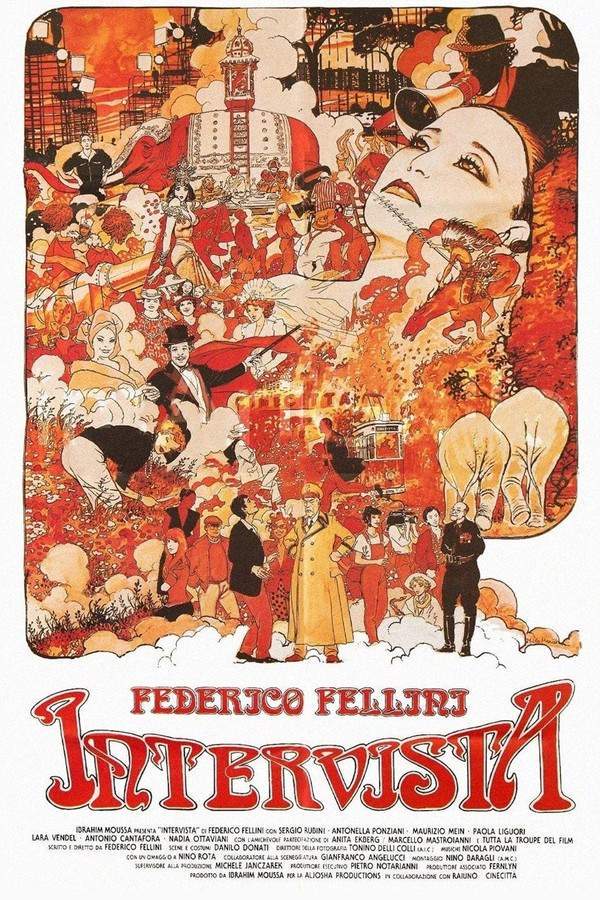

Featured on this page

What's After the Movie?
Not sure whether to stay after the credits? Find out!
Check out our other apps:

SAT Sphere
Build confidence for the Digital SAT.

Mori Atlas
Discover wild places worth protecting.

Luntero
Search smarter for a home in Amsterdam.

Plot Explained
Unravel movie endings and hidden clues.

Pokechamp
Dive into Pokémon data and battle logic.

Driving Theory
Get ready for your European theory test.

Movie Dust
Plan your next cinema trip with ease.

Musemap
Find art and culture as you travel.

Selkobase
Compare credentials before committing.

Local Manual
Turn an unfamiliar country into practical next steps.

Lernavi
Compare school systems before your next move.

GymRoam
Find a workout stop wherever your plans take you.
Explore Our Movie Platform
New Movie Releases (2026)
Famous Movie Actors
Top Film Production Studios
Movie Plot Summaries & Endings
Major Movie Awards & Winners
Best Concert Films & Music Documentaries
Movie Collections and Curated Lists
© 2026 What's After the Movie. All rights reserved.
Privacy Policy