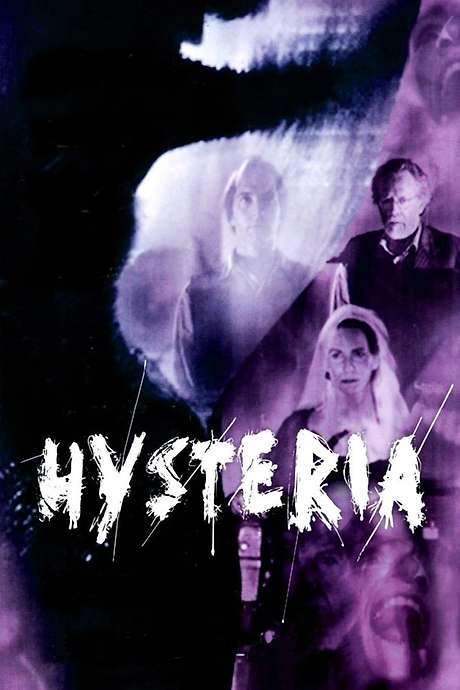
What Is Hysteria About?
The premise of Hysteria in 247 words, with nothing given away. The full story follows below.
In a stark, clinical asylum that feels more like a laboratory of dread, a radical scientific program seeks to knit together the minds of its patients, forging a single, collective consciousness. The film blends cold‑war sci‑fi horror with the lurid grit of grindhouse cinema, creating an atmosphere where sleek technology collides with raw, unsettling human desire. Every hallway hums with the promise—and the threat—of a society that could erase individuality in pursuit of a perfect, synchronized order.
At the heart of the experiment is Harvey Langston, a charismatic psychiatrist whose unconventional methods push the boundaries of ethics and empathy. He is joined by Myrna Malloy, a wheelchair‑bound former dancer whose lingering passion for ballet becomes a powerful and enigmatic force within the shared mental landscape. Their interactions hint at a fragile balance between control and surrender, suggesting that the very act of linking minds may amplify both the beauty and the volatility of each participant.
Meanwhile, Samuel Fry arrives with a more conventional medical mindset, drawn into the institution’s web by his concern for Veronica Bloom, a troubled patient whose fragile state challenges the limits of conventional treatment. Fry’s compassion places him at a crossroads between the alluring possibilities of the collective experiment and the lingering pull of personal connection. As the hospital’s corridors pulse with the low‑grade glow of machines and whispered psychoses, the film invites viewers to contemplate the cost of unity, the allure of shared experience, and the uneasy tension between freedom and conformity.
What Happens in Hysteria?
The complete story of Hysteria, from the first scene to the last, in 393 words (about 2 minutes). Spoilers throughout. Names in the text link to 4 cast member pages.
Spoilers ahead
The inmates of a psychiatric hospital are subjected to radical experiments: chips implanted to fuse their brains into a single, shared consciousness, with the aim of creating the perfect citizen. Dr. Harvey Langston leads this work, seeking to connect the minds of a group of patients and exploring the profound implications for the collective psyche. As the process unfolds, the spirit and soul of each person blend into a larger whole, allowing the patients to share each other’s psychoses, dreams, and even sexuality, while the pain of violence becomes a shared burden. Within this new unity, one voice stands above the rest: Myrna Malloy, a wheelchair-bound former dancer whose enduring passion for ballet anchors and sometimes destabilizes the group, bending the collective will toward her own fierce presence.
Meanwhile, Dr. Samuel Fry finds himself drawn to his patient, Veronica Bloom, a psychotic woman who lacks the medications needed for her treatment. With no pharmaceutical options available, the medical team cannot safely control her, and Fry faces a painful choice: release Veronica despite the danger, knowing she will likely become dependent on prescription drugs and exist in a diminished, “zombie” state. Fry escorts Veronica to Langston, hoping the renowned doctor can help, yet he remains unaware of how radical Langston’s methods have already become. As Fry uncovers the true workings of the asylum, a determined resolve to rescue Veronica forms—he must first locate Veronica’s spirit, which has detached itself from her body.
But the magnetic force of Myrna Malloy pulls Fry toward her, redirecting his affection away from his original motives. Fry’s reverence for Langston—who has chosen him as a successor—also erodes his resistance to Myrna’s influence. Over time, Fry slides toward complicity, a drift amplified by the unsettling truth that Langston has long since transferred his own consciousness into a younger colleague’s body. The implanted patients are released back into the wider community, and Langston’s plan expands: to turn more people into controlled automatons who must rely on one another to function in almost flawless harmony. Yet Langston’s test group grows into a monstrous mirror of his ambitions, willing to use any means—including violence—to ensure its own survival, threatening everything outside the asylum’s walls. The result is a tense meditation on power, identity, and the costs of a society that seeks to perfect itself by overriding the very humanity it aims to protect.
Hysteria Timeline: Every Key Event in Order
12 key events in the order they happen, from “Initiation of the Brain-Connection Experiments” to “Fry Joins the Project”. 12 events name a place, across 7 locations.
- 1
Initiation of the Brain-Connection Experiments
Dr. Harvey Langston oversees implants that connect several patients' brains, creating a rudimentary collective consciousness. The network allows thoughts, emotions, and memories to cross between the subjects. This experiment aims to forge what the doctors call a 'perfect citizen' through shared minds.
Where:psychiatric hospital
- 2
The Rise of Collective Psyche
Connected minds begin sharing psychoses, dreams, and even sexuality. The pain and violence of one person is felt by all, muting the impulse to harm others.
Where:psychiatric hospital
- 3
Myrna Malloy Emerges as Dominant Spirit
Among the linked minds, Myrna Malloy's spirit becomes strongest and begins to dominate others. She remains in a wheelchair but exerts control over the others' emotions and impulses.
Where:shared-mind network, hospital
- 4
Myrna's Ballet-Passion Persists
Despite dependence on others, Myrna's dancer's passion endures. Within the shared mind, her drive for ballet remains a defining force.
Where:shared-mind network
- 5
Fry Falls for Veronica Bloom
Dr. Samuel Fry falls for Veronica Bloom, a psychotic patient lacking needed meds. With Veronica's danger to herself and others, Fry contemplates releasing her despite the risks.
Where:psychiatric hospital
- 6
Fry Brings Veronica to Langston
Fry brings Veronica to Langston, hoping the doctor can aid her survival and treatment. Langston is unaware of how radical his methods have become at this point.
Where:Langston's lab
- 7
Fry Discovers Langston's Radical Methods
As Fry learns what is happening in the asylum, he resolves to free Veronica from Langston's clutches. To do so, he must locate Veronica’s spirit that has detached from her body.
Where:asylum / Langston's lab
- 8
Myrna Redirects Fry's Affection
Myrna uses her influence within the shared consciousness to redirect Fry's love toward herself. This manipulation weakens Fry's resolve and strengthens his susceptibility to Langston's control.
Where:shared-mind network
- 9
Langston Transfers His Consciousness
Langston has long since transferred his own consciousness into a younger colleague's body, continuing his experiments through the new vessel. The move allows Langston to dodge consequences and prolongs the experiment.
Where:Langston's lab
- 10
Implanted Humans Return to the Community
The implanted humans are released back into the community, spreading the shared consciousness beyond the hospital. The plan is to create more automatons who rely on collective harmony to function.
Where:community
- 11
The Test Group Becomes a Monster
Langston's test group evolves into a monster that will do whatever it takes to survive, including violence. The network's cohesion has the potential to override individual ethics.
Where:community / hospital
- 12
Fry Joins the Project
Fry's resistance crumbles as Myrna's manipulation and Langston's influence pull him into participation. The doctor who sought to save Veronica becomes part of the plan.
Where:Langston's lab
Who Are the Main Characters in Hysteria?
4 characters, among them Myrna Malloy (Amanda Plummer), Dr. Harvey Langston (Patrick McGoohan) and Veronica Bloom (Emmanuelle Vaugier): who each one is and the part they play in the story. Every profile links to the actor’s page.
-

Myrna Malloy (Amanda Plummer)
Played by Amanda Plummer
Wheelchair-bound former dancer whose fierce spirit persists within the shared consciousness. Her vitality and artistic memory remain potent, and she uses the others to meet her needs while asserting dominance over the group. Her ballet passion continues to haunt the collective mind, making her the strongest and most influential presence among the patients.
- 🧠 Collective consciousness
- 💃 Former dancer
- 👥 Shared psyche
- DH
Dr. Harvey Langston (Patrick McGoohan)
Played by Patrick McGoohan
Brilliant but ruthless scientist driving the brain-link experiments. He secretly transfers his consciousness into a younger body, guiding the project with a chilling certainty that the end justifies the means. He envisions a new kind of citizen and treats autonomy as a controllable variable in his experiment.
- 🧪 Experimentation
- 🧠 Consciousness transfer
- 🏛️ Authority
- VB
Veronica Bloom (Emmanuelle Vaugier)
Played by Emmanuelle Vaugier
A psychotic patient who, when untreated, poses a danger to herself and others. She relies on prescription drugs, and the doctors’ inability to medicate her safely leaves her vulnerable. As the collective consciousness takes hold, her spirit becomes detached from her body, intensifying the peril she represents.
- 🧬 Psychosis
- 💊 Dependency
- ⚠️ Danger
- DS
Dr. Samuel Fry (Michael Maloney)
Played by Michael Maloney
A physician who falls in love with Veronica Bloom, initially acting out of concern but gradually drawn into Langston’s radical methods. He seeks to help Veronica, yet his loyalty wanes as he becomes a willing participant in the experiment. Fry’s arc centers on the tension between medical ethics and personal attachment.
- ❤️ Love
- 🧭 Ethical dilemma
- 🧠 Medical ethics
Where and When Is Hysteria Set?
Hysteria is set in Psychiatric hospital and Asylum. Here is why the place matters to the story.
Where
Psychiatric hospital, Asylum
The story unfolds inside a psychiatric hospital that also serves as a laboratory for radical brain-link experiments. The sterile corridors and dim wards become the proving ground for a controversial project aimed at creating a perfect citizen. The institution embodies the tension between care and control, as patients are wired into a shared consciousness.
- 🏥 Psychiatric setting
- 🧪 Experimental facility
What Are the Themes of Hysteria?
3 ideas the story keeps returning to, among them Collective Consciousness, Ethical Boundaries and Love vs Control.
-
01
Collective Consciousness
The experiments fuse individual minds into a single collective psyche, allowing each patient to share psychoses, dreams, and even sexuality. Pain and pleasure ripple through the group as actions in one mind affect all others. Dominance emerges when one spirit—Myrna Malloy—overpowers the rest, illustrating how a shared mind can still yield a hierarchical dynamic. The theme questions what remains of individuality when minds are linked.
-
02
Ethical Boundaries
The project proceeds with little regard for consent, turning patients into test subjects for a grand social experiment. The pursuit of harmony through control reveals a chilling disregard for autonomy and dignity. Langston’s ambition to propagate his method shows the peril of scientific arrogance unchecked by ethics. The plan to release altered humans back into society exposes the fragility of moral boundaries.
-
03
Love vs Control
Dr. Fry’s romantic involvement with Veronica Bloom becomes a personal battleground amid the larger mechanization of minds. His initial compassion clashes with the lure of Langston’s power, gradually pulling him toward complicity. Myrna’s manipulation of Fry’s affections further accelerates the erosion of his resistance. The rivalry between affection and domination underscores how intimate bonds can be weaponized in pursuit of a cold, controlled order.
What Kind of Film Is Hysteria?
Dark in tone, with steady pacing and a complex story, going by the plot summary.
- Tone
- Dark
- Pacing
- Steady
- Story
- Complex
- Intensity
- High
- Ending
- Bleak
An oppressive and claustrophobic psychological horror film that steadily builds tension through its disturbing premise of fused consciousness, creating a deeply unsettling atmosphere of identity loss and institutional control.
- oppressive
- claustrophobic
- unsettling
- psychologically intense
- dystopian
- frenetic
- psychological horror
- medical ethics
- identity loss
- collective consciousness
Content notes: psychological trauma, medical experimentation, implied violence, loss of identity.
Quiz
How well do you remember Hysteria? Test yourself on the story.