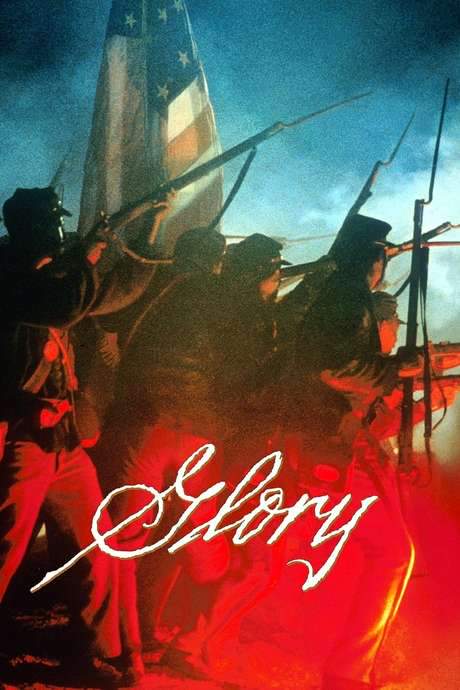
Glory 1989


Directed by

Edward Zwick
Made by

Freddie Fields Productions
Where to Watch Glory
See current US streaming, rental, and purchase options for Glory (1989) via JustWatch.

Sony Pictures Core Amazon Channel
4K
Tubi TV
SD
Amazon Video
4K
Apple TV Store
4K
Fandango At Home
4K
Google Play Movies
SD
Spectrum On Demand
HD
YouTube
SD Streaming availability powered by 
Glory Plot Summary
Read the complete plot summary and ending explained for Glory (1989). From turning points to emotional moments, uncover what really happened and why it matters.
During the Civil War, Captain Robert Shaw is wounded at Antietam and returns home to Boston on medical leave. Shaw, elevated to Colonel to command the 54th Regiment Massachusetts Volunteer Infantry—one of the Union Army’s first Black regiments—asks his friend Maj. Cabot Forbes to serve as his second in command. Their first volunteer is a mutual friend, Thomas Searles, a bookish, free African-American. Other recruits quickly join the ranks, including John Rawlins as a trusted aide, Pvt. Jupiter Sharts, a mute drummer, and Pvt. Trip, a wary young man who will grow into his role in the regiment.
After the Emancipation Proclamation, the men of the 54th learn a brutal fact: the Confederacy plans to execute any Black soldiers captured in Union uniforms along with their white officers. Despite this deadly threat, the volunteers refuse an offer to be honorably discharged and endure demanding training under the stern discipline of Sgt. Maj. Mulcahy. Tensions rise when Trip is arrested for AWOL and flogged; Shaw discovers the root cause—Trip had left camp to replace worn-out shoes. Shaw confronts the base’s racist quartermaster, who has been withholding supplies. When the men find out that the Federal government pays Black soldiers about three-quarters the salary of white soldiers, Trip urges a collective refusal of pay, and Shaw tears up his own pay stub in solidarity. In recognition of his mentorship and his empathy for the troops’ morale, John Rawlins is promoted to Sergeant-Major.
Once the core is formed and the men are properly trained, the 54th comes under the command of Gen. Charles Garrison Harker and is ordered by Col. James Montgomery to sack and burn Darien, Georgia. Shaw initially refuses this directive, but agrees under the threat of being relieved of duty. He’s increasingly tired of seeing his men used for brutal labor and raids on civilians, and he makes clear to Harker and Montgomery that he will report profiteering to the War Department unless the 54th is given a true combat assignment.
The regiment then goes into action at James Island, South Carolina, repelling a Confederate assault. Thomas Searles is wounded in the action but saves Trip’s life in the process. Shaw offers Trip the honor of bearing the regimental flag in battle, but Trip declines, uncertain that the war will bring about a better life for enslaved people.
General George Strong later informs his regimental commanders of a major campaign aimed at securing a foothold at Charleston Harbor, describing the initial assault on Morris Island and the frontal assault required on Fort Wagner. Shaw volunteers the 54th for the mission. The night before the attack, the Black soldiers hold a religious service, give thanks, and seek divine assistance. The next morning, the 54th advances to the assault amid cheers from Union troops who had previously taunted them.
The assault on Fort Wagner is devastating; the 54th suffers heavy losses as they advance across the open beach and take cover in the dunes as darkness falls. Shaw is killed while trying to rally his men. Trip lifts the regimental flag and leads the survivors toward the fort, brandishing the banner until he is mortally wounded. Forbes leads a party into the fort’s outer defenses where Charlie Morse is killed, and Thomas is wounded. A small number of survivors, including Forbes, Rawlins, Thomas, and Jupiter, press forward to face a Confederate gun, and the screen fades to black, implying their deaths.
In the days that follow, Confederate soldiers remove the bodies of Union troops from the beach, raise the Confederate flag over the fort, and bury the fallen in a mass grave. Shaw’s body slides into the same trench where Trip lies, a stark image of the cost of battle. An epilogue notes that although Fort Wagner was never captured, the courage displayed by the 54th helped persuade the Union Army to recruit thousands of Black soldiers for combat—a turning point President Abraham Lincoln credited with helping to shift the war’s momentum.
Glory Timeline
Follow the complete movie timeline of Glory (1989) with every major event in chronological order. Great for understanding complex plots and story progression.
Shaw's return and recruitment of the 54th
Captain Robert Shaw is wounded at Antietam and returns home to Boston on medical leave. He accepts promotion to Colonel and takes command of the newly formed 54th Massachusetts Volunteer Infantry. He recruits a diverse group of volunteers, including Cabot Forbes, Thomas Searles, John Rawlins, Jupiter Sharts, Trip, and a mute drummer.
Post-Emancipation realities and grueling training begins
Following the Emancipation Proclamation, the 54th is told that Confederate forces will execute Black soldiers in Union uniforms along with their white officers. Despite this, the men decline an honorable discharge and begin rigorous training under Sergeant-Major Mulcahy.
Trip’s AWOL and punishment
Trip is arrested for being AWOL and is flogged. Shaw learns he left camp to replace his worn-out shoes, exposing the strain on the troops and the fragility of discipline.
Shaw confronts the racist quartermaster
Shaw directly confronts the base's racist quartermaster who is withholding supplies from the unit. The confrontation highlights the systemic racism and the obstacles Black soldiers face even before seeing combat.
Pay inequity sparks a collective stance
The men learn that Black soldiers are paid about three-quarters of what white soldiers receive. Trip encourages them to refuse their pay, and Shaw tears up his own pay stub in solidarity with the others.
Rawlins earns a promotion
Thomas Searles, known for his bookish intellect and leadership, is promoted to Sergeant-Major in recognition of his mentorship and morale-boosting counsel to the younger troops.
Orders to Darien: a brutal assignment proposed
Under General Charles Harker and Colonel James Montgomery, the 54th is ordered to sack and burn Darien, Georgia. Shaw initially refuses the assignment, but agrees under threat of relief from command.
Shaw demands a combat role
Tired of seeing his men used for manual labor and raids on civilians, Shaw tells Harker and Montgomery he will report profiteering to the War Department unless the 54th is given a combat assignment.
First combat: James Island
The 54th goes into battle at James Island, South Carolina and repels a Confederate attack. Thomas Searles is wounded while saving Trip's life, demonstrating the unit's courage under fire.
General Strong outlines a Charleston campaign
General George Strong informs the regimental commanders of a major campaign to secure Charleston Harbor, describing Morris Island and the foreboding Fort Wagner as the next objective. Shaw volunteers the 54th for the assault.
Religious service before the attack
The night before the assault on Fort Wagner, the Black soldiers hold a religious service to give thanks and seek God’s help. The moment underscores their resolve and unity in the face of danger.
The assault on Fort Wagner
At dawn, the 54th makes a frontal assault on Fort Wagner and suffers devastating losses as they advance across the open beach. Shaw is killed during the assault, and Trip lifts the regimental flag, guiding the remaining troops toward the fort before he is mortally wounded. Forbes leads a party into the fort's outer defenses where Charlie Morse is killed and Thomas is wounded. A small group of survivors, including Forbes and Rawlins, faces a Confederate gun as the scene fades to black.
Aftermath and burial
After sunrise, Confederate soldiers recover the bodies and raise their flag over the fort while burying the fallen in a mass grave. Shaw's body is found in the trench beside Trip, symbolizing their shared sacrifice.
Epilogue: impact on the war effort
The epilogue notes that although Fort Wagner was not captured, the 54th's courage helped persuade the Union Army to recruit thousands more Black soldiers for combat. President Lincoln credits this shift as a turning point in the war.
Glory Characters
Explore all characters from Glory (1989). Get detailed profiles with their roles, arcs, and key relationships explained.
Col. Robert Gould Shaw (Matthew Broderick)
Colonel Shaw is an idealistic Union officer who accepts command of the 54th Massachusetts. He grapples with orders that clash with his sense of justice and the regiment's dignity, ultimately pushing for fair treatment and bold combat assignments. His leadership is tested as he mentors Black soldiers and confronts racist structures.
Sgt. Maj. John Rawlins (Morgan Freeman)
A trusted senior noncommissioned officer and Shaw's key confidant. Rawlins helps maintain morale, guides younger soldiers, and earns a promotion in recognition of his mentorship and steady leadership under pressure.
Maj. Cabot Forbes (Cary Elwes)
Shaw's friend and second in command who handles strategic and logistical challenges. Forbes supports Shaw's vision while managing practical obstacles and keeping the regiment cohesive.
Pvt. Trip (Denzel Washington)
A Black private whose presence helps lead the unit and embodies the fight for dignity and equal treatment. He endures pay inequality and racial contempt, and is mortally wounded while bearing the regimental flag.
Thomas Searles (Andre Braugher)
A bookish, free African-American recruit whose intelligence and dignity anchor the group. He is a close ally to Shaw, illustrating Black leaders' aspirations within a segregated army.
Pvt. Jupiter Sharts (Jihmi Kennedy)
A mute drummer boy whose quiet presence and rhythm keep the unit marching under fire. He embodies the discipline and quiet strength of the 54th.
Capt. Charles Fessenden Morse (Donovan Leitch)
Captain Morse participates in the assault and, despite the risks, remains steadfast in facing duty. He is killed during the operation, symbolizing the cost of courage.
Gen. Charles Garrison Harker (Bob Gunton)
A Union general who commands the 54th's deployment and affiliations, including the controversial Darien operation. He embodies the strategic demands and controversies of wartime command.
Glory Settings
Learn where and when Glory (1989) takes place. Explore the film’s settings, era, and how they shape the narrative.
Time period
1861-1865
Set during the American Civil War in the 1860s, the narrative spans the emancipation era and the brutal campaigns that tested Black soldiers' courage. The period is marked by pay inequities, brutal discipline, and evolving attitudes toward Black troops in a predominantly white army. The story likewise highlights how leadership and morale shift under pressure.
Location
Boston, Antietam (Maryland), Darien, Georgia, James Island, South Carolina, Morris Island, Fort Wagner, Charleston Harbor
The film unfolds across key locations of the Civil War, beginning in a Union base in Boston and moving through coastal campaigns in Georgia and South Carolina. Its settings span fortifications, sieges, and towns altered by wartime violence. Each location centers the experiences and sacrifices of the 54th Massachusetts Volunteer Infantry as they confront racism and seek recognition.
Glory Themes
Discover the main themes in Glory (1989). Analyze the deeper meanings, emotional layers, and social commentary behind the film.
🗽
Equality
The story centers on Black soldiers seeking equal recognition and pay within the Union Army. The recruits confront systemic racism in training, assignments, and compensation. Leadership and mentorship help sustain morale as they endure harsh conditions. Their courage reframes what freedom and citizenship mean in wartime.
⚖️
Justice
Shaw and his men confront profiteering, unequal pay, and orders that treat Black troops as expendable. Shaw's insistence on fairness and accountability tests his authority and ethics. The film uses these tensions to explore moral choices in war and the cost of systemic discrimination.
🛡️
Courage
The assault on Fort Wagner becomes a defining act of bravery under extreme fire. The 54th's discipline and willingness to sacrifice inspire a broader reckoning about Black soldiers' contributions. The film honors those sacrifices and links courage to the movement toward greater equality.

Coming soon on iOS and Android
The Plot Explained Mobile App
From blockbusters to hidden gems — dive into movie stories anytime, anywhere. Save your favorites, discover plots faster, and never miss a twist again.
Sign up to be the first to know when we launch. Your email stays private — always.
Explore the mobile appGlory Spoiler-Free Summary
Discover the spoiler-free summary of Glory (1989). Get a concise overview without any spoilers.
In the tumult of the American Civil War, a bold experiment takes shape within the Union army: the formation of its first volunteer regiment composed entirely of Black soldiers. Charged with leading this historic unit, Robert Gould Shaw—a young officer marked by both ambition and idealism—finds himself navigating a world where honor and prejudice clash on every marching ground. The regiment’s very existence challenges entrenched racism, prompting doubts not only from the enemy across the lines but also from within the Union’s own ranks, where skepticism about the men’s capabilities runs deep.
Beside Shaw stands his trusted confidant, Cabot Forbes, whose steady presence offers a counterpoint to the weight of command. Among the volunteers, a diverse tapestry of personalities emerges: the erudite and quiet Thomas Searles, whose intellect hints at a deeper resolve; the seasoned aide John Rawlins, whose experience grounds the fledgling company; the mute drummer Jupiter Sharts, whose rhythm becomes a silent heartbeat for the unit; and the wary yet resilient Trip, a young man whose journey from uncertainty to purpose mirrors the regiment’s own evolution. Together they form a brotherhood that must learn to trust one another while confronting the stark realities of war.
The atmosphere of the film balances stark realism with an undercurrent of hopeful defiance. Training camps become crucibles where discipline, dignity, and raw determination are forged against a backdrop of systemic inequity. The soldiers grapple with harsh conditions, unequal pay, and the looming threat of a conflict that treats their very identity as a weapon. Yet amid these trials, moments of quiet camaraderie and shared resolve illuminate a powerful collective spirit.
Through its vivid period details and emotionally resonant performances, the story invites viewers to witness a pivotal moment when courage reckons with prejudice, and a small band of volunteers steps onto the stage of history, determined to prove their worth in a nation torn apart.
Movies with Similar Twists and Themes
Uncover films that echo the narrative beats, emotional arcs, or dramatic twists of the one you're exploring. These recommendations are handpicked based on story depth, thematic resonance, and spoiler-worthy moments — perfect for fans who crave more of the same intrigue.




Featured on this page

What's After the Movie?
Not sure whether to stay after the credits? Find out!
Check out our other apps:

SAT Sphere
Build confidence for the Digital SAT.

Mori Atlas
Discover wild places worth protecting.

Luntero
Search smarter for a home in Amsterdam.

Plot Explained
Unravel movie endings and hidden clues.

Pokechamp
Dive into Pokémon data and battle logic.

Driving Theory
Get ready for your European theory test.

Movie Dust
Plan your next cinema trip with ease.

Musemap
Find art and culture as you travel.

Selkobase
Compare credentials before committing.

Local Manual
Turn an unfamiliar country into practical next steps.

Lernavi
Compare school systems before your next move.

GymRoam
Find a workout stop wherever your plans take you.
Explore Our Movie Platform
New Movie Releases (2026)
Famous Movie Actors
Top Film Production Studios
Movie Plot Summaries & Endings
Major Movie Awards & Winners
Best Concert Films & Music Documentaries
Movie Collections and Curated Lists
© 2026 What's After the Movie. All rights reserved.
Privacy Policy