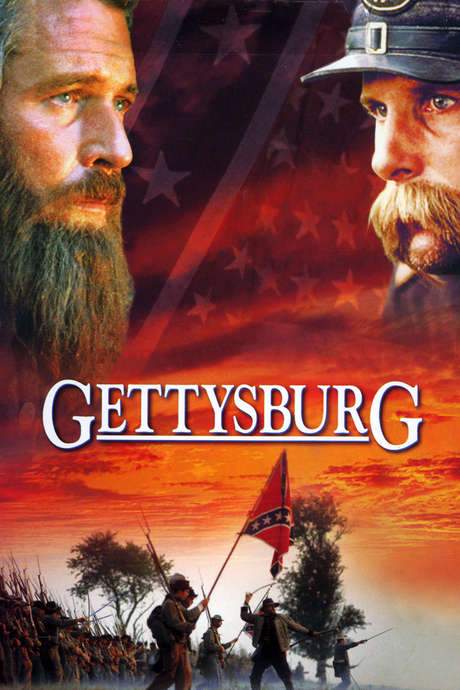
Gettysburg 1993

Directed by

Ronald F. Maxwell
Made by

Esparza / Katz Productions
Where to Watch Gettysburg
See current US streaming, rental, and purchase options for Gettysburg (1993) via JustWatch.






Gettysburg Plot Summary
Read the complete plot summary and ending explained for Gettysburg (1993). From turning points to emotional moments, uncover what really happened and why it matters.
The film opens with a narrated map tracing the Confederate Army of Northern Virginia, commanded by Gen. Robert E. Lee [Martin Sheen], crossing the Potomac in June 1863 and pushing north through Maryland into Pennsylvania. A tense intelligence moment follows when Confederate spy Henry Thomas Harrison informs Lt. Gen. James Longstreet [Tom Berenger] that the Union Army of the Potomac is moving toward them and that Union commander Joseph Hooker has been replaced by George Meade. Lee, wary of relying on “the word of an actor” rather than the word of his cavalry commander J. E. B. Stuart [Joseph Fuqua], ultimately orders the army to concentrate near Gettysburg, trusting the land and timing to shape their fate.
At Union encampments near Union Mills, Col. Joshua Lawrence Chamberlain [Jeff Daniels] of the 20th Maine faces a stark order: absorb 120 men from the disbanded 2nd Maine who had resigned in protest and drill them to fight. It’s a moment of moral grit as Chamberlain addresses the men, persuading all but six to stand and fight, setting a decisive tone for the Union’s stand on the ground ahead. The narrative widens to Gettysburg, where Brig. Gen. John Buford [Sam Elliott] and his cavalry scout the approach of Henry Heth’s division under A. P. Hill’s Third Corps, recognizing the Confederates will seize favorable high ground if allowed to entrench first. Buford acts with the terrain in mind, awaiting reinforcements from Maj. Gen. John F. Reynolds [John Rothman], who rides to the field with I Corps but is felled by a Confederate sharpshooter, a blow that shifts the balance of the first day. As the Union lines fall back to Cemetery Ridge, Lee orders Ewell to take the high ground “if practicable,” a directive that proves crucial in the day’s outcome. > “if practicable”
The Union regrouping continues on the second day as Col. Strong Vincent [Maxwell Caulfield] places his brigade to guard Little Round Top, and Chamberlain and the 20th Maine hold the exposed flank with dwindling ammunition and dwindling options. Vincent’s warning about the danger of a Confederate swing around the Union line resonates as Longstreet’s two available divisions deploy to seize Little Round Top and the neighboring Big Round Top. Maj. Gen. John Bell Hood [Patrick Gorman] protests the plan, aware that attacking uphill with the high ground against them would be costly, yet Longstreet presses forward. Hood sustains wounds that will linger from Devil’s Den, and the Union defense tightens around the summit where Chamberlain leads a stubborn bayonet charge described by him as sweeping like a door closing on the Confederates.
As dusk settles on the second day, Stuart finally arrives and Lee chides him for being out of contact, a reminder of the fragility of coordination in the field. The third day turns to the climactic assault: Lee commits three divisions—Pickett’s, Trimble’s, and Pettigrew’s—to strike the center of the Union line atop Cemetery Ridge. Longstreet expresses doubts about crossing a mile of open ground against a well-fortified foe behind a stone wall, but Lee authorizes the attack, coordinating artillery under Edward Porter Alexander [James Patrick Stuart] to clear the Union guns. The assault unfolds under heavy fire, and Hancock is wounded as he leads from the front. Armistead’s brigade breaches the wall but is ultimately repulsed; Armistead himself is wounded and captured, while Pickett’s men retreat under overwhelming losses.
The battle’s center of gravity shifts as the Confederate plan unfolds, and the narrative threads back to the broader arc of leadership under pressure. Lee’s confidence wavers as the lines crack, and the army begins to withdraw, signaling a turning point in the war that upper echelons must reckon with. The film closes by tracing the fates of the principal figures—leaders who rode out to shape a continent’s fate on that field—leaving viewers with a measured moral reflection on how strategy, courage, and timing intersected in a moment that would redefine a nation. Throughout, the weight of command—whether in the shadow of a field hospital or beneath a sweltering July sun—drives home the human costs and the stubborn resolve that defined Gettysburg.
Gettysburg Timeline
Follow the complete movie timeline of Gettysburg (1993) with every major event in chronological order. Great for understanding complex plots and story progression.
Confederate invasion crosses into the North
From a narrated map, the Confederate Army of Northern Virginia crosses the Potomac River and invades the North in June 1863, marching through Maryland into Pennsylvania. Lee aims to strike the Union on favorable ground while the army maneuvers toward Gettysburg. The maneuvering signals the coming clash between the two sides.
Harrison reports Union movement to Longstreet
On June 30, Confederate spy Henry Thomas Harrison informs Lt. Gen. James Longstreet that the Union Army of the Potomac is moving; Hooker has been replaced by Meade. Longstreet relays the information to Lee, who is wary of relying on a cavalry report. Lee orders concentration near Gettysburg despite doubts.
Lee concentrates near Gettysburg
Lee orders the army to concentrate near the town of Gettysburg after weighing the earlier reports. He wants to draw the Union into battle on ground of his choosing. The plan sets the stage for the climactic engagement in Pennsylvania.
Buford holds the ground at Gettysburg
Brig. Gen. John Buford's cavalry discerns the approaching Confederates and decides to stand on favorable terrain rather than retreat. He sends for reinforcements from Reynolds's I Corps. The Union army slows the Confederate advance, buying time for defenses.
Reynolds killed; Union retreats to Cemetery Ridge
Reynolds arrives to reinforce Buford but is killed by a Confederate sharpshooter. The Union army is pushed back from Gettysburg to Cemetery Ridge as Lee's forces press forward. Ewell is ordered to take the Union positions 'if practicable' but hesitates.
Stuart arrives; Lee reprimands him
That evening, Confederate cavalry chief J. E. B. Stuart finally arrives at headquarters, prompting Lee to reprimand him for being out of contact. Longstreet's second division also arrives; Pickett's division comes later. The command confusion underscores the mounting pressures on the Confederate side.
Little Round Top defended by Vincent and Chamberlain
On July 2, Col. Strong Vincent's brigade deploys to Little Round Top, placing the 20th Maine at the end of the line. Chamberlain persuades the remaining 2nd Maine soldiers to fight, reinforcing the line at the crucial flank. The Union defense secures a vital position on the battlefield.
Longstreet orders Hood to attack at Little Round Top; Hood wounded
Lee orders Longstreet to deploy two divisions to attack Little Round Top. Hood's assault is launched despite protests, and Hood is wounded at Devil's Den. The Union defense holds the high ground for now.
Chamberlain's bayonet charge secures the flank
As ammunition runs low on the Union side, Chamberlain orders a dramatic bayonet charge and a right-wheel drive down the slope. The attack sustains the Union flank and repels the Confederate onslaught.
Day Two ends with Confederate repositioning
Stuart's late arrival and Pickett's divisions moving into position mark the end of a tense second day. Lee reprimands Stuart for the delay while Longstreet's forces prepare for the next phase.
Three-division assault planned for Cemetery Ridge
On July 3, Lee orders a coordinated assault with Pickett, Trimble, and Pettigrew against the Union center at Cemetery Ridge. Longstreet expresses doubts that the attack will succeed, given the well-fortified Union defense behind a stone wall.
Alexander's artillery fails to clear Union guns
General Porter Alexander commands artillery to silence the Union guns on the ridge but struggles to make an impact. Despite heavy fire, Confederate artillery cannot break the line, hampering the planned assault.
Armistead crosses the wall; Armistead wounded and captured
One of Pickett's brigades, commanded by Lewis Armistead, crosses the Union stone wall but Armistead is wounded and captured. The Union troops respond fiercely, and the Confederate assault loses momentum under mounting casualties.
Lee orders withdrawal after the failed assault
Witnessing the heavy losses, Lee withdraws his forces in retreat that evening. The fighting at Gettysburg ends with the Union holding the ridge and the Confederates retreating to the south.
Conclusion: fates of major figures
The film closes by showing the fates of the major generals and leaders involved in the battle, reflecting on the enormous costs and consequences of the clash. The narrative ties together the strategic and personal arcs that defined the three-day struggle.
Gettysburg Characters
Explore all characters from Gettysburg (1993). Get detailed profiles with their roles, arcs, and key relationships explained.
Gen. Robert E. Lee (Martin Sheen)
Lee commands the Confederate Army of Northern Virginia and drives the invasion into the north. He weighs intelligence, cavalry reports, and the risk of overreaching, ultimately ordering a concentrated effort near Gettysburg. The film presents him as capable, strategic, and occasionally hampered by imperfect information, especially regarding the reliability of Stuart’s intelligence. His decisions shape the campaign and its ultimate fate.
Maj. Gen. George E. Pickett (Stephen Lang)
Pickett leads one of Lee’s divisions in the climactic assault on Cemetery Ridge. He embodies resolve and a sense of duty, but his charges are tested by heavy fire and organisational constraints. His leadership under pressure culminates in the infamous failed charge that becomes a turning point of the battle.
Brig. Gen. John Buford (Sam Elliott)
Buford commands cavalry and recognizes the strategic importance of terrain, delaying the Confederates to buy time for reinforcements. He prioritizes delaying action and terrain exploitation over a decisive engagement. His early decisions set the tone for Union defense on day one.
Col. Joshua Lawrence Chamberlain (Jeff Daniels)
Chamberlain commands the 20th Maine and inspires reluctant soldiers to fight. He leads a risky defense at Little Round Top, fixing bayonets and executing a critical counterattack. His leadership exemplifies courage, resourcefulness, and the power of morale in turning the tide.
Maj. Gen. John F. Reynolds (John Rothman)
Reynolds is the Union corps commander who drives initial action and is killed by a Confederate sharpshooter, illustrating the fragility of command early in the battle. His presence signals the volatility of battlefield leadership and the costs of casualties at the top.
Maj. Gen. Isaac R. Trimble (William Morgan Sheppard)
Trimble voices frustration with Ewell’s inaction and speaks to the higher stakes of tactical indecision. He embodies the tension between initiative and hesitation within Confederate command.
Maj. Gen. Longstreet (Tom Berenger)
Longstreet argues against the open-field attack, preferring a more cautious deployment. He provides strategic counterpoint to Lee’s boldness and forges the tension between theory and execution. His skepticism and experience shape critical battlefield decisions.
Brig. Gen. Lewis A. Armistead (Andrew Prine)
Armistead commands a brigade in Pickett’s division and reaches the Union lines at Cemetery Ridge before being wounded and captured. He embodies noble sacrifice and brave persistence amid overwhelming odds.
Brig. Gen. J. Johnston Pettigrew (George Lazenby)
Pettigrew leads one of the Confederate divisions in the center-right assault. He faces the daunting task of crossing open ground under heavy fire, contributing to the day’s brutal charges.
Col. Edward Porter Alexander (James Patrick Stuart)
Alexander leads the artillery and coordinates the Confederate bombardment that precedes the infantry assault. His decisions set the stage for the ensuing ground battle.
Gettysburg Settings
Learn where and when Gettysburg (1993) takes place. Explore the film’s settings, era, and how they shape the narrative.
Time period
1863
The narrative unfolds during the summer of 1863, beginning with Lee's invasion across the Potomac into Maryland and Pennsylvania. The fighting spans three days, July 1–3, with strategic maneuvers by both sides and shifting fortunes. The outcome hinges on critical moments such as Buford's delaying actions, Chamberlain's defense on Little Round Top, and Pickett's Charge.
Location
Gettysburg, Union Mills, Seminary Ridge, Cemetery Ridge, Little Round Top, Big Round Top, Devil's Den, Maryland, Pennsylvania
The action centers around the town of Gettysburg in Pennsylvania, where Union and Confederate forces converge during the 1863 campaign. Key locations include Union Mills, Cemetery Ridge, Seminary Ridge, and Little Round Top, which frame the battle's turn and the defense. The terrain—ridge lines, open fields, and wooded slopes—becomes a decisive factor shaping tactical decisions and casualty outcomes.
Gettysburg Themes
Discover the main themes in Gettysburg (1993). Analyze the deeper meanings, emotional layers, and social commentary behind the film.
⚔️
Leadership Under Pressure
Military leaders are forced to make quick, consequential choices under fire. Buford, Chamberlain, Longstreet, and Lee each navigate competing priorities and imperfect information. The film shows how decisive leadership, morale, and resolve can tilt the balance in a chaotic battlefield. Personal courage and the burden of command are foregrounded in critical moments.
🧭
Strategy vs. Pragmatism
Strategic plans clash with on-the-ground realities as Lee debates deployment with Longstreet and then orders a major assault. Longstreet questions attacking across open ground; Lee insists on leveraging the center attack. The tension between bold offensives and prudent defense drives the narrative and determines the campaign's fate.
💔
Sacrifice and Resolve
The battle demands immense willingness to endure losses for a larger objective. Soldiers fight with limited ammunition, through lethal fire, and at great personal risk. The film underscores the human cost—the casualties, injuries, and the ultimate withdrawal of Lee's army. It frames sacrifice as a defining element of both the battle and the men who fought it.
🗺️
Terrain and Opportunity
Ground shapes every decision, from Buford's choice of 'lovely ground' to Chamberlain's use of Little Round Top. Control of high ground and terrain features becomes the key to holding lines and launching counterattacks. The landscape dictates tempo, casualties, and the arc of the three-day engagement.

Coming soon on iOS and Android
The Plot Explained Mobile App
From blockbusters to hidden gems — dive into movie stories anytime, anywhere. Save your favorites, discover plots faster, and never miss a twist again.
Sign up to be the first to know when we launch. Your email stays private — always.
Explore the mobile appGettysburg Spoiler-Free Summary
Discover the spoiler-free summary of Gettysburg (1993). Get a concise overview without any spoilers.
In the sweltering summer of 1863, the rolling fields of Pennsylvania become a crossroads of destiny. Two great armies, each guided by a distinct vision of America’s future, converge on a modest town whose name will echo through history. The film opens with a sweeping sense of inevitability: a Confederate force marching northward, a Union army entrenched in a defensive posture, and the quiet, stubborn landscape that will bear the weight of their ambitions. Light and shadow play across the horizon, hinting at the magnitude of the clash that looms without yet revealing its outcome.
General Robert E. Lee commands the Confederate Army of Northern Virginia with a blend of charisma and calculated daring, determined to carry the war into enemy territory and force a decisive resolution. Beside him, James Longstreet offers a cautious strategic mind, while the elusive cavalry chief J. E. B. Stuart haunts the periphery, embodying both the brilliance and the frustration of a command struggling to stay connected. Their interactions are underscored by a shared belief in destiny, yet each carries personal doubts that surface in whispered counsel and tense deliberations. The atmosphere around Lee’s camp is one of disciplined optimism, tinged with the restless urgency of men aware that the coming days will test everything they hold dear.
Across the field, General George G. Meade has just assumed command of the Union’s Army of the Potomac, inheriting a force that must quickly coalesce around a defensive strategy. His leadership is pragmatic, focused on the terrain and the logistics of holding a line against a formidable opponent. The Union side is further defined by the stoic resolve of Colonel Joshua Lawrence Chamberlain, a professor‑turned‑officer who wrestles with the responsibility of shaping raw recruits into a fighting unit. Meanwhile, Brig. Gen. John Buford and Maj. Gen. John F. Reynolds bring a keen appreciation for the land’s features, understanding that the very hills and ridges may become as decisive as any battle plan. Their camaraderie is marked by a steady, almost reverent, respect for the soldiers under their command.
The film’s tone balances stark realism with a lingering poetic quality, inviting viewers to feel the weight of command, the echo of marching boots, and the quiet moments when leaders confront their own convictions. Through murmured orders, measured glances, and the ever‑present hum of a restless countryside, the narrative builds a tension that feels both inevitable and profoundly human, leaving the audience poised on the edge of history without yet revealing its final shape.
Movies with Similar Twists and Themes
Uncover films that echo the narrative beats, emotional arcs, or dramatic twists of the one you're exploring. These recommendations are handpicked based on story depth, thematic resonance, and spoiler-worthy moments — perfect for fans who crave more of the same intrigue.



Featured on this page

What's After the Movie?
Not sure whether to stay after the credits? Find out!
Check out our other apps:

SAT Sphere
Build confidence for the Digital SAT.

Mori Atlas
Discover wild places worth protecting.

Luntero
Search smarter for a home in Amsterdam.

Plot Explained
Unravel movie endings and hidden clues.

Pokechamp
Dive into Pokémon data and battle logic.

Driving Theory
Get ready for your European theory test.

Movie Dust
Plan your next cinema trip with ease.

Musemap
Find art and culture as you travel.

Selkobase
Compare credentials before committing.

Local Manual
Turn an unfamiliar country into practical next steps.

Lernavi
Compare school systems before your next move.

GymRoam
Find a workout stop wherever your plans take you.
Explore Our Movie Platform
New Movie Releases (2026)
Famous Movie Actors
Top Film Production Studios
Movie Plot Summaries & Endings
Major Movie Awards & Winners
Best Concert Films & Music Documentaries
Movie Collections and Curated Lists
© 2026 What's After the Movie. All rights reserved.
Privacy Policy