
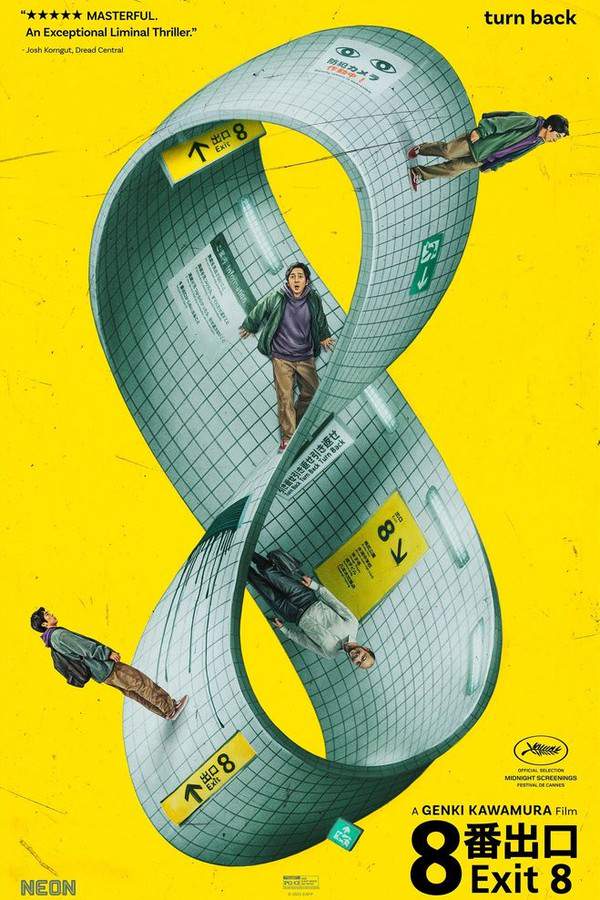
What Is Exit 8 About?
The premise of Exit 8 in 283 words, with nothing given away. The full story and the ending follow below.
Based on the worldwide-popular video game by Kotake Create, Exit 8 plunges viewers into the unsettling atmosphere of a liminal space where the ordinary rules of reality no longer apply. The story centers on The Lost Man, a commuter whose routine subway journey takes a surreal turn after a moment of personal failure and a sudden asthma attack. Plagued by doubts about his future and haunted by a distressing encounter with a stranger, he finds himself trapped in a sterile, endless corridor that exists outside the boundaries of the bustling city he once knew.
This sterile purgatory operates on a singular, chilling logic: the only way to reach the elusive Exit 8 is through hyper-observation. The Lost Man must scrutinize every detail of his surroundings, looking for anomalies—irregularities that signal he must turn back immediately. Ignoring these strange distortions allows him to move forward, but a single oversight resets his ordeal, sending him all the way back to the beginning. The corridor becomes a psychological maze where the stakes are not just physical entrapment, but a test of his mental fortitude and attention to detail.
As he navigates this looping nightmare, the line between reality and hallucination begins to blur. He is not entirely alone in his struggle; the appearance of a stoic Walking Man and a silent Boy suggests that other forces are at play within the loop. The film weaves a tense narrative about perception and courage, challenging its protagonist to notice what others overlook. Caught between the pressure of the anomaly-filled corridor and the weight of his own conscience, The Lost Man must determine if the path to freedom requires something more than just spotting the differences in a hallway.
What Happens in Exit 8?
The complete story of Exit 8, from the first scene to the last, in 622 words (about 3 minutes). Spoilers throughout.
Spoilers ahead
In the dim glow of a subway platform, The Lost Man [Kazunari Ninomiya] witnesses a man scolding a mother for her crying baby, a moment that presses hard on his sense of responsibility just as his girlfriend reveals she’s pregnant, asking him what he’ll do. A stark moment of doubt washes over him, and a sudden asthma attack forces him to confront whether he’s fit to become a father. The scene blurs and then drifts into a surreal, deserted corridor that loops on itself, a place where reality seems to stretch and snap at the edges of fear and resolve.
On the wall, a set of instructions appears, and The Lost Man discovers that progress depends on a strange rule: he must reach Exit 8 by turning back whenever the corridor presents an anomaly, and move forward when it remains still. Any misstep, any deviation from this fragile pattern, sends him all the way back to Exit 0, resetting the fragile progress he’s managed to claw out of the endless maze. The tension intensifies with each loop, as doors gain or lose their knobs, and rain of blood from the ceiling punctuates the bizarre math of survival.
In one loop, he encounters The Boy [Naru Asanuma], a small child who has been quietly shadowing The Walking Man [Yamato Kôchi], an unresponsive figure who seems to drift through every iteration of the corridor. Through a spare, haunting flashback, it’s revealed that The Walking Man was once lost too, but chose a false Exit 8, abandoning The Boy and becoming part of the loop itself. The Boy, initially reticent, proves perceptive and steadfast, slowly building trust with The Lost Man. He shares the truth of his own fear—he ran away from his mother—and offers a small hermit crab shell as a talisman of luck.
As they navigate deeper into the maze, the corridor turns suddenly dark, and a swarm of bald rats with human body parts bursts from the vents, their cries rising to a dreadful crescendo. The two protagonists sprint for safety, the claustrophobic walls closing in as the rats’ eerie wails echo behind them.
When they reach Exit 6, a blaring siren cuts through the air and the scene shifts to floodwaters that surge through the corridor. The Lost Man acts with quick courage, lifting The Boy above the rising water and keeping him safe as he himself is swept away by the tide. In a stark reversal of reality, The Boy finds himself on a beach, with his parents nearby, while The Lost Man and his girlfriend regain consciousness elsewhere. The Beach scene is fleeting yet visceral, a dreamlike waypoint that offers a glimmer of what could be real. Afterward, The Boy returns to the labyrinth, stepping toward Exit 8 once more, now sure of the path.
Back in the real world, The Lost Man materializes in a moment of clarity and calls his girlfriend, promising to meet her at the hospital. He steps onto a crowded subway car, and as the space fills with the hum of strangers, he hears the same baby’s cry and the same sharp admonition from a passerby about the mother’s child. This time, he gathers the resolve he’s been seeking and confronts the rude man, choosing to stand up for the vulnerable moment by moment, just as he has learned to navigate the echoes of the maze.
Throughout this ascent from doubt to action, the story threads a quiet, persistent message: that fatherhood, responsibility, and connection can emerge from the most disorienting loops of fear, memory, and choice. The journey tests not only the nerves but the heart, and it asks whether courage can be found in the very corridors that threaten to erase it.
Exit 8 Timeline: Every Key Event in Order
12 key events in the order they happen, from “Subway crisis and life-changing news” to “Final confrontation on the subway”. 12 events name a place, across 10 locations.
- 1
Subway crisis and life-changing news
On the subway, The Lost Man witnesses a passenger berating a mother for her crying baby. He then receives a phone call from his girlfriend, who reveals she is pregnant with his child and asks what he should do. The moment is underscored by the word Test appearing on his face, foreshadowing his emerging self-doubt about becoming a father.
When:Morning commute Where:Subway
- 2
Sudden plunge into an endless corridor
After the phone call, The Lost Man collapses from an asthma attack and finds himself inside a deserted, endlessly looping corridor. The environment is stark and oppressive, with no clear way out. The sense of isolation grows as the corridor repeats itself.
When:Immediately after the subway scene Where:Deserted corridor
- 3
A rule carved on the wall
Through trial and error and a set of instructions scrawled on a wall, he discovers a rule for navigating the loop. He realises he must target Exit 8, but only by following a precise rhythm of turning back or moving forward. The discovery marks the first practical path to escape.
When:Early in the journey Where:Corridor wall
- 4
Learning to read the anomalies
The corridor is riddled with anomalies that disrupt progress, from doors with new doorknobs to blood raining from the ceiling. Each anomaly forces a decision that can derail his route toward Exit 8. A wrong move resets his progress to Exit 0, heightening the stakes.
When:Ongoing through loops Where:Corridor
- 5
The Walking Man and The Boy appear
The Lost Man meets The Walking Man, an unresponsive figure who walks the same path in every loop. The Boy, a perceptive child, begins to follow both of them, hinting at a new ally who understands the maze. Their dynamic starts to shift the pace of his journey.
When:During the loops Where:Corridor
- 6
Walking Man’s past revealed
A flashback reveals that The Walking Man was once lost too, but became part of the loop after abandoning The Boy for a false Exit 8. This backstory explains his current silence and why The Boy has remained with The Lost Man. The revelation deepens the mystery of the maze.
When:Memory sequence within the loop Where:Flashback
- 7
The Boy opens up and shares his truth
The Boy gradually opens up to The Lost Man, confessing that he ran away from his mother. He also offers a small token of luck—a hermit crab shell—that becomes a symbolic charm. Their bond deepens as trust grows between them.
When:During the journey Where:Corridor
- 8
The corridor turns dark and rats attack
In one exit, the corridor plunges into darkness as bald rats with human body parts emerge from the vents. The cries of the trapped creature amplify the fear, and The Lost Man and The Boy must sprint to survive. The danger tests their resolve and teamwork.
When:Mid-journey encounter Where:Exit passage / darkness
- 9
Exit 6: flood and sacrifice
When they reach Exit 6, a loud siren blares and the corridor floods. The Lost Man heroically saves The Boy by keeping him above the rising water, but he is swept away in the current himself. The moment blends peril with a hopeful bond between them.
When:Climax of the looped segment Where:Exit 6 corridor
- 10
Memory of a beach and the real Exit 8
The Boy appears at a beach with his parents, watched by The Lost Man and his girlfriend in a distant memory-like scene. Upon regaining consciousness, The Boy turns a corner toward Exit 8, and The Lost Man later materializes, confirming that this Exit 8 is real by spotting The Boy's shell on the floor.
When:After the flood sequence Where:Beach (memory) / Exit 8 area
- 11
Back to reality: hospital promise
In the real world, The Lost Man calls his girlfriend, promising to meet her at the hospital. The sense of impending fatherhood propels him toward responsibility beyond the maze. The resolution hints at reconciliation with his partner and a new life to prepare for.
When:After awakening Where:Real world / hospital vicinity
- 12
Final confrontation on the subway
The Lost Man boards a crowded subway train and, for the first time, musters the courage to confront the man who is scolding the crying baby. He stands up for the mother, choosing empathy over fear. The confrontation marks a decisive reclaiming of agency and a step toward becoming a parent.
When:End of the journey Where:Crowded subway car
Who Are the Main Characters in Exit 8?
4 characters, among them Lost Man — Kazunari Ninomiya, The Boy — Naru Asanuma and Walking Man — Yamato Kôchi: who each one is and the part they play in the story. Every profile links to the actor’s page.
- LM
Lost Man — Kazunari Ninomiya
Played by Kazunari Ninomiya
Haunted by the memory of failing to defend a mother, The Lost Man questions his fitness for fatherhood. The looping corridor and the test of Exit 8 push him to confront fear, guilt, and indecision. His determination strengthens as The Boy provides companionship and insight, guiding him toward safer choices.
- 🤔 Conflicted
- 💪 Determined
- 🫶 Caring
- TB
The Boy — Naru Asanuma
Played by Naru Asanuma
A perceptive, quiet child who has been following The Walking Man. He reveals his fear of his mother and gradually opens up to The Lost Man, offering companionship and quiet wisdom. His gift of a hermit crab shell becomes a symbol of luck and resilience.
- 🧒 Perceptive
- 🫶 Hopeful
- 🪄 Resourceful
- WM
Walking Man — Yamato Kôchi
Played by Yamato Kôchi
An unresponsive figure who appears in every loop, embodying the fate that The Lost Man fears. He was once lost himself but became trapped after abandoning The Boy for a false Exit 8, serving as a cautionary presence. His presence underscores the toll of escape and the price of giving up.
- 🫥 Mysterious
- 🚶♂️ Persistent
- ⏳ Entrapped
- LM
Lost Man's Partner — Nana Komatsu
Played by Nana Komatsu
She informs him that she is pregnant with his child, forcing him to confront impending fatherhood. Her message sets the stakes for his decisions, though she remains largely out of reach during the tunnel ordeal. In the hospital-denouement, their bond anchors his resolve to survive and return to her.
- 🤰 Expectant
- 💞 Supportive
- 🫶 Determined
Where and When Is Exit 8 Set?
Exit 8 is set in Subway tunnel, Endless looping corridor, Beach (flashback) and Hospital. Here is why the place matters to the story.
Where
Subway tunnel, Endless looping corridor, Beach (flashback), Hospital
Most of the action unfolds inside a desolate subway system where The Lost Man navigates an endless looping corridor. The environment is surreal, with anomalies such as doors appearing where they shouldn't and blood raining from the ceiling, all under a constant eerie siren. A memory-haunted beach sequence appears in a flashback, underscoring the ties between memory and survival, while a hospital scene anchors the return to reality.
- ❄️ Subway tunnel
- 🌆 Urban
- 🌀 Surreal
- 🏖️ Beach
- 🏥 Hospital
What Are the Themes of Exit 8?
3 ideas the story keeps returning to, among them Time Loop, Parenthood and Courage.
-
01
Time Loop
The Lost Man is trapped in a repeating corridor where progress resets at Exit 0 whenever a misstep triggers an anomaly. The path to Exit 8 is earned only by reading and adapting to the strange rules that govern the loop. The Boy's presence gradually grounds him, turning a nightmare into a test of perseverance and memory.
-
02
Parenthood
Pregnancy news from his partner thrusts The Lost Man into a reckoning about whether he is ready to become a father. The journey forces him to confront guilt about past failures and to redefine responsibility. The resolution hinges on choosing courage over fear to secure a future for his child.
-
03
Courage
Facing the hostile moment of a stranger scolding a crying baby, The Lost Man must muster courage to act. The looping ordeal becomes a proving ground for bravery, pushing him to confront fear and take responsibility. By choosing to protect others, he moves closer to Exit 8 and to real-world connection with his partner.
How Does Exit 8 End?
The last act of Exit 8 and what it means, in 365 words. The ending lands as happy. Big spoilers: read the plot summary first if you have not seen it.
The final act, in full
The ending of Exit 8 leaves viewers with a deliberately ambiguous conclusion that questions whether true escape is ever possible without genuine internal change. After the Lost Man sacrifices himself to save the Boy from the flooding tunnel, he enters a dreamlike vision on a beach with his girlfriend and the child. In this peaceful moment, she presses him on whether he’s ready to be a father—the same question that went unanswered at the start of the film. This vision serves as a turning point, giving him the clarity he desperately needed. When he wakes back in the tunnel, he still holds the crab shell the Boy gave him for luck, and this time he follows the rules correctly, walking through Exit 8 and finding himself back on the platform surrounded by other people.
However, the final scenes cast doubt on whether he’s truly free. He calls his girlfriend and promises to meet her at the hospital, suggesting he’s finally ready to embrace fatherhood and take responsibility. Yet when he encounters the same angry old man harassing a woman and her crying child—the exact situation that opened the film—he once again stays silent. He cannot bring himself to intervene. This failure to act suggests that while he may have physically left the loop, he hasn’t actually grown. The movie seems to imply that the staircase he took wasn’t a real exit but simply another anomaly he failed to recognize, trapping him in the cycle once more.
The film uses the loop as a metaphor for self-sabotage and the paralyzing nature of indecision. The Walking Man, who was once a conscious person trying to escape, took the easy way out and became a hollow NPC, stripped of autonomy—a warning about what happens when you refuse to face difficult truths. The Lost Man, by contrast, learns to follow the rules and make choices, but his inability to stand up for others reveals that escaping the tunnel isn’t the same as escaping yourself. Exit 8 ultimately suggests that breaking life’s vicious cycles requires more than just following instructions—it demands genuine transformation, the courage to act, and the willingness to stop making the same mistakes over and over again.
What Kind of Film Is Exit 8?
Tense in tone, with variable pacing and a moderate story, going by the plot summary.
- Tone
- Tense
- Pacing
- Variable
- Story
- Moderate
- Intensity
- High
- Ending
- Happy
A tense and claustrophobic psychological horror that traps the viewer in an endless, anomaly-filled loop, creating a deeply anxious experience that ultimately builds toward a hopeful resolution.
- claustrophobic
- anxious
- suspenseful
- hopeful
- unsettling
- tense
- survival horror
- purgatory
- fatherhood
- facing fears
Content notes: psychological horror, body horror, child endangerment, claustrophobia.
Quiz
How well do you remember Exit 8? Test yourself on the story.
