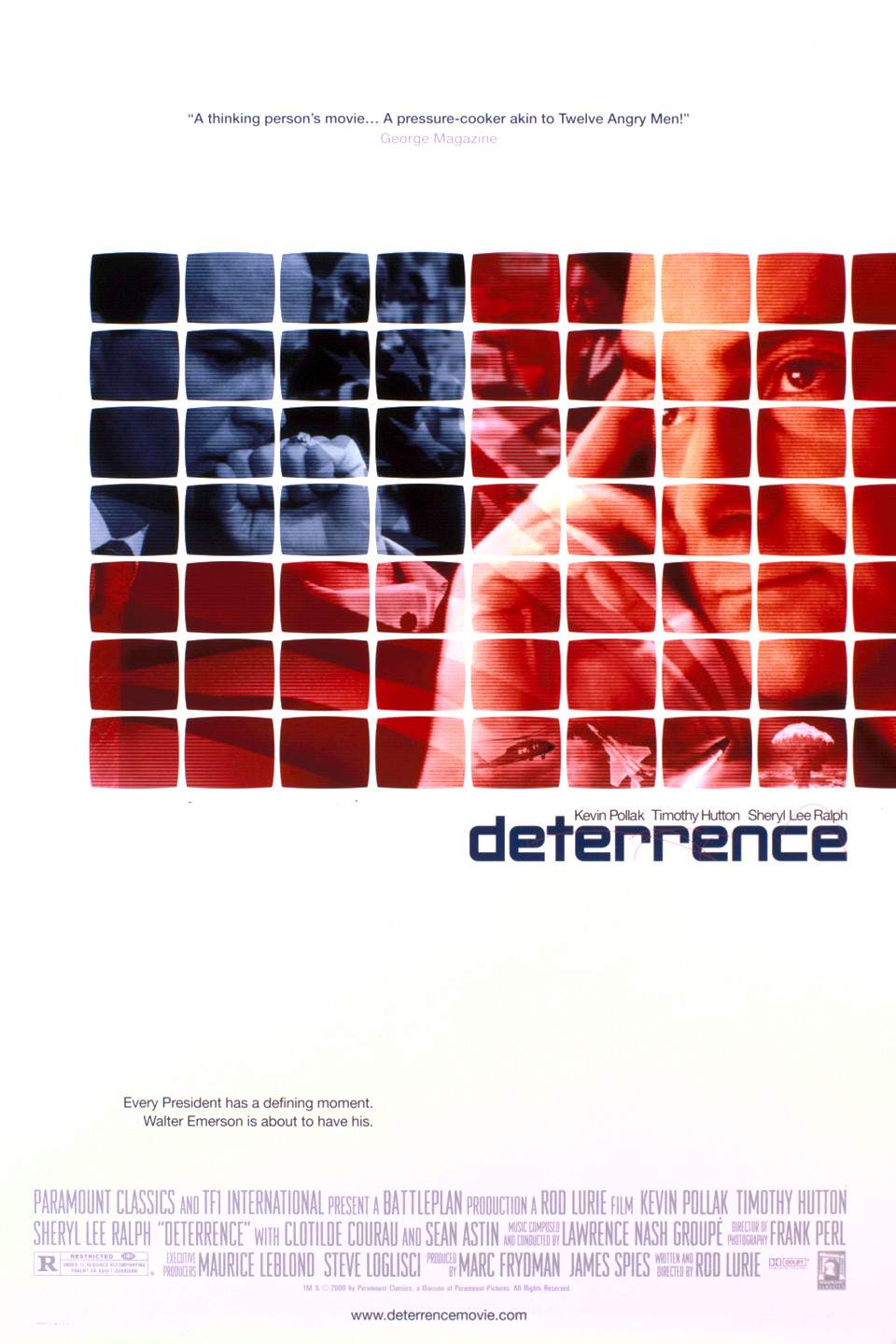
What Is Deterrence About?
The premise of Deterrence in 335 words, with nothing given away. The full story follows below.
In an alternate‑present spring of 2008, a newly inaugurated president finds his political future hanging in the balance. Walter Emerson assumed office only months ago after an unexpected succession, and the nation’s attention follows his whirlwind campaign swing through Colorado ahead of Super Tuesday. Beside him travel the familiar coterie of power: Marshall Thompson, the White House chief of staff; Gayle Redford, the national‑security adviser; a tight Secret Service detail; and a television crew capturing every moment for a nation tuned to the political theater.
A sudden blizzard forces the convoy into the tiny, snow‑bound town of Aztec, where a modest roadside diner becomes an improbable sanctuary. Inside, the presidential entourage shares space with the town’s own inhabitants—Harvey, the pragmatic chef‑owner; Katie, his diligent waitress; Ralph, a resident with a blunt view of the world; and the traveling couple Taylor and Lizzie Woods. The clash of high‑level politics with everyday Americana creates a pressure‑cooker atmosphere, where whispered briefing notes mingle with the clatter of coffee mugs and the relentless howl of the wind outside.
While the storm rages, breaking news arrives: Iraq has crossed into Kuwait, and American troops are caught in the fighting. The announcement shatters the campaign’s veneer, thrusting Emerson and his advisers into an urgent, international crisis far from the familiar corridors of Washington. The diner’s walls become a makeshift command center, the televised broadcast a lifeline, and the president’s voice shifts from campaign promises to a stark, decisive appeal to the world.
Amid the escalating tension, personal convictions surface. The locals voice concerns and hopes, reflecting a ground‑level perspective that contrasts sharply with the strategic calculations of the White House team. The juxtaposition of ordinary lives and extraordinary responsibility fuels a simmering drama, hinting at the moral and political reckonings that will shape the remainder of the day. The frozen setting, the imminent threat, and the uneasy alliance of strangers set the tone for a tense, character‑driven exploration of power, duty, and the thin line between political theater and real‑world consequence.
What Happens in Deterrence?
The complete story of Deterrence, from the first scene to the last, in 1,190 words (about 5 minutes). Spoilers throughout.
Spoilers ahead
Set in an alternate history, the Spring of 2008 finds U.S. President Walter Emerson—someone who rose to the presidency just four months earlier after the death of his predecessor and who had previously been an appointed Vice President—on a campaign swing through Colorado ahead of Super Tuesday. He moves with the familiar entourage of power: White House Chief of Staff Marshall Thompson, National Security Advisor Gayle Redford, his Secret Service protection detail, and a television news crew chronicling every moment of the contest. The mood is tense, the stakes high, and the campaign bustle is about to collide with a world flashing between crisis and catastrophe.
A freak blizzard sweeps the remote town of Aztec, trapping Emerson and his retinue inside a small, ordinary diner. There they share space with a handful of locals: Harvey, the chef and owner; Katie, the diligent waitress; Ralph, a local resident with a blunt eye for reality; and Taylor and Lizzie Woods, a married couple touring the area. The scene becomes intensely intimate as the politicians and civilians are forced to watch events unfold in real time, turning a routine stop into a pressure cooker of personal and political tension.
News arrives that Iraq, under President Uday Hussein, has invaded Kuwait. The invasion is compounded by the revelation that a UN peacekeeping mission, largely staffed by American troops and medical personnel, has suffered casualties in the fighting. The combination of a ground war in the Middle East and an assault on a U.S. ally jolts Emerson into action. From the diner, with the TV crew at his side, he delivers a worldwide address, signaling a hard-edged shift from campaign optics to crisis leadership. His message to Saddam Hussein is stark: retreat and submit to arrest within 90 minutes, or Emerson will authorize a nuclear strike on Baghdad. The ultimatum lands with shock and silence, because it reveals a plan Emerson had not disclosed to his own team or the civilians present.
Emerson frames his decision in stark terms. With the bulk of American forces already engaged in a broader and escalating conflict—what he refers to as the “Second Korean War”—and with Iraq’s aggression threatening a key U.S. ally, he argues that a nuclear strike would reassert American supremacy and decisively halt the Iraqi advance. The rationale sits uneasily on the table as Redford, Thompson, and the rest of the NSC and Joint Chiefs of Staff weigh it against the gravity of unleashing nuclear weaponry. Hussein replies through his United Nations envoy, refusing to bow to the ultimatum, and the dialogue grows heated. The envoy points to Emerson’s fragile hold on power as an unelected leader and even cites anti-Semitic undertones in the conversation as reasons to dismiss Emerson’s authority. Yet the crisis management team presses ahead, coordinating by phone with the NSC and JCS to plot the next moves and to plan the potential use—or avoidance—of nuclear force.
As negotiations stagnate, Hussein broadens his threats. He promises to unleash Iraq’s black-market nuclear missiles against targets across the U.S. and NATO, with particular emphasis on places like the NORAD command center in Colorado, which sits uncomfortably close to Emerson’s own headquarters. The intelligence landscape grows murkier as it becomes clear that Iraq acquired these weapons from France, a supposed ally, while other potential launch sites span Libya and North Korea. In a private, tense exchange, Emerson learns that the French president is bluntly nonchalant about the calamity unfolding and admits France’s role in arming Iraq. Emerson himself speaks privately with the French leader, but he keeps the exact contents of that conversation to himself, not sharing them with his advisers.
The siege of diplomacy bleeds into the personal sphere as public opinion inside the diner splits. Harvey, Katie, and the Woods oppose using nuclear weapons, voicing concerns for civilians and the long-term consequences. Ralph, however, argues that if Emerson can secure a decisive victory for American forces, he will win every vote that matters back home. The First Lady weighs in by phone, revealing her own opposition to the plan. Yet Emerson remains unwavering, convinced that he must act to deter and to defend. He orders a B-2 stealth bomber to cross into Iraq’s airspace, a move that would constitute an act of war in the eyes of Saddam Hussein and his regime. The Iraqi leadership counters with a fearsome volley of threats to unleash its missiles, and the tension in the diner escalates into something almost tangible.
In a shocking turn, Harvey brandishes a shotgun and shoots Captain Coddington, the officer carrying the nuclear football that would enable Emerson to trigger the strike. Harvey is immediately killed by Secret Service agents, a tragedy that wounds Katie deeply and leaves Emerson visibly sorrowful for the loss of a man performing his duty. Despite the interior storm caused by Harvey’s actions, Emerson remains able to obtain the nuclear launch codes by phone through the Joint Chiefs, though the crisis triggers the resignation of Admiral Miller, a senior officer who had been a vocal critic of the president’s plan. With the clock running out, Emerson authorizes the nuclear strike and speaks directly to the crew of the bomber poised to carry out the operation.
The 100-megaton explosion devastates Baghdad, reshaping the city and reverberating around the globe. Iraq’s retaliation unfolds in a shaky balance of defense and disruption: NATO missile defenses shoot down many incoming missiles, and several land targets fail to detonate. Baghdad, however, becomes the pivotal, singular city destroyed in this sequence—an outcome that surprises Emerson’s inner circle and complicates the narrative’s moral calculus.
As the snow finally eases, Emerson returns to the airwaves to address the world once again. In a sweeping, downward-toward-candid confession, he reveals a hidden, long-running government scheme: the United States had quietly facilitated the transfer of nuclear weapons to Iraq via France, with the explicit intent of sabotaging those weapons to prevent Iraq from achieving a truly independent nuclear arsenal. The public justification is stark and forceful—acting to demonstrate that the United States would use nuclear instruments to defend itself if necessary. Privately, Emerson hints at a broader strategic aim: to compel China and North Korea to concede the Second Korean War within months.
Before his party can fully digest the consequences of the crisis and its aftershocks, Emerson and his aides face a final, defining moment. Redford and Thompson ask about a “significant announcement” that they believe will guide the country forward. Emerson reveals his plan to step away from the presidential campaign and to serve out the remainder of his predecessor’s term, rather than pursuing another bid for the nation’s highest office. He insists that, despite the controversial and dangerous actions taken during the crisis, his overarching goal remains to stabilize and defend the country—and he believes the future should be led by someone else who can carry that responsibility forward. The diner’s fragile atmosphere gives way to a somber realization: a political leader who gambled with history has changed not only the course of U.S. foreign policy, but the personal lives of everyone present, and the world will have to live with the consequences of those choices.
Deterrence Timeline: Every Key Event in Order
14 key events in the order they happen, from “Blizzard traps the presidential entourage in a Colorado diner” to “Emerson plans to withdraw from the campaign”. 14 events name a place, across 11 locations.
- 1
Blizzard traps the presidential entourage in a Colorado diner
During a freak spring blizzard, President Walter Emerson, his White House team, security detail, and a TV crew become stranded in a remote Aztec, Colorado diner. They greet local civilians—Harvey, Katie, Ralph, and the Woods—while the storm cuts off contact with the outside world. The gathering shifts from campaign chatter to crisis management as weather isolates them and the clock starts ticking.
When:Spring 2008 Where:Aztec, Colorado
- 2
Iraq invades Kuwait; UN peacekeepers casualties
News arrives that Iraq has invaded Kuwait on orders from Uday Hussein, shocking the region and the U.S. government. The invasion is linked to the deaths of UN peacekeepers largely staffed by U.S. forces, intensifying the crisis. The diners absorb the news as a new existential threat emerges on the world stage.
When:Spring 2008 Where:Kuwait
- 3
Emerson broadcasts a nuclear ultimatum from the diner
Emerson issues a worldwide ultimatum: Hussein must surrender at the Iraqi embassy within 90 minutes or a nuclear strike on Baghdad will proceed. The speech shocks his staff and the civilians, who had not anticipated such drastic measures. Emerson defends the move by arguing a nuclear show of force is necessary to defend a threatened ally and show U.S. resolve.
When:Spring 2008 Where:Diner, Aztec, Colorado
- 4
UN envoy questions Emerson’s legitimacy and resolve
The Iraqi envoy at the United Nations refuses to back down, citing Emerson’s status as a non-elected leader and his Jewish faith as reasons why he is not to be taken seriously. Negotiations grow heated as diplomats push for de-escalation. Emerson, Redford, and Thompson coordinate with the NSC and Joint Chiefs to map out potential nuclear options.
When:Spring 2008 Where:United Nations
- 5
Crisis leadership drums up nuclear options with top military brass
Emerson, Redford, and Thompson rally with the NSC and Joint Chiefs by phone to plan for possible nuclear action. Lines connect the diner, the White House, and various secure channels as the crisis tightens. The civilian observers sense the gravity of the potential path ahead.
When:Spring 2008 Where:Diner/White House Crisis Center
- 6
Iraq threatens missiles; France’s role is exposed
Hussein threatens to launch black-market missiles at U.S. and NATO targets. It is revealed that France supplied these weapons, a shocking revelation that strains alliances. Emerson privately probes the French leader about the deal but withholds those details from his advisers.
When:Spring 2008 Where:Iraq/France
- 7
Civilians weigh in as the crisis deepens
Harvey, Katie, and the Woods oppose using nuclear force, while Ralph insists he could rally support if Emerson acts. Emerson’s wife also disagrees with the plan, and several aides express doubt. Despite the mounting opposition, Emerson remains resolute about pursuing the strike.
When:Spring 2008 Where:Diner, Aztec, Colorado
- 8
B-2 order to cross Iraq’s airspace escalates tensions
With time running short, Emerson orders a B-2 bomber to cross Iraq’s airspace to execute the strike. The Iraqi envoy warns that such an action would constitute an act of war. Tension surges as both sides prepare for possible wide-scale conflict.
When:Spring 2008 Where:Over Iraq
- 9
Captain Coddington is killed; Harvey is shot by Secret Service
Harvey fatally shoots Captain Coddington, the officer carrying the nuclear football. Secret Service agents retaliate, killing Harvey and devastating Katie. Emerson mourns Coddington’s sacrifice even as the crisis hurtles toward its climax.
When:Spring 2008 Where:Diner, Aztec, Colorado
- 10
Nuclear codes are secured; Admiral Miller resigns
Emerson obtains the nuclear launch codes by phone from the Joint Chiefs, but Admiral Miller resigns in protest of the plan. The military leadership fractures as civilian authority presses forward. The countdown toward potential nuclear action continues despite political dissent.
When:Spring 2008 Where:Washington, D.C.
Show the other 4 events of Deterrence Hide the last 4 events
- 11
Emerson authorizes the strike; B-2 heads to Baghdad
Emerson formally authorizes the nuclear strike and speaks to the crew of the B-2 bomber en route to Baghdad. The attack proceeds, and the world watches as Baghdad is targeted. The action triggers immediate retaliation from Iraq and a broader war dynamic.
When:Spring 2008 Where:Over Iraq/Baghdad
- 12
Baghdad destroyed; most missiles fail to detonate
The 100-megaton strike obliterates Baghdad, while NATO missile defenses shoot down the majority of Iraq’s retaliatory missiles. A few missiles land on targets, but their warheads do not detonate as anticipated. Baghdad remains the sole major city destroyed in the chaos.
When:Spring 2008 Where:Baghdad, Iraq
- 13
Snow clears; Emerson reveals the truth behind the crisis
As the storm subsides, Emerson delivers a global TV address revealing that the U.S. government secretly sold faulty nuclear weapons to Iraq via France to preempt an independent Iraqi arsenal. He defends the display as a deterrent and a test of resolve. Privately, he forecasts that the move will pressure China and North Korea to concede the Second Korean War soon.
When:After the snowstorm Where:Global broadcast
- 14
Emerson plans to withdraw from the campaign
Just before leaving the diner, Emerson reveals his intention to withdraw from the presidential race and serve out the remainder of his predecessor’s term. He argues that the crisis demands a different kind of leadership for the future, leaving his political ambitions behind. The moment reframes the narrative from a campaign to a controversial legacy.
When:Post-crisis Where:Diner, Aztec, Colorado
Who Are the Main Characters in Deterrence?
5 characters, among them President Walter Emerson (character), Marshall Thompson and Gayle Redford: who each one is and the part they play in the story.
- PW
President Walter Emerson (character)
A former vice president turned acting president after the previous leader’s death, Emerson is thrust into a non-elected role during a tense international crisis. He believes in displaying U.S. resolve through decisive, unilateral action, even when it challenges norms and invites political risk. His unwavering stance drives the plot, revealing both his resolve and the heavy personal toll of leadership.
- 🗳️ Leader
- ⚖️ Controversial
- 🧭 Decisive
- MT
Marshall Thompson
White House Chief of Staff accompanying Emerson on the campaign tour, Thompson coordinates political strategy and crisis management. He grapples with balancing public messaging and the realities of a governor-in-chief’s dangerous brinkmanship. His role highlights the pressures within the executive branch during an international showdown.
- 🗺️ Aide
- ⚖️ Pragmatic
- 🧭 Strategist
- GR
Gayle Redford
National Security Advisor and Emerson’s key policy advisor during the crisis, Redford anchors the military and intelligence aspects of decision-making. She questions the moral implications of using nuclear force while providing a steady, technically informed perspective to the president. Her insights reveal the weight of policy on civilian life.
- 🛡️ Security
- 🧭 Expert
- ⚖️ Cautious
- H
Harvey
The diner owner and local mechanic of moral gravity who openly opposes striking Iraq with nuclear weapons. His act of violence against a military officer in the heat of the moment underscores the danger of radical action at close quarters. Harvey’s stance embodies civilian fear, resistance, and the costs of leadership decisions on everyday people.
- 🧑🍳 Civilians’ Voice
- 🕊️ Moral Opposition
- 🗡️ Tragic Disruption
- K
Katie
Waitress in the Aztec diner who represents ordinary civilians caught in the storm and crisis. She forms part of the emotional counterweight to political calculations, illustrating how ordinary people experience fear, hope, and moral concern in times of national peril. Katie’s perspective helps ground the story in human consequences.
- 🌟 Civilians
- 💬 Witness
- 🧭 Empathetic
Where and When Is Deterrence Set?
Deterrence is set in Aztec and Colorado (Spring 2008). Here is why the time and place matter to the story.
When
Spring 2008
The events occur during the spring of 2008, in an alternate history where geopolitical shocks collide with a domestic election cycle. The blizzard and the timing ahead of Super Tuesday heighten the sense of urgency and fragility. This period is marked by rapid, unprecedented decisions under public scrutiny and media coverage.
Where
Aztec, Colorado
The story unfolds in a remote Colorado town centered around a roadside diner where a blizzard traps the president and his entourage. The place is isolated, forcing intimate interactions between political figures and civilians. The diner becomes the stage for a high-stakes crisis as national and international tensions unfold outside its doors.
- ❄️ Snowbound
- 🗺️ Diner setting
What Are the Themes of Deterrence?
3 ideas the story keeps returning to, among them Leadership, Moral Dilemma and Nuclear Brinkmanship.
-
01
Leadership
The crisis tests the president’s ability to act decisively under extreme pressure. It explores how a non-elected leader justifies drastic measures to preserve national security. The narrative centers on decision-making, accountability, and the personal costs of leadership during a global confrontation.
-
02
Moral Dilemma
The characters confront ethical questions about the use of extreme force, collateral civilian impact, and the cost of bluffing power. The dilemma pits public safety against civilian consent and reveals how personal beliefs shape statecraft. It also examines the tension between public rhetoric and private conscience.
-
03
Nuclear Brinkmanship
The story dramatizes the brink of nuclear war and the fragility of deterrence. It shows how political grandstanding, miscommunication, and strategic maneuvers can escalate toward catastrophic outcomes. The arc culminates in a bombastic crisis that redefines national security and international relations.
What Kind of Film Is Deterrence?
Tense in tone, with fast pacing and a moderate story, going by the plot summary.
- Tone
- Tense
- Pacing
- Fast
- Story
- Moderate
- Intensity
- High
- Ending
- Bittersweet
A relentlessly tense and claustrophobic political thriller that traps the President and his staff in a remote diner as they face a world-altering nuclear crisis, creating an atmosphere of constant anxiety and moral conflict.
- claustrophobic
- anxious
- suspenseful
- oppressive
- somber
- morally ambiguous
- political thriller
- nuclear crisis
- ethics of power
- high-stakes decision-making
Content notes: nuclear war, war violence, death of soldiers, shooting death, political extremism.