What Is Daaera About?
The premise of Daaera in 283 words, with nothing given away. The full story follows below.
In a quiet town where tradition weighs heavily on every decision, Sheetal navigates the complexities of a life shaped by circumstances beyond her control. At sixteen, she finds herself bound in marriage to an ailing older man—a union so unexpected that most in the community mistake her for his daughter. This misreading settles over the neighborhood like morning fog, casting a veil of assumptions that colors every interaction. When the couple arrives at a haveli seeking medical help, the atmosphere thickens with unspoken questions and careful observations, the residents watching with a curiosity that borders on intrusion.
Across the corridor lives Shravan, the proprietor’s son, whose attention is captured by Sheetal’s presence on the shared balcony. What begins as fleeting curiosity deepens into something more profound, creating a quiet tension that pulses between the two households. The haveli becomes a space of subtle glances and restrained silences, where every moment carries the weight of things left unsaid. Shravan’s mother grows uneasy watching her son’s increasingly mournful state, while the community forms its own opinions, drawing conclusions that add yet another layer of pressure to an already delicate situation.
The film unfolds with poetic restraint, its mournful soundtrack and careful compositions inviting viewers into a world where duty and desire exist in constant opposition. Sheetal tends to her husband with quiet devotion, embodying the conflict between societal expectations and personal yearning—especially as a doctor’s warning casts a shadow over her own well-being. Through its elegant visual language and measured pacing, the story explores the quiet devastation of unfulfilled longing and asks what we owe to ourselves versus what we owe to the roles we’re given, all without ever raising its voice above a whisper.
What Happens in Daaera?
The complete story of Daaera, from the first scene to the last, in 330 words (about 1 minute). Spoilers throughout. Names in the text link to 4 cast member pages.
Spoilers ahead
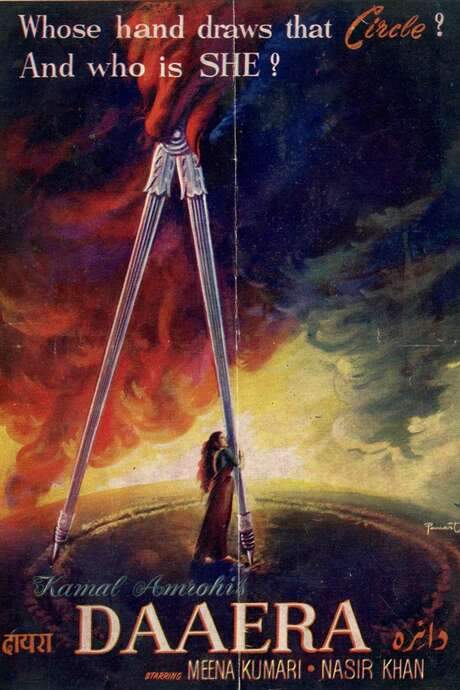
A critically ill man arrives in a town seeking a doctor. With no physician available, he is directed to a nearby haveli where he rents an apartment there with his young wife, Meena Kumari as Sheetal. The noticeable age gap leads most people to assume Sheetal is his daughter, a misreading that colors the couple’s early days and casts a quiet, watchful mood over the community.
When the doctor finally arrives to check on him, he detects symptoms of the same disease in Sheetal and warns her to be careful. Across the corridor, Nasir Khan as Sharan, the proprietor’s son, lives in the apartment opposite and is instantly drawn to Sheetal’s presence on the balcony. His unfulfilled longing grows into deep melancholia, steering his actions and intensifying the tension between the two households.
When Sheetal’s husband is called away on business, she befriends a young girl Gomti, Roopmala as Gomti, who has already faced punishment for loving. Gomti is shocked to discover that the old man accompanying her is not her father but her husband. Sheetal remains a devoted wife, tending to her husband even as her own health deteriorates.
Sharan’s mother, Pratima Devi as Sharan’s mother, grows weary of watching her son’s mournful state and tries to arrange his marriage to Sheetal. When those efforts fail, her son-in-law schemes to push Sharan toward another match. After much persuasion, she finally yields, but in a striking reversal it is revealed that her husband has survived and returned.
In the film’s turning moment, Sheetal’s husband faces the ache of a long separation, and the community edges toward a new arrangement for Sharan. Yet as the plot advances toward its climax, the truth reemerges: the husband has come back. In the final, quiet sequence, Sheetal watches from her balcony as Sharan’s marriage is celebrated and Sharan passes away in silence. This poetic film leans on an elegant, mournful soundtrack and restrained silences, inviting reflection on duty, longing, and the costs of devotion.
Daaera Timeline: Every Key Event in Order
12 key events in the order they happen, from “Ill man arrives seeking a doctor” to “Final quiet aftermath”. 12 events name a place, across 9 locations.
- 1
Ill man arrives seeking a doctor
A critically ill man arrives in town seeking a physician. With no doctor available, he is directed to a nearby haveli for shelter. This initiates the sequence of events centered around the haveli and its occupants.
When:Night Where:Town and haveli
- 2
The couple moves into the haveli
The sick man and his young wife Sheetal move into an apartment within the haveli. The noticeable age gap fuels gossip, with many mistaking Sheetal for the man’s daughter. A doctor later visits and notices symptoms in Sheetal as well, warning her to be careful.
When:Soon after arrival Where:Haveli, apartment
- 3
Sharan’s fascination grows
Sharan, the haveli owner’s son living opposite, becomes entranced by Sheetal on the balcony. His unfulfilled desire plunges him into melancholia and sets up a combustible undertone for the relationships around him. The tension begins to color the social dynamics of the block.
When:Early in the stay Where:Haveli, balcony
- 4
Sheetal befriends Gomti
Sheetal befriends Gomti, a young girl punished for having fallen in love. Gomti is shocked to discover that the old man with her is not her father but her husband. This revelation adds a layer of complexity to affection and duty within the haveli.
When:During the stay Where:Haveli
- 5
Sheetal’s dutiful care persists
Sheetal remains a devoted wife, continuing to nurse her husband even as her own health deteriorates. Her steadfast care underscores the film’s elegiac mood and themes of sacrifice. The couple’s bond deepens amid growing illness.
When:Ongoing Where:Haveli
- 6
Mother pushes for marriage to Sheetal
Sharan’s mother tries to arrange a marriage between Sharan and Sheetal to lift his mourning state. The attempt reveals the family’s interest in securing alliances over personal choice. It shifts the focus toward matchmaking within the haveli’s circle.
When:Soon after Where:Haveli, mother’s area
- 7
Son-in-law plots a different match
When the initial plan falters, Sheetal’s husband (her son-in-law) hatches a scheme to trick Sharan into marrying someone else. The maneuver exposes the opportunistic side of family dynamics and the fragility of arranged solutions. Tensions rise as motives clash.
When:During matchmaking efforts Where:Haveli
- 8
Railway accident changes everything
Amid the schemes and shifting loyalties, Sheetal’s husband is involved in a tragic railway accident and is believed dead. The news jolts the balance of power and intensifies the sense of tragedy hovering over the characters. The accident clears one path while closing another.
When:During the incident Where:Railway line
- 9
Mother accepts Sharan’s widow alliance
Sharan's brother-in-law urges their mother to accept Sharan’s marriage to a widow, and after significant persuasion she agrees. The decision formalizes a new social arrangement within the family. The momentum toward a conventional ending accelerates.
When:After the accident Where:Haveli, mother’s space
- 10
The husband returns alive
In a late twist, it is revealed that Sheetal’s husband has survived the railway accident and has returned to her. This shocks the already tense network of relationships and reframes loyalties. The return unsettles the plans that had begun to solidify.
When:Later Where:Town
- 11
Wedding day and Sharan’s fate
With Sharan’s marriage to a widow arranged, Sheetal watches from her balcony as the ceremony proceeds. In a somber turn, Sharan dies quietly during or after the wedding, underscoring the film’s mournful elegiac tone. The moment lingers as a final tragic note.
When:Wedding day Where:Balcony, haveli
- 12
Final quiet aftermath
The story closes on a note of elegiac quiet, with Sheetal continuing her care and the family processing the upheavals. The dramatic twist of the husband’s survival sits against the loss around Sharan, leaving a lingering melancholy that defines the film.
When:End Where:Haveli
Who Are the Main Characters in Daaera?
5 characters, among them Sharan Kumar (Nasir Khan), Sheetal (Meena Kumari) and Sheetal's Husband (Nana Palsikar): who each one is and the part they play in the story. Every profile links to the actor’s page.
- SK
Sharan Kumar (Nasir Khan)
Played by Nasir Khan
The proprietor’s son who lives opposite Sheetal and is deeply drawn to her presence on the balcony. He is intelligent and introspective, a man whose longing grows into a melancholy that he cannot act on within the social bounds of his world. His inability to fulfill his desire leads to secret plots and a spiraling sadness. His arc culminates in a quiet, tragic end that underscores the film’s themes of unfulfilled love.
- 👀 Obsession
- 💔 Unfulfilled longing
- 🧭 Internal conflict
- S(
Sheetal (Meena Kumari)
Played by Meena Kumari
A dutiful wife who cares for her ill husband while navigating the threat of illness spreading to her. She forms a compassionate bond with Gomti, yet remains loyal to her husband. Her restraint and care illuminate the conflict between personal feeling and marital duty. Her quiet resilience drives the emotional core of the story.
- 💖 Devoted Wife
- 🪶 Quiet resilience
- 🏡 Domestic life
- SH
Sheetal's Husband (Nana Palsikar)
Played by Nana Palsikar
A critically ill man whose condition prompts the other characters to act with concern and secrecy. He is believed dead after a railway accident, triggering arrangements and anxieties among family and lovers. The final twist reveals that he has survived and returns, complicating the love triangle and the moral stakes. His presence anchors the film’s sense of fate and renewal.
- 🤝 Ill and vulnerable
- ⚡ Shocking return
- 🧭 Loyalty and devotion
- SM
Sharan's Mother (Pratima Devi)
Played by Pratima Devi
A pragmatic matriarch who seeks to secure her son’s happiness by arranging his marriage to Sheetal. Her efforts reflect traditional expectations and the influence of family authority. When her plans falter, she contemplates accepting Sharan’s union with a widow, showing how parental concerns adapt to changing circumstances. Her stance captures the generational dimension of the drama.
- 👵 Family matriarch
- 💬 Traditional values
- 🧭 Reluctant adaptivity
- G(
Gomti (Roopmala)
Played by Roopmala
A young girl punished for having fallen in love, she befriends Sheetal and brings a fresh, hopeful perspective to the story. Gomti is both a witness and a catalyst for the drama, inadvertently revealing relationships that others seek to hide. Her bond with Sheetal and her own vulnerabilities illuminate the social strictures surrounding love.
- 👧 Youthful curiosity
- 💫 Forbidden affection
- 🏷️ Social stigma
Where and When Is Daaera Set?
Daaera is set in India and haveli in a town (Mid-20th century). Here is why the time and place matter to the story.
When
Mid-20th century
The events unfold in a period when arranged marriage, duty to family, and social reputation shape personal choices. Traditional gender roles and community oversight press on individuals, prompting secret yearnings and quiet sacrifice. A railway tragedy and illness heighten the sense of fragility and fate. The film’s pacing and music reinforce a contemplative, melodramatic mood of that era.
Where
India, haveli in a town
Set in a traditional Indian town centered around a grand haveli, the story unfolds within its courtyards and balconies. The haveli and its environs frame a close-knit community where appearances and propriety govern daily life. The town’s architecture and social rhythms create a mood of restrained emotion and quiet longing. This setting underpins the film’s elegiac feel and its mournful silences.
- 🏛️ Haveli
- 👪 Traditional family dynamics
- 🌆 Small-town setting
What Are the Themes of Daaera?
4 ideas the story keeps returning to, among them Forbidden Love, Social Constraints and Loss and Silence.
-
01
Forbidden Love
Sharan’s longing for Sheetal develops into an all-consuming fixation that cannot be realized within strict social bounds. Sheetal’s dutiful care for her husband clashes with her own feelings, highlighting the tension between desire and duty. The age and status gap intensify the sense of forbiddenness and push the narrative toward tragedy. The film uses restrained longing to probe how society polices affection.
-
02
Social Constraints
Rigid social norms dictate who can marry whom, how affection is expressed, and who must suffer in silence. The family’s matchmaking schemes and attempts to redirect Sharan expose the pressure to conform. Gossip, reputation, and authority shape outcomes more than individual wishes. The drama critiques the moral economy of the time.
-
03
Loss and Silence
Illness, misfortune, and miscommunication thread through the narrative, eroding happiness. Quiet moments—balconies, corridors, and restrained pauses—register characters’ inner sorrow. Sharan’s heartbreak and the shifted fates of the central relationships build a mood of inevitable melancholy. The final sequence uses stillness to convey the cost of unattained love.
-
04
Elegiac Atmosphere
The soundtrack and sparse sound design emphasize mourning, memory, and distance. Light, shadow, and the haveli’s architecture reinforce the film’s mournful mood. Recurrent motifs of doors and thresholds mirror fragile openings in relationships. The overall tone invites viewers to dwell in the sadness of what remains unspoken.
What Kind of Film Is Daaera?
Melancholic in tone, with slow pacing and a moderate story, going by the plot summary.
- Tone
- Melancholic
- Pacing
- Slow
- Story
- Moderate
- Intensity
- Medium
- Ending
- Sad
A poetic and melancholic drama that unfolds with a slow, elegiac pace, portraying the quiet tragedy of unfulfilled love and the heavy weight of duty against a backdrop of societal pressure.
- melancholic
- tragic
- yearning
- poetic
- somber
- quiet contemplation
- forbidden love
- arranged marriage
- illness
- social constraints
Content notes: suicide, terminal illness, self destructiveness, arranged marriage, tragic accident.