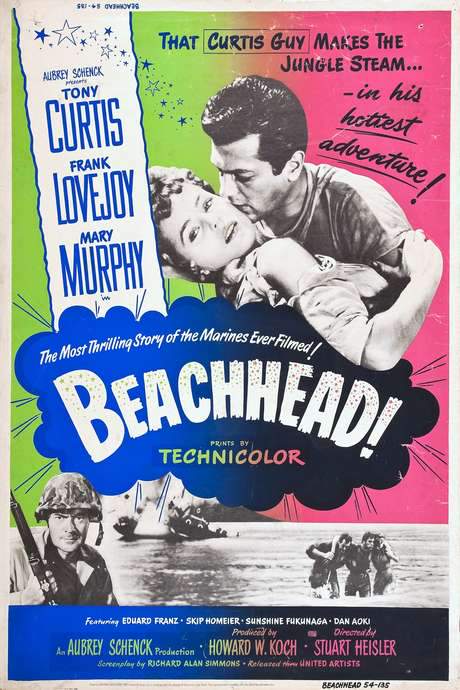
What Is Beachhead About?
The premise of Beachhead in 280 words, with nothing given away. The full story follows below.
Late in October 1943, the shadow of World War II falls heavily over Choiseul Island in the Northern Solomons, where a four-man reconnaissance team lands to execute a delicate and dangerous assignment. Their mission is to locate a French planter who has transmitted a crucial message about a mined zone—intelligence that could spare countless lives in the impending Allied assault. The objective requires more than just discovery; the team must verify that the planter is alive and that his information is genuine, turning the dense, unforgiving jungle into a landscape of suspense and strategic calculation.
Burke leads the patrol with a steady nerve, while Sgt. Fletcher strives to maintain order and morale among men haunted by their shared past. The group carries the weight of being the sole survivors of a platoon lost on Guadalcanal, a history that fractures their trust and tests their camaraderie with every step. Maj. Scott orchestrates the operation from the rear, but the burden of survival rests on the shoulders of the men pushing inland, forcing them to confront the tensions between duty, memory, and the immediate perils of the present.
Navigating the rugged terrain demands patience and precision, for a single misstep could jeopardize the entire operation. The film builds its tension through the stark realities of the Pacific theater, where the environment itself is as formidable as any enemy force. As the men move toward a rendezvous with a waiting PT boat, the story remains grounded in the gritty determination of soldiers tasked with a seemingly impossible feat. It is a tale of endurance and resolve, capturing the fragile line between success and catastrophe where the true stakes are measured in human courage.
What Happens in Beachhead?
The complete story of Beachhead, from the first scene to the last, in 779 words (about 3 minutes). Spoilers throughout. Names in the text link to 5 cast member pages.
Spoilers ahead
Late in October 1943, a small wave of U.S. Marines lands on Choiseul Island to draw attention away from the impending Allied assault on Bougainville Island in the Northern Solomon Islands. Among the troops, a four-man reconnaissance team is assembled to carry out a high-stakes mission. The team is led by Burke Tony Curtis, with Maj. Scott John Doucette shaping the plan from behind the scenes, and Sgt. Fletcher Frank Lovejoy trying to keep discipline and morale intact under pressure. Their objective is precise but perilous: locate a French planter who has managed to send a solitary radio message describing a mined zone in the area. If the information turns out to be true, it could save as much as 18% of the Marines’ invasion force, a number that makes every risk seem worth taking.
The quartet must not only locate the planter but also confirm that he is alive and that the message is genuine. Time is of the essence, and the terrain is treacherous—jungles that swallow footsteps, hidden dangers around every bend, and watchful eyes on the lookout for any sign of intrusion. The mission demands stealth, nerve, and precise judgment, because one wrong move could trigger a disaster that would ripple across the broader operation. If the data checks out, the team will rendezvous with a US Navy PT boat on the coast and slip back into controlled waters, bearing information that could steer the invasion plan with crucial accuracy.
Haunting the four men is a shared memory from Guadalcanal: they were the sole survivors of their sergeant’s platoon, and the weight of that loss sits on their shoulders. Their sense of responsibility, fractured trust, and uneasy camaraderie color every step they take as they push inland and press the planter’s claims to the test. The fragile balance between duty and doubt threads through their movements, turning each cautious advance into a test of character as much as a test of endurance.
As the patrol presses forward, they encounter the stark realities of war in a way that tests both strategy and resolve. They move through uncertain terrain, weighing the risks of exposure against the potential gain of the planter’s information. The mission becomes a study in timing—the moment to strike, the moment to listen, and the moment to pull back if the risk outweighs the reward. The crew’s resolve is pushed to the edge as they navigate possible encounters with enemy forces and the unpredictable environment that the Pacific theater relentlessly presents.
Along the way, the team threads through encounters that remind them they are not simply instruments of a larger plan but individuals with histories, fears, and loyalties that can shift in an instant. The reconnaissance must balance the urgency of the invasion with the prudence required to stay alive and intact for the rendezvous with the PT boat. The tension intensifies as every decision could alter the course of the operation and the fate of many lives on both sides.
In the end, the mission hinges on authenticity and timing: the planter’s information must be verified, and the survivors must reach the coast to connect with the supporting force that will carry the data forward. The story remains grounded in its clear, human stakes—courage under pressure, the burden of past mistakes, and the stubborn hope that one piece of information, accurately confirmed, can change the outcome of a dangerous campaign. The film keeps its tone steady and restrained, letting the fear, grit, and resolve of its small cast carry the weight of a larger war, all while staying true to the suspense and realism that defined these wartime missions.
- Tony Curtis as Burke returns to a role built on quiet leadership and steady nerve, guiding the team through a landscape where danger lurks in every shadow.
- John Doucette as Maj. Scott anchors the mission with calculated plan-making and a sense of duty that helps keep the operation in focus.
- Frank Lovejoy as Sgt. Fletcher embodies the conflict between past losses and present responsibility, a human center that the others lean on even when the path ahead is unclear.
- Eduard Franz as Bouchard, the French planter, stands at the heart of the mission’s purpose, his call for help setting the stakes for everything the patrol hopes to achieve.
- Dan Aoki as the Japanese Sniper adds a constant, watching presence that reminds the team of the ever-present danger beyond the ally lines.
The result is a measured, character-driven war tale that emphasizes strategic patience, the weight of memory, and the fragile line between success and catastrophe in a theater where every heartbeat could be the difference between life and death.
Beachhead Timeline: Every Key Event in Order
12 key events in the order they happen, from “Marines land on Choiseul to divert Bougainville invasion” to “Rendezvous on the coast and mission direction”. 12 events name a place, across 6 locations.
- 1
Marines land on Choiseul to divert Bougainville invasion
Late October 1943, a battalion of U.S. Marines lands on Choiseul Island to create a diversion for the impending Allied invasion of Bougainville. The operation establishes a foothold and begins the island-hopping phase in the Northern Solomon Islands. It also sets the stage for intelligence-gathering missions that could influence the invasion's success.
When:late October 1943 Where:Choiseul Island, Northern Solomon Islands
- 2
Four-man reconnaissance patrol chosen
Four Marines are selected to conduct a reconnaissance mission to locate a French planter who has sent a radio message about mined areas that could affect the invasion. The patrol's success hinges on confirming the message’s authenticity and determining whether the planter is still alive. The mission underscores the high stakes of gathering timely intelligence behind enemy lines.
When:late October 1943 (shortly after landing) Where:Choiseul Island interior
- 3
Mission objective clarified: verify planter’s message
The patrol's objective is to verify the authenticity of the planter's radio message about mined zones. They must also confirm that the planter remains alive to provide critical information for a successful amphibious landing. A potential savings of 18% of the invading force is attached to getting this information accurate.
When:late October 1943 Where:Choiseul Island interior
- 4
Patrol departs to locate the planter
The four Marines depart from their landing zone into the island's jungle to locate the planter and confirm the mined-area information. Tension builds as they move through unfamiliar terrain while watching for Japanese patrols and booby traps. Their pasts as Guadalcanal survivors shape their cautious teamwork.
When:late October 1943 Where:Choiseul Island interior
- 5
Guadalcanal survivors' backstory surfaces
The patrol members reveal they are the sole survivors of their sergeant's Guadalcanal platoon. They blame their former sergeant's leadership for their comrades' deaths, which haunts their present mission. The confession adds strain to their cooperation and fate of the mission.
When:Guadalcanal campaign era (memory) Where:Guadalcanal, Solomon Islands (flashback)
- 6
Discovery of mined-area details from the message
The patrol uncovers the significance of the planter's message about mined zones. They cautiously assess routes, test paths, and discuss how the information could enable a safer amphibious landing. The risk of mines adds urgency to their mission.
When:late October 1943 Where:Choiseul Island interior
- 7
Verification: planter's status and alive signal
The team circulates to locate or confirm the planter's status, ensuring he is alive to share further details. Communication lines are fragile in the jungle, increasing the tension among the group. Success would secure vital intelligence for the upcoming invasion.
When:late October 1943 Where:Choiseul Island interior
- 8
Plan to rendezvous with PT boat is formed
With critical intel obtained, the patrol plans a rendezvous on the coast with a US Navy PT boat to extract. The plan requires careful timing and stealth as they move toward the shore. The crew's unity is tested by past leadership issues and present pressure.
When:late October 1943 Where:Choiseul Island coast
- 9
Patrol advances toward the coast
The group presses toward the coastline, balancing stealth with the need to stay on schedule for the contact with the PT boat. They face possible Japanese patrols and mined water approaches as they close in on the extraction point. The mission's success depends on reaching the rendezvous unscathed.
When:late October 1943 Where:Choiseul Island coast
- 10
Memories of Guadalcanal influence current mission
The veterans carry the weight of Guadalcanal memories, which color their decisions and trust in each other during riskier choices. The past leadership failure remains a shadow that motivates careful, cautious action. These memories also shape how they respond to orders and coordinate movement.
When:Guadalcanal era (memory) Where:Guadalcanal, Solomon Islands (memory)
- 11
Enemy threats intensify as they near the coast
As the patrol nears the coast, the risk of Japanese counter-moves increases. Mines, patrols, and weather threaten the timing of their rendezvous with the PT boat. The tension spikes as the window for escape narrows.
When:late October 1943 Where:Choiseul Island coastal area
- 12
Rendezvous on the coast and mission direction
The four-man team reaches the coast and prepares to meet the PT boat, carrying crucial intelligence that could influence the invasion. The outcome remains uncertain, with the bonds forged under fire carrying them toward an uncertain future. The patrol's past and present merge as they face their next steps.
When:late October 1943 Where:Choiseul Island coast
Who Are the Main Characters in Beachhead?
10 characters, among them Burke (Tony Curtis), Maj. Scott (John Doucette) and Nina Bouchard (Mary Murphy): who each one is and the part they play in the story. Every profile links to the actor’s page.
-

Burke (Tony Curtis)
Played by Tony Curtis
A Marine on the reconnaissance team, Burke is practical and steady under pressure. He navigates the tension between mission objectives and the constant threat of ambush, keeping morale intact as danger closes in.
- 🎖️ Loyal
- 🧭 Steady
- ⚔️ Resourceful
- MS
Maj. Scott (John Doucette)
Played by John Doucette
A commanding officer figure closely tied to the operation, Scott represents formal authority. He weighs strategic decisions and the risks they impose on his men, shaping the patrol's approach to the mission.
- 🧭 Authoritative
- 🎯 Strategic
- ⚔️ Decisive
- NB
Nina Bouchard (Mary Murphy)
Played by Mary Murphy
A civilian connected to the planter, Nina becomes a conduit of information related to the mined area. Her involvement underscores the fragile line between civilian contact and military urgency.
- 🗒️ Informative
- 🕊️ Calm under pressure
- 🗣️ Communicative
- R(
Reynolds (Skip Homeier)
Played by Skip Homeier
A Marine on the patrol, Reynolds contributes practical skills and a grounded perspective under fire. He anchors the group’s morale and readiness to adapt to changing intel.
- 🧰 Practical
- ⚔️ Tenacious
- 🧠 Observant
- SF
Sgt. Fletcher (Frank Lovejoy)
Played by Frank Lovejoy
The sergeant whose leadership is blamed for the prior platoon's demise, Fletcher embodies the weight of command and the scrutiny of his men. His decisions are pivotal to the patrol's fate.
- 🎖️ Command
- 🗿 Pressure
- 🤝 Responsibility
- B(
Biggerman (Alan Wells)
Played by Alan Wells
A Marine on the mission, Biggerman brings presence and steadfastness to the team under the stress of possible ambush and difficult terrain.
- 💪 Resilient
- 🧰 Steady
- 🧱 Tactical
- BF
Bouchard, French Planter (Eduard Franz)
Played by Eduard Franz
The French planter whose message motivates the reconnaissance, Bouchard represents the civilian stakes at play in the contested territory.
- 🗣️ Informative
- 🪖 Courageous
- 🗂️ Mysterious
- JS
Japanese Sniper (Dan Aoki)
Played by Dan Aoki
A dangerous enemy presence, the sniper introduces constant threat to the reconnaissance party and heightens the peril of every move.
- 🎯 Precise
- 🧨 Lethal
- 🗺️ Elusive
- N(
Native (Steamboat Mokuahi)
Played by Steamboat Mokuahi
A local presence who interacts with the Marines, the Native character adds perspective on the land and the human costs of war.
- 🌿 Local
- 🧩 Insightful
- 🪶 Resilient
- TJ
Terrified Japanese Sailor (Akira Fukunaga)
Played by Akira Fukunaga
A frightened Japanese sailor illustrates the menace of the enemy and the human aspect of those under threat in combat zones.
- 😨 Fearful
- 🔫 Threat
- 🌊 Tense
Where and When Is Beachhead Set?
Beachhead is set in Choiseul Island, Bougainville Island and Solomon Islands (Late October 1943). Here is why the time and place matter to the story.
When
Late October 1943
Set during World War II, the story follows a U.S. Marine reconnaissance mission as Allied forces prepare a larger invasion. The window is tight: the patrol must confirm the planter's message and survive enemy contact while coordinating with naval support for a coastal rendezvous.
Where
Choiseul Island, Bougainville Island, Solomon Islands
The action unfolds on Choiseul Island in the Northern Solomon Islands, a strategic backdrop for a diversionary Marine operation targeting Bougainville. The terrain blends dense jungle with coastal approaches, creating a perilous setting for reconnaissance patrols and rendezvous with a Navy PT boat. The region is part of the broader Pacific theater in World War II, known for amphibious assaults and behind-the-lines fights.
- 🏝️ Pacific Island theater
- 🗺️ WWII Frontline
What Are the Themes of Beachhead?
3 ideas the story keeps returning to, among them Duty vs Deception, Camaraderie and Burden and War Realism.
-
01
Duty vs Deception
The patrol operates under the pressure of a dangerous mission to verify a crucial message, highlighting the ethical complexities of wartime deception. Leaders must balance the need for operational success with the risk to their men, and choices under fire determine life or death outcomes.
-
02
Camaraderie and Burden
A small, hardened team relies on mutual trust to survive after the loss of their earlier platoon on Guadalcanal. The survivors grapple with blame and trauma, yet their bond becomes the key to enduring harsh conditions and unpredictable enemies.
-
03
War Realism
The film foregrounds the fog of war: uncertain intel, civilian involvement, and the harsh consequences of every decision. It portrays the moral ambiguity of reconnaissance, where information can save or doom lives, and past failures haunt current choices.
What Kind of Film Is Beachhead?
Tense in tone, with fast pacing and a straightforward story, going by the plot summary.
- Tone
- Tense
- Pacing
- Fast
- Story
- Straightforward
- Intensity
- High
A tense and relentless wartime survival thriller that traps soldiers in hostile jungle terrain with constant danger from enemy troops and treacherous environments.
- tense
- dangerous
- claustrophobic
- urgent
- oppressive
- relentless
- wartime survival
- military mission
- jungle warfare
- blame and guilt
Content notes: war violence, combat death, military fatalities, booby traps, hostile environment.
Where to Watch Beachhead
Stream it on ScreenPix and YouTube Free, or rent or buy it from Fandango At Home. US availability and prices from JustWatch.
 ScreenPix Amazon Channel
  ScreenPix Apple TV channel
  YouTube Free
 Rent or buy 1

Streaming availability in the US, powered by