
Impromptu 1991

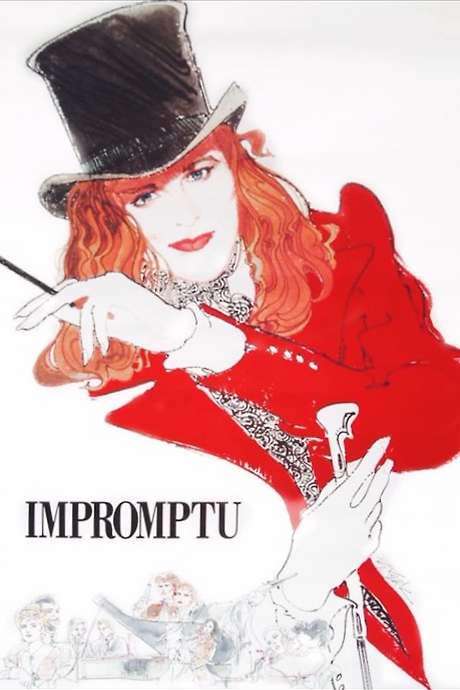
In 1830s France, renowned pianist and composer Frédéric Chopin becomes the object of affection of the determined, independent writer known as George Sand, a woman famed for her scandal‑defying lifestyle. Their budding romance pits artistic passion against societal expectations, charting the turbulent courtship that would shape both their lives.


Does Impromptu have end credit scenes?
No!
Impromptu does not have end credit scenes. You can leave when the credits roll.
Meet the Full Cast and Actors of Impromptu
Explore the complete cast of Impromptu, including both lead and supporting actors. Learn who plays each character, discover their past roles and achievements, and find out what makes this ensemble cast stand out in the world of film and television.

Emma Thompson
Duchess D'Antan

Mandy Patinkin
Alfred De Musset

Hugh Grant
Frederic Chopin

Anna Massey
George Sand's Mother

Julian Sands
Franz Liszt

Judy Davis
George Sand

Bernadette Peters
Marie D'Agoult

Ralph Brown
Eugene Delacroix

François Lalande
Local Doctor
Georges Corraface
Felicien Mallefille
David Birkin
Maurice
Anton Rodgers
Duke D'Antan
André Chaumeau
Priest
Isabelle Guiard
Princess
Nicholas Hawtrey
Philosopher
Lucy Speed
Young Aurora
Fernand Guiot
Butler
John Savident
Buloz
Elizabeth Spriggs
Baroness Laginsky
Sylvie Herbert
Sophie
Jean-Michel Dagory
Innkeeper
Jezabelle Amato
Innkeeper's Wife
Nimer Rashed
Didier
Claude Berthy
Chopin's Valet
Annette Milsom
Ursule
Stuart Seide
Clerk
External Links and Streaming Options
Discover where to watch Impromptu online, including streaming platforms, rental options, and official sources. Compare reviews, ratings, and in-depth movie information across sites like IMDb, TMDb, Wikipedia or Rotten Tomatoes.






Take the Ultimate Impromptu Movie Quiz
Challenge your knowledge of Impromptu with this fun and interactive movie quiz. Test yourself on key plot points, iconic characters, hidden details, and memorable moments to see how well you really know the film.
Impromptu (1991) Quiz: Test your knowledge of the 1991 film Impromptu, which dramatizes the relationship between writer George Sand and composer Frédéric Chopin amid a lively circle of 19th‑century artists.
Which actress portrays the writer George Sand in the film?
Full Plot Summary and Ending Explained for Impromptu
Read the complete plot summary of Impromptu, including all major events, twists, and the full ending explained in detail. Explore key characters, themes, hidden meanings, and everything you need to understand the story from beginning to end.
Baroness Amantine-Lucile-Aurore Dupin, Judy Davis known to the world by her pen name George Sand, has rebuilt her identity in Paris after divorce and the completion of her memoirs. A formidable, driven writer who defies convention, she often wears men’s clothing and moves through society with a bold, restless energy. Her latest fixation is Frédéric Chopin, Hugh Grant a brilliant but fragile composer whose music she has long admired. Sand’s unflinching passion for art and danger alike threads through every choice she makes, and her pursuit of Chopin becomes a test of endurance, nerve, and sincerity in a world that prizes appearances as much as talent.
Into this tense dynamic enters Countess Marie d’Agoult, the mistress of Frédanc Liszt, a shrewd observer who understands both Sand’s charm and the risks of chasing a frail heart. Bernadette Peters plays a woman who knows how jealousy can masquerade as care, and she counsels Sand to pursue Chopin with a strategy that mirrors the power of a traditional courtship: act like a pursuer, even when your target is reticent. Her influence will twist and turn the budding relationship in ways Sand neither anticipates nor fully controls, especially as d’Agoult’s own past with Liszt adds a sharp edge to every maneuver.
The story pivots around a house party at the country residence of the Duchess d’Antan, an aspiring socialite who dreams of staging a Parisian salon in the provinces. Emma Thompson embodies this host as she welcomes Chopin, Liszt, the witty writer Alfred de Musset, and the painter Eugène Delacroix into her world of glittering dinners and dazzling talk. The mood is buoyant but precarious: money is tight, yet the atmosphere is sustained by the sheer brilliance of the guests who must perform brilliantly at every meal to justify their presence. The duchess’s husband, the hunting-obsessed Duke D’Antan, is a foil to their refined ambitions, a stubborn chore of propriety who resents the social whirl his wife courts. Anton Rodgers captures a man torn between affection and appetite, between the traditional duties of land, kin, and estate and the intoxicating pull of Parisian cleverness.
Delacroix, the unscrupulous painter who can seduce with color and brush, lingers in the margins of the gathering. Ralph Brown plays him as both charm and threat, a man who knows the power of compulsion and portraiture alike. He is among those who listen to Sand and her circle with a mixture of awe and calculation, ready to use her presence as a subject or as a shield for his own ambitions. The party also includes two of Sand’s more troublesome old flames: de Musset, the sharp-witted but reckless writer, and Félicien Mallefille, her children’s tutor who arrives uninvited to the scene. Mandy Patinkin gives de Musset a vitality that keeps the talk lively, while Georges Corraface makes Mallefille’s persistence feel both earnest and a touch intrusive.
What begins as a lively, talent-filled gathering soon reveals fractures, as Sand’s boldness collides with d’Agoult’s calculated caution and Chopin’s delicate, fear-filled heart. A riding accident brings the guests into a moment of clumsy danger, and the duke’s gratitude toward the young Sand—disguised as service when she helps with the injured horse—shows the early mingling of stubborn pride and unexpected tenderness that will color every encounter to come. As Sand moves to secure Chopin’s attention, she adopts the courage of a man, while Chopin’s suspicions about being overwhelmed begin to surface. The two exchange a letter of longing, albeit one that is shrouded in misdirection: Sand’s ardor is real, but the letter is delivered—by d’Agoult—without Sand’s signature, a ruse that plants doubt and suspicion in Chopin’s mind.
The social dance intensifies when Sand, in a bold echo of her own audacity, appears in her husband’s clothes, a small rebellion that both amuses and irritates the other guests who have come to savor elegance, not trouble. Sand’s display of color—she literally dresses to echo the Polish flag in homage to Chopin—signals a deliberate bid for his attention, even as the other guests fidget at the spectacle. The party’s hospitality becomes a stage for social satire, as de Musset writes a short play that mocks the very aristocracy hosting the affair, a breach that Chopin protests even as laughter bubbles around the room. A prank—instigated by Sand’s children—leads to a fireplace explosion that injures the hosts and cements in everyone’s memory the perilous edge of their revelry. When the guests finally depart, the atmosphere is thick with both admiration and embarrassment, a mix of awe at talent and discomfort at excess.
A cruel rumor launched by d’Agoult—told to Chopin that Sand’s affection is tied to a money wager—casts Sand in a light of manipulative calculation that Chopin refuses to trust. He discovers a fragment of Sand’s phrase in a copy of her memoir, a detail that confirms d’Agoult’s treachery in his eyes and tempts him to retreat. Yet Sand insists that her strength—her resolve—will bolster his feeble body and guard his spirit, even as his fragile health makes him wary of surrendering his freedom to desire.
The duel that had once been a test of pride shifts in its outcome when Mallefille challenges Chopin and Sand intervenes with a fearless, even fatal, shot. The act is more than a remedy for a grudge; it becomes a declaration that love, when tested by danger, deserves a chance to heal. Sand nurses Chopin back to health, and the relationship between the two begins to warm in earnest, moving from battle to quiet, shared recovery.
If the turning point seems to hinge on the stubbornness of rivalries and the art that binds, the final arc makes it clear: Chopin’s Études are dedicated to d’Agoult, a decision that Liszt takes as a personal affront and a betrayal of the larger artistic circle. The friction among Chopin, Liszt, and Sand finally disperses as the pair retreat to Majorca for convalescence, away from Paris’s ceaseless competition. There, free from the eyes of the Parisian salon, they seek to reclaim their health, their art, and, just possibly, a private happiness that the world may never fully understand.
In the end, the film traces how two creators—one burdened by a fragile body and a fierce will, the other determined to bend the world to her own definition of greatness—must navigate love, reputation, and the price of brilliance. The story remains a portrait of a woman who refused to be confined, a man who offered beauty and vulnerability in equal measure, and a circle of friends and rivals who pushed one another toward art that might outlive them all.

Discover Film Music Concerts Near You – Live Orchestras Performing Iconic Movie Soundtracks
Immerse yourself in the magic of cinema with live orchestral performances of your favorite film scores. From sweeping Hollywood blockbusters and animated classics to epic fantasy soundtracks, our curated listings connect you to upcoming film music events worldwide.
Explore concert film screenings paired with full orchestra concerts, read detailed event information, and secure your tickets for unforgettable evenings celebrating legendary composers like John Williams, Hans Zimmer, and more.


Impromptu Themes and Keywords
Discover the central themes, ideas, and keywords that define the movie’s story, tone, and message. Analyze the film’s deeper meanings, genre influences, and recurring concepts.
Impromptu Other Names and Titles
Explore the various alternative titles, translations, and other names used for Impromptu across different regions and languages. Understand how the film is marketed and recognized worldwide.
Similar Movies To Impromptu You Should Know About
Browse a curated list of movies similar in genre, tone, characters, or story structure. Discover new titles like the one you're watching, perfect for fans of related plots, vibes, or cinematic styles.








Quick Links: Summary, Cast, Ratings, More

What's After the Movie?
Not sure whether to stay after the credits? Find out!




Explore Our Movie Platform
New Movie Releases (2026)
Famous Movie Actors
Top Film Production Studios
Movie Plot Summaries & Endings
Major Movie Awards & Winners
Best Concert Films & Music Documentaries
Movie Collections and Curated Lists
© 2026 What's After the Movie. All rights reserved.