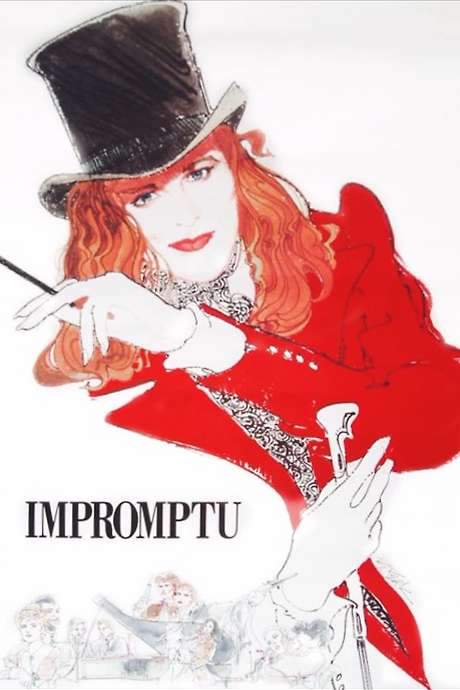
What Is Impromptu About?
The premise of Impromptu in 351 words, with nothing given away. The full story follows below.
In the vibrant world of 1830s France, the glittering salons of Paris pulse with music, literature, and fierce ambition. The film opens on a whirlwind of artistic brilliance, where composers, painters, and writers gather beneath chandeliers that seem to echo the restless energy of a society both enamored with refinement and haunted by convention. The tone is intoxicatingly lyrical, a blend of wit‑laden dialogue and the lingering melancholy of piano keys that hints at deeper currents beneath the polished surface.
George Sand, a baroness turned daring novelist, navigates this sphere with a boldness that defies the expectations placed on women of her class. She dresses in a mixture of masculine tailoring and flamboyant colors, and her reputation for scandal‑defying freedom makes her both admired and questioned by the elite. Across the room, Frédéric Chopin—a prodigious yet fragile composer—captures the attention of the assembled crowd with a quiet intensity, his delicate health contrasting sharply with his soaring musical genius. Their attraction is rooted in a shared devotion to artistic purity, setting the stage for a romance that tests the limits of personal desire against public scrutiny.
Around them swirl other formidable figures: Countess Marie d’Agoult, whose own storied past with the virtuoso Franz Liszt lends a sharp edge to the social dance; the aristocratic hosts, Duke D’Antan and Duchess d’Antan, whose provincial aspirations to recreate Parisian splendor provide a backdrop of genteel ambition; and the sharp‑tongued writer Alfred de Musset, whose wit adds both levity and tension to the gatherings. The ensemble paints a portrait of a cultural milieu where brilliance and rivalry coexist, and where each conversation can feel like a performance.
Within this tapestry of talent and expectation, the film examines how two extraordinary creators grapple with the price of brilliance. George Sand’s relentless pursuit of artistic freedom meets Chopin’s fragile yearning for both love and stability, forming a delicate balance that challenges the boundaries of gender, health, and societal norms. The atmosphere remains charged with possibility, inviting the audience to wonder how their intertwined fates will unfold amid the relentless rhythm of a world that refuses to be silent.
What Happens in Impromptu?
The complete story of Impromptu, from the first scene to the last, in 1,095 words (about 5 minutes). Spoilers throughout. Names in the text link to 8 cast member pages.
Spoilers ahead
Baroness Amantine-Lucile-Aurore Dupin, Judy Davis known to the world by her pen name George Sand, has rebuilt her identity in Paris after divorce and the completion of her memoirs. A formidable, driven writer who defies convention, she often wears men’s clothing and moves through society with a bold, restless energy. Her latest fixation is Frédéric Chopin, Hugh Grant a brilliant but fragile composer whose music she has long admired. Sand’s unflinching passion for art and danger alike threads through every choice she makes, and her pursuit of Chopin becomes a test of endurance, nerve, and sincerity in a world that prizes appearances as much as talent.
Into this tense dynamic enters Countess Marie d’Agoult, the mistress of Frédanc Liszt, a shrewd observer who understands both Sand’s charm and the risks of chasing a frail heart. Bernadette Peters plays a woman who knows how jealousy can masquerade as care, and she counsels Sand to pursue Chopin with a strategy that mirrors the power of a traditional courtship: act like a pursuer, even when your target is reticent. Her influence will twist and turn the budding relationship in ways Sand neither anticipates nor fully controls, especially as d’Agoult’s own past with Liszt adds a sharp edge to every maneuver.
The story pivots around a house party at the country residence of the Duchess d’Antan, an aspiring socialite who dreams of staging a Parisian salon in the provinces. Emma Thompson embodies this host as she welcomes Chopin, Liszt, the witty writer Alfred de Musset, and the painter Eugène Delacroix into her world of glittering dinners and dazzling talk. The mood is buoyant but precarious: money is tight, yet the atmosphere is sustained by the sheer brilliance of the guests who must perform brilliantly at every meal to justify their presence. The duchess’s husband, the hunting-obsessed Duke D’Antan, is a foil to their refined ambitions, a stubborn chore of propriety who resents the social whirl his wife courts. Anton Rodgers captures a man torn between affection and appetite, between the traditional duties of land, kin, and estate and the intoxicating pull of Parisian cleverness.
Delacroix, the unscrupulous painter who can seduce with color and brush, lingers in the margins of the gathering. Ralph Brown plays him as both charm and threat, a man who knows the power of compulsion and portraiture alike. He is among those who listen to Sand and her circle with a mixture of awe and calculation, ready to use her presence as a subject or as a shield for his own ambitions. The party also includes two of Sand’s more troublesome old flames: de Musset, the sharp-witted but reckless writer, and Félicien Mallefille, her children’s tutor who arrives uninvited to the scene. Mandy Patinkin gives de Musset a vitality that keeps the talk lively, while Georges Corraface makes Mallefille’s persistence feel both earnest and a touch intrusive.
What begins as a lively, talent-filled gathering soon reveals fractures, as Sand’s boldness collides with d’Agoult’s calculated caution and Chopin’s delicate, fear-filled heart. A riding accident brings the guests into a moment of clumsy danger, and the duke’s gratitude toward the young Sand—disguised as service when she helps with the injured horse—shows the early mingling of stubborn pride and unexpected tenderness that will color every encounter to come. As Sand moves to secure Chopin’s attention, she adopts the courage of a man, while Chopin’s suspicions about being overwhelmed begin to surface. The two exchange a letter of longing, albeit one that is shrouded in misdirection: Sand’s ardor is real, but the letter is delivered—by d’Agoult—without Sand’s signature, a ruse that plants doubt and suspicion in Chopin’s mind.
The social dance intensifies when Sand, in a bold echo of her own audacity, appears in her husband’s clothes, a small rebellion that both amuses and irritates the other guests who have come to savor elegance, not trouble. Sand’s display of color—she literally dresses to echo the Polish flag in homage to Chopin—signals a deliberate bid for his attention, even as the other guests fidget at the spectacle. The party’s hospitality becomes a stage for social satire, as de Musset writes a short play that mocks the very aristocracy hosting the affair, a breach that Chopin protests even as laughter bubbles around the room. A prank—instigated by Sand’s children—leads to a fireplace explosion that injures the hosts and cements in everyone’s memory the perilous edge of their revelry. When the guests finally depart, the atmosphere is thick with both admiration and embarrassment, a mix of awe at talent and discomfort at excess.
A cruel rumor launched by d’Agoult—told to Chopin that Sand’s affection is tied to a money wager—casts Sand in a light of manipulative calculation that Chopin refuses to trust. He discovers a fragment of Sand’s phrase in a copy of her memoir, a detail that confirms d’Agoult’s treachery in his eyes and tempts him to retreat. Yet Sand insists that her strength—her resolve—will bolster his feeble body and guard his spirit, even as his fragile health makes him wary of surrendering his freedom to desire.
The duel that had once been a test of pride shifts in its outcome when Mallefille challenges Chopin and Sand intervenes with a fearless, even fatal, shot. The act is more than a remedy for a grudge; it becomes a declaration that love, when tested by danger, deserves a chance to heal. Sand nurses Chopin back to health, and the relationship between the two begins to warm in earnest, moving from battle to quiet, shared recovery.
If the turning point seems to hinge on the stubbornness of rivalries and the art that binds, the final arc makes it clear: Chopin’s Études are dedicated to d’Agoult, a decision that Liszt takes as a personal affront and a betrayal of the larger artistic circle. The friction among Chopin, Liszt, and Sand finally disperses as the pair retreat to Majorca for convalescence, away from Paris’s ceaseless competition. There, free from the eyes of the Parisian salon, they seek to reclaim their health, their art, and, just possibly, a private happiness that the world may never fully understand.
In the end, the film traces how two creators—one burdened by a fragile body and a fierce will, the other determined to bend the world to her own definition of greatness—must navigate love, reputation, and the price of brilliance. The story remains a portrait of a woman who refused to be confined, a man who offered beauty and vulnerability in equal measure, and a circle of friends and rivals who pushed one another toward art that might outlive them all.
Impromptu Timeline: Every Key Event in Order
14 key events in the order they happen, from “George Sand's Paris life after divorce” to “Flight to Majorca for convalescence”. 14 events name a place, across 5 locations.
- 1
George Sand's Paris life after divorce
Baroness Sand lives in Paris under the male pseudonym George Sand after completing her memoirs. She is driven and provocative, wearing men's clothing and pursuing a string of lovers. She sets her sights on the young composer Frédéric Chopin.
When:1830s Where:Paris, France
- 2
Countess d'Agoult's manipulative guidance
Sand's friend Countess Marie d'Agoult advises her to pursue Chopin with the tenacity of a hunter, suggesting a masculine approach. She works to keep Chopin and Sand apart, resenting Sand's independence and her own past with Liszt. The tension sets the moral battlefield for their entanglement.
When:1830s Where:Paris, France
- 3
First meeting: 1836 at Duchess d'Antan's house
Sand meets Chopin in 1836 at the French country house of the Duchess d'Antan. The gathering also includes Liszt, de Musset, Delacroix, and others drawn to the fabled salon. The setting promises artistic glitter but also social undercurrents.
When:1836 Where:Duchess d'Antan's country house, French countryside
- 4
Luminaries invited, staying for luxury
The duchess idolizes her celebrated guests and they accept the arrangement to live in luxury with only brilliance required at dinner. The scene blurs lines between patrons and artists, nurturing extravagant pretensions. Sand's presence adds a note of audacious daring to the party.
When:1836 Where:Duchess d'Antan's house
- 5
Sand arrives with children, uninvited rivals
Sand brazenly invites herself and her children to the house party, alongside former lovers de Musset and Mallefille, who also show up uninvited. The dynamic becomes a crowded tinderbox of egos and unresolved rivalries. The strain foreshadows the social fireworks to come.
When:1836 Where:Duchess d'Antan's house
- 6
Riding accident reveals Sand's disguise
During a riding accident, the duke is grateful to the 'young lad' who helps by shooting the injured horse. The twist is that the 'lad' is actually George Sand herself in disguise. The revelation heightens the guests' embarrassment and the tension between host and guests.
When:1836 Where:Duchess d'Antan's estate
- 7
Love note to Chopin and its misdelivery
Sand writes a passionate letter to Chopin and has it delivered by d'Agoult, who signs Sand's name. Chopin is alarmed by the boldness and wary of being overwhelmed by Sand. The moment crystallizes the misunderstandings fueling their attraction.
When:1836 Where:Duchess d'Antan's house
- 8
Dress and seduction: Polish colors
The duchess mimics Sand by dressing in her husband's clothes, while Sand wears a dress in the colors of the Polish flag to catch Chopin's eye. The visual gambit underscores their gender politics and Chopin's confusion about Sand's intent. The tension between restraint and pursuit intensifies.
When:1836 Where:Duchess d'Antan's house
- 9
The satirical play and the fireplace incident
The luminaries stage a short play satirizing the aristocracy, which Chopin protests as bad manners. A prank by Sand's children triggers a fireplace explosion, injuring their hosts and souring the gathering. The party collapses as guests overstay their welcome.
When:1836 Where:Duchess d'Antan's house
- 10
D'Agoult's rumor and the letter's signature revealed
Afterward, d'Agoult falsely tells Chopin that Sand gambled for money to seduce him, pushing him away. He later buys a copy of Sand's memoir and finds the phrase from the signed letter, confirming the deception. The incident exposes the treachery and intensifies mistrust.
When:1836-1837 Where:Paris, France
Show the other 4 events of Impromptu Hide the last 4 events
- 11
Chopin's rebuke and Sand's resolve
Chopin declares that his weak and failing body is separate from his spirit, implying he is not fit for a romance with Sand. Sand insists she can bolster his health and resolve, keeping the flame alive. The moment marks a shift from pursuit to care.
When:1836-1837 Where:Paris, France
- 12
Duel and Sand's intervention
Mallefille, once Sand's rival for her tutor position, challenges Chopin; before the duel, Sand intervenes and shoots Mallefille with his pistol, ending the duel. She then tends to Chopin, nursing him back to health and calming their fraught relationship.
When:1836 Where:Paris, France
- 13
Études dedication and Liszt's quarrel
Sand convinces Chopin to dedicate his Études to d'Agoult, an act Liszt interprets as infidelity and sparks a quarrel with his mistress. The artistic and personal rivalries come to a head, altering tensions among the circle. Chopin's gesture complicates loyalties.
When:1836 Where:Paris, France
- 14
Flight to Majorca for convalescence
With the entanglements set aside temporarily, Sand and Chopin depart for Majorca for convalescence, seeking space away from Parisian artistic competitiveness. The trip signals a new phase of their relationship, grounded in care rather than public drama. The journey ends the immediate salon scene.
When:Post-1836 Where:Majorca, Spain
Who Are the Main Characters in Impromptu?
14 characters, among them Duchess D'Antan (Emma Thompson), George Sand (Judy Davis) and Frédéric Chopin (Hugh Grant): who each one is and the part they play in the story. Every profile links to the actor’s page.
-

Duchess D'Antan (Emma Thompson)
Played by Emma Thompson
A driven socialite who dreams of staging a Parisian-style salon in the provinces. She adores attention, mingles with luminaries, and even dons her husband's clothes, provoking both fascination and derision. Her ambition to influence the artistic circle sets the stage for many social machinations at the estate.
- 🎭 Drama
- 🏰 Aristocracy
- 👗 Fashion
-

George Sand (Judy Davis)
Played by Judy Davis
A formidable and independent writer who uses a male pseudonym to navigate society. She pursues Chopin with boldness, writes passionate letters, and challenges conventional norms with fearless appetite for romance and artistic collaboration. Her wit and resolve complicate the lives of everyone around her.
- 🎭 Drama
- 🧭 Literature
- 👗 Identity
-

Frédéric Chopin (Hugh Grant)
Played by Hugh Grant
A frail yet brilliant composer whose health and sensitivity make him susceptible to pressure from Sand and the salon world. He is drawn to Sand's intensity but remains wary of being overwhelmed by her forceful affection. His responsiveness to affection and fear of exposure shape his decisions throughout the house party and beyond.
- 🎼 Music
- 💫 Romance
- 🧠 Intellect
-

Marie d'Agoult (Bernadette Peters)
Played by Bernadette Peters
The mistress of Liszt who resents Sand's prominence and schemes to undermine her rival. She manipulates information to protect her own position within the circle, even if it means orchestrating deceit. Her actions shape Chopin's perceptions and the dynamics of rivalries among the guests.
- 🎭 Drama
- 🏛️ Aristocracy
- 🧠 Strategy
-

Franz Liszt (Julian Sands)
Played by Julian Sands
A celebrated pianist whose friendship with Chopin and involvement with d'Agoult complicate the relationships at the estate. He quarrels with d'Agoult over Sand's influence and becomes part of the web of artistic alliances and jealousies. His presence underscores the tension between genius and personal loyalty.
- 🎹 Music
- 🎭 Drama
- 🧭 Loyalty
-

Alfred de Musset (Mandy Patinkin)
Played by Mandy Patinkin
A witty writer, host, and participant in performances that lampoon the aristocracy. He becomes entangled in the romantic and social intrigues, contributing to the party's atmosphere with a sharp tongue and theatrical sensibility. His duel with Mallefille intensifies the film's themes of honor and public display.
- 🎭 Drama
- 🖋️ Literature
- 🎯 Competition
-

Eugène Delacroix (Ralph Brown)
Played by Ralph Brown
A painter who seduces the Duchess and sketches her portrait, bringing visual art into the web of romantic and social intrigue. His presence adds a visual, sensual dimension to the salon’s dynamics and highlights the era's painterly culture.
- 🎨 Visual Arts
- 🧭 Influence
- 🧪 Intuition
- FM
Félicien Mallefille (Georges Corraface)
Played by Georges Corraface
The children's tutor who trespasses into the hostess's world and later challenges Chopin to a duel. His intrusion and ambition reflect the disruptive presence of outsiders in elite circles and the lengths some will go to secure legitimacy through association with Sand.
- 📚 Education
- 🗡️ Conflict
- 🧭 Intrusion
- M(
Maurice (David Birkin)
Played by David Birkin
A character present in the estate's social milieu, contributing to the lively, interconnected group of guests. He embodies the bustling, interconnected world of artists and patrons who orbit Sand and Chopin.
- 🎭 Drama
- 🏛️ Society
- DD
Duke D'Antan (Anton Rodgers)
Played by Anton Rodgers
The hunting-obsessed husband of the Duchess, whose practicality and disregard for social performances create friction in the household. His discomfort with the guests' brilliance highlights the contrast between provincial life and Parisian high society.
- 🏰 Aristocracy
- 🗡️ Honor
- 🐎 Tradition
- P(
Priest (André Chaumeau)
Played by André Chaumeau
A local priest who represents the moral and social oversight of the community. His presence grounds the story in traditional values amid the salon's experiments with identity and romance.
- ⛪ Religion
- 🧭 Society
- CV
Chopin's Valet (Claude Berthy)
Played by Claude Berthy
A minor aide who assists Chopin, adding to the portrait of the composer’s life and routine within the social whirl surrounding the estate.
- 🧰 Servitude
- 🎵 Music
- U(
Ursule (Annette Milsom)
Played by Annette Milsom
A supporting character who helps fill in the domestic life of the estate, contributing to the atmosphere of a bustling, hosted gathering.
- 🏠 Domestic Life
- 🧭 Social
- BL
Baroness Laginsky (Elizabeth Spriggs)
Played by Elizabeth Spriggs
A notable guest who embodies the social hierarchy and the playful but critical glimpses into aristocratic circles during the house party.
- 🎭 Drama
- 🏛️ Aristocracy
Where and When Is Impromptu Set?
Impromptu is set in Paris, French countryside (Duchess d'Antan's estate) and Majorca (1836). Here is why the time and place matter to the story.
When
1836
Set in the year 1836, the narrative sits in the midst of the Romantic era, where artists and writers navigated salons, flirtations, and social hierarchies. The period features fashionable hostesses, bustling intellectual circles, and salon-driven networks that influence reputations. The time frame anchors the events of invitation, performance, injury, and retreat that shape the relationships among Sand, Chopin, Liszt, Musset, and their circle.
Where
Paris, French countryside (Duchess d'Antan's estate), Majorca
The story unfolds around a Parisian salon culture and a provincial country house where the invited luminaries gather. It also follows the characters' retreat to Majorca for convalescence, moving the action from opulent drawing rooms to more intimate settings. The settings reflect a Romantic era world of high society, art, and personal ambition, with both urban and rural backdrops driving the plot.
- 🎭 Drama
- 🏛️ Aristocracy
What Are the Themes of Impromptu?
4 ideas the story keeps returning to, among them Romance & Rivalry, Gender & Identity and Artistic Rivalry.
-
01
Romance & Rivalry
Love is shown as both a magnet and a weapon, drawing Sand and Chopin together while provoking jealousy and strategic maneuvering among their peers. The pursuit is shaped by social theatrics, with participants calculating how to win affection without sacrificing status. Rivalries among artists and lovers drive much of the drama, testing loyalties and exposing vulnerabilities.
-
02
Gender & Identity
George Sand embraces a masculine persona and dresses in non-traditional attire, challenging gender norms of the time. The Duchess mimics male persona as part of social performance, blurring lines between gender expectations and personal ambition. These choices expose the pressures women faced to secure influence through appearance and bravado within a male-dominated cultural world.
-
03
Artistic Rivalry
A tapestry of famous artists—Chopin, Liszt, Musset, and Delacroix—competes for recognition, inspiration, and influence within a fashionable salon. Their ambitions collide with personal relationships, leading to provocations, pranks, and a lingering sense of competition. The environment rewards brilliance but punishes perceived insincerity, making artistry inseparable from social power.
-
04
Deception & Letters
Deception threads through the plot, most clearly in the forged letter that d'Agoult signs, manipulating Chopin's perceptions. Miscommunication and misattribution fuel misunderstandings, culminating in dramatic confrontations and strategic moves. The letter and its consequences reveal how intimacy can be weaponized within high-society circles.
What Kind of Film Is Impromptu?
Bittersweet in tone, with steady pacing and a moderate story, going by the plot summary.
- Tone
- Bittersweet
- Pacing
- Steady
- Story
- Moderate
- Intensity
- Medium
- Ending
- Bittersweet
A sophisticated and defiant period drama that captures the passionate, turbulent, and ultimately bittersweet romance between two brilliant artists navigating societal scorn and personal fragility.
- passionate
- defiant
- melancholic
- witty
- romantic
- sophisticated
- artist's life
- gender roles
- defying convention
- romantic rivalry
Content notes: gunfight.
Quiz
How well do you remember Impromptu? Test yourself on the story.