What Is Vatel About?
The premise of Vatel in 298 words, with nothing given away. The full story follows below.
In the summer of 1671 the glittering world of Louis XIV’s Versailles looms over a province gasping for relief. The ambitious Prince de Conde summons the Sun King to his ancestral château, hoping that a three‑day spectacle of unrivaled splendor will secure the royal favor and the funds his lands desperately need. The film opens amid the clatter of gilded carriages, the rustle of silk, and the weight of a crown that turns every gesture into a calculated performance.
At the heart of the impending extravaganza is Vatel, the Prince’s master of festivities. Though born of humble origins, he possesses a rare blend of artistry, discipline, and an almost reverent devotion to the art of celebration. Tasked with turning the prince’s grand vision into reality, Vatel moves through the bustling kitchens, the glittering gardens, and the hushed servants’ quarters with a quiet authority that commands both admiration and unease. His talent makes him the invisible engine behind the opulent illusion the court demands.
Within this world of baroque excess, a tender yet precarious connection forms between Vatel and Anne de Montausier, the king’s newest confidante. Their growing affection is set against a rigid hierarchy that measures worth by birth and title, casting a subtle tension over every shared glance. As the preparations intensify, the pressure of meeting the king’s expectations, the Prince’s relentless ambition, and the expectations of a court that watches every detail all converge upon Vatel, testing the limits of his honor and resolve.
The atmosphere is one of sumptuous decadence tinged with an undercurrent of anxiety—an elegant façade that hints at the strain behind the glitter. The story promises a delicate dance between duty and desire, artistry and authority, against the backdrop of a court where every banquet is both a triumph and a gamble.
What Happens in Vatel?
The complete story of Vatel, from the first scene to the last, in 548 words (about 2 minutes). Spoilers throughout. Names in the text link to 2 cast member pages.
Spoilers ahead
In 1671, amid the ongoing Franco-Dutch War, a financially strained prince of Condé welcomes King Louis XIV to the opulent Château de Chantilly for three days of unprecedented festivity. The prince spares no expense in his bid to secure a commission as an army General, determined to elevate his status at any cost. At the very heart of this grand spectacle stands François Vatel, the Master of Festivities and Pleasures in the prince’s household, a man of rare talent and impeccable honor, yet born of lowly birth.
As the demands of luxury mount, the tasks placed before Vatel grow increasingly menial and morally compromising. He fights to preserve his dignity while choreographing a spectacle that must outshine any court in Europe. Amid the glitter and pressure, he finds himself drawn to Anne de Montausier, the king’s latest lover, who returns his sincere affection. Yet their bond is tempered by the rigid social pecking order of the court, making any romance feel both dangerous and doomed. The tension between desire and propriety casts a quiet, aching shadow over Chantilly, turning every gesture into a careful calculation.
The story crescendos on the final day of the king’s visit, when Vatel discovers a painful truth: he is a puppet in the hands of his superiors, bought and sold like a piece of property. The revelation comes as the Prince of Condé loses him in a card game with the king, a betrayal that leaves Condé wrenched between friendship and political expedience. Despite Condé’s reluctance to let him go, he finds himself pressured by the king’s entourage and the king’s own hunger for military glory to send Vatel to Versailles as part of the Royal Court. Faced with this crushing choice, Vatel refuses to abandon the people who depend on him—the loyal servants and cooks who keep the château alive—and he cannot bring himself to depart with them.
Consumed by despair, Vatel makes a definitive, tragic choice and ends his life by throwing himself on his sword. The court fashions a different, comforting version of events for the king: that Vatel killed himself because the roast could not feed a larger-than-expected guest list, that the fireworks were dampened by clouds, and that there was doubt about the morning fish supply. This invented explanation pleases the king, easing his own conscience and avoiding the messy truth. Anne de Montausier is left overwhelmed with grief and, recognizing the impossibility of their bond, withdraws from court life in silence. She disappears from the record, leaving no trace of what might have been, and the memory of their forbidden love lingers only as a whispered tragedy within the walls of Chantilly.
Against the backdrop of pomp and political maneuvering, the film unfolds as a meditation on ambition, class, and the costs of beauty. Vatel’s unwavering devotion to his craft and to those who rely on him stands in stark contrast to a society that prizes status above integrity. The romance with Anne de Montausier adds a human heartbeat to the story, a fragile thread that cannot endure the weight of courtly ambition. In the end, the tale offers a somber reflection: grand displays can mask deep fractures, and the price of prestige may be measured in the quiet, unsung sacrifices of those who organize the spectacle.
Vatel Timeline: Every Key Event in Order
12 key events in the order they happen, from “Franco-Dutch War sets the stage at Chantilly” to “Condé’s internal conflict comes to a head”. 12 events name a place, across 3 locations.
- 1
Franco-Dutch War sets the stage at Chantilly
In 1671, during the Franco-Dutch War, Prince of Condé hosts King Louis XIV for three days of festivities at the Château de Chantilly. The occasion is meant to showcase power and prestige, but it is also a stage for courtly games and political maneuvering. The setting foreshadows the personal and social pressures that will grip Vatel and the others.
When:1671, Day 1 Where:Château de Chantilly
- 2
Vatel is appointed Master of Festivities
François Vatel is appointed Master of Festivities and Pleasures and tasked with orchestrating the entire celebration. He is praised for his talent and integrity, yet his low birth marks him as an outsider in the aristocratic circle. The assignment places him at the heart of the court’s ambitions and anxieties.
When:1671, Day 1 Where:Château de Chantilly
- 3
Vatel faces demeaning tasks
The tasks given to Vatel are often menial and dishonorable, designed to prove his loyalty through service rather than merit. He struggles to maintain his dignity as he's pulled into the daily grind behind the dazzling spectacle. These humiliations plant the seeds of his later disillusionment.
When:1671, Day 1-2 Where:Château de Chantilly
- 4
Vatel falls for Montausier
Vatel falls in love with Anne de Montausier, the king’s latest lover, and she in turn returns his feelings. Their romance unfolds within the constraints of courtly etiquette and the rigid hierarchy around them. The relationship underscores the personal cost of the social ladder they navigate.
When:1671, Day 2 Where:Château de Chantilly
- 5
The impossibility of the liaison
Their liaison remains impossible because of class differences and royal protocol. The couple understands that continuing would violate the social order and invite scandal. The constraint highlights the fragility of happiness within the glittering court.
When:1671, Day 2 Where:Château de Chantilly
- 6
The card game reveals Vatel’s precarious place
On the last day of the king’s visit, Vatel realizes he has been reduced to a pawn in a game between Condé and Louis XIV. The prince appears to misplace him by losing him in a card game, and the king demands his presence at Versailles as part of the Royal Court. The revelation shatters Vatel’s sense of agency and worth.
When:1671, Day 3 Where:Château de Chantilly
- 7
Condé informs Vatel he must go to Versailles
Condé communicates through a servant that Vatel must accompany the king to Versailles as part of the Royal Court. He does so reluctantly, torn between friendship and political obligation. The moment reveals how power reshapes personal loyalties into contractual promises.
When:1671, Day 3 Where:Château de Chantilly
- 8
Vatel refuses to abandon his people
Disheartened by the forced transfer, Vatel refuses to leave his people and the château. He chooses loyalty to his staff over personal advancement. The decision underscores his integrity in the face of overwhelming social pressure.
When:1671, Day 3 Where:Château de Chantilly
- 9
Vatel’s suicide
Vatel commits suicide by throwing himself on his sword, a dramatic act born of crushed dignity and broken pride. His death is framed not only as personal tragedy but as a commentary on the brutal demands of court life. The spectacle moves quickly from celebration to catastrophe.
When:1671, Day 3 Where:Château de Chantilly
- 10
The royal court covers the cause of death
The king is told by his court that Vatel’s death stemmed from a failed roast, dull fireworks, and worries about fish for the morning meal. The careful explanation appeases the king and deflects responsibility from the court's system. The lie reveals how appearances can mask deeper manipulations at court.
When:After death Where:Royal Court
- 11
Montausier grieves and retreats from court
Anne de Montausier is grief-stricken by Vatel’s death and quietly leaves the court. She maintains her silence and dissolves from public view, never speaking of the affair again. The closing of her arc emphasizes the erasure of personal lives within the court's churn.
When:After death Where:Court
- 12
Condé’s internal conflict comes to a head
Condé is torn between friendship with Vatel and the political pressure of King Louis XIV’s entourage. He relents, keeping his promise to the king even at the expense of his friend. The ending underscores the price of glory and obedience in the era’s power dynamics.
When:1671, Day 3 Where:Château de Chantilly
Who Are the Main Characters in Vatel?
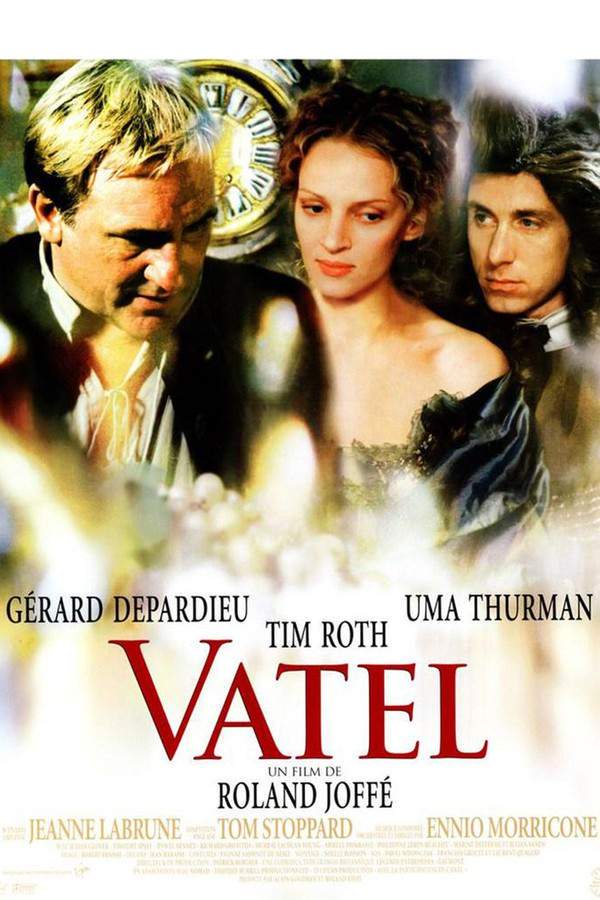
2 characters, among them François Vatel (Gérard Depardieu) and Anne de Montausier (Uma Thurman): who each one is and the part they play in the story. Every profile links to the actor’s page.
-

François Vatel (Gérard Depardieu)
Played by Gérard Depardieu
The Master of Festivities and Pleasures in the prince’s household, Vatel is portrayed as honorable and exceptionally talented, yet born into lower social ranks. He labors to maintain dignity amid a relentless stream of orders and humiliating tasks, striving to impress the king and secure his own status. His forbidden love for Anne de Montausier compounds his conflict between personal longing and social duty. When the king demands his transfer to Versailles, Vatel accedes to a crushing moment of existential choice and ends his life.
- 🎭 Ambition
- 💎 Class struggle
- 🍽️ Banquet culture
-

Anne de Montausier (Uma Thurman)
Played by Uma Thurman
Anne is the king’s mistress and a focal point of Vatel’s affection, embodying grace and intelligent restraint within the rigid court. She shares a mutual, but impossible, love with Vatel, navigating the treacherous waters of court politics and propriety. Her grief after Vatel’s death reveals the personal costs borne by those entangled in royal intrigues. Her presence highlights the vulnerability of women who are both power players and victims of the era’s rules.
- 💔 Forbidden love
- 🎭 Court intrigue
- 👑 Royal affair
Where and When Is Vatel Set?
Vatel is set in Château de Chantilly and Versailles (1671). Here is why the time and place matter to the story.
When
1671
Set in 1671 during the Franco-Dutch War, the story unfolds in a France under Louis XIV’s early sway, where court life is defined by ritual, display, and political maneuvering. The era is marked by extravagant feasts, strict social hierarchies, and a constant push for favor and advancement at court. This period highlights the pressures and ambitions that drive Vatel and his patrons alike.
Where
Château de Chantilly, Versailles
The film centers on the Château de Chantilly, a lavish royal residence where three days of festivities unfold. Chantilly embodies the era's excess and meticulous spectacle, serving as the battleground for social climbing and personal dignity. The later reference to Versailles signals the broader reach of royal power beyond Chantilly and the rigid court hierarchy that governs everyone’s fate.
- 🏰 Grand residence
- 🎨 Opulent setting
- 👑 Royal court
What Are the Themes of Vatel?
4 ideas the story keeps returning to, among them Ambition, Forbidden Love and Power and Control.
-
01
Ambition
François Vatel rises through sheer talent and personal honor but remains of low birth, fueling a desperate bid for recognition at the king’s court. The feast becomes a stage where social ascent is measured by spectacle rather than merit. As orders pile up, the pressure to deliver perfection exposes the fragile line between dignity and subservience. The pursuit of status drives the choices that ultimately define Vatel’s fate.
-
02
Forbidden Love
Vatel’s feelings for Anne de Montausier transcend social boundaries, yet their romance is doomed by courtly hierarchy and propriety. The lovers must navigate the gulf between desire and duty, knowing the relationship cannot endure within the rigid structure of the era. Their connection deepens the tragedy, showing how personal affection clashes with public obligation. The outcome underscores the cost of social constraint on genuine emotion.
-
03
Power and Control
Vatel is treated as a pawn by his superiors and the royal entourage, effectively bought and sold to serve political ends. The king’s desire for control, and Condé’s calculations, push Vatel into situations that strip him of agency. The illusion of mastery masks the fragility of a life lived at the mercy of those in power. The narrative probes how authority manipulates individuals to preserve a larger spectacle.
-
04
Grandeur and Folly
The lavish banquet and spectacular displays become symbols of opulence that outpace moral concerns and human needs. Vanity and the obsession with perfection reveal the hollowness of grandiose displays when they are built on fragile foundations. The film critiques how ceremony can mask insecurity, fear of failure, and the fragility of reputation. Ultimately, the pursuit of magnificence yields tragedy rather than triumph.
What Kind of Film Is Vatel?
Melancholic in tone, with steady pacing and a moderate story, going by the plot summary.
- Tone
- Melancholic
- Pacing
- Steady
- Story
- Moderate
- Intensity
- Medium
- Ending
- Sad
A stately yet somber period drama that builds a sense of impending tragedy amidst opulent festivities, exploring the crushing weight of honor and social constraints.
- oppressive
- fatalistic
- melancholic
- somber
- grandiose
- tragic romance
- class divide
- social hierarchy
- honor and duty
- political manipulation
Content notes: suicide.
Where to Watch Vatel
. US availability and prices from JustWatch.
Streaming availability in the US, powered by