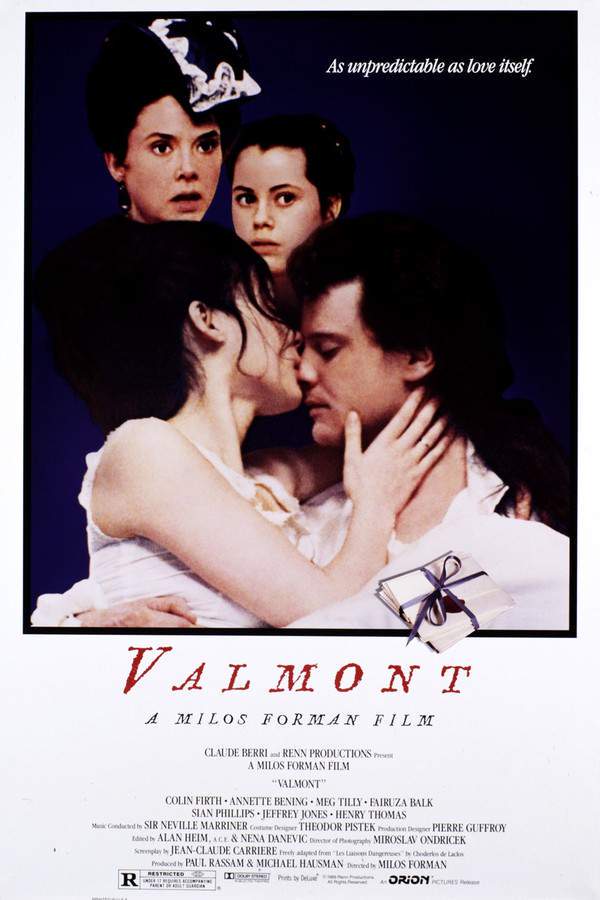
What Is Valmont About?
The premise of Valmont in 261 words, with nothing given away. The full story follows below.
In the glittering salons of 18th‑century France, reputation is a currency and desire a battlefield. The film immerses us in a world where aristocratic elegance masks a ruthless calculus of power, and every whispered promise carries the weight of social ruin. Against this backdrop, the story follows two master manipulators who treat love not as a feeling but as a strategic game.
Marquise de Merteuil is a sharp‑witted, recently widowed noblewoman whose pleasure in exerting control over those around her is matched only by her longing for retribution when she feels slighted. When she learns that her former lover, Gercourt, intends to wed the innocent Cécile de Volanges, a young woman raised in a convent, Merteuil’s pride sparks a meticulously plotted scheme. She summons the charming yet morally ambiguous Vicomte de Valmont, offering him a high‑stakes wager: win Cécile’s affection before the wedding night, and in return he may claim Merteuil’s own desire; fail, and he must abandon his libertine ways.
Vicomte de Valmont thrives on the thrill of conquest, but his ambitions extend beyond a single conquest. He is drawn to the virtuous Madame de Tourvel, a married woman whose reputation for fidelity presents an enticing, seemingly unattainable prize. The film’s tone is simultaneously seductive and cold, laced with wit and a keen cynicism that exposes the flimsy veneer of aristocratic virtue. As Merteuil and Valmont navigate a labyrinth of letters, secret meetings, and whispered intrigues, their partnership becomes a delicate dance of mutual exploitation, each testing the limits of desire, pride, and the fragile balance of their social world.
What Happens in Valmont?
The complete story of Valmont, from the first scene to the last, in 630 words (about 3 minutes). Spoilers throughout.
Spoilers ahead
Marquise de Merteuil [Annette Bening] is a wealthy widow in 18th-century France who learns that her secret lover Gercourt will marry Cécile de Volanges, a young woman raised in a convent to safeguard her chastity. The rumor that Gercourt cannot sever ties with a former mistress who is mentally unbalanced fuels her anger at his hypocrisy, his insistence on a virgin bride, and the slight he shows her character. Enraged, she plots revenge.
She recruits her former lover, the debonair Vicomte de Valmont [Colin Firth], and lays out a ruthless wager: if he can win Cécile’s innocence before the wedding night to humiliate Gercourt, he may also bed Merteuil; if he fails, he must resign himself to a monastic life. Valmont, however, has his own quarry in mind—Madame de Tourvel, a married woman famed for her virtue, who has been warned about his track record and deliberately avoids him. Merteuil’s scheme hinges on exposing the wedding’s hollow moral pretense while testing the limits of desire and betrayal.
Meanwhile, Cécile’s music teacher Danceny begins to write love letters to Cécile, and the two fall into a tender, earnest romance. Merteuil, ever the provocateur, sets about creating opportunities for the young lovers to consummate their bond, but Cécile remains naïve and Danceny too honorable to press her. Frustrated, Merteuil takes Cécile on holiday to the country estate where Valmont is chasing Tourvel, and, through a calculated ploy, has Valmont help Cécile craft letters. He goes to Cécile’s room and consummates the girl’s virginity. A guilt-darkened Cécile seeks Merteuil’s comfort, and Merteuil nudges her toward marrying Gercourt while keeping Danceny as her lover.
Valmont’s pursuit of Tourvel does bear fruit, and she is seduced as planned. In the morning she writes to her husband about her new feelings and leaves to attend to errands, but Valmont has already departed. In a provocative turn, Merteuil then uses the aftermath to manipulate Valmont further: she seductively waits for him on a bed, essentially spurning him, which infuriates him and prompts a renewed, dangerous charge toward Cécile. He then persuades Cécile to write a letter to Danceny that reveals Merteuil’s manipulation and falsehoods. Tourvel, meanwhile, spends the night with Valmont, only to find that he has gone by morning, and her sorrow deepens when she learns the truth of Valmont’s others’ schemes.
Valmont returns to Merteuil and proposes marriage, arguing they would be stronger together than apart. Merteuil coldly reminds him that they were married once before and that any union between them would end in betrayal. She then reveals that Danceny lies in her bed; she has seduced him and told him everything. Enraged, Valmont heads to Cécile’s side, hoping to whisk her away to safety in the countryside so she can follow her heart. Instead, Cécile reveals that she has confessed all to her mother, who promptly banishes Valmont from the house.
The following day, Danceny challenges Valmont to a duel to defend Cécile’s honor. Valmont, already hung over from drinking, is unable to duel fairly, and Danceny fights in self-defense when Valmont makes the first move and is defeated. Valmont dies in battle, and his funeral gathers many of his former lovers. Merteuil, devastated by the loss of her closest ally and rival, learns that Cécile is carrying Valmont’s child; Madame de Rosemonde, Valmont’s aunt, rejoices at the news. Cécile and Gercourt marry in a grand ceremony, with Danceny surrounded by several eligible young women, while Merteuil remains alone, having lost her grip on the world she once controlled.
In the final moments, Madame de Tourvel visits Valmont’s tomb and places a rose on it, returning to her quiet life with her husband. The story closes on a tableau of longing, consequence, and the quiet loneliness that follows a calculated manipulation of love.
Valmont Timeline: Every Key Event in Order
16 key events in the order they happen, from “Merteuil learns of Gercourt's upcoming marriage to Cécile” to “Tourvel honors Valmont at his tomb”. 11 events name a place, across 9 locations.
- 1
Merteuil learns of Gercourt's upcoming marriage to Cécile
Merteuil learns that Gercourt plans to marry Cécile, a naive convent raised girl. She laments the hypocrisy of his vow of virginity while keeping a lover of his own. This revelation sets her on a path of calculated revenge against him and those who betrayed her.
- 2
Merteuil enlists Valmont with a cruel wager
She seeks out her former lover, the Vicomte de Valmont, and proposes a cruel wager: seduce Cécile's virginity before the wedding to humiliate Gercourt. He has little interest in Cécile and is more drawn to Madame de Tourvel, a virtuous married woman. If he succeeds, he earns Merteuil's favor; if he fails, he must enter a monastery.
- 3
Danceny and Cécile begin a secret courtship
Danceny, Cécile's music teacher, begins writing love letters to her and they soon fall in love. Their romance is earnest and hopeful, in sharp contrast to the scheming around them. The budding relationship becomes a dangerous liability for Merteuil's plan.
- 4
Merteuil takes Cécile to the country estate to advance the plot
Merteuil takes Cécile on holiday to the country estate where Valmont had pursued Tourvel. She arranges for Valmont to help Cécile craft love letters, hoping to create opportunities for passion. Valmont, eager to outmaneuver Gercourt, ends up taking Cécile's virginity.
Where:Country estate
- 5
Cécile loses her virginity to Valmont
Cécile's loss of virginity leaves her guilt ridden and anxious about her future. Merteuil consoles her and urges that she marry Gercourt while keeping Danceny as her lover. The social pressures intensify, driving the characters deeper into manipulation.
- 6
Merteuil encourages Cécile to marry Gercourt and keep Danceny as lover
Merteuil consoles Cécile and urges that she marry Gercourt while keeping Danceny as her lover. Her calculated counsel deepens the web of deceit surrounding the young couple. The plan moves forward as social expectations loom over every decision.
- 7
Tourvel is seduced by Valmont and begins an affair
Madame de Tourvel is swept off by Valmont's charm and begins an affair with him. In the morning she writes to her husband confessing the affair, then leaves to prepare a meal, only to return and find Valmont has already departed. The betrayal shakes her sense of virtue and devotion.
When:the morning after Where:Tourvel's residence
- 8
Valmont and Merteuil's power dynamic escalates
To reward Valmont for his betrayal Merteuil sits on the bed in a cold calculated display, causing him to storm out. The taunt underscores the brutal power dynamics between them. Valmont then heads to Cécile to press her to write to Danceny and reinforce Merteuil's manipulation.
Where:Merteuil's residence
- 9
Merteuil manipulates Cécile into a deceiving letter to Danceny
Merteuil uses pressure to manipulate Cécile into writing a letter that claims Merteuil convinced her to cast Danceny as her lover instead of marrying him. Danceny discovers the deception and resents Merteuil's control over Cécile.
Where:Cécile's location
- 10
Tourvel spends a night with Valmont and faces the consequences
Tourvel spends the night with Valmont, a key moment in their forbidden affair. The following day she learns the consequences of her choices and the fragility of her virtue. Valmont's feelings for her begin to complicate his plans and hide the true cost of his deception.
When:the night of the encounter Where:Valmont's residence
Show the other 6 events of Valmont Hide the last 6 events
- 11
Valmont confronts Merteuil about their relationship and Danceny
Valmont returns to Merteuil and proposes that they marry. Merteuil warns that any marriage between them would end in betrayal and she reveals that Danceny is in her bed; he had come to threaten her but she seduced him and told him everything.
Where:Merteuil's residence
- 12
Valmont and Cécile consider escaping but face family opposition
Valmont goes to Cécile and suggests they flee the country so she can love whom she chooses. Instead, Cécile reveals that she has confessed everything to her mother, who orders Valmont from the house.
Where:Cécile's home
- 13
A duel ends Valmont's life
The next day Danceny challenges Valmont to a duel to avenge Cécile's honor. Valmont, drunk, attacks and is killed by Danceny in self defense.
When:the next day Where:Duel location
- 14
Valmont's funeral and the fallout
Valmont's funeral is attended by his former lovers, including Merteuil who is devastated by the loss. Cécile reveals she is carrying his child and Madame de Rosemonde is overjoyed by the news; Cécile and Gercourt are soon married with Danceny surrounded by a crowd of eligible young women.
Where:Valmont's funeral
- 15
Merteuil is left alone after her schemes unravel
Merteuil remains alone, having lost Gercourt, Danceny, and Valmont. The fall from power echoes the cost of her ruthless manipulation. Her once formidable social position dissolves as the men and relationships she played with move on.
Where:Merteuil's residence
- 16
Tourvel honors Valmont at his tomb
Some time later Madame de Tourvel lovingly places a rose on Valmont's tomb before returning to her waiting husband. The act marks the lingering consequences of the men and women’s schemes. The final image is one of quiet, somber remembrance.
When:some time later Where:Valmont's tomb
Who Are the Main Characters in Valmont?
4 characters, among them Vicomte de Valmont (Colin Firth), Madame de Tourvel (Annette Bening) and Cécile de Volanges: who each one is and the part they play in the story. 2 of them link to the actor’s page.
-

Vicomte de Valmont (Colin Firth)
Played by Colin Firth
A charismatic yet calculating rake who pursues Tourvel and collaborates with Merteuil to manipulate Cecile and Danceny. His vanity and appetite for conquest drive the plot, leading to a web of deception and ultimately a fatal duel.
- 💎 Aristocrat
- 💘 Seductive
- 🗡️ Ruthless
-

Madame de Tourvel (Annette Bening)
Played by Annette Bening
A married woman renowned for virtue who becomes the object of Valmont's seduction. She struggles between duty and desire, revealing the moral turmoil that arises when virtue is tested by passion. Her withdrawal and eventual reconciliation with her husband underscore the cost of infidelity.
- 💎 Virtue
- 🧭 Moral conflict
- CD
Cécile de Volanges
A naive young woman raised in a convent to preserve her chastity, who becomes entangled in Valmont's schemes and Danceny's affection. She is manipulated by Merteuil and, at the end, revealed to be with child, highlighting the consequences of the adults' machinations on her life.
- 👶 Naivety
- 💃 Youth
- CD
Chevalier Danceny
An honorable musician and Cecile's lover, idealistic and principled. He falls for Cecile and is drawn into Merteuil and Valmont's intrigues. He duels Valmont and, in self-defense, kills him, sealing the tragedy.
- 🎵 Romantic
- 🛡️ Honor
Where and When Is Valmont Set?
Valmont is set in France (18th century). Here is why the time and place matter to the story.
When
18th century
The events unfold during the 18th century French aristocracy, where arranged marriages and social maneuvering shape romantic entanglements. Public virtue clashes with private libertinage as betrayals ripple through the social circle. The era’s salons and estates serve as the theater for manipulation, desire, and consequences.
Where
France
Set in 18th‑century France, the story moves between Parisian salons and grand country estates, with a parallel thread of convent upbringing. It centers on the social codes surrounding marriage, reputation, and virtue among the aristocracy. The setting highlights opulent manners, secret affairs, and the moral ambiguities of a society that prizes appearances over honesty.
- 🇫🇷 France
- 🏛 Aristocracy
- 🏰 Country estates
What Are the Themes of Valmont?
4 ideas the story keeps returning to, among them Love, Betrayal and Hypocrisy.
-
01
Love
Romantic longing drives the plot, pulling Cecile, Danceny, Tourvel, and Valmont into a tangle of desire and vulnerability. The story shows how affection can clash with social expectations and what people will do to control outcomes. Across the narratives, love becomes a tool, a solace, and a source of pain. The film suggests that genuine feeling can be shadowed by calculation and vanity.
-
02
Betrayal
Merteuil and Valmont orchestrate schemes that ensnare Cecile and Tourvel, revealing how trust can be weaponized for revenge. The betrayals ripple through friendships and marriages, leaving heartbreak in their wake. The pursuit of personal satisfaction comes at the cost of others’ reputations and happiness.
-
03
Hypocrisy
The nobles project virtue and honor outwardly while pursuing secret liaisons behind closed doors. Masks and flirtations mask selfish desires, exposing a double standard that governs their social world. The narrative shows how reputation is manufactured and morality is situational.
-
04
Power
Power dynamics shape every relationship, as status and wealth enable schemes and control. The wager between Valmont and Merteuil hinges on who can bend others to their will. The story shows how influence can corrupt affection, honor, and loyalty, with tragedy as the inevitable consequence.
What Kind of Film Is Valmont?
Dark in tone, with steady pacing and a complex story, going by the plot summary.
- Tone
- Dark
- Pacing
- Steady
- Story
- Complex
- Intensity
- High
- Ending
- Bittersweet
A dark and cynical period drama that moves with a steady, deliberate pace through a complex web of aristocratic manipulation, where calculated seductions and betrayals create a heavy, morally bankrupt atmosphere culminating in tragic consequences.
- cynical
- manipulative
- debauched
- melancholic
- calculating
- decadent
- aristocratic corruption
- seduction as a game
- loss of innocence
- revenge
Content notes: sexual manipulation, loss of virginity under duress, duel to the death, emotional abuse.
Quiz
How well do you remember Valmont? Test yourself on the story.