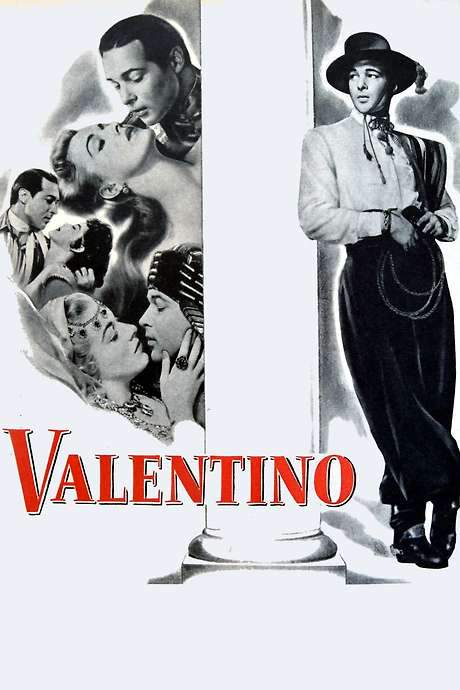
Valentino 1951

Directed by

Lewis Allen
Made by

Edward Small Productions
Valentino Plot Summary
Read the complete plot summary and ending explained for Valentino (1951). From turning points to emotional moments, uncover what really happened and why it matters.
This romantic biopic traces the life of Rudolph Valentino, the Italian-born performer who comes to the United States and rises to become a movie star, all while navigating love, ambition, and the price of fame. The story begins with a voyage from Italy to New York, where the young artist works as a dancer and crosses paths with Joan Carlisle — who is traveling under the alias Sarah Gray — and the pair quickly fall into a tender, transformative romance. Yet jealousy brews within the troupe, as Maria Torres’s leadership over the dance ensemble casts a shadow over Rudolph’s early dream, and she dismisses him in a moment of insecurity and pride.
Once in New York, Rudolph finds himself penniless and starts over as a dishwasher, befriending waiter Luigi Verducci. A fierce brawl lands him in trouble, but Luigi’s loyalty endures as Rudolph borrows money to buy a tuxedo and starts landing work as a nightclub dancer. Rudolph’s refined European dance style charms the club’s patrons and catches the eye of high-society women, while a pivotal evening brings film director Bill King into the room with Joan, hinting at a possible big break in Hollywood. Inspired by the scene, Rudolph agrees to give acting a try, nudging himself toward a future beyond nightclub performances.
The next steps bring him into the film world, where he appears in a small role opposite Lila Reyes and forges a friendship that will influence his career. Lila explains the behind-the-scenes influence Joan holds over casting, prompting Rudolph to secure a meeting with her. Their alliance soon deepens into a charged relationship, even as Joan’s feelings become tangled with her marriage and career. When Joan learns of Rudolph’s awareness of her influence, she accuses him of courting her merely for advantage, and Rudolph, feeling misunderstood, leaves in a mix of indignation and resolve.
Driven by ambition, Rudolph heads west to Hollywood. He starts with modest parts, dreaming bigger as he learns the rhythms of the studio system. A key audition for the lead role in The Four Horsemen of the Apocalypse becomes a turning point: Rudolph and Lila stage a bold, character-matching performance at a party hosted by Mark Towers, and the risk pays off when Towers agrees to cast him. The movie’s success vaults Rudolph into stardom and convinces him to bring Luigi to Hollywood as his assistant, a partnership that deepens his control over his own ascent and widens his circle in the industry.
As fame grows, Rudolph’s romance with Joan rekindles, though she remains connected to King in a different capacity. They briefly reconcile on a beach vacation, but Rudolph makes his own confession — he loves Joan but does not want marriage at that moment. The call to be the best man at King’s wedding to Joan soon follows, complicating the pair’s delicate balance of honesty and duty. Rudolph’s career becomes even louder with the announcement that he will star in a new romantic drama, The Sheik, with Bill King directing and Joan as the female lead. The tension between on-screen romance and off-screen reality intensifies during rehearsals, forcing both actors to confront the limits of their chemistry and the weight of audience expectations.
The Sheik becomes a blockbuster, yet the friction intensifies as Towers questions why Rudolph refuses to shoot a sequel with Joan. To escape the mounting pressure, Rudolph travels with Luigi, hoping for respite, but abdominal pain signals something more serious. A doctor diagnoses appendicitis and recommends rest and surgery, even as journalist Eddie Morgan watches for any hint of scandal around Rudolph and Joan. Morgan’s fascination with the couple leads him to spy on them, heightening the sense of impending trouble behind the scenes.
Towers again presses for a working reunion between Rudolph and Joan, who meet in Malibu and admit lingering feelings while acknowledging they can no longer pretend otherwise. Photographers capture the two together, provoking a confrontation that exposes the precariousness of their relationship. To shield Joan from scandal, Rudolph conceals his true situation and invites Joan to consider a future free of danger, publicly announcing an engagement to Lila, with Lila herself ready to support the claim. Morgan agrees to drop the sensational angle after the revelation, but the personal peril continues to mount.
On the road to New York, Rudolph collapses and dies soon after, leaving a city and a world in shock. When Joan reads the news, she confronts the possibility that King may have known her feelings all along, and King reassures her that he did, in his own way. Rudolph’s funeral becomes a monumental public moment, and a woman dressed in black keeps vigil at his grave each year, a quiet, persistent reminder of the enduring mystique and tragedy surrounding a legend who rose to fame too quickly and left too soon.
Valentino Timeline
Follow the complete movie timeline of Valentino (1951) with every major event in chronological order. Great for understanding complex plots and story progression.
Valentino's voyage romance
On a passenger steamship traveling from Naples to New York, Rudolph Valentino works as a dancer and catches the eye of actress Joan Carlisle, who is traveling under the name Sarah Gray. The two quickly fall in love during the voyage, but the ship's dance leader Maria Torres grows jealous and dismisses Rudolph from the troupe.
New York arrival and rough start
Arriving penniless in New York, Rudolph works as a dishwasher while befriending waiter Luigi Verducci. A brawl leads to his firing, and he borrows money to buy a tuxedo, setting the stage for his first step toward stardom.
Nightclub breakthrough
Rudolph is hired as a dancer at a nightclub, where his refined European style attracts high-society attention. One night, director Bill King visits with Joan, and Rudolph's tango with Joan catches King's eye, hinting at a future film role.
First acting chance
The next day Rudolph lands a small acting role alongside Lila Reyes and befriends her. Lila explains Joan's influence over casting, and Rudolph arranges a meeting with Joan, marking the start of their evolving relationship.
Casting tensions
Bill King asks Joan if she approves Rudolph for a role; learning Rudolph knows about her influence, Joan accuses him of opportunism and Rudolph, offended, storms off. The exchange foreshadows the complicated relationship between art, fame, and romance.
Hollywood breakthrough begins
Valentino travels to Hollywood and starts with minor roles, chasing the breakout that could redefine his career. He auditions for Julio in The Four Horsemen of the Apocalypse, and with a bold plan, performs with Lila at a Towers-hosted party, convincing the producer to cast him.
Rising star and pursuit of Joan
Rudolph's film debut becomes a success, and he brings Luigi to Hollywood, hiring him as an assistant. He climbs into larger roles and becomes a heartthrob, but he still tries to reconnect with Joan, who is now dating Bill King.
Beach reconciliation
Rudolph relentlessly pursues Joan and follows her to a beach vacation, where they reconcile. He openly confesses his love but admits he does not wish to marry, and Joan parts from him amicably.
Best man invitation
Rudolph's career continues to flourish, enabling him to follow King’s invitation to be best man at his wedding to Joan. The personal drama thickens as their lives interlace with public events.
Falcon's Lair and The Sheik
Valentino's status enables him to purchase an estate he names Falcon's Lair and be cast as the lead in The Sheik, directed by Bill King with Joan as the female lead. The on-set romance and tension produce many retakes as both actors feel uneasy about the love scenes.
The Sheik success and pushback
The Sheik becomes a blockbuster, but Towers questions why Rudolph refuses a sequel with Joan. Seeking respite, Rudolph travels with Luigi to get away from the glare of fame.
Illness and gossip
During the trip, Rudolph complains of abdominal pain and a doctor diagnoses appendicitis, recommending rest and surgery. Meanwhile Eddie Morgan continues to dig for gossip, while Morgan spies on Rudolph and Joan.
Malibu confession and scandal threat
Joan confesses she still loves Rudolph but no longer feels for her husband; they plan to tell Bill King the truth. Photographers capture them together, prompting confrontation when Rudolph protects Joan from scandal.
Engagement to shield Joan
Rudolph arranges a meeting with Joan and Morgan at his home and lies about an engagement to Lila to shield Joan from gossip; Lila backs him up, and Morgan agrees not to publish.
Death, funeral and memory
On the way to New York, Rudolph collapses and dies in a hospital, ending his career at a tragically early age. His funeral becomes a major public event, and for years a woman dressed in black visits his grave on the anniversary of his death. Joan reads of his death and asks Bill King if he knew her true feelings; King affirms that he did.
Valentino Characters
Explore all characters from Valentino (1951). Get detailed profiles with their roles, arcs, and key relationships explained.
William 'Bill' King (Richard Carlson)
A film director who discovers Rudolph in a club and pursues him for starring roles. He is Joan's husband and a gatekeeper in casting decisions, shaping Rudolph's early career. His involvement illustrates Hollywood's power dynamics and the intersection of professional and personal loyalties.
Luigi Verducci (Joseph Calleia)
A waiter who befriends Rudolph on the journey to America and later joins him as an assistant in Hollywood. He lends Rudolph money for a tuxedo and shares in the challenges of early fame. Luigi represents loyalty and practical support in a turbulent industry.
Joan Carlisle / Sarah Gray (Eleanor Parker)
An actress who captivates Rudolph and influences casting, while also being bonded to Bill as his wife. Their romance becomes a focal tension that affects both careers and personal choices. Her relationship with Rudolph reflects the complexities of love within the film industry.
Mark Towers (Otto Kruger)
A producer who initially resists Rudolph but ultimately supports his breakthrough, embodying the gatekeeper role of Hollywood decision-makers. He pushes Rudolph into dramatic roles and later pressures reuniting him with Joan for marketable narratives. Towers represents the business side of fame.
Maria Torres (Dona Drake)
Leader of the dance ensemble whose jealousy foreshadows conflict on stage and in life. She embodies the competitive tension among performers in the feast-or-fame world of silent cinema. Her presence adds a layer of professional rivalry to Rudolph's early career.
Eddie Morgan (Lloyd Gough)
A journalist who samples gossip about Rudolph and Joan, pursuing sensational stories. He monitors their relationship and attempts to destabilize reputations through the press. Morgan's efforts highlight the media's role in shaping a star's public image.
Lila Reyes (Patricia Medina)
A friend who becomes Rudolph's partner and later fiancée, supporting his career and personal decisions. She plays a crucial role in his life during the navigation of fame and relationships. Her loyalty underscores the personal networks that accompany stardom.
Rudolph Valentino (Anthony Dexter)
The film's central figure, an immigrant who rises from dancer to one of cinema's first global icons. His charm fuels his career yet his relationships are tested by fame and public scrutiny. The narrative follows his artistic triumphs, personal conflicts, and his early death, cementing his lasting legacy.
Valentino Settings
Learn where and when Valentino (1951) takes place. Explore the film’s settings, era, and how they shape the narrative.
Time period
1910s–1920s
Set during the silent film era, the narrative follows Rudolph Valentino's ascent from a penniless dancer to a Hollywood icon. The timeline spans the 1910s into the mid-1920s, capturing the rise of a film star and the era's rapid changes in fame. It also reflects the period's public fascination with celebrity culture and tabloid-style scrutiny.
Location
Naples, Italy, Atlantic Ocean, New York, Hollywood, California, Malibu, California, Falcon's Lair
The story unfolds from a voyage on a passenger ship from Naples to New York to the glittering clubs and studios of early Hollywood. It then shifts to New York's nightlife and onto the film sets of Hollywood, with later scenes set in Malibu and Rudolph Valentino's Falcon's Lair estate. These locations trace the immigrant journey, rise to fame, and the private life behind the public image.
Valentino Themes
Discover the main themes in Valentino (1951). Analyze the deeper meanings, emotional layers, and social commentary behind the film.
🎯
Ambition
Valentino's ascent is driven by a relentless pursuit of stardom, moving from a shipboard dancer to a movie star. The film shows how ambition opens doors in a nascent Hollywood while also creating personal and professional strains. It highlights the costs and pressures that accompany meteoric success.
💘
Romance
Romance threads through Valentino's career, centering on his relationship with Joan and the involvement of Lila. The love dynamics collide with career and casting decisions, testing loyalty and ambition. The story explores whether affection can endure fame and public scrutiny.
🎭
Fame and Scandal
Public attention fuels Valentino's rise, while photographers and gossip threaten reputations. The narrative treats the tension between private desire and public spectacle, culminating in a highly visible death and memorial. The legacy of Valentino endures as the film examines how fame shapes memory.

Coming soon on iOS and Android
The Plot Explained Mobile App
From blockbusters to hidden gems — dive into movie stories anytime, anywhere. Save your favorites, discover plots faster, and never miss a twist again.
Sign up to be the first to know when we launch. Your email stays private — always.
Explore the mobile appValentino Spoiler-Free Summary
Discover the spoiler-free summary of Valentino (1951). Get a concise overview without any spoilers.
In a glittering era when silent pictures ruled the night‑time sky, the film opens a window onto the dazzling yet fragile world of an immigrant who would become an icon. Rudolph Valentino arrives in America with a dancer’s poise and a hunger for something greater, stepping from cramped ship decks onto the bustling streets of New York and, eventually, the bright studios of Hollywood. The story captures the intoxicating allure of early‑twentieth‑century showbiz—the smoky clubs where European flair mesmerized patrons, the frenetic energy of a burgeoning film industry, and the constant hum of cameras that turn ordinary moments into legend.
At the heart of the narrative is a tender, complicated romance that blossoms amid the chase for fame. Joan Carlisle, a magnetic presence who shares the stage and the spotlight with Rudolph, becomes the focus of his affection and a mirror for his own ambitions. Their connection is portrayed with a lyrical intimacy that contrasts sharply with the relentless demands of the public eye, hinting at a love that must constantly negotiate the pressures of celebrity.
Supporting the hero’s rise is a steadfast friendship forged in the kitchens and back‑rooms of the city. Luigi Verducci stands as a loyal confidant, offering both comic relief and grounding perspective as Rudolph navigates the precarious path from dancer to leading man. Their bond underscores a recurring theme: the tension between personal loyalty and the isolating glare of adulation.
The tone balances romantic sweep with a wistful awareness of the cost of stardom, inviting viewers to feel both the exhilaration of a meteoric ascent and the quiet yearning for a love that can survive the spotlight. By the film’s close, the audience is left pondering how far one can chase a dream before the very fame that fuels it begins to demand something priceless in return.
Movies with Similar Twists and Themes
Uncover films that echo the narrative beats, emotional arcs, or dramatic twists of the one you're exploring. These recommendations are handpicked based on story depth, thematic resonance, and spoiler-worthy moments — perfect for fans who crave more of the same intrigue.


Featured on this page

What's After the Movie?
Not sure whether to stay after the credits? Find out!
Check out our other apps:

SAT Sphere
Build confidence for the Digital SAT.

Mori Atlas
Discover wild places worth protecting.

Luntero
Search smarter for a home in Amsterdam.

Plot Explained
Unravel movie endings and hidden clues.

Pokechamp
Dive into Pokémon data and battle logic.

Driving Theory
Get ready for your European theory test.

Movie Dust
Plan your next cinema trip with ease.

Musemap
Find art and culture as you travel.

Selkobase
Compare credentials before committing.

Local Manual
Turn an unfamiliar country into practical next steps.

Lernavi
Compare school systems before your next move.

GymRoam
Find a workout stop wherever your plans take you.
Explore Our Movie Platform
New Movie Releases (2026)
Famous Movie Actors
Top Film Production Studios
Movie Plot Summaries & Endings
Major Movie Awards & Winners
Best Concert Films & Music Documentaries
Movie Collections and Curated Lists
© 2026 What's After the Movie. All rights reserved.
Privacy Policy