

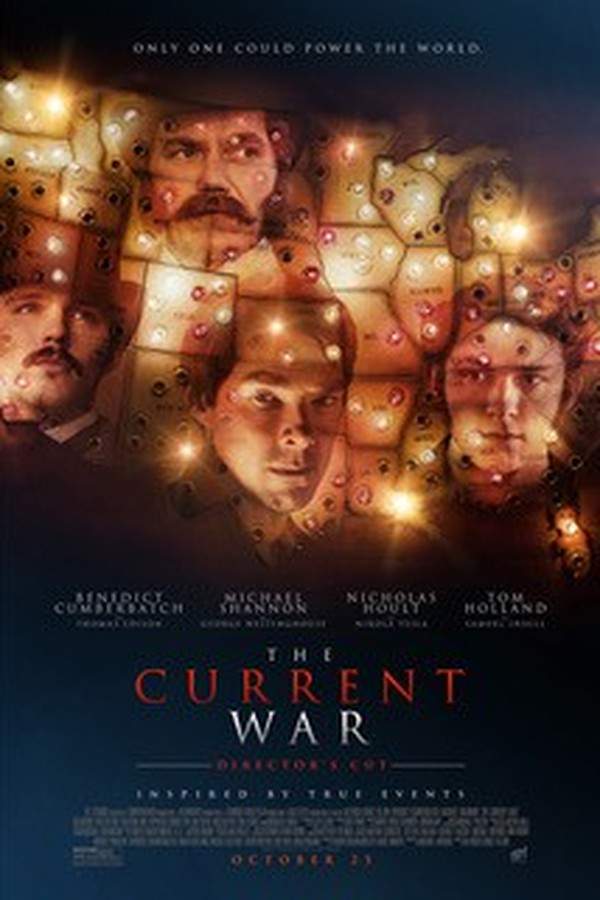
The Current War 2017

Directed by

Craig Roberts
Made by

Bazelevs Production
The Current War Plot Summary
Read the complete plot summary and ending explained for The Current War (2017). From turning points to emotional moments, uncover what really happened and why it matters.
Certainly! Here’s a detailed and polished rephrasing of your movie summary in markdown format, adhering to all your guidelines:
In the year 1880, the story begins with Benedict Cumberbatch as Thomas Edison, passionately applying for a patent for his revolutionary electric lightbulb. In his detailed presentation, Edison explains the design and purpose of his invention to an eager audience. As he demonstrates his vision, a crowd of men gathers in the woods, drawn by the promise of fortune. They approach to find a sprawling field illuminated by thousands of glowing lightbulbs—an awe-inspiring sight that symbolizes Edison’s dream of illuminating the world. Edison has gathered these investors to bankroll his venture, though he still requires additional funding to fully realize his ambitions.
Meanwhile, Edison is traveling on a train to meet influential figures such as Matthew Macfayden’s J.P. Morgan, a powerful financier, along with the President and his wife, Mary Edison (played by Tuppence Middleton), and their children, affectionately nicknamed Dot and Dash for Morse code signaling. During this journey, Edison discusses his latest inventions, including the phonograph, with his trusted secretary, Tom Holland’s Samuel Insull, as they prepare for future meetings. The next stop involves a crucial dinner with Michael Shannon’s George Westinghouse, an inventor and industrialist with competing plans for electrical systems.
Before the dinner, Edison attempts to secure funding in the city, setting up an office in Manhattan that will serve as the hub for his expanding electrical empire. However, he abruptly decides to return home, exhausted from the whirlwind of negotiations, and is greeted at the station by Katherine Waterston’s Marguerite Westinghouse. The Westinghouse family visit is canceled unexpectedly, but their acquaintance remains strong. During the visit, Franklin Pope notes Edison’s eccentric personality, giving Westinghouse insight into Edison’s intense work ethic and obsession with innovation.
Back at home, Edison’s wife Mary expresses concern about his relentless work schedule. She speaks into their phonograph, recording her voice and her desire for him to build a fence in their yard—an ordinary wish that highlights her longing for normalcy amidst his scientific pursuits. Sadly, Mary’s health begins to decline, though Edison remains fixated on his work, dismissing her illnesses as minor. When she collapses, a doctor diagnoses her with a serious condition, prompting Edison to ask for delays on bills to care for her.
Despite personal tragedy, Edison’s business accelerates. Morgan invests half a million dollars in Edison’s projects, fueling hopes of lighting up Manhattan. Edison’s team works tirelessly, successfully illuminating several buildings, capturing public attention and solidifying his reputation. However, Nicholas Hoult’s Nikola Tesla, a brilliant inventor, watches with curiosity and skepticism from the crowd, as Tesla is recruited to work for Edison Electric. Tesla demonstrates that Alternating Current (AC) is far more efficient than Edison’s Direct Current (DC) system, but Edison—confident in his DC technology—resists switching.
Westinghouse, meanwhile, advocates for AC, proposing the use of transformers to transmit electricity over much greater distances at lower costs. He plans a demonstration to prove that AC can be a superior system, capable of powering entire cities more efficiently. Edison attempts to discredit AC by publicly illustrating its dangers—most notoriously by electrocuting a horse with AC current, calling it “Westinghouse, the horse,” in a controversial and ethically questionable stunt designed to sway public opinion.
As tensions escalate, Tesla explains the advantages of AC, yet Edison remains committed to his DC system. The rivalry spills into the press, with accusations flying and patent disputes intensifying. Edison fears losing his dominance and accuses Westinghouse of using stolen designs—the same ones Edison has patented—prompting legal battles and a bitter public feud. Amidst the chaos, Simon Manyonda’s Lewis Latimer and Tesla attempt to develop improvements, but Tesla is eventually fired after disagreements with his new partners.
While personal tragedies deepen, with Mary’s health worsening, Edison’s focus remains on his inventions. He dedicates himself to improving the phonograph and secretly records her voice, seeking solace in her words. Meanwhile, J.P. Morgan proposes merging Edison’s company with others to consolidate power under the newly forming General Electric, a move Edison fiercely opposes, feeling betrayed and overshadowed. Morgan’s plan leaves Edison with only a symbolic position and a seat on the board.
The race to light the 1893 World’s Columbian Exposition in Chicago reaches its climax. Both Edison and Westinghouse bid for the contract, with Edison’s team concerned about the safety of AC and its potential dangers to the public. To prove the dangers, Edison orchestrates a demonstration where he uses AC to electrocute a horse, further fueling fear. Ultimately, Westinghouse wins the bid, and his lighting system dazzles visitors at the fair, showcasing the potential of electric lighting without harming anyone—marking a historic milestone.
Throughout the event, Edison’s creation of the electric chair is brought to light, as he is approached by a man interested in its humane application for executions. Edison, opposed to the idea of taking life, is reluctant but is pressured into participating in a demonstration. The electric chair proves problematic, highlighting the ethical dilemmas intertwined with technological progress. In court, Westinghouse counters Edison’s claims about AC’s lethality by exposing confidential letters, revealing Edison’s efforts to discredit AC and strengthen his own position.
Amid legal battles and corporate maneuvers, Westinghouse shows his shrewdness and resilience, recalling civil war days when he successfully tricked a drunken soldier, illustrating that he’s no fool. Edison, confronted with these conflicts, receives a call from Westinghouse, who warns him not to threaten his reputation further—telling him he’s about to publish damaging letters.
In the final stages, Tesla and Westinghouse form an alliance, working together to develop revolutionary motors and power systems for the upcoming fair. Meanwhile, Tom Holland’s Samuel Insull promotes Edison’s phonographs worldwide, boosting revenue. Despite the setbacks, Edison accepts that Westinghouse’s system will illuminate the future’s brightest moments.
At the famous 1893 World’s Fair, Westinghouse’s lighting captivates the public, all while Edison graciously acknowledges that his own inventions have changed the world forever, even if his company lost the contract. In a reflective moment, Edison admits that his next project—the kinetograph, or motion picture camera—is so groundbreaking that it will eventually eclipse his work with electricity. As they part ways, Edison and Westinghouse share a mutual respect rooted in their extraordinary contributions to technology, understanding that both their visions have forever altered the course of history.
The Current War Timeline
Follow the complete movie timeline of The Current War (2017) with every major event in chronological order. Great for understanding complex plots and story progression.
Edison applies for a lightbulb patent
Thomas Edison presents his design for a lightbulb and seeks a patent, highlighting its purpose and features. As he does this, a large field of glowing bulbs is revealed, symbolizing his invention's potential. Numerous men gather in the woods to see this spectacle, emphasizing the groundbreaking nature of his work.
Edison meets with financiers and officials
On a train heading to meet J.P. Morgan and the President with his family, Edison discusses his plans and technical innovations like the phonograph. He also considers expanding his electric company, showing his ambitions to electrify Manhattan and beyond.
Morgan agrees to fund Edison
J.P. Morgan commits $500,000 to Edison, enabling him to establish a Manhattan office and expand his electrical infrastructure. Edison begins working intensely with his team to bring electricity to Manhattan, marking a major step in his project.
Edison pioneers electrical lighting in Manhattan
Edison successfully supplies electricity to a few buildings in Manhattan during an inaugural demonstration. The event draws attention, with Nikolai Tesla observing the scene, hinting at upcoming technological rivalries.
Westinghouse proposes AC system
Westinghouse criticizes Edison’s direct current system for its limited reach and high cost, proposing an alternative alternating current (AC) system using transformers. He plans to demonstrate that AC can supply power over much greater distances more efficiently.
Tesla joins Edison Electric
Tesla is hired by Edison and tasked with developing innovations, including an improved motor, with strict deadlines. Despite his talents, Tesla works under tight constraints and begins to challenge Edison’s direct current approach.
Mary’s health deteriorates
Edison’s wife Mary becomes seriously ill, and her condition worsens. Edison focuses on his work, recording her voice on the phonograph as she speaks, trying to preserve her memory before she passes away.
Mary passes away
Mary Edison dies, leaving Edison devastated. He finds comfort in listening to her voice recording, which reminds him of their life together, as he faces the grief of losing his wife.
Electrocution demonstration and electric chair
Edison attempts to demonstrate the dangers of AC current by electrocuting a horse in a public show, promoting the idea that AC is lethal. Subsequently, Edison develops the electric chair, viewing it as a humane execution method, tying it to his anti-AC campaign.
Rivalry with Westinghouse heats up
Edison and Westinghouse become embroiled in a public battle over electrical systems, with smear campaigns and accusations. Edison claims Westinghouse’s AC is dangerous, while Westinghouse defends his system as more practical and economical.
Westinghouse wins the 1893 World’s Fair bid
The organizers choose Westinghouse’s AC system to light the Chicago World’s Fair after considering safety and cost. Edison accepts the defeat, acknowledging Westinghouse’s superior technology for this event, though he deeply regrets the loss.
Edison’s involvement with the electric chair exposed
The electric chair, which Edison helped develop as a supposedly humane execution device, is tested on a man who confesses to murder. The method fails to be humane, reflecting negatively on Edison’s stance against AC’s safety.
Merger and rebranding to General Electric
J.P. Morgan proposes merging Edison’s company with others, creating General Electric. Edison, feeling betrayed, reacts fiercely to the change in company ownership and the loss of his control, marking a significant turning point in his career.
Outcome of the 1893 World’s Fair
Westinghouse lights the fair using his AC system, showing its safety and efficiency. Edison, meanwhile, witnesses the event and finds a sense of victorious achievement in his earlier inventions, despite losing the bid.
Edison’s reflection and future projects
After the fair, Edison acknowledges Westinghouse’s success and hints that his new inventions, like the kinetograph, will surpass his past works. He foresees a future where his innovations will be remembered, apart from his electrical battles.
The Current War Characters
Explore all characters from The Current War (2017). Get detailed profiles with their roles, arcs, and key relationships explained.
Thomas Edison (Benedict Cumberbatch)
A driven and visionary inventor focused on electric innovation, Edison is passionate about making life better through technology. His stubbornness and commitment to his beliefs often put him at odds with competitors and colleagues. His personal struggles, especially with his wife’s illness and loss, add depth to his character.
Marguerite Westinghouse (Katherine Waterston)
As Westinghouse’s supportive wife, Marguerite is shown managing family and social expectations amid the chaos of technological rivalry. She represents stability and moral integrity, advocating for Western Union’s vision and stability.
George Westinghouse (Michael Shannon)
A pragmatic and competitive engineer, Westinghouse is determined to create a more efficient electrical system using alternating current. His rivalry with Edison is driven by innovation and business strategy, and he aims to bring electricity to the masses while maintaining integrity.
Tesla (Nicholas Hoult)
A brilliant but underappreciated inventor, Tesla is eager to prove the superiority of AC power with his innovative motor designs. His character embodies genius with a touch of eccentricity, seeking recognition and validation for his inventions.
Samuel Insull (Tom Holland)
Edison's dedicated secretary and assistant, Samuel is practical, ambitious, and a key supporter of Edison’s vision. He is involved in planning and business strategies, often navigating corporate politics.
The Current War Settings
Learn where and when The Current War (2017) takes place. Explore the film’s settings, era, and how they shape the narrative.
Time period
1880s to 1890s
The film is set during the late 19th century, a pivotal period in technological advancement and industrialization. This era saw the emergence of electric power, the first electric lighting systems, and major corporate rivalries. It was a time of rapid innovation, scientific experimentation, and fierce commercial competition, especially between Edison and Westinghouse.
Location
New York City, Manhattan, Westinghouse mansion, Chicago World's Fair
The movie takes place primarily in late 19th-century New York City, an era of rapid industrial growth and technological innovation. Manhattan serves as the hub for Edison Electric's operations and showcases the transition to electric power. The Chicago World's Fair highlights the prominence of World's Expositions as showcases for new technology, particularly electricity, symbolizing progress and competition.
The Current War Themes
Discover the main themes in The Current War (2017). Analyze the deeper meanings, emotional layers, and social commentary behind the film.
⚡
Innovation
The movie revolves around groundbreaking technological inventions such as the lightbulb, phonograph, and electrical systems. It highlights the drive for progress and how perseverance and ingenuity can transform society. The theme stresses the importance of invention in shaping the future and the competitive nature of innovation.
🌐
Competition
The film captures the fierce rivalry between Edison and Westinghouse over whose electrical system would dominate. This competition extends beyond technology to political influence, business interests, and personal reputation. It demonstrates how rivalry can accelerate progress but also lead to ethical dilemmas.
💔
Loss and Sacrifice
Edison endures personal loss with the death of his wife Mary, which deeply affects him. The movie explores sacrifices made in the pursuit of progress, illustrating how ambition can come at a personal toll. It also depicts the moral complexities of inventions like the electric chair.

The Current War Spoiler-Free Summary
Discover the spoiler-free summary of The Current War (2017). Get a concise overview without any spoilers.
In the waning years of the nineteenth century, America teeters on the brink of a luminous transformation. A restless energy pulses through bustling cities and fledgling towns alike, promising to replace oil lamps with a steady, reliable glow. The film immerses viewers in an era where invention is both a public spectacle and a private obsession, and where the promise of power feels as intoxicating as it is uncertain. The tone balances gritty industrial realism with a soaring sense of possibility, letting the hum of newly‑wired streets become a character in its own right.
Thomas Edison enters this world as a magnetic showman, driven by an unshakable belief that his inventions can reshape daily life. His relentless optimism is matched by an exacting work ethic, and his charisma draws investors, journalists, and a devoted inner circle. Opposite him, George Westinghouse embodies a more measured, engineering‑focused mindset. He is a pragmatic entrepreneur who trusts the science of his designs and values efficiency over flash. Their contrasting personalities create a compelling tension: Edison’s flair for public demonstration clashes with Westinghouse’s quiet confidence in technical superiority, setting the stage for a contest that feels as much personal as it is professional.
Against this backdrop, the story unfolds with a palpable sense of anticipation. The race to harness electricity becomes a metaphor for the broader struggle to control progress itself, raising questions about ambition, ethics, and the cost of illumination. As both men rally supporters, court skeptics, and the curious public, the film maintains a steady undercurrent of intrigue, hinting at the monumental stakes without revealing the outcomes. The atmosphere is charged with the electric buzz of discovery, leaving the audience eager to see how these opposing visions will reverberate through history.
Movies with Similar Twists and Themes
Uncover films that echo the narrative beats, emotional arcs, or dramatic twists of the one you're exploring. These recommendations are handpicked based on story depth, thematic resonance, and spoiler-worthy moments — perfect for fans who crave more of the same intrigue.

Featured on this page

What's After the Movie?
Not sure whether to stay after the credits? Find out!




Explore Our Movie Platform
New Movie Releases (2026)
Famous Movie Actors
Top Film Production Studios
Movie Plot Summaries & Endings
Major Movie Awards & Winners
Best Concert Films & Music Documentaries
Movie Collections and Curated Lists
© 2026 What's After the Movie. All rights reserved.