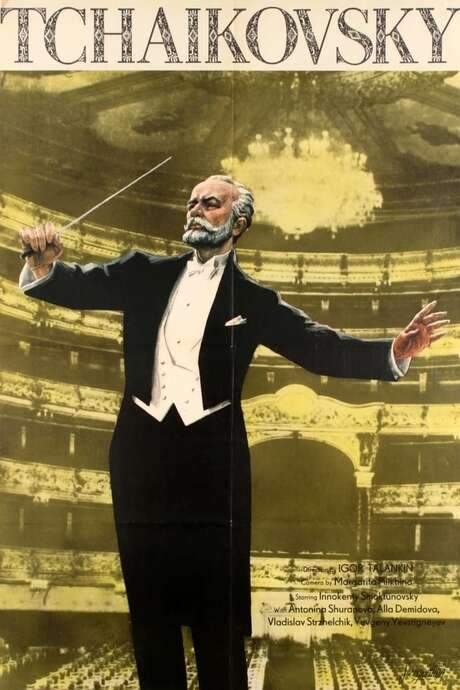
Tchaikovsky 1970

Directed by

Aleksandr Smirnov
Made by

Mosfilm
Tchaikovsky Plot Summary
Read the complete plot summary and ending explained for Tchaikovsky (1970). From turning points to emotional moments, uncover what really happened and why it matters.
Tchaikovsky, Innokentiy Smoktunovskiy, sits at the center of a film that threads his dazzling music with intimate longing, personal struggle, and the weight of public expectation. In the opening chapters, as he wrestles with the craft of his First Piano Concerto, his friend Nikolai Grigoryevich Rubinstein Vladislav Strzhelchik bluntly refuses to perform it at the premiere, a setback that casts a long shadow over the young composer’s confidence. The disappointment mirrors a larger pattern: art that bursts forth under scrutiny, often at the expense of warmth and ease.
Following the misfire of the premiere, the narrative moves through a sequence of pivotal moments that push his music and his life in new directions. After the heavy blow of the Swan Lake setback, the wealthy widow Nadezhda Filaretowna von Meck provides crucial financial support, steering the artist through turbulent times without fully smoothing the rough edges of his reality. Later, as he turns to Eugene Onegin, a correspondence from a student named Antonina Ivanovna pulls him toward a personal crossroads; an attempt to meet her leads to a brief arrest, underscoring how proximity to affection and connection can collide with society’s boundaries. In the wake of these emotional storms, he dedicates his Fourth Symphony to von Meck, a gesture that signals hope—hope that marriage and stability might finally bring him peace.
Yet the road remains rocky. The film does not shy away from the darker chapters: a crisis in his married life pushes him toward despair, and in a moment of surrender he attempts suicide. Von Meck steps in once more, offering financial aid in the hope that he can secure a divorce and salvage what remains of his life and career. The world around him is restless, too; Rubinstein’s Paris debut brings renewed attention to the concerto, but the arc abruptly turns when Rubinstein dies, a turning point that echoes through the rest of Tchaikovsky’s choices. The composer declines an opportunity to assume leadership of the Moscow Conservatory, choosing instead to follow his own unpredictable path.
Back in Russia, the film places Tchaikovsky under the lens of public critique—especially for a controversial staging of The Maid of Orleans. As he grapples with reputational scrutiny, von Meck’s influence shifts dramatically when she hostingly throws a party in his honor and then abruptly severs the relationship. Despite concerted efforts to tarnish his name, the composer’s resilience shines through as he achieves a notable triumph with Queen of Spades, a moment that reaffirms his stature even as personal ties fray. In a striking interlude, the legendary dancer Maya Plisetskaya appears as Desire, a brief but memorable motif that bridges the stage world with the film’s portrait of a life saturated by performance and emotion.
The film’s emotional peak comes as von Meck’s illness looms large. Learning of her illness, Tchaikovsky writes what becomes his final symphony, Pathétique, a work that crystallizes the sense of farewell and reflection that threads his later years. The closing pages of the story are heavy with inevitability: not long after the premiere of Pathétique, the composer succumbs to cholera, his prolific career ending as dramatically as it began, leaving behind a legacy of some of classical music’s most enduring themes and melodies.
Across these episodes, the film maintains a clear, steady focus on the tension between genius and vulnerability. It presents how Tchaikovsky’s music is inseparable from his life—how his melodies arise from love and loneliness, from triumph and humiliation, from the friendships that sustain him and the patrons who propel him forward. The narrative keeps a careful balance between biographical detail and the universal human questions that his life embodies: how to endure public scrutiny, how to seek personal happiness, and how to translate inner tumult into art that can outlive the man who created it. The result is a richly textured portrait that stays faithful to the spirit of its subject while expanding the emotional landscape beyond what a straightforward chronology might offer.
Tchaikovsky Timeline
Follow the complete movie timeline of Tchaikovsky (1970) with every major event in chronological order. Great for understanding complex plots and story progression.
Rubinstein spurns premiere of the First Piano Concerto
While Tchaikovsky is composing his First Piano Concerto, his friend Nikolai Rubinstein refuses to play it at the premiere, deeming it unplayable. The rejection casts doubt on the work and colors the premiere's reception.
Von Meck supports Tchaikovsky after Swan Lake disappointment
Following the disappointment surrounding Swan Lake, Nadezhda von Meck, a wealthy widow, sends him financial support. Her generosity provides essential stability and signals a turning point in his personal fortunes.
Eugene Onegin begins; Antonina Ivanovna's letter
Tchaikovsky begins work on the opera Eugene Onegin and unexpectedly receives a love letter from student Antonina Ivanovna. The letter stirs his curiosity and complicates his personal life as he contemplates romance and responsibility.
Brief arrest after attempting to meet Antonina
His attempt to meet Antonina Ivanovna leads to a brief arrest, highlighting the fragility of his social standing and the restrictions placed on his personal pursuits. The incident underscores the pressures he faced while navigating love.
Fourth Symphony dedicated to von Meck
Tchaikovsky dedicates his Fourth Symphony to Nadezhda von Meck, who hopes marriage will grant him peace. The dedication reflects von Meck's influence over his emotional life and her belief in the power of a settled personal life to steady his art.
Suicide attempt amid married-life struggles
Overwhelmed by married life, Tchaikovsky makes a suicide attempt as his personal turmoil deepens. The crisis prompts intervention from von Meck and signals a pivotal moment in their relationship and his career.
Von Meck offers divorce-support funds
In response to the crisis, von Meck intervenes with financial aid aimed at securing his divorce. Her practical help demonstrates a potent, though complicated, generosity that shapes the course of his personal decisions.
Paris premiere fame and Rubinstein's death
Rubinstein performs the concerto favorably in Paris, earning acclaim and renewed attention for Tchaikovsky's work. Soon after, Rubinstein dies, cutting short any ongoing collaboration between the two friends.
Tchaikovsky declines Moscow Conservatory headship
Tchaikovsky declines the opportunity to head the Moscow Conservatory, choosing instead to focus on composing and directing his own artistic path. The decision marks a shift away from institutional duties toward personal creative exploration.
Back in Russia: criticism over The Maid of Orleans
Returning to Russia, Tchaikovsky faces criticism for The Maid of Orleans as critics question his artistic choices. The hostile reception adds pressure and fuels his resolve to pursue other projects.
Von Meck cuts ties after hosting a party
Von Meck abruptly cuts ties after hosting a party in his honor, signaling a chilling shift in their relationship. The sudden severance affects the composer both personally and professionally.
Reputation recovery with Queen of Spades
Despite attempts to tarnish his reputation, Tchaikovsky finds success with Queen of Spades, restoring his standing among audiences and colleagues. The triumph reaffirms his resilience and artistic credibility.
Pathétique composed amid illness of von Meck
Hearing of von Meck's illness, Tchaikovsky composes his final symphony, Pathétique, pouring his emotions into the music. The work carries a sense of farewell and introspection that mirrors his own life.
Death after Pathétique premiere
Tchaikovsky succumbs to cholera shortly after the premiere of Pathétique, bringing a dramatic close to a prolific career. The passing marks a somber end to a transformative era in Russian music.
Tchaikovsky Characters
Explore all characters from Tchaikovsky (1970). Get detailed profiles with their roles, arcs, and key relationships explained.
Petja Tchaikovsky (Chaikovsky)
A prodigiously talented and emotionally intense composer, Petja navigates the pressures of public expectation, personal longing, and the burdens of genius. His music often carries deep feeling, even as he struggles with self-doubt and social constraints.
Yulia von Meck
A wealthy patroness who supports Tchaikovsky during critical periods. Her generosity enables him to pursue his work, though it also frames a complex dynamic between financial aid and personal autonomy.
Nikolai Rubinstein
A leading pianist and critic whose judgments influence Tchaikovsky's opportunities. He can be dismissive at times but also recognizes the composer’s talent, shaping the trajectory of premieres and collaborations.
Natalia von Meck (Antonina Ivanovna)
A student who writes a love letter that draws Tchaikovsky into a new personal and social encounter, illustrating the director's entangled personal life and the risk of scandal.
Queen of Spades
A stage role that becomes a turning point in Tchaikovsky's career, signaling a shift in public reception and artistic validation.
Desire
A symbolic figure embodying passion and emotional longing, whose presence in the narrative mirrors the composer’s romantic yearnings and creative drive.
Chief of Police
A minor authority figure representing the risk and consequences of pursuing forbidden encounters, reflecting the film’s tension between personal life and social norms.
Tchaikovsky Settings
Learn where and when Tchaikovsky (1970) takes place. Explore the film’s settings, era, and how they shape the narrative.
Time period
Late 19th century
The events span roughly the 1870s to the early 1890s, a period of prolific output and intense personal struggle for Tchaikovsky. It is marked by premieres, patronage, and public reception shaping a composer's legacy. The narrative culminates with Pathétique and the composer's death shortly after its premiere.
Location
Russia, Paris, Moscow
Set primarily in late 19th-century Russia, the story follows Tchaikovsky's life across major cities. Paris features as a key location where his work is performed and gains wider recognition. The Moscow Conservatory and Russian cultural circles anchor his career, reflecting the era's patronage and artistic ambition.
Tchaikovsky Themes
Discover the main themes in Tchaikovsky (1970). Analyze the deeper meanings, emotional layers, and social commentary behind the film.
💸
Patronage
A wealthy patron, von Meck, provides critical financial support that sustains Tchaikovsky during moments of crisis. The relationship highlights how art often relies on benefactors to navigate personal and professional pressures. It also shows how patronage can influence a composer’s choices and opportunities.
🕊️
Mental Struggle
The composer wrestles with intense emotions, leading to moments of despair and contemplation of self-harm. The film portrays his vulnerability, inner conflict, and the toll of fame on personal life. His resilience and eventual creative breakthroughs shape his artistic trajectory.
🎭
Reputation and Reception
Tchaikovsky faces criticism and skepticism within the musical establishment, even as some works win acclaim. The contrast between societal judgment and artistic achievement drives his resolve. Public premieres, sensational reception, and the politics of the stage all influence his career.

Coming soon on iOS and Android
The Plot Explained Mobile App
From blockbusters to hidden gems — dive into movie stories anytime, anywhere. Save your favorites, discover plots faster, and never miss a twist again.
Sign up to be the first to know when we launch. Your email stays private — always.
Explore the mobile appTchaikovsky Spoiler-Free Summary
Discover the spoiler-free summary of Tchaikovsky (1970). Get a concise overview without any spoilers.
In the rich cultural landscape of 19th-century Russia, Pyotr Tchaikovsky emerges as a composer whose melodies capture both the grandeur and the fragility of the human spirit. The film spans the final twenty years of his life, tracing the contours of an artistic journey marked by brilliant creation and private longing. Against a backdrop of sweeping orchestral performances, the narrative illuminates how genius often walks hand in hand with vulnerability, and how the public heights of success can contrast sharply with quieter personal struggles.
At the heart of the story lies a remarkable and unconventional friendship—that between Tchaikovsky and his devoted patron, Baroness Nadezhda von Meck. Their relationship, sustained through correspondence and mutual artistic admiration, offers a window into a world where creativity depends on both personal resolve and the generosity of kindred spirits. The film weaves this connection through glimpses of Tchaikovsky’s childhood and adolescence, suggesting how early experiences shaped the man behind the enduring music.
The tone balances the soaring heights of artistic achievement with the more uncertain spaces where doubt and ambition meet. Excerpts from beloved operas and ballets performed by acclaimed Russian musicians underscore each chapter, lending the story a rhythm that mirrors the composer’s own emotional landscape. The camera lingers on performances and private moments alike, capturing the duality of a public figure navigating expectations, critique, and the weight of a legacy in progress.
Through intimate glimpses and sweeping musical interludes, the film invites viewers into the complex world of an artist whose work transcended his era. Here, the stage and the soul are inseparable—each composition a reflection of love, loss, and the enduring pursuit of beauty amid the tensions that define a life devoted to art.
Movies with Similar Twists and Themes
Uncover films that echo the narrative beats, emotional arcs, or dramatic twists of the one you're exploring. These recommendations are handpicked based on story depth, thematic resonance, and spoiler-worthy moments — perfect for fans who crave more of the same intrigue.


Featured on this page

What's After the Movie?
Not sure whether to stay after the credits? Find out!
Check out our other apps:

SAT Sphere
Build confidence for the Digital SAT.

Mori Atlas
Discover wild places worth protecting.

Luntero
Search smarter for a home in Amsterdam.

Plot Explained
Unravel movie endings and hidden clues.

Pokechamp
Dive into Pokémon data and battle logic.

Driving Theory
Get ready for your European theory test.

Movie Dust
Plan your next cinema trip with ease.

Musemap
Find art and culture as you travel.

Selkobase
Compare credentials before committing.

Local Manual
Turn an unfamiliar country into practical next steps.

Lernavi
Compare school systems before your next move.

GymRoam
Find a workout stop wherever your plans take you.
Explore Our Movie Platform
New Movie Releases (2026)
Famous Movie Actors
Top Film Production Studios
Movie Plot Summaries & Endings
Major Movie Awards & Winners
Best Concert Films & Music Documentaries
Movie Collections and Curated Lists
© 2026 What's After the Movie. All rights reserved.
Privacy Policy