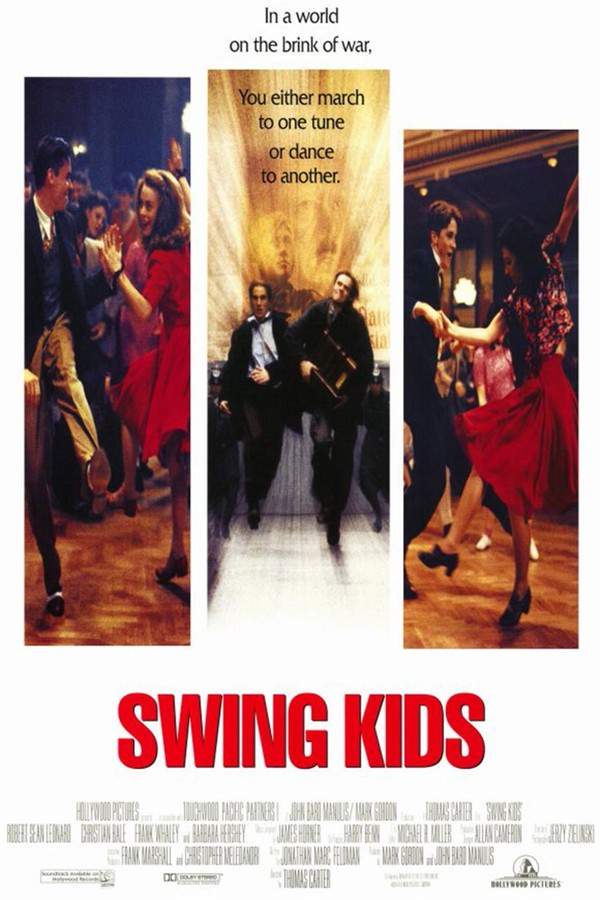
Swing Kids 1993

Directed by

Thomas Carter
Made by

Buena Vista Pictures
Where to Watch Swing Kids
See current US streaming, rental, and purchase options for Swing Kids (1993) via JustWatch.







Swing Kids Plot Summary
Read the complete plot summary and ending explained for Swing Kids (1993). From turning points to emotional moments, uncover what really happened and why it matters.
In Hamburg in 1939, Peter Müller and Thomas Berger join their friends Arvid and Otto at a swing club called the Bismarck, where the night hums with jazz and carefree dancing that feels temporary under the tightening grip of the regime.
Peter goes home to find his mother in an argument with the Nazi Blockleiter. Herr Knopp, head of the local Gestapo, arrives and dismisses the Blockleiter. He begins questioning Frau Müller about connections to some of her late husband’s friends. Peter’s father had been accused of communism, and the confrontation leaves a lasting scar on the family.
Arvid’s house is disturbed when Thomas accidentally ruins one of Arvid’s prized records. Upset, Arvid kicks them out. To make amends, Peter and Thomas steal a radio from a bakery, a radio Peter knows was taken from a ransacked Jewish home. Thomas escapes, but Peter is caught. Herr Knopp, who is attracted to Peter’s mother, intercedes for him; in return, Peter must enroll in the Hitlerjugend. Thomas also joins, telling Peter they will enjoy both the privileges of Hitlerjugend membership and the pleasures of being Swing Kids.
Arvid is confronted on the street by a group of Hitler Youth, including former friend Emil. They beat him and break his hand, threatening his work as a jazz musician.
Peter, who has a job delivering books, is asked to spy on his boss, whom the Nazis suspect is working against the Reich. In HJ school, the boys are encouraged to spy on their friends and families. Thomas accuses his father of insulting Hitler, hoping to cause trouble for him, but is unnerved when the Nazis come to his home and take his father away. His subsequent attempts to resume his friendship with Peter and persuade him to collaborate with the Nazis are tinged with fear.
Arvid overcomes his injury and is able to play music again. However, while working at a jazz club, he refuses to play a German song, lashing out at the club’s patrons for being blind to the Nazi agenda. Peter is sympathetic but Thomas loudly argues the Nazi side. Peter angrily proclaims Thomas to be a “fucking Nazi” and storms off. Blacklisted from playing in clubs, Arvid realizes there is nothing for him in Germany and dies by suicide.
As Thomas begins to believe fully in Nazi ideology, Peter feels as though there is no hope for him. Peter, disenchanted with how his life is coming apart, dresses up and goes to a swing club which is scheduled to be raided by members of the Hitlerjugend. As Thomas begins assaulting the club’s patrons he attacks Peter; however, during the fight Peter is able to reach Thomas. Thomas begs Peter to run away but Peter won’t. As Peter is driven away by the police, his younger brother Willi loudly shouts Swing Heil! over and over again, proud that his brother stood up for being a swing kid.
Epilogue text reveals that a second generation of Swing Kids lived to see the Nazis defeated.
Swing Kids Timeline
Follow the complete movie timeline of Swing Kids (1993) with every major event in chronological order. Great for understanding complex plots and story progression.
Four friends join the Swing Club Bismarck
In Hamburg, 1939, Peter Müller, Thomas Berger join their friends Arvid and Otto at the swing club Bismarck, where they dance and revel in the music. The club becomes a temporary escape from the tightening grip of the regime as they bond over Swing.
Müller home confronts Blockleiter
Peter arrives to find his mother arguing with the Nazi Blockleiter, a menacing sign of the regime's reach into everyday life. The confrontation sows fear and hints at the sacrifices required to survive under the Nazis.
Knopp arrives and questions the family
Herr Knopp, head of the local Gestapo, dismisses the Blockleiter and begins questioning Frau Müller about her late husband's friends. He explains that Peter’s father had been accused of communism, and that interrogations had harmed his health, illustrating the regime’s systemic pressure.
Arvid's house, the ruin of a prize record
At Arvid’s house, Thomas accidentally ruins one of Arvid's prized records, provoking a bitter argument. Arvid kicks Peter and Thomas out, severing their friendship and setting the stage for a misguided apology.
A stolen radio and a forced joining
To apologize, Peter and Thomas steal a radio from a bakery, a radio Peter knows was taken from a ransacked Jewish home. Thomas escapes, but Peter is caught; Herr Knopp intercedes and forces Peter to enroll in the Hitlerjugend, with Thomas joining soon after.
Arvid attacked by the Hitler Youth
Arvid is confronted on the street by a group of Hitler Youth, including former friend Emil, who beat him and break his hand. The assault shatters his ability to perform as a jazz musician and deepens the club’s cultural crackdown.
Peter spies on his boss
Peter, who has a job delivering books, is asked to spy on his boss, a clear sign of the Reich’s surveillance state. The assignment marks the beginning of everyday life governed by suspicion and loyalty tests.
HJ school pushes spying on friends and family
In Hitlerjugend school, the boys are encouraged to spy on their friends and families, eroding trust and normal childhood bonds. The environment pressures them to betray confidences for the regime's approval.
Thomas accuses his father; father is taken away
Thomas accuses his father of insulting Hitler, and soon Nazis come to their home and take his father away. The incident deepens the rift between Peter and Thomas and pushes both toward very different paths.
Arvid returns to music but rebels
Arvid recovers his ability to play but refuses to perform a German song, openly challenging the Nazi agenda. Peter feels sympathy for his friend, while Thomas doubles down on the Nazi stance, driving a wedge between them and accelerating Arvid’s isolation.
Swing club raid looms; Peter faces a moral split
As Thomas’s ideology grows, Peter feels there is little hope left in Germany. He dresses to attend a swing club that is about to be raided by the Hitler Youth, seeking a last moment of freedom before force closes in.
Climax: the clash at the swing club
During the raid, Thomas attacks the club’s patrons as Peter tries to reach him. Peter refuses to run and is taken away by the police as Willi shouts Swing Heil!, a defiant last echo of his brother’s defiance.
Epilogue: a second generation survives
An epilogue reveals that a second generation of Swing Kids lived to see the Nazis defeated, underscoring the enduring hope and resilience of those who refused to surrender to tyranny.
Swing Kids Characters
Explore all characters from Swing Kids (1993). Get detailed profiles with their roles, arcs, and key relationships explained.
Peter Müller (Christian Bale)
Peter is a Swing Kid torn between his love of jazz, his friendship with Arvid and Otto, and the demands of a Nazi-leaning society. Initially a reluctant participant in HJ, he tries to balance rebellion with safety. As events unfold, Peter’s moral stance grows as he resists pressure and refuses to betray his friends, culminating in a decisive stand when confronted by his antagonist.
Thomas Berger (Robert Sean Leonard)
Thomas is Peter's friend who embraces Nazi ideology, influenced by peer pressure and propaganda. His belief system sharpens conflict, pushing him to spy and advocate for the regime. His relationship with Peter deteriorates as fear and loyalty to the Reich take precedence. By the film’s end, his choices reveal the corrosive power of indoctrination.
Arvid
Arvid is a jazz musician and Swing Kid who refuses to perform a German song and defends his art. His talent and defiance mark him as a symbol of cultural resistance. After facing threats and pressure, he dies by suicide, reflecting the devastating cost of repression. His passion for music represents the struggle for freedom in a totalitarian state.
Willi Müller
Willi is Peter's younger brother, eager to support his brother's courage. His admiration for Peter’s stance culminates in the film’s finale when he shouts 'Swing Heil!' as a public display of loyalty to swing culture. The moment underscores the generational impact of resistance and the regime’s attempt to squash it.
Swing Kids Settings
Learn where and when Swing Kids (1993) takes place. Explore the film’s settings, era, and how they shape the narrative.
Time period
1939
The story unfolds during the late 1930s when the Nazi regime tightens its grip on German society. Propaganda, party loyalty, and the Hitlerjugend encroach on everyday life, especially for youths drawn to jazz and swing. The era’s fear and censorship frame the characters’ choices and consequences.
Location
Hamburg, Germany
Set in Hamburg in 1939, the film centers on a group of teens navigating life under Nazi rule. The city’s public spaces and clubs become pressure points where music, friendship, and ideology clash. The everyday atmosphere blends ordinary youth culture with the looming threat of surveillance and punishment.
Swing Kids Themes
Discover the main themes in Swing Kids (1993). Analyze the deeper meanings, emotional layers, and social commentary behind the film.
🕯️
Resistance
Amid propaganda and police intimidation, the Swing Kids cling to music, dance, and friendship as acts of defiance. These acts resist conformity and offer a private space where individual identity can survive. The risks are real: surveillance, suspicion, and potential punishment for nonconformity. The film portrays quiet courage in ordinary moments, highlighting resistance as a personal, not grand, act.
🎷
Music as Rebellion
Jazz and swing become symbols of freedom in a society bent to suppress them. The characters use music to connect across lines of class and ideology while confronting the regime. Arvid’s jazz performances serve as a beacon for those who refuse to surrender to Nazi propaganda. Music’s vitality conflicts with authoritarian control, illustrating how culture can challenge power.
👥
Loyalty & Betrayal
Friendships are tested as the state urges spying, loyalty to the regime, and competition for belonging. Peter and Thomas epitomize diverging paths: one clinging to humanity, the other embracing ideological conformity. The pressure to betray friends or family shows the corrosive effect of totalitarianism on trust. The film culminates in divided loyalties and the tragic costs of choosing ideology over kinship.

Coming soon on iOS and Android
The Plot Explained Mobile App
From blockbusters to hidden gems — dive into movie stories anytime, anywhere. Save your favorites, discover plots faster, and never miss a twist again.
Sign up to be the first to know when we launch. Your email stays private — always.
Explore the mobile appSwing Kids Spoiler-Free Summary
Discover the spoiler-free summary of Swing Kids (1993). Get a concise overview without any spoilers.
In the late 1930s, the streets of Hamburg pulse with a uneasy mix of propaganda and hidden rhythm. Beneath the rigid banners of a totalitarian regime, a handful of teenagers discover a world where the swing beat offers a fleeting escape from the looming darkness. The city’s clandestine clubs become sanctuaries where jazz and dance transform ordinary evenings into moments of daring joy, and the simple act of moving to the music feels like an act of rebellion.
Among the youths drawn to this secret rhythm is Peter Müller, a thoughtful young man whose yearning for freedom is matched only by his sense of responsibility to his family. He is joined by Thomas Berger, a charismatic friend whose confidence masks an inner conflict between loyalty to the crowd and the allure of the swing scene. Their circle also includes the earnest musician Arvid and the ever‑optimistic Otto, each bringing his own shade of hope and vulnerability to the group’s collective heartbeat.
Together they form the “Swing Kids,” a loose fellowship bonded by the shared love of swing and the quiet defiance it represents. Their gatherings are infused with laughter, improvisation, and a palpable sense that, for a few stolen hours, the weight of the regime can be set aside. Yet the very freedom they cherish is fragile, and the atmosphere of surveillance that hangs over the city whispers that every indulgence could draw a watchful eye. In this tense, yet rhythm‑driven world, the young protagonists navigate the delicate balance between youthful exuberance and the ever‑present threat of conformity, inviting the audience to feel both the exhilaration of their secret dances and the suspense of the shadows that linger just beyond the music.
Movies with Similar Twists and Themes
Uncover films that echo the narrative beats, emotional arcs, or dramatic twists of the one you're exploring. These recommendations are handpicked based on story depth, thematic resonance, and spoiler-worthy moments — perfect for fans who crave more of the same intrigue.


Featured on this page

What's After the Movie?
Not sure whether to stay after the credits? Find out!
Check out our other apps:

SAT Sphere
Build confidence for the Digital SAT.

Mori Atlas
Discover wild places worth protecting.

Luntero
Search smarter for a home in Amsterdam.

Plot Explained
Unravel movie endings and hidden clues.

Pokechamp
Dive into Pokémon data and battle logic.

Driving Theory
Get ready for your European theory test.

Movie Dust
Plan your next cinema trip with ease.

Musemap
Find art and culture as you travel.

Selkobase
Compare credentials before committing.

Local Manual
Turn an unfamiliar country into practical next steps.

Lernavi
Compare school systems before your next move.

GymRoam
Find a workout stop wherever your plans take you.
Explore Our Movie Platform
New Movie Releases (2026)
Famous Movie Actors
Top Film Production Studios
Movie Plot Summaries & Endings
Major Movie Awards & Winners
Best Concert Films & Music Documentaries
Movie Collections and Curated Lists
© 2026 What's After the Movie. All rights reserved.
Privacy Policy