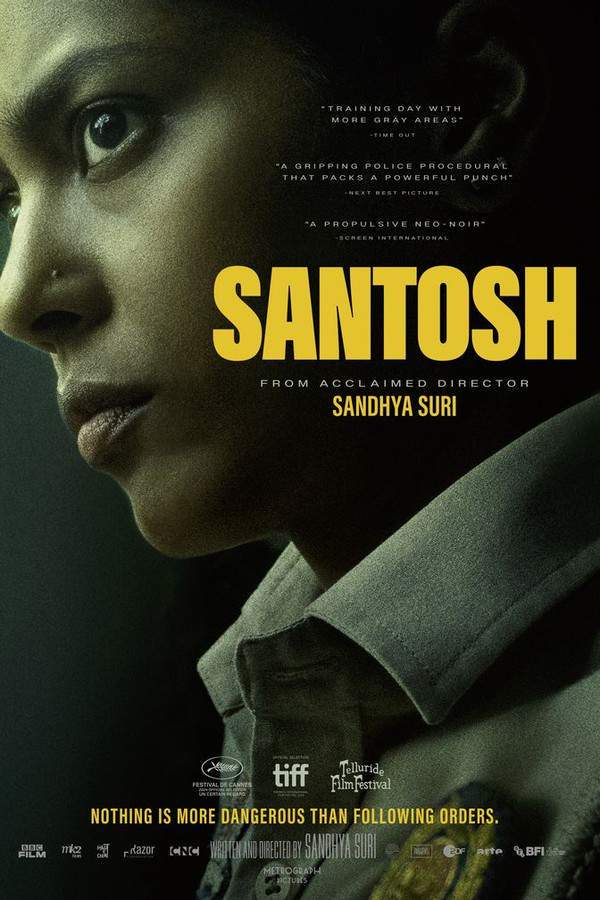
Santosh 2024

Made by

Haut et Court
Santosh Plot Summary
Read the complete plot summary and ending explained for Santosh (2024). From turning points to emotional moments, uncover what really happened and why it matters.
Santosh Saini, the wife of a constable who was killed during a riot, travels to the police headquarters to claim his pension and is brought into service under a government scheme called “compassionate recruitment,” taking a new post in a rural town. While on duty, she overhears a Dalit father speaking about the disappearance of his 15-year-old daughter, Devika Pippal, who had gone missing two days earlier. The father had reported the case before, but his concerns were dismissed. Santosh tells him that he can file a new report with her, and together they visit the police station, where their concerns are again met with mockery and indifference.
The following day, a protest erupts in front of the police station. Among the crowd lies Devika’s body—she had been raped, murdered, and dumped in a well in a Dalit village. Devika’s parents stand by her, demanding justice and promising not to leave until the culprit is punished. The police break up the protest by force, and Santosh, along with other female constables, are ordered to drag the demonstrators away. She later delivers Devika’s body to the morgue, paying for the service herself. The tragic death and the ensuing protests draw widespread media attention.
Santosh, along with Inspector Geeta Sharma and other officers, goes to the Dalit village to investigate. Devika’s parents reveal that she was last seen when she went to fetch water at dawn. Santosh finds Devika’s cellphone and reads messages with a man named Saleem, who claims he is bound for Mumbai. She relays this information to Geeta later that evening.
Her investigation leads her to the village chief’s house, where Saleem and his father work on the chief’s farm; they had left the area a few days prior. At a cricket match, she pressures Saleem’s friend to provide information, and the friend eventually texts the city where Saleem is staying.
With Geeta’s help, they plan to arrest Saleem in that city, but Geeta is called away by an emergency, leaving Santosh to press on alone for the day. Geeta arrives later, and they arrest Saleem in the evening and report to the police commissioner’s house. The commissioner advises keeping Saleem nearby after a visit from a politician, [Beniwal], who becomes involved in the case.
The next day, Saleem is subjected to beatings during interrogations at an abandoned house. He confesses that he knew Devika, liked her, and had received her cellphone number, but the officers’ questions remain unsatisfying. They escalate the interrogation with torture and waterboarding. Santosh is handed a paddle and participates in the beating, experiencing a full panic attack afterward.
Unable to sleep, Santosh wrestles with guilt as Geeta administers a sleeping pill and informs her that Saleem is dead. Santosh wonders whether Saleem could be innocent, but Geeta counters that his innocence would not help the case. A crucial new clue emerges when Santosh discreetly checks Saleem’s smartphone and discovers he was in Mumbai on the day Devika died, making it unlikely that he committed the crime. In the days that follow, the police announce that Saleem died by hanging himself, but Geeta privately warns Santosh that autopsy results will eventually reveal Santosh as responsible for Saleem’s death.
A return to the village chief’s house reveals new context: Devika had gone to fetch water at a well that had been contaminated by a cat’s corpse in the Dalit village. While there, [Beniwal] arrives again, and Santosh questions whether he knew about Devika’s entry into the village. He evades the question, and a friend remarks that Dalits are not allowed to fetch water at the chief’s well, noting a party they had recently attended. When Santosh presses him about possible involvement in Devika’s murder, he retorts with a pointed question about what she would do if he were guilty.
In a final confrontation, Santosh sits down with Geeta at a restaurant and accuses her of knowing that Saleem was innocent. Geeta replies that Saleem’s death has brought some measure of justice and serves as a warning to potential rapists, arguing that uncovering the true culprit would not benefit Devika’s family or the village. She even shows Santosh her suspension letter. After visiting the Pippal family, Santosh leaves her uniform in her quarters and boards an intercity train, a choice that closes this chapter of the investigation while leaving the deeper moral questions unresolved.
Santosh Timeline
Follow the complete movie timeline of Santosh (2024) with every major event in chronological order. Great for understanding complex plots and story progression.
Appointment under compassionate recruitment
Santosh Saini visits the police headquarters to claim her late husband’s pension and is unexpectedly appointed as a constable under a compassionate recruitment scheme. She begins her new role in a rural town, stepping into a position she never imagined. This formal appointment marks the start of her frontline duty and the clash with local bureaucracy.
Overhearing a plea about a missing daughter
While on duty, Santosh overhears a Dalit man describing the disappearance of his 15-year-old daughter, Devika Pippal, two days earlier. He explains how the police ignored his previous reports and begged for someone to listen. Her concern is ignited by the sense that justice is slipping away for the marginalized.
Filing a complaint amid indifference
Santosh urges the Dalit man to file a fresh complaint and accompanies him to the police station. They are mockingly disregarded by officers who doubt the case will yield results. The scene exposes the bias and apathy toward marginalized communities in the local force.
Protest erupts; Devika's body is found among demonstrators
The next day, a protest forms in front of the police station as villagers demand accountability. Santosh discovers Devika's corpse among the crowd and learns she had been raped, murdered, and dumped in a well in a Dalit village. The grieving parents refuse to leave until justice is served, and the authorities abruptly disperse the protesters. Santosh later ferries the body to the morgue at her own expense, drawing wider media attention.
First field investigation in the Dalit village
Santosh, Inspector Geeta Sharma, and other officers travel to the Dalit village to begin the investigation. Devika’s parents reveal she was last seen at dawn fetching water. Santosh finds Devika’s cellphone and reads messages with Saleem indicating he was headed to Mumbai, which she reports to Geeta that evening.
Tracking Saleem to his city
Santosh visits the village chief’s house to learn that Saleem and his father were working on the chief’s farm but had left days earlier. She corners Saleem’s friend at a cricket match, who eventually texts the city where Saleem is staying.
Arrest of Saleem and political interference
Santosh and Geeta plan to arrest Saleem in the city where he is staying. Geeta is called away by an emergency, so Santosh pursues the case alone for a day. They arrest Saleem in the evening and report to the commissioner, who suggests holding Saleem near his house after a visiting politician, Beniwal.
Interrogation turns brutal
In an abandoned house, the police severely beat and torture Saleem during interrogations, including waterboarding. Santosh is handed a paddle and participates in the beating, before suffering a panic attack as the pressure mounts.
Saleem’s death and a hidden truth
Santosh cannot sleep and is given a sleeping pill by Geeta, who mentions that Saleem is dead. Santosh wonders if Saleem was innocent, but Geeta hints that confirming innocence would not help Devika’s family. She secretly checks Saleem’s smartphone and discovers he was in Mumbai on the day Devika died, implying he could not have killed her.
A cover story forms and autopsy looming
The team circulates the tale that Saleem died by hanging, but Geeta privately warns that autopsy results will eventually reveal Santosh’s responsibility. The implication is a looming cover-up that strains trust within the police and between investigators and Devika’s family.
Confrontation over the water-and-well clue
Santosh returns to the village chief’s house and learns Devika had entered the well area to fetch water, contaminated by a cat carcass. Beniwal arrives and avoids her questions, while a friend points out that Dalits are not allowed to fetch water from the chief’s well, hinting at complicity and caste bias.
Geeta’s truth and suspension revealed
Santosh confronts Geeta at a restaurant, accusing her of knowing Saleem was innocent. Geeta concedes that Saleem’s death has served as a caution to potential rapists, and she reveals Santosh’s suspension by showing the letter.
Leaving the uniform behind
After visiting the Pippal family, Santosh leaves her police uniform in her quarters and boards an intercity train, signaling a personal decision to step away from the case and the force. The act marks a turning point in her commitment to seeking justice.
Santosh Characters
Explore all characters from Santosh (2024). Get detailed profiles with their roles, arcs, and key relationships explained.
Santosh Saini
A widowed police constable who inherits her husband’s job through a government compassion recruitment scheme. She is determined, morally conflicted, and driven by empathy for Devika’s family, pushing beyond bureaucratic boundaries to pursue the truth. Her internal struggle between upholding the law and resisting coercive tactics drives much of the drama.
Beniwal
The chief’s brother-in-law and a powerful local figure who embodies privilege and opportunism. He evades questions about Devika’s death and wields influence to sustain a system that benefits the powerful. His actions illustrate how elites can shape investigations and obstruct justice.
Geeta Sharma
Inspector who collaborates with Santosh but ultimately acts as a gatekeeper of the status quo. She privately argues that pursuing the real culprit would complicate the case and suggests suppressing unwanted truth. Her stance highlights internal politics and moral ambiguity within the police force.
Santosh Settings
Learn where and when Santosh (2024) takes place. Explore the film’s settings, era, and how they shape the narrative.
Time period
Set in a contemporary Indian setting, the film reflects modern policing, media attention, and the ongoing struggle against caste-based violence and injustice.
Location
Rural town, Police Headquarters, Dalit village, Mumbai
The story centers on a rural Indian town anchored by a busy police headquarters, with key scenes in a nearby Dalit village and its wells. Protests erupt in front of the police station, highlighting the tension between state authority and marginalized communities. The narrative also moves to the city of Mumbai, showing the movement of suspects and how urban spaces interact with rural pressures.
Santosh Themes
Discover the main themes in Santosh (2024). Analyze the deeper meanings, emotional layers, and social commentary behind the film.
⚖️
Justice and Impunity
The story probes how power, caste, and political influence shape the pursuit of justice. Santosh confronts a system that tolerates coercive tactics and cover-ups while still demanding accountability for victims. The film critiques police brutality and shows how media scrutiny can swell public demand for answers, even as those in authority seek to control outcomes. It asks whether true justice can emerge when investigators operate under pressure from above.
🧭
Duty vs Morality
Santosh’s compassionate recruitment into the force sets up a conflict between professional duty and personal conscience. She wrestles with the use of coercion during interrogation and the toll it takes on her mental health. Her choices affect the suspect, Devika’s family, and the broader community, illustrating how moral compromises can ripple through a case. The film explores whether adherence to law can coexist with moral integrity.
✊
Caste and Rights
Devika’s murder exposes deep-seated caste prejudice in both village life and wider society. The Dalit community’s demand for justice clashes with powerful interests embodied by the village chief and his allies. Water access and social exclusion become flashpoints for protest and state response. The narrative frames the fight for dignity and equal rights against a backdrop of systemic bias.

Coming soon on iOS and Android
The Plot Explained Mobile App
From blockbusters to hidden gems — dive into movie stories anytime, anywhere. Save your favorites, discover plots faster, and never miss a twist again.
Sign up to be the first to know when we launch. Your email stays private — always.
Explore the mobile appSantosh Ending Explained
Unravel the ending of Santosh (2024) with our detailed explanation. Understand the final scenes, character fates, and unresolved questions.
Santosh’s journey concludes with her making a powerful declaration of independence from a corrupt system that had used her as a pawn. After her final case, she prepares to leave her police job, realizing she can no longer blindly follow the dishonest practices that dominate her workplace. Her act of leaving is symbolic; she discards her uniform and the nose pin gifted by her boss, representing her rejection of the false sense of achievement and her previous complicity in the system’s injustices. As she waits at the train station, uncertain about her future but determined to forge her own path, she notices a young couple embodying love and innocence, reminding her of Devika and Saleem. This sight sparks a moment of hope and rebellion, as she chooses to board a train to Mumbai—a city symbolic of dreams and new beginnings—rather than returning to her old life. This final decision shows her resolve to seek a life beyond the corrupt justice system, embracing her independence and the possibility of rewriting her story. Santosh’s ending is both cathartic and poignant, symbolizing her break from oppressive societal and institutional structures, and her willingness to forge her own destiny, free from the weight of her past and the system’s betrayals.
Santosh Spoiler-Free Summary
Discover the spoiler-free summary of Santosh (2024). Get a concise overview without any spoilers.
In the remote hills of northern India, a quiet town’s police station becomes the unlikely starting point for a new chapter in public service. After her husband’s tragic death, Santosh steps into his uniform through a compassionate recruitment scheme, bringing a blend of grief‑laden determination and fresh perspective to a world where tradition and bureaucracy often clash. The landscape is stark and beautiful, its dusty lanes and mist‑cloaked fields echoing the weight of unspoken histories that shape everyday life.
Within the precinct, Geeta Sharma—a progressive, feminist inspector—offers a contrasting yet complementary energy. Her sharp intellect and steadfast belief in justice set a tone of both challenge and mentorship for the newly appointed constable. Together they navigate a workplace where authority is both a shield and a burden, and where the expectations of a male‑dominated system meet the quiet resolve of women determined to make a difference.
The town itself teems with layered social dynamics, particularly the entrenched caste divisions that subtly influence the community’s pulse. When a sensitive case involving a young woman from a marginalized background surfaces, the duo finds themselves at the crossroads of duty, empathy, and the complex moral terrain of rural policing. Their partnership becomes a lens through which the audience can glimpse the fragile balance between law, cultural mores, and the silent yearning for change.
Against this backdrop of stark realism and simmering tension, the film explores how ordinary people confront extraordinary circumstances. It asks what it means to carry an inherited badge, to confront systemic inertia, and to forge solidarity amid the echoing calls for accountability that ripple through a world where every decision bears the weight of many unseen lives.
Movies with Similar Twists and Themes
Uncover films that echo the narrative beats, emotional arcs, or dramatic twists of the one you're exploring. These recommendations are handpicked based on story depth, thematic resonance, and spoiler-worthy moments — perfect for fans who crave more of the same intrigue.









Featured on this page

What's After the Movie?
Not sure whether to stay after the credits? Find out!
Check out our other apps:

SAT Sphere
Build confidence for the Digital SAT.

Mori Atlas
Discover wild places worth protecting.

Luntero
Search smarter for a home in Amsterdam.

Plot Explained
Unravel movie endings and hidden clues.

Pokechamp
Dive into Pokémon data and battle logic.

Driving Theory
Get ready for your European theory test.

Movie Dust
Plan your next cinema trip with ease.

Musemap
Find art and culture as you travel.

Selkobase
Compare credentials before committing.

Local Manual
Turn an unfamiliar country into practical next steps.

Lernavi
Compare school systems before your next move.

GymRoam
Find a workout stop wherever your plans take you.
Explore Our Movie Platform
New Movie Releases (2026)
Famous Movie Actors
Top Film Production Studios
Movie Plot Summaries & Endings
Major Movie Awards & Winners
Best Concert Films & Music Documentaries
Movie Collections and Curated Lists
© 2026 What's After the Movie. All rights reserved.
Privacy Policy