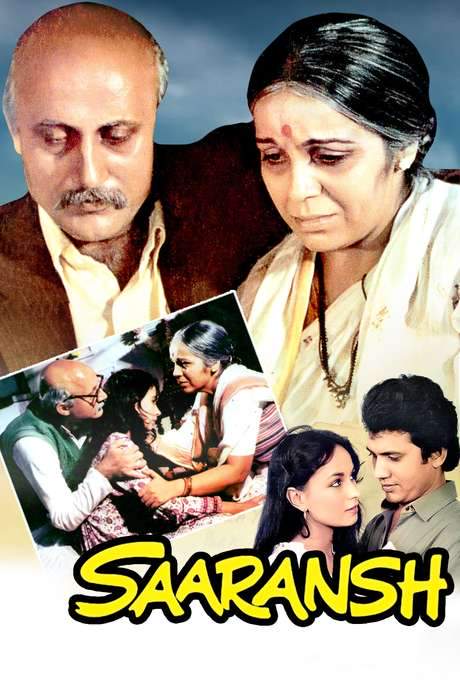


Where to Watch Saaransh
See current US streaming, rental, and purchase options for Saaransh (1984) via JustWatch.


Streaming availability powered by 
Saaransh Plot Summary
Read the complete plot summary and ending explained for Saaransh (1984). From turning points to emotional moments, uncover what really happened and why it matters.
Anupam Kher as B.V. Pradhan wakes up early to write a letter to his son Ajay, who lives in New York. Midway through the missive, a painful memory returns: he has just learned from a friend of Ajay that Ajay was killed in a mugging in the United States. Pradhan’s best friend, Vishwanath, and his wife Parvati worry that, even after three long months, Pradhan has not yet come to terms with the loss of his only son. He confesses to Vishwanath that the death has gnawed away at his will to live.
With the family finances collapsed by Ajay’s absence, they rent out a room in their Shivaji Park apartment to Sujata Suman, a budding Bollywood actress, who is Soni Razdan in the cast. Sujata is involved with Vilas Chitre, the only son of the influential politician Gajanan Chitre. Vilas wants to marry Sujata but keeps his father in the dark, postponing the nuptials out of fear or cowardice.
Meanwhile, Pradhan receives a registered letter stating that Ajay’s ashes, along with a few other belongings like a TV, VCR, and a refrigerator, have arrived from the USA. At the customs office, he is shown disrespect and denied help by the Public Relations Officer. In a moment of desperate resolve, Pradhan forcibly enters the office of the head of customs and demands that Ajay’s ashes be handed over immediately. The officer consoles him, apologizes for the inconvenience, and promises that the remaining items will soon be transferred.
Pradhan, an atheist, gives Ajay’s ashes to Parvati, who takes them to a Pandit. The Pandit proclaims that Ajay will soon be reincarnated in the form of a baby nearby. Disheartened, Pradhan takes some ashes and scatters them near a kids’ park bench. Realizing how hollow life feels to him, he attempts suicide by stepping in front of a speeding car, but survives. Parvati begs him to reconsider, yet he remains resolute. Eventually, they decide to end their lives by consuming poison together.
Just as they are about to act, Sujata tells Vilas that she is pregnant. Vilas remains indecisive about the marriage, and Sujata calls him a coward, ultimately driving him away. Pradhan offers to take Sujata to meet Gajanan in hopes of securing his approval for a marriage between Sujata and Vilas. Vilas refuses to accept that the baby could be his, and Gajanan—knowing Vilas is lying—refuses their proposal and threatens dire consequences if Sujata does not abort and move away.
Pradhan, guided by his sense of principle, refuses to let Sujata drift away and provides her a safe haven in his house. Parvati, hearing of the baby, becomes convinced that the child is Ajay’s reincarnation and grows more certain in her beliefs. The couple’s attempts to dissuade Sujata fail, and Gajanan resorts to every trick of the trade: bribing Pradhan, cutting electricity to their home, and having his goons beat Vishwanath to disrupt the milk supply. Gajanan himself even arranges for an abortion in a doctor’s clinic, bribing a local practitioner to terminate the pregnancy.
When Pradhan tries to seek help from the Commissioner, red tape blocks him. He storms into the Mantralaya, the Chief Minister’s office, and confronts the powers that be. The Chief Minister—Akash Khurana, a former student of Pradhan—immediately rings up the Commissioner and the Remand Home where Sujata is being held, demanding that Gajanan be produced to ensure justice is served.
Pradhan finally realizes that Parvati’s insistence on Ajay’s reincarnation in Sujata’s baby could complicate things for Sujata and Vilas, so he urges them to leave the city and seek a fresh start. He hands over Ajay’s belongings to them, and Sujata asks to see Parvati one last time. Parvati’s stubbornness to let them go clashes with Pradhan’s desire to protect them. He steadies her and explains that Ajay is no longer coming back, and that both of them have already done a good deed by helping Sujata’s baby survive.
The film closes with Pradhan taking Parvati for an early-morning walk to the nearby kids’ park. There, flowers sprout where Ajay’s ashes were once scattered. Pradhan tells Parvati that the true beauty of life lies in our shared mortality, while life itself keeps moving forward.
Saaransh Timeline
Follow the complete movie timeline of Saaransh (1984) with every major event in chronological order. Great for understanding complex plots and story progression.
Pradhan writes a morning letter to Ajay
The film opens with Pradhan waking early to pen a letter to his son in New York. He voices his longing and the unbearable ache of loss. The moment sets up his fragile emotional state and lack of purpose.
Ajay's death confirmed by a friend
A friend in New York informs Pradhan that Ajay was killed in a mugging. The news lands with crushing finality as the family tries to process the tragedy. The event anchors the rest of the film in grief and disbelief.
Three months of grief worry the family
Three months pass and Pradhan shows little will to live while Vishwanath and Parvati worry for him. They fear his sorrow may destroy him or sever their bond with him. The house feels heavy with unspoken grief.
Sujata rents a room to make ends meet
With no income, Pradhan and Parvati rent a room to Sujata Suman, a budding Bollywood actress. Sujata becomes entangled with Vilas, the son of a powerful politician, adding new tensions to the household. Her arrival stirs hope and complication in equal measure.
Ajay's ashes arrive from the USA
Pradhan receives a registered letter announcing Ajay's ashes and a few belongings have arrived from the USA. He goes to the customs office to collect them but is met with indifference from a Public Relations Officer. The moment highlights the gulf between his personal grief and bureaucratic procedure.
Pradhan demands only the ashes; officer relents
Pradhan forcibly enters the customs chief’s office and demands that only Ajay's ashes be handed over. He breaks down in tears, and the officer consoles him and promises the rest of the items will follow. The scene marks a turning point in his resolve to claim his son's memory.
Ashes entrusted to Parvati; Pandit predicts reincarnation
Parvati takes Ajay's ashes to a Pandit, who tells them Ajay will be reincarnated as a baby nearby. The idea offers a glimmer of consolation that life can continue. Pradhan remains skeptical and emotionally exhausted by the prediction.
Pradhan scatters ashes; suicide attempt
Disillusioned, Pradhan scatters part of Ajay's ashes near a nearby kids park. He then attempts to end his life by stepping in front of a speeding car, but Parvati pleads with him to choose life. The moment crystallizes his breakdown and fragile hope.
Suicide pact interrupted by pregnancy news
Pradhan and Parvati resolve to end their lives together, but Sujata informs Vilas that she is pregnant. Vilas remains indecisive about marriage, turning the moment away from self-destruction toward responsibility and conflict.
Pradhan helps Sujata meet Gajanan; pregnancy opposed
Pradhan offers to take Sujata to meet Gajanan Chitre, hoping for approval of the marriage. Gajanan refuses to acknowledge the child and begins to undermine the couple, triggering a new round of battles.
Gajanan's harassment and abortion plot
Gajanan's goons harass Pradhan by cutting electricity, blocking milk supply, and throwing crackers into the house. He collaborates with a doctor to illegally abort Sujata's baby, intensifying the peril for Sujata and the unborn child. Red tape and fear complicate every path forward.
Pradhan appeals to the CM; police action
Desperate, Pradhan storms into Mantralaya seeking justice. The Chief Minister—an old student of his—orders the Commissioner of Police to produce Gajanan and ensure justice is served against him. The scene rekindles Pradhan's faith in authority, even as doubt remains.
Deciding Sujata and Vilas's fate
Pradhan realizes Parvati's belief will complicate Sujata and Vilas's lives and asks them to leave the city. He also hands over Ajay's belongings, which have been retrieved from the customs, to Sujata. The act symbolizes a reluctant release and permanent change.
Parvati's heartbreak and acceptance
Parvati demands to see Sujata, but Pradhan stops her to preserve Sujata's future. Parvati is heartbroken, yet she begins to accept that Ajay is gone and that their duty was to support Sujata's baby. The moment marks a quiet turning point in her grief.
Final dawn: life goes on
In the final scene, Pradhan and Parvati walk to the park at dawn. Flowers bloom where Ajay's ashes were scattered, and Pradhan proclaims that while life is mortal, life goes on. The film closes on a note of quiet resilience.
Saaransh Characters
Explore all characters from Saaransh (1984). Get detailed profiles with their roles, arcs, and key relationships explained.
B.V. Pradhan (Anupam Kher)
A grieving, principled father who struggles with the loss of his son Ajay. An atheist, he is driven by a sense of duty and dignity, and his resolve gradually shifts from despair to protective action, culminating in acts of compassion for Sujata.
Parvati Pradhan (Rohini Hattangadi)
Pradhan's wife who clings to the belief that Ajay will be reincarnated. She becomes emotionally attached to Sujata and her baby, shaping her identity around this belief while learning to accept reality.
Sujata Suman (Soni Razdan)
A budding Bollywood actress who becomes lodging in the Pradhan household after Ajay's death. She faces pregnancy and social scrutiny, and her relationship with Vilas anchors the film's moral choices.
Vilas Chitre (Madan Jain)
The son of a powerful politician, he is indecisive and afraid, torn between love for Sujata and his father’s pressure. His actions—real or manipulated—drive the central conflict about Sujata's baby.
Gajanan Chitre
An influential politician whose goons harass and threaten Pradhan to abort the pregnancy. His power and ruthlessness expose the tension between personal interests and the vulnerable.
Chief Minister Shashikant
A former student of Pradhan who wields political influence to intervene and seek justice for Sujata. He embodies the social hierarchy and the weight of state power in the narrative.
Pandit / Astrologer
A religious figure who performs rituals and prophesies that Ajay may reincarnate in Sujata’s baby, adding a spiritual dimension to the storyline.
Police Inspector
A figure of bureaucratic authority, his involvement underscores the red-tape and procedural obstacles faced by Pradhan. He is a practical presence rather than a moral ally.
Saaransh Settings
Learn where and when Saaransh (1984) takes place. Explore the film’s settings, era, and how they shape the narrative.
Time period
Early 1980s
Set in the early 1980s Mumbai, the film portrays a city of crowded tenements, bureaucracy, and changing social mores. It follows a grieving father navigating loss while facing economic hardship and red-tape. The timeframe aligns with the era's cinema that emphasized realism and social issues.
Location
Shivaji Park (Mumbai), New York
Primarily set in a middle-class Shivaji Park apartment in Mumbai, the place reflects the family's modest life. The narrative also traverses the city's bureaucratic spaces, including the customs office and the Chief Minister's office. A thread briefly touches New York through Ajay's death.
Saaransh Themes
Discover the main themes in Saaransh (1984). Analyze the deeper meanings, emotional layers, and social commentary behind the film.
💔
Grief
The film centers on Pradhan's mourning after Ajay's murder, making his loss the emotional engine of the story. Grief shapes every decision, from his isolation to his acts of protecting Sujata and her baby. The portrayal is intimate and cumulative, showing how sorrow influences moral choices. It ultimately reframes despair as a call to responsibility and human connection.
🌀
Life & Rebirth
Parvati's belief that Ajay will be reincarnated drives a key subplot, influencing her care for Sujata and her baby, and shaping how the family perceives life and continuity. This belief adds a spiritual dimension to the drama, contrasting with Pradhan's atheism. It creates emotional tension when Sujata's situation challenges the family's expectations. The narrative uses reincarnation as a lens to explore hope amid hardship.
🏛️
Bureaucracy & Power
The story portrays systemic obstacles: disrespect at the customs office, red tape, and political influence used to manipulate outcomes. Pradhan's confrontation with authorities highlights the friction between personal tragedy and state machinery. The plot moves through public institutions, exposing how power can both impede and facilitate justice. The Chief Minister's later intervention reframes power as a tool for accountability.
❤️
Compassion & Duty
Despite personal grief, Pradhan opens his home to Sujata and her child, choosing protection and moral responsibility over despair. The act challenges social conventions and economic desperation, showing kindness as a force for change. The dynamic with Parvati evolves as she shifts from rigid beliefs toward acceptance. The film culminates in a sense of shared humanity and the renewal of life through Sujata's baby.

Coming soon on iOS and Android
The Plot Explained Mobile App
From blockbusters to hidden gems — dive into movie stories anytime, anywhere. Save your favorites, discover plots faster, and never miss a twist again.
Sign up to be the first to know when we launch. Your email stays private — always.
Explore the mobile appSaaransh Spoiler-Free Summary
Discover the spoiler-free summary of Saaransh (1984). Get a concise overview without any spoilers.
In the quiet rhythm of a Shivaji Park apartment, B.V. Pradhan—a retired schoolteacher—shares his days with his devoted wife, Parvati. Their lives have been irrevocably altered by the loss of their only son, a tragedy that lingers like an unfinished sentence. The couple moves through each morning with a subdued tension, their conversations a delicate dance between memory and the unspoken question of how to live on. The atmosphere is steeped in melancholy yet tinged with a persistent, almost stubborn, hope that ordinary moments might still hold meaning.
When a young, aspiring actress named Sujata takes up a spare room, the household’s static routine is gently unsettled. Vishwanath, Pradhan’s longtime friend, watches the pair navigate this new dynamic, noting the way grief can both cling and loosen its hold. Sujata brings with her a world of ambition and uncertainty, subtly reminding the couple that life outside their grief continues its own pulse. Their interactions, marked by quiet compassion and occasional friction, hint at the possibility of renewal without erasing the past.
Beyond the walls of the apartment, the bustling streets of Mumbai and the distant echoes of New York create a backdrop of cultural contrast and bureaucratic complexity. The story balances the intimate, interior struggles of its protagonists with the broader, often indifferent, rhythms of a city in motion. Through understated humor and restrained drama, the film invites the audience to contemplate how love, memory, and the simple act of sharing space can become a quiet rebellion against despair.
Movies with Similar Twists and Themes
Uncover films that echo the narrative beats, emotional arcs, or dramatic twists of the one you're exploring. These recommendations are handpicked based on story depth, thematic resonance, and spoiler-worthy moments — perfect for fans who crave more of the same intrigue.



Featured on this page

What's After the Movie?
Not sure whether to stay after the credits? Find out!
Check out our other apps:

SAT Sphere
Build confidence for the Digital SAT.

Mori Atlas
Discover wild places worth protecting.

Luntero
Search smarter for a home in Amsterdam.

Plot Explained
Unravel movie endings and hidden clues.

Pokechamp
Dive into Pokémon data and battle logic.

Driving Theory
Get ready for your European theory test.

Movie Dust
Plan your next cinema trip with ease.

Musemap
Find art and culture as you travel.

Selkobase
Compare credentials before committing.

Local Manual
Turn an unfamiliar country into practical next steps.

Lernavi
Compare school systems before your next move.

GymRoam
Find a workout stop wherever your plans take you.
Explore Our Movie Platform
New Movie Releases (2026)
Famous Movie Actors
Top Film Production Studios
Movie Plot Summaries & Endings
Major Movie Awards & Winners
Best Concert Films & Music Documentaries
Movie Collections and Curated Lists
© 2026 What's After the Movie. All rights reserved.
Privacy Policy