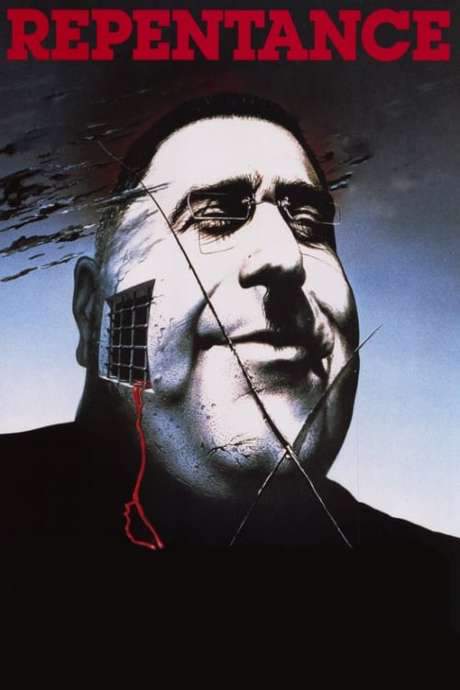
Repentance 1984

Directed by

Georgi Mataradze
Made by

Sovexportfilm
Repentance Plot Summary
Read the complete plot summary and ending explained for Repentance (1984). From turning points to emotional moments, uncover what really happened and why it matters.
The film opens in a quiet Georgian town, where daily life starts with a simple, domestic scene—an unnamed woman preparing cakes—before the weight of history and memory presses in. The town’s mayor, Varlam Aravidze, has died, and the mood is a blend of mourning and unease as people reckon with what his leadership once meant. One day after the funeral, a troubling repetition disrupts the quiet: the mayor’s corpse reappears in the garden of his son’s house, forcing the community to confront a past it would rather forget. The unsettling recurrence of the dead figure becomes a tangible reminder that violence and fear can linger long after the sound of the funeral bells fades.
A dramatic turn arrives when a woman named Ketevan Barateli is accused of digging up the body. She defends herself calmly, arguing that Varlam did not deserve burial because his rule was marked by a terror resembling a Stalin-era regime that erased many lives—parents, friends, and neighbors who vanished without explanation. Her testimony unfolds in a courtroom that doubles as a gallery of memory, with her allegations about Varlam’s regime threaded through a series of flashbacks that reveal the brutality behind the public face of authority. The trial becomes not just a legal confrontation but a public reckoning with the shadows of the town’s recent history, forcing the truth to surface in fragments and memories.
As the proceedings unfold, Varlam’s family becomes entangled in the defense of his legacy. His son, Abel Aravidze, denies any wrongdoing by his father, while his lawyer pushes to have the accused woman declared insane. The courtroom becomes a stage for competing versions of truth, with the past insisting on its own version of events. Standing apart from the adults’ disputes, Tornike, Varlam’s grandson, is startled by the revelations about his grandfather’s crimes. Tornike’s shock deepens into despair, and the film follows his tormented arc as he ultimately takes his own life, a stark and devastating consequence that underscore the generational impact of tyranny.
After Tornike’s death, Abel steps outside the family tragedy by discarding his father’s corpse from a cliff on the town’s edge, a final, grim act that seals the private guilt within a public act. The narrative then circles back to the opening image, returning to the kitchen where the same ritual of cake-making continues, a quiet counterpoint to the violence that has just been exposed.
In the closing scene, an old woman at a window asks if the road she sees is the path to the church. The woman who is preparing the cake responds that the road is Varlam Street and will not lead to the church. The old woman presses the point with a pointed question that lingers in the air: > “What good is a road if it doesn’t lead to a church?” This final exchange crystallizes the film’s meditation on memory, accountability, and the elusive nature of redemption in a community haunted by its past.
- Note: Throughout the narrative, key figures appear in the storyline: the town’s mayor and his heir are anchored by the performances of Varlam Aravidze and his son, Abel Aravidze, the grandson Tornike, and the accuser Ketevan Barateli. The lingering impact of history on personal lives and communal memory is rendered through intimate scenes, formal trial debates, and the stark, symbolic imagery that defines Repentance.
Repentance Timeline
Follow the complete movie timeline of Repentance (1984) with every major event in chronological order. Great for understanding complex plots and story progression.
Death of the mayor and funeral
The town reels from the sudden death of Mayor Varlam Aravidze and attends his funeral. The opening scene shows a woman baking in a quiet kitchen, a contrast to the political shadow surrounding the town. This start hints at a past that will demand reckoning.
Corpse appears in the garden
The mayor's corpse is found in the garden of his son's house the day after the funeral, shocking the neighbors. It is removed and reburied, only to be unearthed again in the same garden. The eerie repetition hints at buried truths resurfacing.
Corpse reburied, then reappears
The corpse is reburied after the initial discovery, but it surfaces again in the garden. The town grows uneasy as the supernatural recurrence collides with a community memory long suppressed. People begin to wonder who is responsible for this haunting absence of closure.
Ketevan Barateli arrested
A woman named Ketevan Barateli is arrested and accused of digging up the mayor's body. Her arrest shifts the case from rumor to a formal inquiry that will illuminate historical grievances. The town's patience wears thin as it confronts the past.
Ketevan defends herself in court
During her defense, Ketevan contends that Varlam did not deserve burial because of his Stalin-like terror and the disappearances he oversaw. She reframes the case as a moral reckoning rather than a mere crime. Her testimony begins to pull back the curtain on a repressed history.
Trial and flashbacks reveal the regime
The trial is interwoven with flashbacks that expose the regime's brutal acts and the disappearances tied to Varlam. The courtroom becomes a stage on which the town confronts long buried crimes. The narrative ties personal stories to a broader political history.
Abel denies his father's wrongdoings
Varlam's son Abel testifies that his father did not commit crimes, attempting to shield the family legacy. His defense team challenges Ketevan's credibility, sometimes aiming to portray her as unstable. The clash deepens the moral struggle at the heart of the trial.
Tornike's shock and despair
Tornike, Varlam's grandson, listens with growing horror as the past is revealed. The revelations force him to reassess his family and the town they inhabit. The emotional tension heightens the film's sense of impending consequence.
Tornike's suicide
Overwhelmed by the weight of the revelations, Tornike takes his own life. The tragedy underscores the personal cost of unearthing past tyranny. It amplifies the film's meditation on memory and guilt across generations.
Abel discards the corpse
Abel moves to sever the burden of the dead tyrant by throwing Varlam's corpse off a cliff on the town's outskirts. The act signals a final attempt to reject the past or to bury it beyond reach. The landscape mirrors the moral precipice the family faces.
Ending: cake scene and road to church
The narrative returns to the opening cake scene as a quiet ritual of memory and reconciliation. The closing dialogue links the road to moral direction and questions whether the town is truly led toward salvation. The film ends with a stark line that echoes the town's search for meaning: 'What good is a road if it doesn't lead to a church?'
Repentance Characters
Explore all characters from Repentance (1984). Get detailed profiles with their roles, arcs, and key relationships explained.
Tornike Aravidze (Merab Ninidze)
Varlam’s grandson, Tornike is shocked by revelations about his grandfather’s crimes. He embodies the new generation’s struggle to reckon with inherited guilt and the weight of a family legacy. His path is marked by inner conflict and, ultimately, tragedy as he confronts the depth of the past.
Varlam Aravidze (Avtandil Makharadze)
The town’s mayor, a figure of power who presided over a Stalin-like regime of terror. His authority casts a long shadow over the present, shaping investigations and the community’s complicity. Although dead by the time of the main events, his legacy drives the court’s accusations and the town’s moral reckoning.
Ketevan Barateli (Zeinab Botsvadze)
A woman accused of digging up the mayor’s corpse who insists he does not deserve burial due to his crimes. She becomes a voice of memory and courage, recounting the regime’s terror through testimony and flashbacks. Her steadfast stand highlights the cost of speaking truth in a town ruled by fear.
Abel Aravidze (Avtandil Makharadze)
Varlam’s son, who denies any wrongdoing and seeks to protect his father, even as the truth emerges. His attempts to block accusations show loyalty woven with denial and self-preservation. He plays a pivotal role in the moral tension of the story, culminating in a drastic act at the end.
Repentance Settings
Learn where and when Repentance (1984) takes place. Explore the film’s settings, era, and how they shape the narrative.
Time period
Late Soviet era
The present timeline sits in the waning years of the Soviet period, while the narrative repeatedly shifts into flashbacks of a Stalin-like regime. Disappearances and state violence are recalled as the trial exposes past crimes. The juxtaposition highlights how time both erases and preserves memory of oppression.
Location
Georgian town
The story unfolds in a quiet Georgian town where close-knit streets hide a brutal political history. The town's social life revolves around its powerful mayor’s legacy, shaping how communities respond to crime and punishment. The setting underscores how ordinary life continues while memory of oppression lingers in every conversation and rumor.
Repentance Themes
Discover the main themes in Repentance (1984). Analyze the deeper meanings, emotional layers, and social commentary behind the film.
🕯️
Memory
The film builds its narrative around memory as both witness and judge, forcing characters to confront buried truths. Flashbacks reveal how past actions shape present guilt and communal responsibility. Memory becomes a mechanism for accountability, even when it fractures families and communities.
🔒
Oppression
A Stalin-like regime casts a long shadow over the town, with disappearances and fear turning ordinary life into a test of loyalty. The narrative shows how power can be exercised through control of information, through silence, and through public rituals that mask cruelty. The tension between authority and moral truth drives the drama.
⚖️
Justice
The trial becomes a crucible where truth collides with family loyalty and political convenience. Characters wrestle with whether confession, punishment, or silence can heal the wounds of tyranny. The film questions whether justice can emerge from a system built on repression, and what that means for those who survive.

Coming soon on iOS and Android
The Plot Explained Mobile App
From blockbusters to hidden gems — dive into movie stories anytime, anywhere. Save your favorites, discover plots faster, and never miss a twist again.
Sign up to be the first to know when we launch. Your email stays private — always.
Explore the mobile appRepentance Spoiler-Free Summary
Discover the spoiler-free summary of Repentance (1984). Get a concise overview without any spoilers.
In a quiet Georgian town where the rhythm of everyday life is defined by modest domestic rituals, the community is still reverberating from the funeral of its long‑standing mayor, Varlam Aravidze. The ceremony offers little consolation, and the following day a disturbing image appears: the mayor’s corpse has resurfaced in the garden of his son’s house. This unsettling recurrence transforms an ordinary suburb into a stage where history refuses to stay buried, setting a tone that feels both intimate and unnervingly cinematic.
The strange event draws the attention of Ketevan Barateli, a local woman who finds herself at the center of a legal confrontation that quickly becomes a public forum for confronting the town’s recent past. Calm and measured, she challenges the idea that the late mayor can be laid to rest, suggesting that his legacy continues to haunt the lives of ordinary people. Opposite her stand his heir, Abel Aravidze, who clings to a more conventional narrative, and his young grandson, Tornike, whose presence hints at the generational weight of unresolved memory. The courtroom, with its stark deliberations, acts less as a venue for verdicts than as a mirror reflecting the community’s fragmented recollections and unspoken tensions.
Visually, the film moves between spare, almost ritualistic scenes—such as a woman methodically preparing cakes in a kitchen—and stark, symbolic moments that underline the lingering presence of authority and fear. The recurring motif of a road that leads nowhere, spoken of in the final exchange, underscores a meditation on direction, belief, and the possibility of redemption. Throughout, the atmosphere is nightmarish yet measured, a modern political vision that invites viewers to linger on the uneasy space between personal routine and the echo of a collective, haunted past.
Movies with Similar Twists and Themes
Uncover films that echo the narrative beats, emotional arcs, or dramatic twists of the one you're exploring. These recommendations are handpicked based on story depth, thematic resonance, and spoiler-worthy moments — perfect for fans who crave more of the same intrigue.


Featured on this page

What's After the Movie?
Not sure whether to stay after the credits? Find out!
Check out our other apps:

SAT Sphere
Build confidence for the Digital SAT.

Mori Atlas
Discover wild places worth protecting.

Luntero
Search smarter for a home in Amsterdam.

Plot Explained
Unravel movie endings and hidden clues.

Pokechamp
Dive into Pokémon data and battle logic.

Driving Theory
Get ready for your European theory test.

Movie Dust
Plan your next cinema trip with ease.

Musemap
Find art and culture as you travel.

Selkobase
Compare credentials before committing.

Local Manual
Turn an unfamiliar country into practical next steps.

Lernavi
Compare school systems before your next move.

GymRoam
Find a workout stop wherever your plans take you.
Explore Our Movie Platform
New Movie Releases (2026)
Famous Movie Actors
Top Film Production Studios
Movie Plot Summaries & Endings
Major Movie Awards & Winners
Best Concert Films & Music Documentaries
Movie Collections and Curated Lists
© 2026 What's After the Movie. All rights reserved.
Privacy Policy