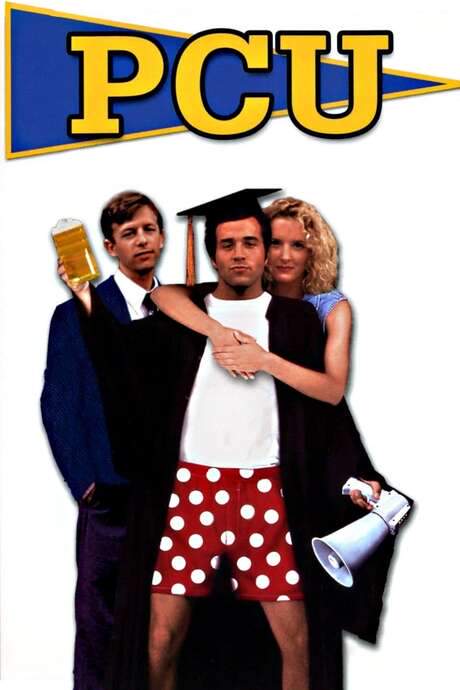
PCU 1994

Directed by

Jon Favreau
Made by

Paul Schiff Productions
PCU Plot Summary
Read the complete plot summary and ending explained for PCU (1994). From turning points to emotional moments, uncover what really happened and why it matters.
Preppy pre-freshman Tom Lawrence visits Port Chester University (PCU), a campus where fraternities have been outlawed and political correctness runs rampant. During his visit, accident-prone Tom makes enemies with nearly every group of students, and spends much of his time dodging a growing mob after him.
He soon finds himself in the middle of a campus-wide conflict between two rival factions, The Pit and Balls and Shaft. Among the members of the latter is Rand McPherson, who, with the other Balls and Shaft, wants the long-banned Greek system to come back and reclaim a page from PCU’s history. On the other side, The Pit operates out of the former Balls and Shaft house, a chaotic, party-centric space run by seniors Gutter and Mullaney, home to mid-year freshman co-ed Katy, and led by multi-year senior James “Droz” Andrews. The Pit’s culture is loud, carefree, and openly rebellious against the campus’s strict, politically correct protests; their counter-protests and raucous parties become a constant source of complaint forms and administrative headaches.
The campus is also home to other factions that color the landscape: a commune-like house of pot users known as Jerrytown that [Gutter] frequents, a radical feminist group called the Womynists, an Afrocentric coalition suspicious of The Pit, and a president who presses for extreme sensitivity and multiculturalism. President Garcia-Thompson is obsessed with sweeping changes—she even pitches controversial plans like Bisexual Asian Studies having its own building while STEM facilities suffer, and she proposes changing the campus mascot to a whooping crane for the bicentennial celebration. Her vision and tactics spark widespread tension, especially as she schemes with Balls and Shaft to push The Pit off campus and give Rand control of the house.
In a bid to raise the funds needed to defend their turf, The Pit throws a party. The effort is initially undermined when the Womynists protest outside, objecting to the party flyers and to the very existence of The Pit’s antics. Yet a twist of fate flips the night: George Clinton and Parliament-Funkadelic arrive and perform, drawing a huge crowd of students who funnel into the party with renewed energy. The spectacular turn of events allows The Pit to raise enough money to keep their house, a victory that rallying students barely celebrate over the ongoing campus climate war.
Garcia-Thompson, however, doubles down. After being locked in a room by Droz with the song Afternoon Delight playing on repeat, she acts on a slate of complaints against The Pit and shuts down the party, expelling its residents even as they’ve just secured funds to stay. Tom learns via an overheard conversation with the Board of Trustees that the President’s politically correct changes are harming both PCU’s legacy and how the school is perceived in the media. The dynamics of power and popularity shift as the students begin to question the limits of campus politics.
The following morning, at the bicentennial ceremony, Droz and former Pit residents stage a bold gambit: they liberate the Whooping Crane and spark a campus-wide protest against protesting itself. The demonstration suggests that even with The Pit’s eviction, the student body cannot be fully controlled by the administration, and the Board ultimately responds by removing the President from her post. Rand’s tirade—dismissive and bigoted toward other student groups—is broadcast across the campus by Droz, revealing how the speech can backfire when it reaches the wider audience.
With the power dynamics in flux, Tom decides to commit to PCU, and The Pit moves back into their residence, signaling a reevaluation of loyalties and a shift in campus life. On his bus ride home, Tom catches sight of Rand, who finds himself in Tom’s former predicament: chased by students across campus as the power structure and the culture-war tensions continue to ripple through the university.
In the end, the campus learns a hard lesson about the limits of control, the unpredictability of student activism, and the stubborn persistence of a group determined to carve out its own space within a campus that constantly tries to redefine itself. The story threads together competing ideals, personal growth, and the chaotic but ultimately hopeful notion that a college town can survive, even thrive, when its students push back against executive overreach while still finding ways to come together when the moment calls for it.
PCU Timeline
Follow the complete movie timeline of PCU (1994) with every major event in chronological order. Great for understanding complex plots and story progression.
Tom arrives at PCU for a campus visit
Tom Lawrence visits Port Chester University, a campus where fraternities are outlawed and political correctness dominates daily life. His accident-prone nature earns him instant enemies among several student groups. He spends much of the day dodging a growing mob while navigating campus politics.
The Pit house and its chaotic culture
The Pit operates out of a lively, disheveled house led by Droz, with seniors Gutter and Mullaney and freshman Katy. They throw wild, anti-PC parties in clear defiance of campus norms and protests. The Pit's unrestrained lifestyle becomes a flashpoint for campus conflict.
Rivalry emerges: The Pit vs Balls and Shaft
Two factions clash: The Pit and Balls and Shaft, groups pushing to restore the outlawed Greek system. Rand McPherson, a member of Balls and Shaft, becomes their de facto spokesperson and target for the Pit's resentment. The campus edges toward an all-out turf war as each side mobilizes.
The president's radical campus agenda
Port Chester's president, Garcia-Thompson, aggressively pushes sensitivity training and multiculturalism. She floats controversial plans, like Bisexual Asian Studies having its own building and changing the campus mascot to a whooping crane. Her high-handed policies escalate tensions with nearly every group on campus.
Conspiracy to oust The Pit
Garcia-Thompson secretly allies with Balls and Shaft to remove The Pit from campus and hand control of the house to Rand. She triggers a damage bill against The Pit, threatening eviction and homelessness if unpaid. The looming threat forces The Pit into a desperate bid to save their home.
The Pit organizes a fundraising party
The Pit decides to throw a big fundraiser to raise the money needed to stay in their house. The Womynists protest the party flyers and the event’s contents, while the residents plot to steal alcohol and rally students. The plan eventually draws in a broader campus crowd.
George Clinton saves the party with a surprise performance
George Clinton and Parliament-Funkadelic headline the fundraiser, drawing a flood of students to the party. The music turns what began as a fragile fundraiser into a campus-wide spectacle. The performance helps raise enough money to keep The Pit afloat for the moment.
Garcia-Thompson shuts down the party
Garcia-Thompson retaliates by locking The Pit residents out and expelling them from the house, undoing their fundraising success. Tom later reveals to Droz that he overheard a Board of Trustees discussion about the President’s PC changes harming the school’s legacy and publicity. The administration’s clampdown heightens campus tensions.
Bicentennial ceremony and the crane heist
At the bicentennial ceremony the next morning, Droz and former Pit residents liberate the campus' Whooping Crane and spark an impromptu protest. The act demonstrates that the student body can resist authority even as The Pit is shut down. The event shifts the campus mood toward defiance of top-down control.
Board removes Garcia-Thompson
Following the demonstrations, the Board of Trustees fires Garcia-Thompson, signaling a rare victory for student sentiment over politically correct policy. The move signals a shift in campus governance and emboldens dissenting groups. The administration's fall reshapes the power balance on campus.
Rand's toxic tirade is broadcast
Rand McPherson launches a sexist, racist and homophobic tirade from the podium, insulting other student groups. Droz secretly uses the mic to broadcast Rand's rant to the entire campus, exposing the intolerance at Balls and Shaft's core. The moment becomes a campus-wide reckoning about bias and accountability.
Tom commits to PCU and The Pit moves back
Tom decides to stay and enroll at PCU, signaling his commitment to the college. The Pit regains control of their house and moves back in, marking a return to campus life despite ongoing tensions. The decision sets the stage for a fragile equilibrium on campus.
Tom heads home and Rand is chased
Tom leaves campus by bus, resolved to attend PCU. On the ride home, he spots Rand McPherson, who is now the target of students and being chased across campus. The film closes with Rand occupying the position Tom started in, highlighting the cycle of campus chaos.
PCU Characters
Explore all characters from PCU (1994). Get detailed profiles with their roles, arcs, and key relationships explained.
Tom Lawrence (Chris Young)
A pre-frosh visiting PCU who is accident-prone and quickly finds himself entangled in campus conflicts with nearly every group. His missteps drag him through the chaotic energy of PCU as he navigates factions and awkward social terrain, eventually choosing to align with the campus's rebellious undercurrent.
Rand McPherson (David Spade)
A member of Balls and Shaft who wants the outlawed Greek system back and uses provocative rhetoric to push his agenda. He embodies the loud, provocative campus guy whose actions spark the central conflicts and put him at odds with many groups. His tirade on the podium becomes a catalyst for the campus-wide upheaval.
Droz (Jeremy Piven)
Leads The Pit, a party-centric house that defies political correctness and organizes protests. He orchestrates strategic moves on campus and even uses the microphone to amplify rivalries, illustrating how charisma and cunning can drive collective action.
Gutter (Jon Favreau)
A senior resident of The Pit, part of the house's raucous energy and party culture. He embodies the lived-in, chaos-friendly spirit of The Pit and contributes to its defiant presence on campus.
Mullaney (Alex Desert)
A long-time member of The Pit, providing steadiness to the house’s dynamic and contributing to its multi-year culture. He represents the more weathered perspective within the rebellious group.
Katy (Megan Ward)
Mid-year freshman who becomes part of The Pit’s social circle. She participates in campus life amid the ongoing clashes between factions and student activism.
President Garcia-Thompson (Jessica Walter)
The campus president obsessed with sensitivity awareness and multiculturalism, pushing transformative but controversial policies. Her administration clashes with student groups and ultimately faces a significant backlash that leads to upheaval at PCU.
Samantha (Sarah Trigger)
A student figure who appears amid the campus dynamics, reflecting the broader student body’s reactions and interactions with the factions on campus.
Womynist #1 (Viveka Davis)
A member of the feminist group on campus, one of the organizers of protests and a representative of the Womynists’ activism and critique of campus policies.
Womynist #2 (Maddie Corman)
Another key member of the feminist group, contributing to the campus conflict through organized protests and responses to policy changes.
PCU Settings
Learn where and when PCU (1994) takes place. Explore the film’s settings, era, and how they shape the narrative.
Time period
Early 1990s
Set in the early 1990s, the story unfolds during a period of rising campus activism and sensitivity initiatives. Political correctness drives many campus debates, shaping student interactions and administrative decisions. The bicentennial ceremony becomes a flashpoint that tests the limits of authority and student agency.
Location
Port Chester University (PCU), The Pit, Jerrytown
Port Chester University (PCU) is a contemporary campus where social groups clash over policy and funding. The Pit house serves as a rebellious, party-centered hub, while Jerrytown provides a counterculture space for pot users. The semester culminates in a bicentennial celebration that amplifies protests, funding battles, and shifts in campus power.
PCU Themes
Discover the main themes in PCU (1994). Analyze the deeper meanings, emotional layers, and social commentary behind the film.
🧭
Political Correctness
The film satirizes the culture of political correctness by showing how sensitivity policies shape campus life and threaten traditional power structures. It presents competing factions—students advocating inclusion and administrators enforcing rules—as a microcosm of national debates. The President's proposals about new buildings and funding highlight the fragility of reform when language and behavior become battlegrounds. Ultimately, student actions reveal how authority can be pressured to bend to public opinion.
🪧
Campus Activism
The story frames protests and performances as central to campus life. A party organized by The Pit becomes a symbolic rally to raise funds and challenge restrictions, drawing in students as the Womynists protest the event. The Whooping Crane incident and the chant demonstrate how student energy can override administrative limits. By the end, collective action forces institutional concessions.
⚖️
Power Struggle
The conflict between The Pit and the administration embodies a struggle for control over campus culture. The President's attempts to reshape the school through policy clash with the students' appetite for autonomy and spectacle. The broadcast of Rand's tirade reveals the consequences of unchecked rhetoric and drives the Board to action. The resolution shows that leadership can be ousted when public pressure aligns with student solidarity.

Coming soon on iOS and Android
The Plot Explained Mobile App
From blockbusters to hidden gems — dive into movie stories anytime, anywhere. Save your favorites, discover plots faster, and never miss a twist again.
Sign up to be the first to know when we launch. Your email stays private — always.
Explore the mobile appPCU Spoiler-Free Summary
Discover the spoiler-free summary of PCU (1994). Get a concise overview without any spoilers.
In a world where campuses have become battlegrounds for ideological purity, Port Chester University looms as a hyper‑politically‑correct enclave where even the memory of fraternities has been erased. The administration pushes ever‑more elaborate programs and sensitivities, while student groups carve out micro‑cultures that clash in vivid, absurdist fashion. The atmosphere crackles with satire, its humor derived from the tension between over‑the‑top correctness and the irrepressible desire to throw a good‑natured, chaotic party.
Enter Tom Lawrence, a jittery high‑school senior on his first day of college, whose nervous energy makes him an accidental magnet for every campus faction. He quickly finds an unlikely ally in James “Droz” Andrews, the charismatic, long‑standing leader of a raucous collective called The Pit. Droz’s crew—an eclectic band of party‑loving misfits—embodies a carefree rebellion that refuses to be tamed by the university’s endless protest forms and complaint boards. Their loud, unfiltered gatherings stand in stark contrast to the campus’ polished, self‑aware veneer, setting the stage for a clash of philosophies.
Opposing them is Rand McPherson, a self‑appointed champion of a revivalist Greek movement, whose ambition to restore a traditional house pits him directly against Droz’s anarchic sanctuary. Watching from the office, the ever‑sensitive President Garcia‑Thompson is determined to rid the campus of The Pit’s perceived excesses. As these opposing forces sharpen their rhetoric, the looming question becomes whether the misfit crew can preserve their space in a world that increasingly demands conformity. The film thrives on this cultural tug‑of‑war, delivering a fast‑paced, witty look at collegiate life where ideals, identity, and a desire to just have fun collide in wildly entertaining ways.
Movies with Similar Twists and Themes
Uncover films that echo the narrative beats, emotional arcs, or dramatic twists of the one you're exploring. These recommendations are handpicked based on story depth, thematic resonance, and spoiler-worthy moments — perfect for fans who crave more of the same intrigue.



Featured on this page

What's After the Movie?
Not sure whether to stay after the credits? Find out!
Check out our other apps:

SAT Sphere
Build confidence for the Digital SAT.

Mori Atlas
Discover wild places worth protecting.

Luntero
Search smarter for a home in Amsterdam.

Plot Explained
Unravel movie endings and hidden clues.

Pokechamp
Dive into Pokémon data and battle logic.

Driving Theory
Get ready for your European theory test.

Movie Dust
Plan your next cinema trip with ease.

Musemap
Find art and culture as you travel.

Selkobase
Compare credentials before committing.

Local Manual
Turn an unfamiliar country into practical next steps.

Lernavi
Compare school systems before your next move.

GymRoam
Find a workout stop wherever your plans take you.
Explore Our Movie Platform
New Movie Releases (2026)
Famous Movie Actors
Top Film Production Studios
Movie Plot Summaries & Endings
Major Movie Awards & Winners
Best Concert Films & Music Documentaries
Movie Collections and Curated Lists
© 2026 What's After the Movie. All rights reserved.
Privacy Policy