
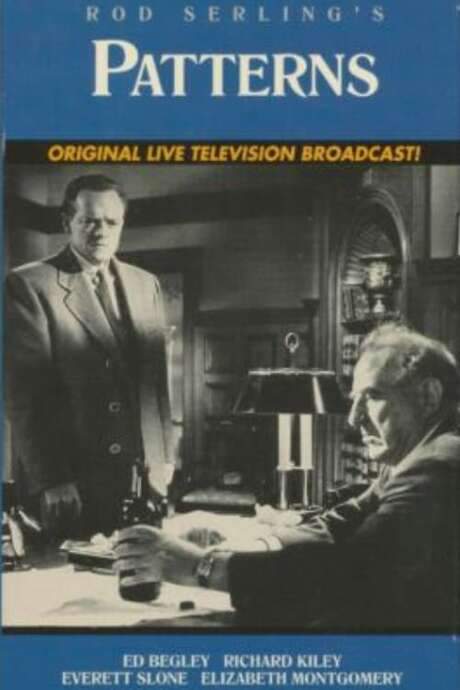
What Is Patterns About?
The premise of Patterns in 281 words, with nothing given away. The full story follows below.
In the sleek, glass‑capped towers of Manhattan, a powerful industrial empire exerts its influence over factories, workers, and the very rhythm of the city. The company’s culture is a mixture of old‑world loyalty and a relentless drive for efficiency, where boardrooms hum with the language of numbers and ambition. Under the stern stewardship of a hard‑nosed president, the firm’s every move is calculated, its success measured by growth and the willingness to sacrifice the personal for the corporate.
Fred Staples arrives as the newest executive, a bright engineering mind whose recent achievements have already earned the admiration of the leadership. He quickly forms a tentative partnership with Andy Sloane, the seasoned vice‑president who has long balanced the cut‑and‑thrust of corporate strategy against the demands of his own family. Their interactions reveal a world where mentorship can become manipulation, and where the promise of advancement is as tempting as it is fraught with hidden cost. Observing their dynamic from the helm is Walter Ramsey, a president who prizes ruthless efficiency and sees in Staples the ideal candidate to inherit the mantle of second‑in‑command.
As the company’s internal machinations surface, the atmosphere grows increasingly charged. Old loyalties clash with modern imperatives, and the allure of power sits beside a growing awareness of its moral weight. Staples finds himself at a crossroads, pulled between the seductive promise of higher status and the uneasy conscience stirred by the sacrifices demanded of those around him. The stage is set for a tension‑filled struggle, where ambition, integrity, and the very definition of success will be tested against one another, leaving the future of the firm — and the lives within it — hanging in a delicate balance.
What Happens in Patterns?
The complete story of Patterns, from the first scene to the last, in 321 words (about 1 minute). Spoilers throughout. Names in the text link to 2 cast member pages.
Spoilers ahead
Ruthless Walter Ramsey runs Ramsey & Company, a Manhattan-based industrial empire he inherited from his father. He brings Fred Staples, a youthful industrial engineer whose performance at an Ohio factory recently acquired by Ramsey has impressed him, into a top executive role at the headquarters. Though Staples is initially unaware, Ramsey is grooming him to replace the aging Bill Briggs as the second-in-command at the firm.
Briggs has been with the firm for forty years, having worked for and admired the company’s founder. He genuinely cares about people, regularly prioritizing work over time with his teenage son, but his humane approach clashes repeatedly with Ramsey’s heartless “modern” method of doing business. Not wanting to fire Briggs outright, Ramsey does everything in his power to push him toward resignation. The old man stubbornly refuses to give in, but the stress weighs on him and he begins to drink, worsening his health. Staples is torn between his ambition and his sympathy for Briggs, a tension shared by his wife, Fran Staples.
At a board meeting, while discussing a report Briggs and Staples wrote together, Ramsey praises Staples for turning Briggs’ old, well-intentioned but unworkable ideas into something practical, and the room erupts in a heated exchange. Shortly after leaving, Briggs collapses and dies in the hospital.
Fed up, Staples goes to tell Ramsey off and announce his resignation. Ramsey rebukes him, arguing that a corporation like Ramsey & Company needs men who can play at his level in order to succeed. He offers Briggs’ job to Staples at double his present salary, double stock options, and an unlimited expense account, but Staples resists. Undeterred, Ramsey ups the pitch, saying Staples will never be able to become his whipping boy, but could reach the presidency if he stays and keeps challenging him. Staples leaves and tells his wife that he is staying, convinced there is at least a chance to influence the company’s direction.
Patterns Timeline: Every Key Event in Order
12 key events in the order they happen, from “Ramsey takes command of Ramsey & Company” to “Staples commits to stay in hopes of reform”. 12 events name a place, across 10 locations.
- 1
Ramsey takes command of Ramsey & Company
Walter Ramsey ruthlessly oversees Ramsey & Company, continuing the legacy he inherited from his father. He runs the Manhattan-based industrial empire with a hard-edged, modern approach focused on profit and expansion. The film establishes his authority and sets the tone for the power struggles to come.
Where:Manhattan headquarters
- 2
Staples joins as top executive
Walter Ramsey brings Fred Staples, a young industrial engineer, into the top ranks after seeing his impressive performance at an Ohio factory Ramsey acquired. Staples is initially unaware of the true motive to groom him as Briggs' eventual replacement. Ramsey hopes Staples will be groomed to replace Briggs as second-in-command.
Where:Ramsey & Company headquarters
- 3
Briggs, a 40-year veteran, is revered yet strained
Briggs has dedicated four decades to the firm and still admires the founder. He values people and careful work, often clashing with Ramsey's ruthless, modern mindset. His loyalty to the old ways sets up the upcoming power struggle.
Where:Company offices
- 4
Ramsey sabotages Briggs to push him toward resignation
To avoid firing him outright, Ramsey undermines Briggs through tactics designed to erode his position and confidence. He tries to humiliate Briggs in front of the board and management during negotiations, widening the rift between them. The maneuvering foreshadows the personal and professional costs of the leadership battle.
Where:Ramsey & Company offices
- 5
Stress takes a toll on Briggs' health
The strain of the corporate power play leads Briggs to drink and further damages his health. He witnesses the creeping hostility from the leadership and refuses to give in to Ramsey's game. His deteriorating condition foreshadows the high personal stakes in the conflict.
Where:Briggs' home and hospital
- 6
Staples torn between loyalty and ambition
Staples sympathizes with Briggs and his ideals but is tempted by the offer of leadership. His wife supports him yet pressures him to weigh his choices carefully. The personal conflict pits his conscience against corporate advancement.
Where:Staples' home
- 7
Boardroom confrontation and Briggs' legacy discussed
Briggs and Staples present a report that balances old-fashioned ideals with practical needs. Ramsey publicly praises Staples for translating Briggs' ideas into feasible plans, signaling a test of Staples' loyalty. The heated exchange hints at the looming personal and professional stakes.
Where:Boardroom, Ramsey & Company HQ
- 8
Briggs collapses after the room leaves
Shortly after walking out of the meeting, Briggs collapses from the stress and is rushed to the hospital. His collapse is a direct result of the conflict and the pressure from Ramsey's tactics. He later dies in the hospital, removing the direct obstacle to Ramsey's plan.
Where:Hospital
- 9
Staples considers quitting after Briggs' death
Fed up with the toxic power struggle and the pressure from Ramsey, Staples contemplates telling Ramsey off and resigning. He weighs the personal and professional costs of staying in a role that may compromise his ethics. The moment marks a potential turning point in the leadership succession.
Where:Ramsey & Company offices
- 10
Ramsey offers Briggs' job and rewards to Staples
Ramsey doubles Staples' salary and stock options and grants an unlimited expense account, trying to secure his loyalty. He insists that Staples would be essential to the company's continued success and that he can reach his full potential under Ramsey's leadership. Staples faces a critical choice between power and principle.
Where:Ramsey's office
- 11
Staples resists becoming a 'whipping boy'
Staples rejects the idea of becoming a tool to bolster Ramsey's control and expresses his unwillingness to submit to the ruthless dynamic. He makes clear he would challenge Ramsey and pursue the presidency if needed. This exchange redefines the power balance and preserves his autonomy.
Where:Ramsey's office
- 12
Staples commits to stay in hopes of reform
Despite the ominous offer, Staples tells his wife that he will stay at Ramsey & Company, believing there is at least a chance to influence change from within. Ramsey, energized by a capable challenger, accepts this arrangement as a necessary spark. The film ends with the uneasy alliance as Staples prepares to navigate the future.
Where:Home and Ramsey & Company HQ
Who Are the Main Characters in Patterns?
4 characters, among them Walter Ramsey (Everett Sloane), Fred Staples (Richard Kiley) and Fran Staples (June Dayton): who each one is and the part they play in the story. 3 of them link to the actor’s page.
- WR
Walter Ramsey (Everett Sloane)
Played by Everett Sloane
A ruthless empire-builder who views the company as a machine for power and profit. He engineers crises to test and shape his lieutenants, using humiliation and pressure as tools of control. Ramsey thrives on strategic dominance and the belief that the end justifies the means.
- 💼 Power
- 🧭 Strategy
- 🗜️ Control
- FS
Fred Staples (Richard Kiley)
Played by Richard Kiley
A talented industrial engineer recruited after an Ohio factory success. He is torn between Briggs's humane stewardship and Ramsey's magnetic, coercive push toward the presidency. His ambition is tempered by a growing moral awareness and concern for how decisions affect people.
- 💡 Ambition
- 🧭 Ethics
- 🏢 Corporate
- FS
Fran Staples (June Dayton)
Played by June Dayton
Staples's wife, who supports him as the pressure at work intensifies. She embodies the domestic perspective on the consequences of corporate maneuvering and the personal sacrifices involved in climbing the ladder.
- 👫 Family
- 💬 Support
- BB
Bill Briggs
The aging board member whose long service and good intentions clash with Ramsey's modern, hard-edged approach. His health deteriorates under mounting stress, culminating in a collapse and death in the hospital.
- 🏥 Health
- 🧭 Tradition
Where and When Is Patterns Set?
Patterns is set in Manhattan and Ohio (1950s). Here is why the time and place matter to the story.
When
1950s
Set in the 1950s, a period of rapid corporate expansion and the rise of professional management. Boards, stock options, and competitive strategies define the climate, pushing leaders to trade loyalty for performance. The era's emphasis on efficiency and profit provides a tense backdrop for the power struggle at Ramsey & Company.
Where
Manhattan, Ohio
The film centers on Ramsey & Company's Manhattan headquarters, a symbol of postwar corporate power. The company also operates an Ohio factory that anchors Staples' career and the industrial reach of the empire. The setting captures the glossy high-rise environment and the factory floor where production and pressure collide.
- 🏙️ Urban
- 🏭 Industrial
What Are the Themes of Patterns?
4 ideas the story keeps returning to, among them Power & Ambition, Ethics vs Profit and Old Guard vs Modern.
-
01
Power & Ambition
The film centers on the drive to ascend within a powerful company. Staples's career path becomes a battleground for Ramsey's test of loyalty and talent. Ambition drives manipulative tactics and high-stakes decisions that threaten personal relationships. The narrative uses this pursuit to explore how power reshapes ethics and trust.
-
02
Ethics vs Profit
Ramsey's profit-first philosophy clashes with Briggs's humane, steady approach and Staples's moral tension. The story constantly weighs human cost against financial gain, forcing characters to choose between principle and advancement. This tension reveals how corporate mechanisms can dehumanize workers while boosting the bottom line.
-
03
Old Guard vs Modern
Briggs embodies the old guard whose loyalty to organization and people clashes with Ramsey's modern, ruthless efficiency. The clash highlights a generational shift in corporate culture and management style. The balance between experience and innovation becomes the key battleground for control.
-
04
Authority & Control
Ramsey exercises authority through manipulation, incentives, and psychological pressure. The boardroom becomes a theatre where control is won, lost, and contested through strategic moves. Staples' hesitation and eventual stay reveal how influence can shape leadership turnover and corporate destiny.
What Kind of Film Is Patterns?
Tense in tone, with steady pacing and a straightforward story, going by the plot summary.
- Tone
- Tense
- Pacing
- Steady
- Story
- Straightforward
- Intensity
- Medium
- Ending
- Bittersweet
A tense corporate drama that creates an atmosphere of high-stakes psychological pressure, following a man's internal struggle between ambition and empathy as he witnesses the ruthless destruction of a colleague.
- tense
- anxious
- morally conflicted
- oppressive
- somber
- professional pressure
- corporate corruption
- moral dilemma
- ambition vs conscience
- power struggle
Content notes: emotional manipulation, workplace bullying, death from stress.
Quiz
How well do you remember Patterns? Test yourself on the story.
