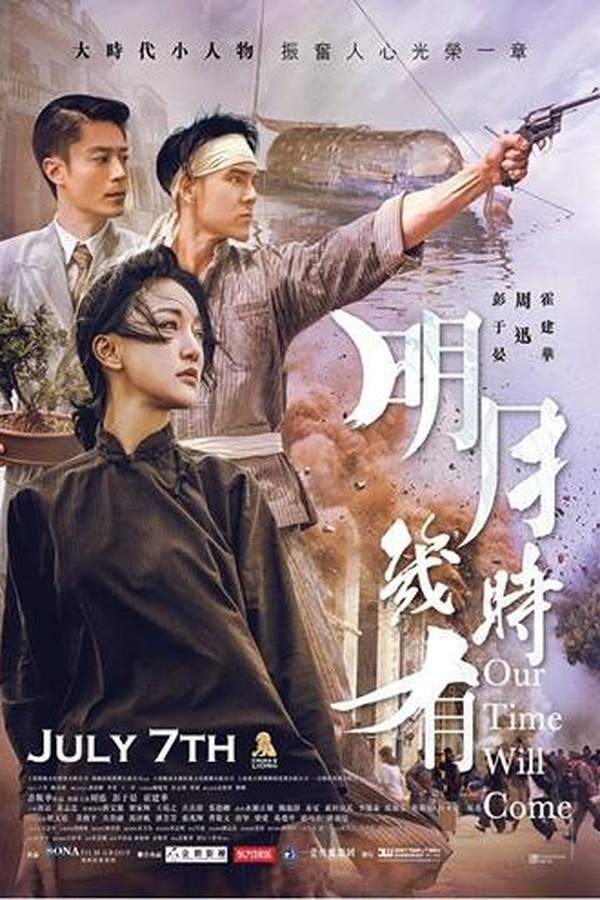
What Is Our Time Will Come About?
The premise of Our Time Will Come in 296 words, with nothing given away. The full story follows below.
Set against the shadowed streets of 1940s Hong Kong during the Japanese occupation, Our Time Will Come unfolds as a stirring portrait of courage and quiet defiance. At the heart of the story is Fang Gu, a resolute schoolteacher whose literary sensibilities cannot shield her from the harsh realities unfolding around her. As famine and fear grip the city, Fang finds herself drawn into a world far more dangerous than the classroom — a world of secret messages, hidden alliances, and the fragile hope of liberation.
Alongside the legendary guerrilla leader JinJin “Blackie” Lau, Fang joins the Dongjiang resistance forces, whose daring exploits have earned them a near-mythic reputation among the occupied populace. Their partnership is one forged in urgency and mutual respect, two souls bound by a shared refusal to surrender their homeland. Yet their cause is complicated by the presence of Lee Gam-wing, Fang’s childhood sweetheart, whose loyalties and sympathies pull him toward paths she cannot follow. The emotional tension between these three figures adds a deeply personal undercurrent to the larger struggle for freedom.
The film carries a tone of hushed urgency, where every conversation might carry coded meaning and every kindness could be an act of rebellion. Life under occupation is rendered with both intimacy and gravity, the camera lingering on the quiet sacrifices of ordinary people who choose resistance in their own ways. The streets of wartime Hong Kong become a stage for both heartbreak and heroism, where poetry, friendship, and the bonds of community endure even as the world above crumbles.
Blending historical sweep with intimate human drama, Our Time Will Come is a tribute to the unsung figures of the resistance — those who fought not with grand gestures alone, but with whispered courage in the darkest of times.
What Happens in Our Time Will Come?
The complete story of Our Time Will Come, from the first scene to the last, in 588 words (about 3 minutes). Spoilers throughout. Names in the text link to 3 cast member pages.
Spoilers ahead
Set during the turbulent era of the 1940s, the story unfolds in Hong Kong during the oppressive Japanese occupation. The narrative is framed as a historical account, told by an elderly taxi driver who is being interviewed for a documentary. As he reflects on his childhood, he recalls the bravery and sacrifice of the people he knew, focusing specifically on the legendary figure known as “Fang Gu,” played by Xun Zhou.
In 1942, the woman known as Fang Lan—who would eventually become the legendary Fang Gu—is introduced as a quiet, bookish young woman with a deep poetical streak. She lives with her mother in a home where they rent out rooms to various intellectuals, including the writer Mao Dun. At the start of the story, Fang is engaged to marry Wallace Huo as Lee Gam-wing. However, their relationship fractures when she breaks off the engagement, deeply troubled by Lee’s apparent indifference toward the widespread starvation and suffering of the Hong Kong population under enemy rule.
As the Japanese forces plan to execute the city’s intelligentsia, a brave resistance movement forms to smuggle targeted intellectuals to “Free China.” Fang finds herself drawn into this struggle, assisting the bold resistance leader Blackie Lau, portrayed by Eddie Peng. Together, they work to ensure the safety of Mao and his wife, and they are even tasked with the grim duty of disposing of the body of a collaborator spy who had been executed.
Meanwhile, Lee Gam-wing takes a precarious path, working for the Kempeitai (the feared Japanese military police) under Colonel Yamaguchi. Because Yamaguchi shares a passion for Tang poetry—a subject in which Lee is an expert—the two form an unlikely friendship. Despite his position within the enemy’s ranks, Lee is not entirely loyal to the occupiers and occasionally provides assistance to the resistance.
By 1944, Fang has fully embraced her role in the fight for freedom, eventually becoming the leader of the East Hong Kong section of the resistance. This transformation is met with strong opposition from her mother, who wishes for her daughter to embrace the traditional roles of a wife and mother. While Fang rejects these expectations, her mother eventually grows to accept her daughter’s commitment to the cause. During this time, a complex love triangle develops; Fang finds herself torn between her lingering feelings for Wallace Huo and her growing attraction to the daring Eddie Peng.
The tension reaches a breaking point when Fang’s mother attempts to help the cause by smuggling an important message. This act of bravery leads to her arrest by the Kempeitai. In a desperate bid to save her, Fang and Lau lead a daring attack on the military police station, but the mission ends in tragedy and Mrs. Fang is executed.
The fallout is devastating. Colonel Yamaguchi discovers that Lee had been betraying him by tipping off the resistance about the location of the prisoners, and as a result, Yamaguchi has Lee killed. With the city becoming an impossibly dangerous place for them to remain, Lau and Fang are forced to flee the city via a junk boat under the cover of night. Their ultimate fate is left an open mystery.
The film concludes with a visual transition, as a shot of Hong Kong in 1944 fades into the vibrant, bustling landscape of the modern city. The elderly taxi driver, having finished sharing the haunting memory of Fang Gu, ends his interview and returns to his quiet life as a humble driver, leaving the legacy of the resistance to linger in the air.
Our Time Will Come Timeline: Every Key Event in Order
15 key events in the order they happen, from “A taxi driver's story begins” to “The story returns to the present”. 13 events name a place, across 4 locations.
- 1
A taxi driver's story begins
An elderly taxi driver is interviewed for a documentary about life under the Japanese occupation of Hong Kong. He begins to recount the story of the legendary Fang Gu and the people he knew as a boy growing up during those turbulent years.
When:Present day Where:Hong Kong
- 2
Fang Lan breaks off her engagement
Fang Lan, a bookish young woman with a poetical streak, lives with her mother in 1942 Hong Kong. She ends her engagement to Lee Gam-wing, citing his lack of concern for the fact that much of the city's population is starving to death.
When:1942 Where:Hong Kong
- 3
Intellectuals take refuge in the Fang home
Mrs. Fang rents out rooms in her house to various intellectuals, including the famous writer Mao Dun. This puts the ordinary Fang household at the heart of Hong Kong's literary and cultural circles under occupation.
Where:The Fang family home, Hong Kong
- 4
A plot against the intelligentsia
The resistance learns that the Japanese plan to execute much of Hong Kong's intelligentsia. They devise a plan to smuggle the targeted intellectuals out of the occupied city to 'Free China'.
Where:Hong Kong
- 5
Fang's first mission for the resistance
Fang assists resistance leader Blackie Lau in helping Mao Dun and his wife escape from Hong Kong. She also helps dispose of the corpse of an executed collaborator spy, proving her willingness to take on dangerous work.
Where:Hong Kong
- 6
Lee joins the Kempeitai
Lee Gam-wing goes to work for the poetry-loving Colonel Yamaguchi of the Kempeitai, the much-feared Japanese military police. Despite his friendship with Yamaguchi, who shares his love of Tang poetry, Lee sometimes secretly assists the resistance.
Where:Kempeitai headquarters, Hong Kong
- 7
Fang joins the resistance and rises through the ranks
Over the vehement opposition of her mother, Fang joins the resistance movement. Mrs. Fang wants her daughter to settle down as a wife and mother, roles that Fang firmly rejects, and by 1944 she becomes the leader of the resistance's East Hong Kong section.
When:1942-1944 Where:Hong Kong
- 8
A mother's acceptance
Over time, Mrs. Fang comes to accept her daughter's chosen path in the resistance. Though she initially wished for Fang to lead a conventional domestic life, she grows to embrace her daughter for who she truly is.
- 9
Blackie Lau becomes a legend
Lau emerges as the most daring resistance leader in Hong Kong, constantly eluding the Kempeitai and its Chinese collaborators. His exploits make him a persistent thorn in the side of the Japanese occupiers.
Where:Hong Kong
- 10
A love triangle forms
Fang still harbors feelings for her former fiancé Lee while finding herself attracted to the fearless Lau. This complicated emotional tension unfolds in parallel with the increasing dangers of resistance work.
Show the other 5 events of Our Time Will Come Hide the last 5 events
- 11
Mrs. Fang is arrested
To assist her daughter's work with the resistance, Mrs. Fang smuggles an important message. The Kempeitai catches her, and she is arrested and taken into custody.
Where:Hong Kong
- 12
The failed rescue and execution
Fang and Lau lead an attack on the Kempeitai station in a desperate attempt to free Mrs. Fang. The rescue fails, and Mrs. Fang is executed by the Japanese authorities.
Where:Kempeitai station, Hong Kong
- 13
Lee is betrayed and killed
Colonel Yamaguchi discovers that Lee had been working for the resistance and had tipped off Fang about where her mother was being held. Despite their friendship founded on a shared love of Tang poetry, Yamaguchi has Lee killed.
Where:Hong Kong
- 14
Escape into the unknown
With Hong Kong having become too dangerous, Lau and Fang flee the city by junk at night. Their ultimate fates are never revealed, leaving their story open-ended.
When:1944 Where:Hong Kong
- 15
The story returns to the present
A shot of Hong Kong at night in 1944 transforms into modern Hong Kong today. The elderly taxi driver breaks off his documentary interview and quietly goes back to his work as a humble taxi driver.
When:Present day Where:Hong Kong
What Kind of Film Is Our Time Will Come?
Bittersweet in tone, with steady pacing and a moderate story, going by the plot summary.
- Tone
- Bittersweet
- Pacing
- Steady
- Story
- Moderate
- Intensity
- High
- Ending
- Bittersweet
A solemn, atmospheric war drama that follows a brave woman's transformation into a resistance leader, balancing moments of heroism and tenderness against the tragic weight of wartime sacrifice.
- somber
- tense
- nostalgic
- melancholic
- heroic
- atmospheric
- world war ii
- japanese occupation
- hong kong history
- resistance movement
Content notes: war violence, execution, political repression, parental death, torture implied.
Quiz
How well do you remember Our Time Will Come? Test yourself on the story.