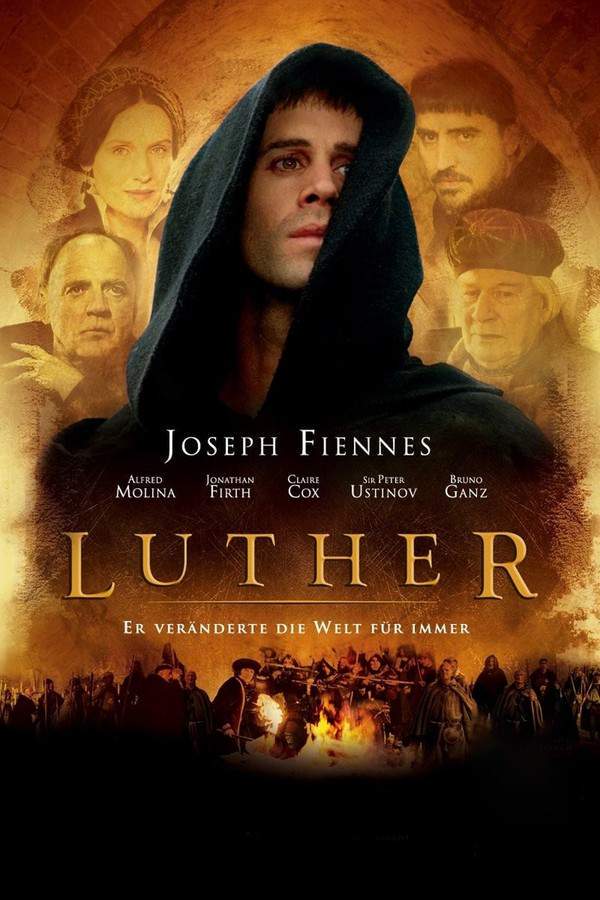
Luther 2003

Directed by

Eric Till
Made by

R.S. Entertainment
Where to Watch Luther
See current US streaming, rental, and purchase options for Luther (2003) via JustWatch.


Streaming availability powered by 
Luther Plot Summary
Read the complete plot summary and ending explained for Luther (2003). From turning points to emotional moments, uncover what really happened and why it matters.
The film opens in a raging thunderstorm in 1505, where the young monk Martin Luther is driven to vow a life devoted to God and becomes an Augustinian friar. The initial torment of his faith sets a quiet, persistent tone: he wrestles with a view of God as merciless and vengeful, even as he seeks a path that could reconcile faith with mercy.
Two years into life at St. Augustine’s Monastery in Erfurt, Luther grapples with doubt and spiritual turmoil. His elder mentor, Staupitz, encourages him to shift focus away from himself and toward Christ, urging a gentler understanding of the divine love that might redeem rather than condemn. This guidance marks a turning point in how he sees God and his own vocation.
From Erfurt, Luther’s journey leads him to Rome, where the opulence and moral laxity he encounters challenge his emerging beliefs. He confronts corruption, glimpses the spectacle surrounding indulgences, and even encounters relics like the skull believed to be John the Baptist, which together fuel his growing questions about the practice of indulgences themselves. This Rome episode intensifies his inner conflict and sets the stage for a radical reevaluation of church practices back home.
Returning to Germany, Luther is assigned to Wittenberg, where his teaching begins to emphasize a God of love over a God of judgment. He begins to articulate a message that salvation comes through faith and grace rather than through ritual purchases, a stance that unsettles the established order but resonates with many in his community.
In 1513, the papacy under Leo X intensifies the pressure, commissioning Johann Tetzel to travel through towns to sell indulgences intended to fund ambitious church projects. Luther publicly denounces indulgences, dismissing them as “just a piece of paper,” and boldly posts his 95 theses on the church door, inviting open debate and challenging the church to confront the corruption he perceives. This act sparks a formal reckoning, leading to a series of examinations beginning in Augsburg with Cardinal Cajetan and other church officials.
Excommunication follows, and Leo X moves to have Luther delivered to Rome. Yet Luther finds protection in Frederick the Wise of Saxony, who secretly relocates him. In Wartburg Castle, Luther hides away, while Andreas Karlstadt, his vehement contemporary, pushes for revolutionary upheaval among the nobles. The reformer’s concern over social unrest deepens as he wrestles with how reform should unfold in practice, even as he begins the monumental task of translating the Bible into German.
Luther’s personal life then becomes a public symbol of transformation when he marries Katharina von Bora, a former nun. As political tides shift, Charles V summons the evangelical princes to the Diet of Augsburg, attempting to outlaw Protestantism and ban the German Bible. The princes resist, and the assembly grants them the chance to read the Augsburg Confession, signaling a persistent, if contested, commitment to reform.
The film closes with a contemplation of Luther’s enduring influence, his translation work, and the enduring impact of his reformist legacy on faith and society.
Luther Timeline
Follow the complete movie timeline of Luther (2003) with every major event in chronological order. Great for understanding complex plots and story progression.
Storm triggers Luther's monastic vow
A violent thunderstorm drives Luther to fear for his life. In the crisis, he dedicates himself to God and chooses the Augustinian path, becoming an Augustinian friar. The decision marks the start of his lifelong religious journey.
Luther becomes a friar under Staupitz
Two years into his vows, Luther serves at St. Augustine's Monastery in Erfurt and wrestles with the image of God as a deity of hate. His supervisor, Johann von Staupitz, counsels him to seek Christ's mercy rather than his own judgment. The mentor's guidance steers Luther toward a more compassionate understanding of faith.
Trip to Rome sparks crisis over indulgences
Luther delivers a letter for Staupitz to Rome and is unsettled by the city's hypocrisy and wealth. In Rome he encounters relics and even a skull claimed to be John the Baptist, and he purchases an indulgence, which troubles him. This experience plants the seeds for his later critique of indulgences.
Return to Germany and teach love of God
Back in Germany, Luther is assigned to Wittenberg where he begins teaching that God is not a God of hate but a God of love. He emphasizes grace and mercy over wrath in his sermons and writings. This shift sets the stage for challenging church practices.
Luther denounces indulgences and posts the 95 Theses
With the backdrop of Pope Leo X's papacy, Luther denounces indulgences as a mere paper and questions their authority. He pins his 95 theses to the door of the church, calling for an open debate about indulgences. This act ignites a clash with church authorities.
Summoned to Augsburg to answer for his writings
Luther is summoned to Augsburg to answer before Cardinal Cajetan and other church officials. The questioning tests his resolve and willingness to defend his reformist views. The encounter intensifies the confrontation between reformers and papal authority.
Excommunication and protection by Frederick the Wise
Following his condemnation, the pope excommunicates Luther and orders him to be delivered to Rome. Prince-elector Frederick the Wise intervenes, offering sanctuary and protection in Saxony. Luther evades capture and continues his reform work from his new safe haven.
Diet of Worms verdict
Luther is brought before Charles V and the Cardinals at Worms, where he is asked to recant his writings. He asks for time to consider his response, and the next day he refuses to recant his beliefs. The trial establishes his defiant stand and secures his status as an outlaw in the eyes of the Empire.
Luther hides at Wartburg and begins translation
Frederick the Wise hides Luther at Wartburg Castle to protect him from authorities. During this exile, Luther begins translating the Bible into German, bringing religious texts to a broader audience. The secretive stay deepens his influence on the Reformation.
Karlstadt pushes the Great Peasants' Revolt
Luther's former colleague Andreas Karlstadt encourages the Great Peasants' Revolt against oppressive nobles. Luther is shocked by the revolt and urges the princes to quell it, differentiating reform from social upheaval. The tension highlights rivalries within the reform movement.
Bible translation completed during exile
While in exile, Luther completes a German translation of the Bible, making scriptures accessible to lay readers. The project cements his influence on Protestant practice and German religious culture. The translated Bible becomes a cornerstone of the Luther era.
Luther marries Katharina von Bora
Luther marries Katharina von Bora, a former nun, sealing a new personal life alongside his public reform. The marriage challenges conventions and strengthens the reformist leadership in Wittenberg. Their partnership becomes a symbol of Protestant family life.
Diet of Augsburg and the Augsburg Confession
Charles V summons evangelical princes to the Diet of Augsburg to outlaw Protestantism and the German Bible. The nobles refuse to recant and, instead, are allowed to present the Augsburg Confession. The event marks a formal confrontation between reformers and Catholic authorities.
Luther Characters
Explore all characters from Luther (2003). Get detailed profiles with their roles, arcs, and key relationships explained.
Martin Luther (Joseph Fiennes)
A German monk who evolves into a fearless reformer. He wrestles with the idea of a loving God while challenging indulgences and church authority, eventually posting the 95 Theses and leading a movement that changes Western Christianity. His journey is marked by conscience, courage, and a relentless search for theological clarity.
Johann von Staupitz
Luther's mentor and supervisor, who urges him to focus on Christ rather than himself. He provides pastoral guidance and supports Luther's early reformist ideas, acting as a stabilizing influence during turbulent times.
Pope Leo X
The pope during Luther's rise, whose policies and indulgence campaigns set the stage for institutional confrontation. He represents the papal authority and the political-religious stakes of the era.
Charles V
The Holy Roman Emperor who presides over trials and imperial politics during Luther's ascent. His decisions at Worms and in the Diet of Augsburg shape the fate of Protestantism.
Katharina von Bora
A former nun who marries Luther, symbolizing the personal and social shifts of the era. Their partnership reflects a new model of religious life outside traditional monastic structures.
Luther Settings
Learn where and when Luther (2003) takes place. Explore the film’s settings, era, and how they shape the narrative.
Time period
Early 16th century (1500s)
Set during the Renaissance-era upheavals in the Holy Roman Empire, the film follows Luther from his conversion in 1505 through the 1510s and into the early 1520s. It maps the rise of reformist ideas as indulgences and church authority come under scrutiny. The period culminates in the Diet of Worms and the Augsburg Confession, reflecting a decade of religious and political struggle.
Location
Erfurt, Wittenberg, Worms, Wartburg Castle, Rome, Augsburg
The story spans Erfurt, Wittenberg, Worms, Wartburg Castle, Rome and Augsburg. In Erfurt, Luther joins the Augustinian order at the St. Augustine Monastery. Wittenberg becomes the hub of his teaching and the birthplace of his reforming ideas, while Worms hosts his famous trial. Wartburg Castle provides a protected refuge as Rome and Augsburg frame the broader drama surrounding indulgences and imperial politics.
Luther Themes
Discover the main themes in Luther (2003). Analyze the deeper meanings, emotional layers, and social commentary behind the film.
🕊️
Faith vs Dogma
The film centers on Luther's shift from viewing God as wrathful to embracing a message of divine love. It explores personal conscience clashing with church authority, and how conviction can fuel reform. The narrative shows faith as a lived, interpretive experience rather than blind obedience.
🧾
Indulgences
Indulgences are presented as a corrupt practice driving wealth to Rome and a tool for power. Luther's critique of indulgences sparks a public debate and a re-examination of what salvation means. The theme highlights how economic interests intertwine with spiritual claims.
⚖️
Dissent and Reform
Dissent arises as Luther posts his theses and refuses to recant at Worms, demonstrating the conflict between emerging national reform movements and papal authority. The film traces how institutional structures push back, while reformers mobilize princes to support religious change. The period culminates in the Augsburg Confession, formalizing a new Protestant identity.

Coming soon on iOS and Android
The Plot Explained Mobile App
From blockbusters to hidden gems — dive into movie stories anytime, anywhere. Save your favorites, discover plots faster, and never miss a twist again.
Sign up to be the first to know when we launch. Your email stays private — always.
Explore the mobile appLuther Spoiler-Free Summary
Discover the spoiler-free summary of Luther (2003). Get a concise overview without any spoilers.
In the early 1500s, a continent shrouded in the flickering light of candle‑lit chapels and the echo of Gregorian chant is roiled by whispers of excess and yearning for change. The Catholic Church dominates every facet of daily life, its towering cathedrals and intricate rituals framing the world as both sanctuary and stronghold. Yet beneath the reverent hymns lies a palpable tension, a quiet undercurrent of doubt that hints at a storm waiting to break.
At the heart of this restless world stands a young monk, Martin Luther, whose boundless curiosity and fierce idealism set him apart from his cloistered peers. Drawn to the promise of a life devoted entirely to God, he embraces the austere routine of the Augustinian order, only to find his own questions growing louder with each whispered prayer. The film follows his inner battle between a vision of divine mercy and the harsher, punitive doctrines he has been taught, casting his spiritual struggle in stark, reverent light.
Guiding him is his seasoned mentor, Staupitz, whose gentle counsel urges the fledgling monk to shift his focus from personal anguish toward a broader, more compassionate understanding of faith. Their conversations unfold amid stone‑cold cells and sun‑dappled cloisters, creating a quiet tension that mirrors the larger unrest bubbling through the continent. Around them, scholars, clerics, and laypeople each carry their own fragments of belief, forming a tapestry of conviction that both sustains and strains the fragile equilibrium of the age.
As the monk’s doubts deepen, the atmosphere grows increasingly charged, hinting at a seismic shift that could reverberate far beyond the monastery walls. The film balances solemn reverence with a simmering sense of inevitability, inviting viewers to feel the weight of history poised on the brink of transformation without revealing the exact path that will follow.
Movies with Similar Twists and Themes
Uncover films that echo the narrative beats, emotional arcs, or dramatic twists of the one you're exploring. These recommendations are handpicked based on story depth, thematic resonance, and spoiler-worthy moments — perfect for fans who crave more of the same intrigue.

Featured on this page

What's After the Movie?
Not sure whether to stay after the credits? Find out!
Check out our other apps:

SAT Sphere
Build confidence for the Digital SAT.

Mori Atlas
Discover wild places worth protecting.

Luntero
Search smarter for a home in Amsterdam.

Plot Explained
Unravel movie endings and hidden clues.

Pokechamp
Dive into Pokémon data and battle logic.

Driving Theory
Get ready for your European theory test.

Movie Dust
Plan your next cinema trip with ease.

Musemap
Find art and culture as you travel.

Selkobase
Compare credentials before committing.

Local Manual
Turn an unfamiliar country into practical next steps.

Lernavi
Compare school systems before your next move.

GymRoam
Find a workout stop wherever your plans take you.
Explore Our Movie Platform
New Movie Releases (2026)
Famous Movie Actors
Top Film Production Studios
Movie Plot Summaries & Endings
Major Movie Awards & Winners
Best Concert Films & Music Documentaries
Movie Collections and Curated Lists
© 2026 What's After the Movie. All rights reserved.
Privacy Policy