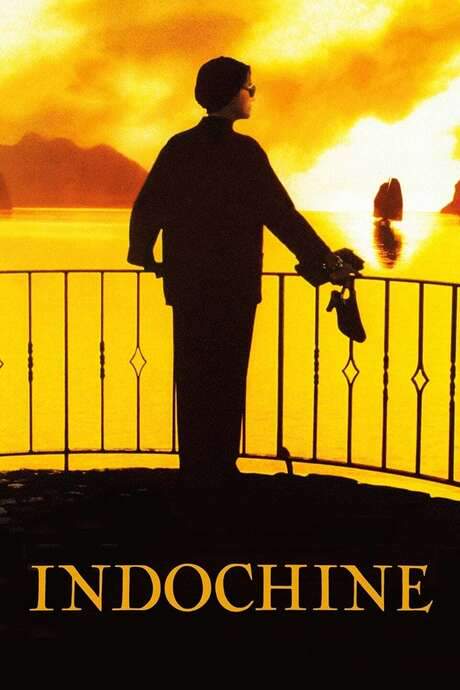
Indochine 1992


Directed by

Régis Wargnier
Made by

Investimage 3
Where to Watch Indochine
See current US streaming, rental, and purchase options for Indochine (1992) via JustWatch.







Indochine Plot Summary
Read the complete plot summary and ending explained for Indochine (1992). From turning points to emotional moments, uncover what really happened and why it matters.
Éliane Devries is a woman born to French parents in colonial Indochina who quietly governs her and her widowed father’s rubber plantation, relying on a workforce of indentured laborers. As the adoptive mother of Camille, a teenager whose birth parents were close friends of Éliane and members of the Nguyễn dynasty, she holds a careful, sometimes protective, influence over the family’s tangled loyalties. The plantation and its people form the backdrop to a world where power, affection, and duty clash beneath the tropical sun.
Jean-Baptiste Le Guen, a young French Navy lieutenant, appears at an auction where he and Éliane compete over the same painting. Their rivalry quickly deepens into a charged affair as their paths cross again days later when he shows up at her plantation, chasing a boy he suspects of opium smuggling after torching a sampan. The two embark on a forbidden relationship that unsettles the delicate balance Éliane maintains between her social status, her status as Camille’s guardian, and the political tensions rippling through Indochina.
The affair strains Éliane’s grip on power and reputation, while Camille, radiant and impressionable, meets Jean-Baptiste again when he rescues her from a prisoner escape attempt. Camille falls for him, and the revelation forces Éliane to use her influence to have him transferred north to Haiphong. A public humiliation follows at a Christmas party when Jean-Baptiste confronts Éliane, and the moment ends with a slap that earns him a punishment—deployment to the remote Dragon Islet (Hòn Rồng), a harsh outpost in northern Indochina.
Camille accepts an engagement to Thanh, a Vietnamese student with pro-Communist leanings who was expelled from France for his political stance surrounding the 1930 Yên Bái mutiny. Thanh’s convictions place Camille in danger, and he helps her seek Jean-Baptiste high up in the north. This perilous search leads Camille to Dragon Islet, where she and other laborers are held until a confrontation with French officers erupts into violence. Jean-Baptiste, defying orders to protect Camille, helps her escape as gunfire erupts.
Their escape takes them to the Gulf of Tonkin, where they endure days adrift before landing among a Communist theater troupe that offers them sanctuary in a secluded valley. Months pass, and Camille discovers she is pregnant with Jean-Baptiste’s child. The lovers must keep moving to stay safe, and Thanh arranges for the troupe to smuggle them into China, fleeing the oppressive shadows of their past.
The couple’s story enters the realm of legend as tuồng performances—a Vietnamese theatre tradition—preserved by actors who tell their tale on stage. Near the Chinese border, Jean-Baptiste baptizes their newborn son, Étienne, in a river as Camille rests. Yet safety remains elusive: French soldiers ambush them, Camille evades capture, and Jean-Baptiste is arrested and confined to a Saigon jail while Étienne is handed to Éliane.
A fragile, 24-hour visitation window is arranged so that Jean-Baptiste can see Étienne before being sent to Brest for a potential court-martial. He spends the night with Éliane and the child at her Saigon residence, a moment that cements the impossibility of their reunion in any straightforward way. The morning after, Jean-Baptiste is found dead—gun in hand, a bullet to his temple, and Étienne unharmed—an apparent suicide that frustrates the suspicions of both families and authorities. Camille, meanwhile, is captured and sent to Poulo-Condor, a high-security prison where visitors are forbidden. After five years, the political landscape shifts again as the Popular Front rises to power, leading to her release.
Éliane and Camille’s fates diverge and then converge once more: Camille chooses to remain with the Vietnamese Communist cause, leaving her mother behind to fight for a free Vietnam with the aid of the very movement that once endangered them. Éliane, with Étienne in tow, sells her plantation and departs Indochina, carrying the weight of a mother’s decisions across continents. By 1954, a grown Étienne accompanies Éliane to Switzerland, where Camille serves as a Vietnamese Communist Party delegate at the Geneva Conference. In a tense, crowded lobby of the negotiators’ hotel, he searches for his mother’s elusive friend and discovers a new generation bound by history and the complexities of love, duty, and exile. In the wake of those negotiations, French Indochina’s grip loosens, and Vietnam is partitioned into North and South, marking a new chapter in the region’s long struggle for autonomy.
The story is a sweeping meditation on love and loyalty across decades of upheaval, where the personal costs of political conflict ripple through families and communities alike. It is told with a measured, restrained voice, inviting reflection on how choices—stoked by desire, ambition, and ideology—shape destinies far beyond the hearts that beat within them.
Indochine Timeline
Follow the complete movie timeline of Indochine (1992) with every major event in chronological order. Great for understanding complex plots and story progression.
Éliane's plantation and Camille's upbringing
In 1930, Éliane Devries runs her rubber plantation in colonial Indochina and becomes the adoptive mother of Camille, the daughter of her late friends from the Nguyễn dynasty. The plantation relies on indentured labor, shaping the world Camille grows up in. This setup establishes the power dynamics that drive later conflicts.
Auction bid and public challenge
Éliane and Jean-Baptiste Le Guen bid on the same painting at an auction, and he publicly challenges her, testing her resolve and freedom. The moment foreshadows the confrontational tension that will define their relationship. The auction scene cements the initial clash between a plantation matriarch and a daring naval officer.
Affair begins between Éliane and Jean-Baptiste
Days after the auction, Jean-Baptiste visits Éliane's plantation and they begin an affair, despite their social differences. His interest in a boy linked to his opium-arson case becomes a pretext for closer ties. The affair deepens secrets that will destabilize both their lives.
Jean-Baptiste transferred to Haiphong
Éliane leverages her Navy connections to transfer Jean-Baptiste to Haiphong, moving him away from her and Camille. The shift marks a turning point in their relationship as distance complicates their bond. The colonial power structure adds a layer of inevitability to their separation.
Christmas party confrontation and punishment
At a Christmas party, Jean-Baptiste publicly slaps Éliane, revealing the volatile mix of desire and power between them. For this act, he is punished and sent to Dragon Islet, a remote French military base. The punishment isolates him from Éliane and Camille.
Camille engaged to Thanh
Éliane arranges for Camille to become engaged to Thanh, a pro-Communist Vietnamese youth expelled from France for his support of reform. The engagement ties Camille to dangerous political currents. The arrangement foreshadows the journeys Camille will take with Jean-Baptiste.
Camille imprisoned on Dragon Islet
Camille, seeking Jean-Baptiste, travels north and is imprisoned with a Vietnamese family on Dragon Islet. The captors subject the travelers to torture and murder, revealing the brutal realities of colonial border policing. The incident sets the stage for a daring escape.
Escape with Jean-Baptiste
In the ensuing firefight, Camille shoots an officer and Jean-Baptiste defies his superiors to protect her, allowing them to flee together. The pair begin a perilous journey away from Dragon Islet. Their bond deepens under life-threatening strain.
Refuge with a Communist theater troupe
After days adrift in the Gulf of Tonkin, Camille and Jean-Baptiste are taken in by a Communist theater troupe and find shelter in a secluded valley. They live among performers who offer them safety and anonymity. The valley becomes a temporary sanctuary for their growing family.
Camille becomes pregnant
Months after finding refuge, Camille is pregnant with Jean-Baptiste's child, cementing the stakes of their exile and increasing the urgency to leave for safety. The pair prepare for a future that is increasingly uncertain. Thanh's political role continues to loom over their fate.
Smuggled into China
Thanh, now a high-ranking Communist operative, arranges for the theater troupe to smuggle Camille and Jean-Baptiste into China. The escape succeeds, plunging them into a broader revolutionary movement. Their identities as lovers and fugitives become entwined with the region's political upheaval.
Baptism and ambush
Near the Chinese border, Jean-Baptiste baptizes their newborn son Étienne in a river before French soldiers ambush him. Camille evades capture and the troupe escapes; Jean-Baptiste is jailed in Saigon and Étienne is handed over to Éliane. The line between family and politics blurs as loyalties fracture.
Jean-Baptiste's death and Camille's imprisonment
The Navy plans a court-martial to avoid a public Indochina trial, granting Jean-Baptiste a final 24-hour visit with Étienne. He is found dead in his bed with a gun in hand, and the official ruling is suicide; Camille is captured and sent to Poulo-Condor prison. The tragedy cements decades of sacrifice and separation.
Five-year release and departure
Five years after Camille's imprisonment, the Popular Front comes to power and liberates political prisoners, including Camille. Éliane and Camille reunite, but Camille declines to return to her mother and son, choosing to continue Vietnam's independence with the Communists. Éliane sells the plantation and leads Étienne away from Indochina.
Geneva Conference and 1954 partition
In 1954, Éliane and a grown Étienne visit Switzerland where Camille serves as a Vietnamese Communist Party delegate at the Geneva Conference. The crowded negotiators' hotel makes it difficult to spot him, but he tells her he sees her as his mother. France's Indochina becomes independent and Vietnam is partitioned.
Indochine Characters
Explore all characters from Indochine (1992). Get detailed profiles with their roles, arcs, and key relationships explained.
Éliane Devries
Born to French parents in colonial Indochina, Éliane runs her late father's rubber plantation with indentured laborers. She wields significant influence through wealth and Navy connections and acts as Camille's adoptive mother. Pragmatic and protective, she navigates power and love within a dangerous, unequal society.
Camille
Éliane’s ward, Camille is a teenager who falls in love with Jean-Baptiste and becomes entangled in political upheaval. She forms a close, sometimes challenging bond with Éliane while pursuing a future amid war, love, and exile. Her journey includes a planned marriage to Thanh and a difficult choice between personal happiness and collective struggle.
Jean-Baptiste Le Guen
A young French Navy lieutenant whose public challenge sparks a forbidden romance with Éliane. He fights to protect Camille, endures displacement, and is ultimately ambushed and imprisoned; his death is ruled a suicide after a sequence of wartime betrayals and personal losses.
Thanh
A pro-Communist Vietnamese youth expelled from France for supporting the Yên Bái mutiny. He becomes a sympathetic ally to Camille and later a high-ranking Communist operative who helps smuggle lovers to safety and guides the couple’s escape routes.
Étienne (Adult)
The son of Camille and Jean-Baptiste, Étienne embodies the cross-cultural lineage. He is christened during their journey and grows up being cared for by Éliane while seeking and recognizing his mother’s influence. His presence ties the family saga to the political upheavals shaping Vietnam’s future.
Indochine Settings
Learn where and when Indochine (1992) takes place. Explore the film’s settings, era, and how they shape the narrative.
Time period
1930s–1954
The film spans the late colonial era through the 1940s and into the early 1950s, tracing love and upheaval under French rule. It follows Éliane's plantation life, wartime disruptions, and the ensuing independence movements that redraw borders and loyalties. The timeline culminates with the 1954 Geneva Conference and the partition of Vietnam.
Location
Colonial Indochina, Haiphong, Dragon Islet, Gulf of Tonkin, Saigon, Poulo-Condor, China, Switzerland
The world is set in French Indochina during the 1930s and 1940s, centered on Éliane's rubber plantation and the social order of colonial rule. The story moves from Haiphong to the Dragon Islet (Hòn Rồng), across the Gulf of Tonkin, and finally to Saigon, capturing key locations of labor, escape, and resistance. Later the narrative shifts toward China and Switzerland as the conflict reshapes lives and destinies of the characters.
Indochine Themes
Discover the main themes in Indochine (1992). Analyze the deeper meanings, emotional layers, and social commentary behind the film.
🏛️
Colonialism
The story exposes the power structures of a colonial society where wealth, race, and status shape choices. Éliane fuses social leverage with personal relationships to protect her family and interests. The plot shows how empire and exploitation intersect with intimate life, driving the characters’ decisions across decades.
❤️
Forbidden Love
Éliane’s affair with Jean-Baptiste tests boundaries of desire, duty, and social propriety within a colonial framework. Camille’s affection for the same man further complicates mother–daughter and lover–loved dynamics. The romance crosses cultural and political lines, fueling conflict and resilience.
🕊️
Freedom & Rebirth
The struggle for Vietnam’s independence, exile, and the Geneva Conference frame the characters’ journeys. Displacement, imprisonment, and shifting loyalties highlight the costs of political change. The narrative ends with a new political order while personal bonds persist in memory.

Coming soon on iOS and Android
The Plot Explained Mobile App
From blockbusters to hidden gems — dive into movie stories anytime, anywhere. Save your favorites, discover plots faster, and never miss a twist again.
Sign up to be the first to know when we launch. Your email stays private — always.
Explore the mobile appIndochine Spoiler-Free Summary
Discover the spoiler-free summary of Indochine (1992). Get a concise overview without any spoilers.
In the heat‑baked valleys of colonial French Indochina, a sprawling rubber plantation stands as a quiet hub amid the restless tide of history. The film opens to a landscape where tropical sun filters through dense foliage, and the lingering scent of teak mingles with the murmur of a people on the brink of change. The era—spanning the 1930s to the 1950s—offers a backdrop of elegant French colonial society intersecting with a growing Vietnamese nationalist spirit, creating a world that feels both richly textured and unsettled.
Éliane Devries commands the estate with a blend of authority and subtlety, a Frenchwoman born to expatriate parents who has turned the plantation into both livelihood and sanctuary. Beside her is her adopted daughter, Camille, a bright‑eyed teenager whose lineage ties her to the historic Nguyễn dynasty, linking her personal story to the broader currents of Vietnamese identity. The arrival of Jean‑Baptiste Le Guen, a young French Navy lieutenant, introduces a new dynamic, his presence stirring both curiosity and tension within the tightly knit circle.
As the three navigate their intertwined fates, the film leaves the audience feeling the pull of personal yearning against the inexorable march of political upheaval. Their relationships are framed by a measured, restrained tone that never rushes but instead allows each moment to linger like the humid air of the jungle. The plantation, the river, and the distant drums of protest all serve as silent witnesses to choices that echo beyond individual hearts.
Through lush cinematography and a contemplative pace, the story becomes a meditation on love, loyalty, and the cost of belonging in a world where the personal and the political are inseparable. The mood is one of quiet intensity, inviting viewers to sense the inevitable collisions that shape destinies without ever spelling out the outcomes.
Movies with Similar Twists and Themes
Uncover films that echo the narrative beats, emotional arcs, or dramatic twists of the one you're exploring. These recommendations are handpicked based on story depth, thematic resonance, and spoiler-worthy moments — perfect for fans who crave more of the same intrigue.






Featured on this page

What's After the Movie?
Not sure whether to stay after the credits? Find out!
Check out our other apps:

SAT Sphere
Build confidence for the Digital SAT.

Mori Atlas
Discover wild places worth protecting.

Luntero
Search smarter for a home in Amsterdam.

Plot Explained
Unravel movie endings and hidden clues.

Pokechamp
Dive into Pokémon data and battle logic.

Driving Theory
Get ready for your European theory test.

Movie Dust
Plan your next cinema trip with ease.

Musemap
Find art and culture as you travel.

Selkobase
Compare credentials before committing.

Local Manual
Turn an unfamiliar country into practical next steps.

Lernavi
Compare school systems before your next move.

GymRoam
Find a workout stop wherever your plans take you.
Explore Our Movie Platform
New Movie Releases (2026)
Famous Movie Actors
Top Film Production Studios
Movie Plot Summaries & Endings
Major Movie Awards & Winners
Best Concert Films & Music Documentaries
Movie Collections and Curated Lists
© 2026 What's After the Movie. All rights reserved.
Privacy Policy