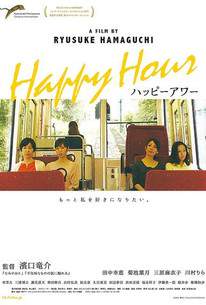
Happy Hour 2016

Directed by

Ryûsuke Hamaguchi
Made by

Fictive
Happy Hour Plot Summary
Read the complete plot summary and ending explained for Happy Hour (2016). From turning points to emotional moments, uncover what really happened and why it matters.
The film follows the lives and loves of four middle-class, thirty-seven-year-old women who are friends and who live in Kobe: unemployed Jun, housewife Sakurako, divorced nurse Akari, and married arts administrator Fumi. After attending a seminar led by a New Age communications guru, Ukai, Jun casually reveals that she has been having an affair with a younger man and plans to divorce her husband. The others are shocked, some more hurt than others, by her secrecy. Over time, especially during a trip Jun organizes, they rekindle and re-contextualize their friendship. The three friends attend Jun’s court hearing to support her; the experience reshapes their perceptions of their own lives and relationships in a web of intertwined stories that blur the line between their private battles and the public face of adulthood.
Jun is a free-spirited, highly independent woman who has chosen to pursue personal happiness even as she confronts a failing marriage. She is married to a biologist, Kohei, who opposes the divorce and believes he can persuade her to stay. In court, Jun concedes that Kohei never hit her, but argues that their marriage was emotionally and psychologically stifling. She explains that she did her best to be a good wife, yet Kohei’s emotional distance and his lack of interest in sex kept her from pursuing the dream of having a baby. Her honesty in the courtroom doesn’t win sympathy; the tapes reveal her infidelity and her entanglement with a younger man, making her seem less like a victim and more like a woman who chose to break away. Kohei, meanwhile, reveals that she is pregnant, a twist that complicates the divorce proceedings. As tensions rise, Jun’s attempts to provoke Kohei into violence fail, and Kohei makes it clear he will continue pursuing the divorce. Eventually, Jun escapes on a ferry to an unknown destination, hoping distance will force a dissolution of the marriage. Jun vanishes for the remainder of the film, and Kohei reveals that she has sought shelter in a place that supports women who are divorcing their husbands.
Akari is the toughest, most no-nonsense member of the group, a nurse who chafes at work alongside a younger, less experienced colleague, Yuzuki. She guards her emotions closely, yet she pours energy into nurturing her friends. Her path toward a meaningful relationship proves difficult; a doctor at the hospital she works at tests the waters with interest, but she rebuffs him. At an art event hosted by Fumi, Akari encounters a spontaneous moment when a star of the show, Kozue, draws Ukai away, and Hinako, Ukai’s sister, crosses paths with Akari. A later, pivotal moment transpires when Hinako and Akari share a heartfelt conversation that leads to a spontaneous kiss between Hinako and Akari, followed by Akari kissing Ukai when he interrupts them. This cascade of encounters shakes Akari’s guarded stance and shifts her connections with Yuzuki back at work; she begins to reconnect with her colleague with warmth rather than distance. Akari ultimately returns to her duties, and her relationship with Yuzuki evolves into a more supportive, if still cautious, dynamic.
Sakurako is the most emotional of the quartet, married to overworked salaryman Yoshihiko, and they share a teenage son, Daiki, while living under the same roof as Yoshihiko’s mother, Mitsu. Mitsu warns them about Daiki’s relationship with a girl, but the warning proves prophetic when Daiki reveals that he needs money for the girl’s abortion. Yoshihiko orders Sakurako to deliver the money and to apologize to the girl’s family, a request that humiliates Sakurako and tests their partnership. Mitsu, stepping in, helps to bridge the widening gap between Sakurako and Yoshihiko, and Daiki’s revelation about his father’s and mother’s bonds deepens Sakurako’s struggle to protect her family while seeking her own happiness. Daiki later tries to run away with his girlfriend on the ferry, but the girl stands him up; he arrives to say goodbye to Jun, thanking her for his birth and for helping shape his life. Back home, Sakurako’s disappointment with Yoshihiko grows into something more self-directed: she embarks on an affair of her own. When she confesses to Yoshihiko that she slept with another man, he remains distant and stoic, leaving for work as she carries on with the day, which culminates in a moment of quiet, unspoken pain as Yoshihiko breaks down in tears on his walk to work.
Fumi is deeply anxious about her marriage to Takuya, an editor who works with Kozue, a young writer whose presence stirs insecurities in Fumi. The underlying tension intensifies as Fumi suspects that their union is more about appearances than shared trust. The dinner with Kohei and Kozue exposes how others may misread Jun’s feelings and how Kozue herself feels entitled to claim Takuya’s attention. Kozue bluntly suggests that the other friends are projecting their own emotions onto Kohei and that they do not truly understand Jun’s situation. The tension peaks when Takuya’s affection for Kozue becomes evident, prompting Fumi to end the relationship. Takuya apologizes and leaves, but a car accident soon after leaves him in a coma and under the care of Akari in the hospital. Fumi experiences a painful mix of guilt and fear as she sits by his side; the event forces her to confront the fragility of her marriage. After a quiet moment on a hospital roof with Akari, where Fumi admits that she blames herself for the pain around Takuya, she decides to join the others in planning another trip together, a step toward rebuilding the bonds of their friendship and looking toward the future.
The film uses the intertwined lives of these four women to explore how friendship can illuminate difficult choices, and how the pursuit of personal happiness often comes with emotional costs. As each woman navigates heartbreak, resilience, and evolving desires, the group’s bond is tested and ultimately redefined. The climactic thread of Jun’s unresolved absence and the ongoing impact of the court case serve as a catalyst for both individual growth and a renewed sense of solidarity among the friends. In the end, they choose to lean on one another and to plan another shared journey, signaling that while their paths may diverge, their connection remains a central, guiding force in their lives.
Happy Hour Timeline
Follow the complete movie timeline of Happy Hour (2016) with every major event in chronological order. Great for understanding complex plots and story progression.
Jun's confession at Ukai's seminar
At a New Age seminar in Kobe led by Ukai, Jun casually admits she has been having an affair and plans to divorce her husband. The confession rattles the four friends and prompts them to reassess their own lives and the foundations of their friendship.
Jun's court appearance and emotional abuse admission
In court, Jun concedes that Kohei did not physically abuse her, but says their marriage was emotionally and psychologically damaging. The hearing worsens when a tape reveals her infidelities, undercutting her portrayal as a victim and complicating the divorce case.
Kohei reveals Jun's pregnancy
After the court session, Kohei discloses to the friends that Jun is pregnant with his child. The news adds tension to the group and further complicates the prospects of Jun's divorce.
Jun flees by ferry to pursue divorce
When progress stalls, Jun escapes to a ferry destination to be separated from Kohei long enough to trigger a divorce. Her disappearance leaves the group concerned and wondering about her safety.
Jun's shelter for divorcing women
Jun is later described as being in a shelter that supports women trying to divorce their husbands. The place marks a temporary start to her uncertain future and distance from her friends.
Akari's friction with Yuzuki at work
Akari challenges a younger colleague, Yuzuki, showing little tolerance for mistakes. The tension underscores Akari's guarded approach to relationships and shows her reluctance to form close bonds at work.
Akari breaks her leg after a fall
During a tense moment at work, Akari reprimands Yuzuki and then suffers a fall down the stairs, breaking her leg. The accident forces her to slow down and reassess her life away from the office.
Art event, Ukai walk-out, and romantic entanglements
At Fumi's art event, Ukai walks out before the scheduled interview with Kozue. Akari follows him to a club, where she meets Hinako, Ukai's sister; Hinako and Akari share a kiss, and Akari also kisses Ukai when he interrupts.
Sakurako informs Daiki about Jun and the lovers' past; Daiki plans to run away
Sakurako reveals to Daiki that Jun was the catalyst for her and Yoshihiko's affair, reshaping Daiki's view of his mother and his parents' past. He decides to run away with his girlfriend, but she stands him up, and Daiki ends up at the ferry where he encounters Jun and thanks her for his birth.
Sakurako begins an affair; Yoshihiko's stoic reaction
Sakurako starts a new affair and tells Yoshihiko about it. He reacts with quiet detachment, acknowledging the rift but remaining emotionally distant; a turning point in their marriage as problems mount.
Kozue and Takuya's tension; Kohei's interview changes dynamics
During Kozue's short story reading, Kohei steps in as interviewer after Ukai walks out, altering how the group views Kohei and Jun's marriage. Kozue suggests the others are projecting their feelings onto Kohei, which strains friendships and heightens jealousy.
Takuya's and Kozue's closeness; Fumi's confrontation
Kozue confesses her feelings for Takuya and spends the night with him after a dinner; Fumi confronts Takuya the next morning and breaks up. The revelation deepens Fumi's insecurities about her own marriage.
Takuya's car accident and coma
Shortly after the breakup, Takuya is involved in a serious car accident and is rushed to Akari's hospital, where he falls into a coma. The accident compounds the trauma among the group and leaves Fumi heartbroken.
Hospital rooftop talk and plans for another trip
Fumi and Akari share a candid moment on the hospital roof, where they promise to make up and plan another trip with Sakurako and Jun. The scene reframes their friendship and hints at healing through shared experiences.
Happy Hour Characters
Explore all characters from Happy Hour (2016). Get detailed profiles with their roles, arcs, and key relationships explained.
Jun
Free-spirited 37-year-old who is married but embarks on an affair and a divorce. She traverses emotional and psychological abuse in her marriage, seeking independence and a new path. Her actions test the boundaries of friendship as the group supports her while confronting their own desires.
Akari
A tough, no-nonsense nurse who struggles with intimate relationships but is loyal to her friends. She trains a younger colleague, navigates work pressures, and finds unexpected connection that evolves into a potential romance. Her arc emphasizes resilience and warmth within a firmly realistic persona.
Sakurako
The most emotional of the group, Sakurako wrestles with her marriage, her son's troubles, and later an affair that challenges her sense of loyalty. She bonds with her mother-in-law Mitsu and grows through shared vulnerability with her friends.
Fumi
An arts administrator whose insecurity about her marriage deepens as she confronts love triangles and social expectations. She hosts events that become pressure points, ultimately impacting her relationship with her husband and friends.
Happy Hour Settings
Learn where and when Happy Hour (2016) takes place. Explore the film’s settings, era, and how they shape the narrative.
Time period
Present day (early 2010s)
The story unfolds in contemporary Japan, a period marked by shifting gender roles and evolving relationship norms. The characters navigate careers, family obligations, and the search for personal fulfillment in a city that blends tradition and modernity. The timeframe situates the drama in a recent past that resonates with audiences familiar with modern urban life.
Location
Kobe, Japan
Kobe is a port city on Japan's southern Honshu island, known for its cosmopolitan atmosphere and scenic harbor. The film uses Kobe as a backdrop for the tightly-knit but imperfect friendships among four middle-class women. Its modern urban landscape mirrors the personal journeys of its characters, blending traditional expectations with contemporary independence.
Happy Hour Themes
Discover the main themes in Happy Hour (2016). Analyze the deeper meanings, emotional layers, and social commentary behind the film.
🕊️
Independence
The film centers on women reclaiming agency over their lives, choosing to pursue personal happiness even when it means breaking from marriage or societal expectations. Jun's decision to seek a divorce and redefine her path anchors the group’s conversations about self-determination. The narrative treats autonomy as a gradual, sometimes painful, process that unfolds through small acts and shared reflections. Friendship acts as both catalyst and support in this journey toward independence.
💔
Marital Struggles
A core thread traces the fragility of marriages under emotional strain, jealousy, and mismatched desires. The women encounter emotional abuse, infidelity, and the tension between keeping up appearances and seeking authenticity. The court scene and private confrontations reveal how love can coexist with dissatisfaction and how difficult it is to change a stagnant relationship. The film presents marriage as a complex social contract rather than a simple path to happiness.
🤝
Friendship
Friendship provides a lifeline that sustains the women through betrayals, jealousy, and heartbreak. The quartet’s bond evolves as secrets surface and loyalties shift, forcing each to reevaluate what she wants from life. Their trips, conversations, and support rituals become moments of collective insight. Ultimately, the film frames sisterhood as a mirror that reveals both strength and vulnerability.

Coming soon on iOS and Android
The Plot Explained Mobile App
From blockbusters to hidden gems — dive into movie stories anytime, anywhere. Save your favorites, discover plots faster, and never miss a twist again.
Sign up to be the first to know when we launch. Your email stays private — always.
Explore the mobile appHappy Hour Spoiler-Free Summary
Discover the spoiler-free summary of Happy Hour (2016). Get a concise overview without any spoilers.
In the bustling streets of Kobe, four women in their late thirties share a friendship that feels both ordinary and extraordinary. Their lives intersect at a modest apartment, a local café, and a yoga studio, creating a quiet tapestry of everyday moments that pulse with warmth, humor, and the occasional ache of longing. The film’s tone is gently observational, blending gentle humor with an unflinching look at the compromises and desires that colour adult life, while the city itself hums in the background like a well‑kept secret.
Jun is a free‑spirited, independent soul whose marriage to a biologist feels more like a comfortable routine than a partnership. Sakurako balances the demands of a salaryman husband, a teenage son, and the pressures of living with in‑laws, quietly yearning for a space of her own. Akari works as a nurse, juggling a demanding shift schedule and a tough exterior that masks a deep well of caring for her friends. Fumi carries the weight of an arts‑administration career and a marriage that feels more like a performance, haunted by insecurities that surface when a young writer enters her husband’s orbit. Together they form a circle that tolerates secrets, celebrates small victories, and offers a safe harbor for each other’s doubts.
A chance encounter at a New‑Age seminar, led by an enigmatic communications guru, becomes the catalyst that nudges the group toward unforeseen honesty. The revelations that follow ripple through their lives, prompting each woman to confront the hidden fractures in her own story. When one of the friends disappears after a particularly trying moment, the remaining trio finds themselves on the brink of a new, quietly powerful journey—one that will test the limits of loyalty, explore the complexity of desire, and remind them why their friendship has always been a guiding light.
Movies with Similar Twists and Themes
Uncover films that echo the narrative beats, emotional arcs, or dramatic twists of the one you're exploring. These recommendations are handpicked based on story depth, thematic resonance, and spoiler-worthy moments — perfect for fans who crave more of the same intrigue.




Featured on this page

What's After the Movie?
Not sure whether to stay after the credits? Find out!
Check out our other apps:

SAT Sphere
Build confidence for the Digital SAT.

Mori Atlas
Discover wild places worth protecting.

Luntero
Search smarter for a home in Amsterdam.

Plot Explained
Unravel movie endings and hidden clues.

Pokechamp
Dive into Pokémon data and battle logic.

Driving Theory
Get ready for your European theory test.

Movie Dust
Plan your next cinema trip with ease.

Musemap
Find art and culture as you travel.

Selkobase
Compare credentials before committing.

Local Manual
Turn an unfamiliar country into practical next steps.

Lernavi
Compare school systems before your next move.

GymRoam
Find a workout stop wherever your plans take you.
Explore Our Movie Platform
New Movie Releases (2026)
Famous Movie Actors
Top Film Production Studios
Movie Plot Summaries & Endings
Major Movie Awards & Winners
Best Concert Films & Music Documentaries
Movie Collections and Curated Lists
© 2026 What's After the Movie. All rights reserved.
Privacy Policy