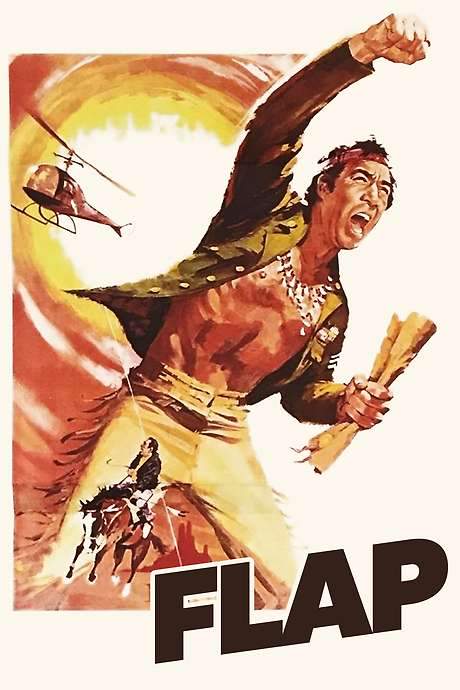
Flap 1970

Directed by

Carol Reed
Made by

Cine Vesta Associates
Where to Watch Flap
See current US streaming, rental, and purchase options for Flap (1970) via JustWatch.


Streaming availability powered by 
Flap Plot Summary
Read the complete plot summary and ending explained for Flap (1970). From turning points to emotional moments, uncover what really happened and why it matters.
Flapping Eagle, Anthony Quinn, makes his home on a sunlit Indian reservation in the southwestern United States, where life blends hard living with fragile tenderness. He drifts through days marked by heavy drinking and friction with his sweetheart, Dorothy Bluebell, Shelley Winters, whose patience is stretched thin by his mood swings and restless energy. The couple’s ongoing tensions quietly echo the broader strain between personal desire and collective land rights that simmer at the edge of the reservation.
Across town, a blunt, sometimes brutal police presence frames much of the external conflict. Sgt. Rafferty, a city officer who exerts a harsh authority and appears biased, becomes a persistent thorn in Flap’s side—an antagonism that Flap openly questions, even as he concedes the officer’s authority in the eyes of the law. The tension between Flap and Rafferty intensifies as the story unfolds, revealing a clash not just of personalities but of worldviews.
Into this volatile mix steps Wounded Bear Mr. Smith, a tribal lawyer whose office is stacked high with what look like parchment scrolls rather than traditional law books. Victor Jory brings a wry, almost ceremonial weight to the role, translating treaty promises into counsel that shapes the tribe’s responses to every new setback. From his side, the legal wall of Indian treaties becomes a guide and a weapon, turning paper into a living argument about sovereignty and survival.
Flap’s path moves from protest to active confrontation as he becomes an unlikely activist. He disrupts a construction crew blasting a highway through Indian land, a controversial project—Interstate 25—that slices through pueblos during the era. He also inadvertently sabotages the crew’s front loader, signaling his willingness to challenge development and the encroachment it represents. Following Wounded Bear’s hints about legal “abandonment” turning property into Indian claim, Flap’s actions escalate in both scale and symbolism, drawing attention to a people’s right to assert ownership of their ancestral space.
The plot thickens as Flap’s acts of defiance transition him from troublemaker to widely watched advocate. A helpfully provocative move—stealing a train, prompted by the belief that the locomotive would legally belong to the tribe once it’s removed from ordinary control—pushes him further into the limelight and deepens the city’s confrontation with tribal claims. The clash becomes a public battle, with Flap’s notoriety matching Rafferty’s resolve, and both sides feeling the weight of law and history pressing in from all directions.
Tensions erupt in a violent, tragic sequence when Rafferty, the target of Flap’s ire, is beaten after a string of provocations and the death of a dog belonging to a lonely elder. Now a fugitive and symbol of indigenous activism, Flap leads a march into the city to advance the tribe’s claims. The culmination comes from a distance of a hospital window, where Rafferty finally ends Flap’s life with a sudden shooter’s aim, leaving the community to reckon with the consequences of protest, authority, and the enduring fight for treaty promises.
What lingers after the action subsides is a portrait of resilience under pressure, where tradition, law, and personal conviction collide in a struggle that questions who gets to tell the story of land, rights, and belonging. The characters’ movements—Flapping Eagle’s impassioned leadership, Dorothy Bluebell’s quiet endurance, Rafferty’s brutal scrutiny, and Wounded Bear’s ceremonial legal map—together outline a world where treaties, memory, and the power of collective voice keep echoing long after the final confrontation.
Flap Timeline
Follow the complete movie timeline of Flap (1970) with every major event in chronological order. Great for understanding complex plots and story progression.
Flap's life on the reservation
Flap lives on a Southwestern Indian reservation and drinks heavily, a habit that strains his relationship with his sweetheart Dorothy Bluebell. He survives by making deliveries with an old pickup, aided by a small circle of friends. The ongoing friction in his personal life foreshadows the larger clashes with authority to come.
Rafferty's brutal antagonism
Sgt. Rafferty, a city police officer, targets Flap with a mix of brutality and prejudice, treating him as trouble simply because of who he is. The harassment hints at a broader conflict between Native sovereignty and law enforcement. Flap's resolve hardens as Rafferty's abuses escalate.
Dolls spill brings in Wounded Bear
A box of Indian dolls intended for sale spills, drawing a ticket from Rafferty and escalating Flap's legal troubles. This incident brings Wounded Bear Mr. Smith into the picture, a lawyer whose office is stacked with parchment-like records. The parchments symbolize treaty promises that will guide the ensuing confrontations.
Treaties as counsel
Wounded Bear explains that the stacks of parchments represent treaties made with the tribe and that these documents will guide Flap's legal and political strategy. He counsels Flap to base his actions on treaty rights rather than conventional law. The meeting marks the moment where legal theory starts driving activism.
Disrupting highway construction
Flap stumbles into activism by disrupting a crew blasting a highway through Indian land, inadvertently destroying their brand-new front loader. The incident demonstrates his willingness to challenge state projects that encroach on tribal territory. It also widens the media spotlight on Flap's cause.
The train heist
Guided by Wounded Bear, Flap believes a train abandoned in tribal territory would become Indian property, so he steals it. The audacious act raises the stakes of his activism and broadens the scope of the tribe's claimed assets. It cements Flap's status as a controversial figure in the public eye.
The dog shooting and Rafferty confrontation
Flap shoots a dog belonging to a poor, lonely old Indian, an act that inflames the community and tests the limits of his resolve. In retaliation, Rafferty is confronted by Flap in a violent confrontation that ends with Rafferty badly beaten. The incident solidifies Flap's transformation from petty offender to a recognizable activist.
Flap becomes fugitive-activist
Flap disappears from daily life and becomes a fugitive who embraces activism, drawing publicity for his protests and using treaty arguments as justification. He gains supporters who view him as a symbol of resistance against police overreach. His new status complicates the city’s response to his cause.
Treaty-backed protests gain attention
With Wounded Bear advising him, Flap's protests attract broader public attention and legitimacy, framed around treaty promises rather than ordinary civil disobedience. Media coverage amplifies their message and pressures authorities. The activism begins to shift the political landscape around the tribe's rights.
March into the city
Flap leads a march into the city to assert the tribe's claim on land and resources, drawing a crowd of supporters who echo his treaty-based arguments. The demonstration puts pressure on city officials and magnifies the spotlight on the tribe's legal standing. The march marks a culminating moment of the activist phase.
The hospital assassination
From a hospital window, Rafferty aims a handgun and assassinates Flap, delivering a shocking turn in the story. The shooting caps the public confrontation with a fatal act of violence carried out by the police officer. The event ends Flap's activism in a dramatic and irreversible way.
Flap Characters
Explore all characters from Flap (1970). Get detailed profiles with their roles, arcs, and key relationships explained.
Flapping Eagle (Anthony Quinn)
A volatile, passionate Indigenous man who drinks heavily and clashes with city authorities. He rapidly evolves into a bold activist, disrupting projects and guiding his people through treaty-based arguments. His charisma and anger propel a movement, but his methods bring him into direct conflict with Rafferty, culminating in a fatal confrontation.
Dorothy Bluebell (Shelley Winters)
Flap’s sweetheart who bears the strain of his drinking and the couple’s frequent quarrels. She represents a more grounded perspective within the community and provides emotional counterbalance to Flap’s fervor. Her stance highlights the personal cost of political struggle on relationships.
Sgt. Rafferty (Victor French)
A brutal, seemingly bigoted city police officer whose actions escalate the conflict with Flap. He embodies the law-and-order mindset that clashes with Indigenous activism, becoming a central antagonist in the story. His conduct triggers a chain of retaliations that intensify the turmoil.
Wounded Bear Mr. Smith (Victor Jory)
The tribe’s lawyer, an eccentric figure surrounded by piles of treaty parchments. He uses legal rhetoric to guide Flap and the community, framing their actions within the language of treaties and promises made to the tribe. His counsel links traditional rights with modern legal processes.
Silver Dollar (Tribal Chief) (Anthony Caruso)
A respected tribal leader who embodies authority and sovereignty. He mediates between the community’s demands and the wider political landscape, signaling legitimacy for the treaty-based actions. His presence anchors the movement within tribal governance and tradition.
Ann Looking Deer (Susana Miranda)
A member of the tribe who features in the community’s circle during the unfolding events. She represents the everyday voices within the reservation and highlights the social fabric affected by the upheaval. Her involvement underscores the collective nature of the struggle.
Flap Settings
Learn where and when Flap (1970) takes place. Explore the film’s settings, era, and how they shape the narrative.
Time period
Mid-1960s
The events unfold during a period of heavy infrastructure growth and social activism, marked by highway construction through tribal lands and renewed attention to treaty promises. Community tensions rise as legal and political maneuvers collide with street-level protest. This era provides the backdrop for Flap's transformation from a troubled resident to a public figure challenging authority.
Location
Southwestern United States Indian reservation, city near pueblos along Interstate 25
The story unfolds on a Native American reservation in the southwestern United States, centered around tribal life near pueblos. The setting includes the edge of a city where law enforcement intersects with Indigenous activism and a highway project (Interstate 25) cuts through tribal land. The landscape reflects a blend of reserve life and urban pressures that drive the conflict between community leaders and official authority.
Flap Themes
Discover the main themes in Flap (1970). Analyze the deeper meanings, emotional layers, and social commentary behind the film.
🪧
Activism
Flap’s move from personal trouble to tribal activism centers the narrative around collective action and land rights. The treaty parchments and legal arguments become tools to push back against external development. The film portrays how protest, organizing, and public visibility can alter the dynamics between a marginalized community and city power.
🚔
Police and Power
The story highlights clashes with law enforcement, depicting Rafferty as a brutal and biased officer. This conflict exposes how policing can be weaponized against Indigenous protesters and marginalized voices. The tension between authority and community justice drives much of the film’s drama and tragedy.
🪶
Identity
The protagonist navigates a complex identity as Indigenous, alcoholic, and passionate about his people's rights. The narrative examines how cultural heritage, personal flaws, and political awakening intertwine. The film presents identity as something forged in resistance, community, and the scrutiny of outsiders.

Coming soon on iOS and Android
The Plot Explained Mobile App
From blockbusters to hidden gems — dive into movie stories anytime, anywhere. Save your favorites, discover plots faster, and never miss a twist again.
Sign up to be the first to know when we launch. Your email stays private — always.
Explore the mobile appFlap Spoiler-Free Summary
Discover the spoiler-free summary of Flap (1970). Get a concise overview without any spoilers.
In a sun‑drenched reservation tucked into the Southwest, the everyday rhythm is a uneasy blend of hardship and fragile tenderness, a landscape where ancient treaties hover like invisible borders. The film opens with a tongue‑in‑cheek warning to the mayor—“FLAP is coming!”—hinting at a satirical clash between modern bureaucracy and the stubborn longevity of Native claims, from the iconic Alcatraz to the looming possibility of City Hall itself. The tone is equal parts biting comedy and earnest social commentary, inviting the audience to laugh while they confront the absurdities that still shape indigenous life today.
At the heart of this world is Flapping Eagle, a charismatic yet restless figure whose days drift between heavy drinking, sharp humor, and a restless energy that keeps both his community and his own conscience on edge. His relationship with Dorothy Bluebell, a patient and resilient partner, underscores the personal toll of larger cultural battles, as her quiet endurance offers a counterpoint to his impulsive swings. Together they embody the tension between personal desire and collective responsibility, hinting at deeper questions about identity, love, and the legacy of land rights without spelling out any specific confrontations.
Opposite them stands the stern presence of Sgt. Rafferty, a city police officer whose rigid authority embodies the external pressures bearing down on the reservation. Alongside him, the enigmatic tribal lawyer Wounded Bear Mr. Smith carries stacks of parchment‑like documents, a visual reminder that legal language and treaty promises remain vital tools in the fight for sovereignty. Their interactions with Flap suggest a broader, uneasy dance between law, tradition, and the relentless march of development, all framed within a comedic yet thoughtful narrative that keeps the audience curious about where the warning to the mayor might lead.
Movies with Similar Twists and Themes
Uncover films that echo the narrative beats, emotional arcs, or dramatic twists of the one you're exploring. These recommendations are handpicked based on story depth, thematic resonance, and spoiler-worthy moments — perfect for fans who crave more of the same intrigue.

Featured on this page

What's After the Movie?
Not sure whether to stay after the credits? Find out!
Check out our other apps:

SAT Sphere
Build confidence for the Digital SAT.

Mori Atlas
Discover wild places worth protecting.

Luntero
Search smarter for a home in Amsterdam.

Plot Explained
Unravel movie endings and hidden clues.

Pokechamp
Dive into Pokémon data and battle logic.

Driving Theory
Get ready for your European theory test.

Movie Dust
Plan your next cinema trip with ease.

Musemap
Find art and culture as you travel.

Selkobase
Compare credentials before committing.

Local Manual
Turn an unfamiliar country into practical next steps.

Lernavi
Compare school systems before your next move.

GymRoam
Find a workout stop wherever your plans take you.
Explore Our Movie Platform
New Movie Releases (2026)
Famous Movie Actors
Top Film Production Studios
Movie Plot Summaries & Endings
Major Movie Awards & Winners
Best Concert Films & Music Documentaries
Movie Collections and Curated Lists
© 2026 What's After the Movie. All rights reserved.
Privacy Policy