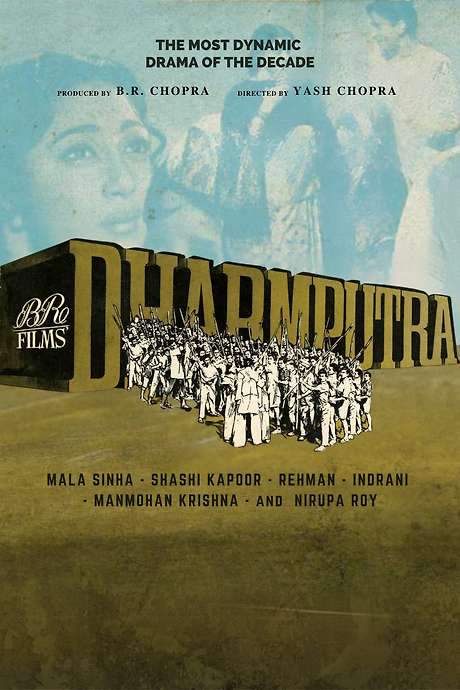
What Is Dharmputra About?
The premise of Dharmputra in 306 words, with nothing given away. The full story follows below.
In the waning years of British colonial rule, Dharmputra unfolds within the shared walls of two Delhi households—one Muslim, one Hindu—whose fates have long been intertwined. The Nawab Badruddin family and the Rai clan represent a vision of harmony that transcends religious identity, their closeness a quiet defiance of the divisions that history threatens to impose. Through crowded rooms and whispered conversations, the film captures a way of life where chosen family carries as much weight as blood, and where the simple act of sharing a home becomes a statement of belief in unity.
At the heart of this domestic world stands Husn Bano, a young woman whose personal journey becomes entangled with questions of honor, duty, and sacrifice. When circumstances test the limits of family loyalty, the Rai family—led by Amrit Rai and his wife Savitri—rallies around her, their actions embodying the profound bonds that have long united these two households. From this crucible of compassion emerges a child who will grow up carrying the weight of both families’ hopes and histories, a living symbol of reconciliation in a time of profound change.
The film’s sober, restrained tone captures not just the intimate rhythms of daily life but the tremors of a nation in transformation. Against a backdrop of growing political unrest and the clarion call of independence, the story asks what happens when love and loyalty are tested by forces far larger than any home can contain. The performances anchor the emotional weight of the narrative, while the historical setting reminds viewers that the personal and the political are never truly separate. As years pass and the child comes of age, the questions deepen: can the ties that bind these families withstand the pressures of a society pulling itself apart—and what happens when the very ideals that once united them are called into question?
What Happens in Dharmputra?
The complete story of Dharmputra, from the first scene to the last, in 606 words (about 3 minutes). Spoilers throughout. Names in the text link to 8 cast member pages.
Spoilers ahead
The film opens in 1925, squarely in the era of British rule and the growing tide of the independence movement, and follows the intertwined lives of two Delhi families—the Nawab Badruddin clan and the Rai clan, who share a home and a sense of closeness that binds them through crowded rooms and whispered conversations. Within this shared space, Husn Bano [linking to actor] becomes the focal figure when she falls for a young man named [Javed], and a pregnancy tests the bonds between love, family duty, and social expectations. When the Nawab tries to arrange a match for Husn with Javed, the young man vanishes, leaving Husn in a perilous limbo and setting the stage for a dramatic turn of events. In the meantime, the compassionate and steadfast actions of Amrit Rai and his wife, Mrs. Savitri Amrit Rai, demonstrate the power of chosen family: they step in to support Husn, share the burden of her secret, and ultimately adopt the newborn boy, who is named Dilip Rai. The two families rally around this infant, and Dilip becomes the symbol of reconciled loyalties within a house that has already weathered great social change. A brief dancer cameo by Shashikala punctuates the gatherings and rites of the era, reminding viewers of the vibrant social tapestry that surrounds these personal reckonings.
As the years pass, Husn Bano and Javed, who has re-entered Husn’s life in the wake of earlier upheavals, reappear in a story that has shifted beneath their feet. Husn returns to a home that has accepted Dilip as one of its own, a child raised under the Rai name and cherished by the extended family. Yet the atmosphere has changed in troubling ways: the young man who has grown up as Dilip has embraced a harsh, extremist ideology—one that despises Muslims and seeks to expel them from India, even going so far as to burn buildings and incite violence. The once-warm greeting from the Rai clan is tempered by distrust and fear as Dilip’s newfound fanaticism collides with the long history of affection that shaped his upbringing.
The film then casts a clinical, yet intimate, light on how a family negotiates identity, loyalty, and belonging when hate erupts from within the heart of someone they have loved. Husn, who once navigated a delicate balance between personal desire and social duty, is forced to confront a stark choice: protect the memory of the man she loved or confront the threatening reality of the man he has become. The Rai household, anchored by Meena and Meena’s Mother, must reckon with a future that may demand hard compromises and painful separations. The story delves into the ethical dilemmas facing families living through nation-wide upheaval, asking whether shared history and love can withstand the corrosive pressure of fear, prejudice, and political violence.
Throughout, the film maintains a sober, restrained tone that lets the characters carry the emotional weight. The performances—anchored by Husn Bano’s enduring resilience, Javed’s complex arc, and Dilip’s controversial transformation—are framed by a historical backdrop that emphasizes both unity and division within a rapidly changing society. Supporting threads weave through the narrative, including the presence of a Doctor of the Rai family, Dr. Amrit Rai, and the occasional political interjections that highlight the era’s turmoil, such as a cameo by Rajendra Kumar as a Party Leader. By the end, the question remains: can the bonds of a family strained by prejudice and political violence adapt long enough to survive a country tearing itself apart—and can Husn and Dilip bridge a past of closeness with a present defined by hate, without erasing the memories that once held them together?
Dharmputra Timeline: Every Key Event in Order
12 key events in the order they happen, from “Opening setting in 1925 Delhi” to “The central conflict: legacy vs. distrust”. 12 events name a place, across 2 locations.
- 1
Opening setting in 1925 Delhi
The film opens in 1925 against the backdrop of British rule and the rising Indian independence movement. Two Delhi families, Nawab Badruddin’s and Gulshan Rai’s, share almost the same house and form a tightly knit social circle. The political tension outside contrasts with the close personal ties inside the household.
When:1925 Where:Delhi, British India
- 2
Husn Bano and Javed's forbidden pregnancy
Husn Bano falls for a young man named Javed and becomes pregnant. The relationship brings social pressure and secrecy as they navigate family expectations. The pregnancy sets future stakes for both families who are otherwise tightly connected.
When:1925-1926 Where:Delhi
- 3
Nawab's attempt to arrange marriage and Javed's disappearance
To legitimize Husn's child, Nawab tries to arrange her marriage to Javed. Before plans can solidify, Javed mysteriously disappears, leaving the families anxious and divided. The absence catalyzes the later acts of support from Amrit Rai and his wife Savitri.
When:1925-1926 Where:Delhi
- 4
Amrit Rai and Savitri adopt the baby
Amrit Rai and his wife Savitri step in to help Husn by assisting with the birth of the baby, and they adopt the boy, giving him the Rai family name. The child, Dilip, becomes the cherished link between the two households. The adoptive parents lay the foundation for Dilip's upbringing.
When:late 1920s Where:Delhi
- 5
Dilip grows as the apple of both families
Despite the past, Dilip is loved by both the Nawab’s and Rai households and feels the warmth of both families. He is raised in a supportive, merged environment that values loyalty and kinship. This fusion of families shapes his early sense of belonging.
When:early 1930s Where:Delhi
- 6
Husn and Javed reunite and wed
Husn is reunited with Javed, and they marry, re-entering the Rai household as a couple. Their union reinforces the fragile ties between the two families. The marriage takes place within the same social fabric that raised Dilip.
When:1930s Where:Delhi
- 7
Nawab is killed in a protest
During a protest demanding British withdrawal, the Nawab is killed as part of the anti-colonial struggle. The death deepens the emotional stakes for Husn and the family. It marks a turning point in the family’s relationship with political activism.
When:1930s Where:Delhi, British India
- 8
Years pass; Husn and Javed return to a warm welcome
Years later, Husn Bano and her husband Javed return to the Rai family and are warmly welcomed. The household atmosphere returns to its familiar harmony, at least on the surface. The reunion underscores the enduring bonds across generations.
When:1930s-1940s Where:Delhi
- 9
Dilip's transformation into a fascist, Muslim-hater
Dilip undergoes a stark transformation, becoming fascist and antagonistic toward Muslims. He aligns with extremists who seek to expel Muslims from India, signaling a dangerous turn from the boy loved by both families. This shift turns personal history into political peril.
When:late 1930s-1940s Where:Delhi
- 10
Husn encounters a changed Dilip
Husn meets Dilip again, only to discover that the boy she once knew has become a figure of hate and violence. The reunion highlights the deep rifts born from political extremism. Trust between mother and son becomes severely strained.
When:late 1930s-1940s Where:Delhi
- 11
Dilip carries out attacks against Muslims
Driven by extremist ideology, Dilip participates in burning buildings and killings aimed at Muslims. The violence escalates the family’s internal conflict and tests loyalty to faith, country, and kin. Its wake spreads fear and moral ambiguity through the household.
When:late 1930s-1940s Where:Delhi
- 12
The central conflict: legacy vs. distrust
The film ends with Husn and the Rai family confronting how to respond to Dilip’s hate and the threat it poses. The timeline raises questions about whether love and loyalty can survive in a climate of sectarian violence. The outcome remains open, inviting reflection on coexistence.
When:late 1930s-1940s Where:Delhi
Who Are the Main Characters in Dharmputra?
6 characters, among them Dilip Rai (Shashi Kapoor), Nawab Badruddin (Ashok Kumar) and Husn Bano (Mala Sinha): who each one is and the part they play in the story. Every profile links to the actor’s page.
- DR
Dilip Rai (Shashi Kapoor)
Played by Shashi Kapoor
Dilip Rai begins as the cherished son of two closely knit families but becomes a symbol of extremist nationalism. He embraces a fascist, anti-Muslim creed and aligns with others who seek to expel Muslims from India. His actions, rooted in hate, put him at odds with his own family and threaten the delicate harmony of the households.
- 🔥 Extremism
- 🧭 Identity
- NB
Nawab Badruddin (Ashok Kumar)
Played by Ashok Kumar
The patriarch of the Badruddin family whose death during a British-era protest marks a turning point in the story. He embodies a blend of authority and national sentiment, and his absence heightens the tension between the two families. His legacy underscores the era's political stakes.
- 🏛️ Leadership
- 🔥 Patriotism
- HB
Husn Bano (Mala Sinha)
Played by Mala Sinha
Nawab Badruddin's daughter who has a past romance with Javed and becomes the mother of Dilip. Her reunion with Javed and the life they build with the Rai family illustrate how personal histories intersect with political upheaval. She navigates love and duty in a society strained by sectarian conflict.
- 💞 Love
- 🕊️ Conflict
- J(
Javed (Rehman)
Played by Rehman
Husn Bano's former lover and the biological father of Dilip. His disappearance and eventual return highlight the disruptions caused by the era's turmoil and the tangled loyalties within the families. He embodies the complexities of love entangled with survival and allegiance.
- 💔 Love
- 🕊️ Betrayal
- MS
Mrs. Savitri Amrit Rai (Nirupa Roy)
Played by Nirupa Roy
Amrit Rai's wife who assists Husn during the birth of Dilip and helps raise him within the Rai family. Her nurturing stance anchors the more volatile political elements, offering stability and moral guidance. She embodies maternal resilience in trying times.
- 🤝 Family
- 🕊️ Guidance
- DA
Dr. Amrit Rai (Manmohan Krishna)
Played by Manmohan Krishna
A compassionate member of the Rai household who, with Savitri, adopts Dilip and raises him, providing a sense of belonging amid upheaval. He represents reason, care, and the human capacity to choose humanity over hatred. His role underscores how families can shelter a child from the surrounding fanaticism.
- 👨👩👧 Family
- 🛡️ Protection
Where and When Is Dharmputra Set?
Dharmputra is set in Delhi and British India (1925). Here is why the time and place matter to the story.
When
1925
Set in 1925 during British rule, the film portrays the height of the Indian independence movement. Protests against colonial rule shape the atmosphere and challenge family loyalties. The era's political turmoil drives the drama and tests personal relationships.
Where
Delhi, British India
Set in Delhi during the British Raj in 1925, the story unfolds as two prominent families share one roof. The city context is defined by protests, social hierarchies, and the rising independence movement. The setting amplifies personal stakes as political agendas permeate domestic life.
- 🏛️ Historical
- 🌆 Urban
What Are the Themes of Dharmputra?
3 ideas the story keeps returning to, among them Nationalism, Communalism and Moral Dilemma.
-
01
Nationalism
Set against the Indian independence movement, nationalism fuels devotion and action. The story reveals how fervor can slip into fanaticism, as characters embrace extremes to advance their beliefs. Personal bonds bend under political pressure, testing what families owe to country and to each other.
-
02
Communalism
Tensions between Hindu and Muslim communities loom large as Husn Bano's past with Javed and Dilip's hatred push people apart. The plot shows fear, distrust, and the urge to exclude others based on faith. Violence and coercion threaten the safety of both families and the broader community.
-
03
Moral Dilemma
Family loyalty collides with political ideology as characters must choose between love and principle. The narrative probes whether humanity can survive in the face of radicalization and sectarian zeal. Each choice reveals what individuals value when the future of a nation hangs in the balance.
What Kind of Film Is Dharmputra?
Dark in tone, with variable pacing and a moderate story, going by the plot summary.
- Tone
- Dark
- Pacing
- Variable
- Story
- Moderate
- Intensity
- High
A tense and emotionally heavy historical drama that explores the tragic fallout of communal hatred on intertwined families against the grim backdrop of the India-Pakistan partition.
- tense
- grim
- confrontational
- tragic
- emotional
- historical
- religious conflict
- partition of india
- political extremism
- family drama
Content notes: political violence, murder, religious hatred, arson.
Where to Watch Dharmputra
. US availability and prices from JustWatch.
Streaming availability in the US, powered by