
Corpus Christi 2019

Directed by

Jan Komasa
Made by

Aurum Film
Corpus Christi Plot Summary
Read the complete plot summary and ending explained for Corpus Christi (2019). From turning points to emotional moments, uncover what really happened and why it matters.
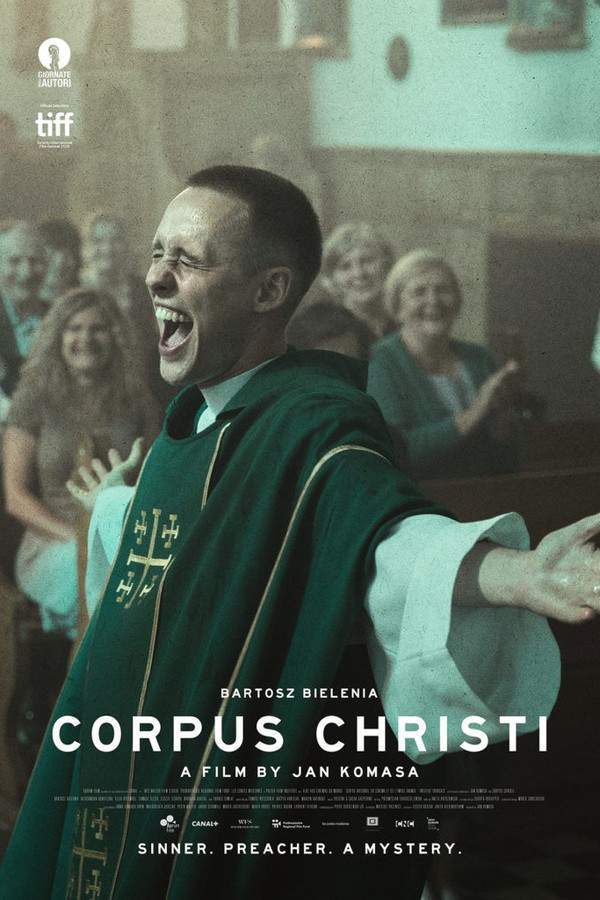
Daniel, a devout Catholic Bartosz Bielenia serving a sentence for second-degree murder, returns to civilian life with a stubborn roadblock: his criminal past keeps him from realizing his dream of becoming a priest. He is assigned to a sawmill worker’s life in a quiet village, and on a visit to the village church, he pretends to be a priest. The vicar of the church, unaware of the deception, leaves him in charge while he travels for medical treatment, trusting that a newcomer who seems earnest can handle the parish in his absence.
From his first days in the role, Daniel throws himself into every duty with a mix of surprising flair and a certain unorthodox charm. The parishioners respond with warmth and curiosity, appreciating how he approaches rituals with a fresh, untraditional touch while still honoring the core beliefs that drew him to this calling. Daniel’s sermons carry an unusual blend of honesty and raw emotion, and he is unafraid to share confessions even when they reveal inconvenient truths about himself. His willingness to lean into uncomfortable conversations earns both admiration and unease among different parts of the community.
As he begins to probe a recent car crash, the community’s mood shifts. One car carried an adult man who died, while the other involved six teenagers. The man is portrayed as a disliked outcast with a history of violent behavior, yet the villagers resist considering the possibility that the teenagers might bear responsibility for what happened. Daniel’s curiosity is not healed by silence; instead, it grows, drawing him toward a troubling missing piece in the story.
Daniel’s path intersects with Marta, a local woman whose brother was among the victims. Marta, Eliza Rycembel, becomes a crucial ally and a gateway to a darker truth that is not easy for the town to accept. She shares with him a video her brother sent hours before the accident—a clip showing the group, including the driver, engaging in heavy drinking and drug use. She keeps the video private for now, but its existence unsettles the village’s reluctance to reexamine culpability. A new, hard-edged reality begins to surface, and the town’s power structures grow wary of Daniel’s questions. The mayor, Leszek Lichota, warns Daniel to stop digging, insisting that the matter is closed and that further inquiry could destabilize a fragile social balance. Still, the question of who should be buried in the village cemetery becomes a point of deep contention.
Months pass, and Daniel learns that the cremated remains of the driver are waiting to be laid to rest. The town’s response becomes personal and cruel: many residents have sent hateful, threatening letters to the driver’s widow, who herself has become ostracized for insisting on her husband’s innocence. Feeling a growing responsibility to restore dignity, Daniel, joined by a guilt-ridden Marta, challenges the villagers with the letters and demands a proper burial for the solo driver. This act of defiance reframes the conflict from a mere accident to a communal reckoning with guilt, blame, and mercy.
Tension spikes when Marta’s mother reacts harshly to the uncovering of these documents, ejecting Marta from the home and forcing her to seek refuge in the temporary rectory with Daniel. In this intimate space, their relationship deepens, moving beyond professional complicity toward something more personal, even as they navigate the moral fog surrounding the accident. A sense of hope flickers as the two work together to honor the deceased, even as outsiders whisper about imposture and consequences.
The burial service itself becomes a turning point. The village atmosphere shifts as many residents set aside their animosity to pay their respects at last. Yet the peace is short-lived: just before the Mass that would follow, a priest from Daniel’s youth detention center arrives, having been tipped off about the impostor in their midst. He orders Daniel to leave immediately, forcing a dramatic escape. Rather than vanish, Daniel seizes the moment to stage a farewell Mass of his own, revealing tattoos that mark his history and his willingness to claim a different path, even as he departs.
Back behind bars, Daniel confronts a raw, brutal moment: he meets the brother of the man he murdered and engages in a ferocious fight. The skirmish ends with Daniel prevailing, and in a surprising turn of mercy, the other prisoners permit him to walk free. The film closes on a note that feels both earned and unsettled, a meditation on faith, guilt, community pressure, and the precarious line between truth and the need for belonging.
Corpus Christi Timeline
Follow the complete movie timeline of Corpus Christi (2019) with every major event in chronological order. Great for understanding complex plots and story progression.
Release from prison and village assignment
Daniel is released from his sentence for second-degree murder and is assigned to work at a sawmill in a village. He carries the weight of his past and clings to a fragile dream of becoming a priest again. The new setting introduces him to the local community and its secrets.
Visits church and is left in charge
Shortly after arriving, Daniel visits the local Catholic church and pretends to be a priest. The vicar, away for medical treatment, leaves him in charge, granting him unexpected authority. Daniel begins to test the waters of priestly duties in the community.
Daniel performs priestly duties and confesses murder
Daniel carries out church duties with unorthodox methods and wins the villagers’ approval. He even confesses to having murdered someone from the pulpit, unsettling some and thrilling others with his candor. The community starts to see him as a spiritual figure despite the truth about his past.
Inquiry into the car crash
Daniel probes the recent car crash that killed an adult man and six teenagers. The driver is an unpopular outcast, yet the villagers resist blaming the teenagers and resist re-opening the case. Tensions rise as questions about responsibility surface.
Marta reveals a troubling video
Daniel learns from Marta, whose brother died in the crash, about a video his brother sent hours before the accident. The clip shows the group drinking and taking drugs, though Marta has not yet shared it publicly. The video hints at possible involvement but remains undisclosed.
Mayor and council push back on investigation
The mayor warns Daniel against further inquiry and insists the matter is closed. A heated debate erupts in the village over whether the driver should be buried with the other victims, testing the community’s willingness to question the accepted narrative. Daniel’s probing stirs old loyalties and fear.
Months later: remains and letters
Months pass, and the cremated remains of the driver await burial. Villagers flood the widow with hateful letters, ostracizing her for maintaining her husband’s innocence. Daniel and Marta confront the community with the letters, challenging the surface consensus and prompting a new burial plan for the driver.
Rectory refuge and growing intimacy
Marta’s mother ejects her for revealing the letters, and she seeks refuge in the temporary rectory with Daniel. The two become intimate, complicating Daniel’s role and loyalties as he navigates questions of justice and faith. The relationship further entangles the community’s moral divides.
Burial service, interruption, and the farewell Mass
During the burial service for the driver, the village’s animosity softens as people pay their respects. The priest from Daniel’s youth detention center arrives, tells Daniel to leave immediately, and Daniel escapes through a window. He then conducts a farewell Mass, reveals his tattoos, and departs, exposing his true identity.
Return to jail, duel, and release
Daniel is sent back to jail, where he encounters the brother of the man he murdered. They fight, and Daniel emerges victorious, though the outcome feels hollow. The other prisoners ultimately allow him to walk free.
Corpus Christi Characters
Explore all characters from Corpus Christi (2019). Get detailed profiles with their roles, arcs, and key relationships explained.
Daniel (Bartosz Bielenia)
A young man recently released from detention who pretends to be a priest in a village. He embraces the duties of the church, gaining the trust and admiration of parishioners with his unorthodox approach. His confession of murder and pursuit of truth about the car crash drive the central conflict, culminating in a brutal jail fight before a controversial release. His arc challenges the line between redemption and accountability.
Marta (Eliza Rycembel)
A friend of Daniel whose brother was one of the crash victims. She reveals a crucial video that could illuminate the incident, yet she faces intense pressure from the community and her own mother. She becomes entangled with Daniel, exposing vulnerability and the search for truth amid grief. Her actions propel the narrative toward questions of loyalty and justice.
Mayor Walkiewicz (Leszek Lichota)
The village mayor who embodies local authority and the politics of keeping peace at all costs. He warns Daniel against further inquiry and resists reopening the case to protect the community’s image. His decisions highlight the tension between public appearance and moral inquiry within a small town. He represents the tension between leadership and accountability.
Mother (Lidia Bogaczówna)
Marta’s mother, who exerts strong influence over her daughter and the family’s stance in the dispute. She embodies protective, tradition-bound instincts and contributes to the social pressure that shapes the village’s reaction to the incident. Her actions reflect the enduring power of family loyalties in a tight-knit community.
Parish Priest (Zdzisław Wardejn)
A priest from Daniel’s past who arrives to confront the impostor, representing external authority and the ethical scrutiny Daniel must face. He urges Daniel to leave, underscoring the risks of exposure and the consequences of deception. His intervention acts as a catalyst for Daniel’s final choices.
Corpus Christi Settings
Learn where and when Corpus Christi (2019) takes place. Explore the film’s settings, era, and how they shape the narrative.
Time period
Present-day Poland
The story unfolds in contemporary Poland over several months after a fatal car crash. It explores current social dynamics, including public judgment, media-like scrutiny, and the tension between mercy and justice within a close-knit community. The timeframe keeps the focus on modern attitudes toward crime and redemption while maintaining a timeless moral core.
Location
Poland, rural Polish village
Set in a small Polish village anchored by a local Catholic church, the sawmill, and a tight-knit community. The village square, cemetery, and rectory provide the main backdrops for daily life and rumor. The rural setting emphasizes how reputation and tradition shape decisions about forgiveness, justice, and communal harmony.
Corpus Christi Themes
Discover the main themes in Corpus Christi (2019). Analyze the deeper meanings, emotional layers, and social commentary behind the film.
🪪
Identity
Daniel assumes a sacred role while concealing a criminal past, forcing the village to confront who a priest should be. His performative priesthood tests the boundaries between faith, truth, and deception. The story probes whether identity is fixed or shaped by others' beliefs and expectations. deception becomes a tool for survival, but also a moral liability.
⚖️
Justice
The village’s handling of the crash becomes a test of communal justice versus personal vendetta. Authority figures, like the mayor, push toward settling the matter to protect the town’s image. When hidden truths come to light, the community must decide whether mercy can coexist with accountability. The burial ritual becomes a proxy for moral reckoning.
⛪
Religion
Religion functions as both social glue and a mechanism for exclusion. The church provides Daniel a platform to help, while others use faith to resist uncomfortable truths. The narrative pits pastoral care against public opinion, revealing how religious authority can heal, but also condemn. The tension illustrates the complex role of faith in communal life.
🫂
Community
The village’s collective memory and ostracism shape individuals’ choices and loyalties. Hatred letters to the widow expose how fear and stigma govern behavior. Yet moments of compassion surface when truth and dignity are honored through a burial. The film portrays a community oscillating between solidarity and hostility, driven by shared history and fear.

Coming soon on iOS and Android
The Plot Explained Mobile App
From blockbusters to hidden gems — dive into movie stories anytime, anywhere. Save your favorites, discover plots faster, and never miss a twist again.
Sign up to be the first to know when we launch. Your email stays private — always.
Explore the mobile appCorpus Christi Spoiler-Free Summary
Discover the spoiler-free summary of Corpus Christi (2019). Get a concise overview without any spoilers.
In a quiet, rural village still shadowed by a tragedy that unfolded a year earlier, the rhythm of daily life hums around a modest Catholic church. The town’s streets are lined with weather‑worn houses, and the community gathers in the pews, clutching at the hope that the next Sunday will bring a little more peace. Beneath the hushed prayers, however, there is an undercurrent of unease, a sense that the wounds of the past have never fully healed and that answers still linger in the wind.
Enter Daniel, a charismatic young man with a complicated history that has kept him on the margins of society. When the resident vicar is forced to leave for medical reasons, Daniel steps into the pulpit, presenting himself as a priest and quickly finding himself at the helm of the parish. His unconventional methods and raw honesty stir both fascination and suspicion among the faithful, as he blends street‑wise confidence with an unexpected tenderness that seems to resonate with the townspeople’s yearning for redemption.
Among those drawn to his presence is a local woman, Marta, whose own family is entangled with the lingering aftermath of the tragedy. Their connection hints at a deeper bond forged in shared curiosity and a desire to understand what truly happened. As Daniel navigates his new role, the village’s collective memory begins to surface, and a subtle mystery weaves itself through the sermons, whispered conversations, and the quiet moments beneath the church’s vaulted ceiling.
The tone of the film balances melancholy with flickers of hope, painting a portrait of a community caught between grief and the possibility of renewal. Through Daniel’s uneasy stewardship, the story explores themes of identity, forgiveness, and the fragile line between sinner and shepherd, inviting the audience to wonder whether an outsider can truly mend a place that has known only loss.
Movies with Similar Twists and Themes
Uncover films that echo the narrative beats, emotional arcs, or dramatic twists of the one you're exploring. These recommendations are handpicked based on story depth, thematic resonance, and spoiler-worthy moments — perfect for fans who crave more of the same intrigue.


Featured on this page

What's After the Movie?
Not sure whether to stay after the credits? Find out!
Check out our other apps:

SAT Sphere
Build confidence for the Digital SAT.

Mori Atlas
Discover wild places worth protecting.

Luntero
Search smarter for a home in Amsterdam.

Plot Explained
Unravel movie endings and hidden clues.

Pokechamp
Dive into Pokémon data and battle logic.

Driving Theory
Get ready for your European theory test.

Movie Dust
Plan your next cinema trip with ease.

Musemap
Find art and culture as you travel.

Selkobase
Compare credentials before committing.

Local Manual
Turn an unfamiliar country into practical next steps.

Lernavi
Compare school systems before your next move.

GymRoam
Find a workout stop wherever your plans take you.
Explore Our Movie Platform
New Movie Releases (2026)
Famous Movie Actors
Top Film Production Studios
Movie Plot Summaries & Endings
Major Movie Awards & Winners
Best Concert Films & Music Documentaries
Movie Collections and Curated Lists
© 2026 What's After the Movie. All rights reserved.
Privacy Policy