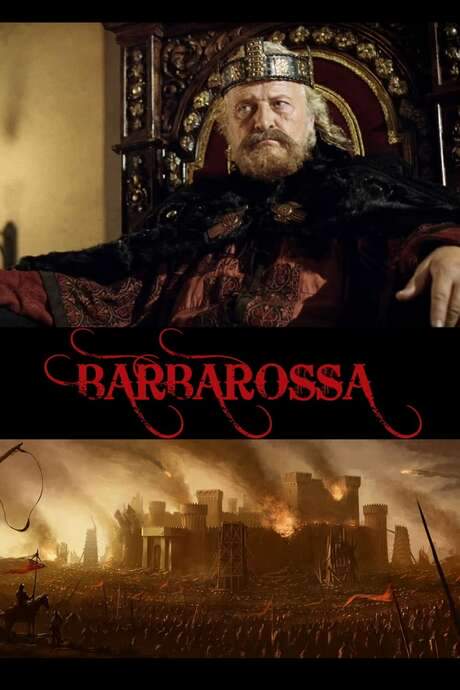
Barbarossa 2009

Directed by

Renzo Martinelli
Made by

Na-Comm
Where to Watch Barbarossa
See current US streaming, rental, and purchase options for Barbarossa (2009) via JustWatch.

Streaming availability powered by 
Barbarossa Plot Summary
Read the complete plot summary and ending explained for Barbarossa (2009). From turning points to emotional moments, uncover what really happened and why it matters.
Italy, 12th century. Northern Italy lies under the shadow of a German Emperor, the fierce Frederick I Hohenstaufen, better known as Barbarossa, Rutger Hauer. His grand aim is to reclaim and extend Charlemagne’s old empire, sweeping through Central and Southern Italy to unify the realm under a single rule. Yet in the north, a rival dream takes shape from the heart of Milan: a bold young leader named Alberto da Giussano, Raz Degan, has forged a formidable band—about 900 young men from different cities—into a loose, fearless force that longs to throw off foreign domination and restore freedom to Lombardy. This is the seed of a resistance that will test empires and shape a legend.
Barbarossa’s world expands further when, during a hunt, the Emperor is saved by a mysterious boy who introduces himself as Alberto da Giussano. In gratitude, Barbarossa gifts the youth an imperial dagger engraved with his own name, a symbol of the bond and the burden that will bind their fates together. A few years later, in Würzburg, the great seer Hildegard von Bingen, Ángela Molina, prophesies a troubling destiny: Frederick’s name will endure in memory for centuries, but a warning echoes through the lines of fate—the scythe that will bring defeat and water that will herald his death.
Back in Milan, the story widens as young Evandro, Ștefan Velniciuc, urges Alberto into action. The pair load goods onto a boat at the river, pursued by Lodigiani soldiers who claim the merchants must pay tolls for crossing their lands. In a brutal clash, Evandro slashes a soldier’s throat, and Alberto and his companions fight their way home, though Alberto is wounded in the fray. At home, two sisters—Tessa and Eleonora—offer a fragile calm, their faces bright with danger and desire as Eleonora, the brunette sister, steals a quick kiss from Alberto while he is still recovering.
Across the way, Milan’s leadership is tested. Two emissaries from Lodi arrive to plead for Barbarossa’s aid against the growing Milanese leverage, and a German emissary comes bearing a letter that names the Emperor’s will. But Milan’s cleric Gerardo—bold, even reckless—tramples the letter beneath his foot, and his ally Siniscalco Barozzi, F. Murray Abraham, is forced into a delicate game of loyalty and manipulation. Barozzi, clever and calculating, pushes Milan toward resistance even as the Emperor shows restraint—yet that restraint frays as Barozzi sees a city that may not bend.
The siege begins to take shape along the Adige River in Verona, where the Germans construct a new bridge and push their war machines forward. The Milanese respond with stubborn tenacity, and Barbarossa, angered by Verona’s boldness and Brescia’s brutal ruin, begins to assert his will with a hard hand. Eleonora, the sister of Alberto’s ally and love interest, becomes a point of tension as Barozzi’s schemes stir distrust and a dangerous love triangle begins to form around Tessa, a young woman whose future is glimpsed by the dagger she never wields. When Barozzi tries to press his claim to Tessa, she recoils from his cynical appetite for power, hinting at the precarious lines that will test both love and loyalty.
The siege intensifies. Alberto volunteers for dangerous tasks when Barozzi orders food sorties for Milan’s people; Barozzi dons a cruel calculus, exploiting the volunteers’ lives to sharpen his own grip on power. In a brutal moment, Barozzi uses a crossbow to strike down Ranero, Alberto’s own brother, a betrayal that steels Alberto’s resolve and sets in motion a vow of vengeance that will shape the war to come. After a night of grief, Alberto infiltrates Barbarossa’s camp and encounters the Emperor himself, who recognizes the gift of the dagger and, for a moment, offers a chance at mercy. Yet the war drums march onward, and Alberto returns to his father as the gates of Milan begin to bleed under pressure.
In Rome, Barbarossa, now crowned Emperor, faces the precarious blessing of a new papacy and the precarious plague that shadows his triumph. The Empress fears the mutability of loyalty and life in a city wracked by disease, while Eleonora—having survived a brutal era and formed a deeper bond with Alberto—begins to see a future beyond survival: a Lombard alliance that might stand against the Reich. In the mountains and monasteries of Lombardy, Alberto and his friends rally the towns, calling themselves the Company of Death and proclaiming their creed: “Death or freedom.” Eleonora becomes a symbol of resilience and the pair’s relationship deepens, even as Barozzi’s grip pulls at the threads of trust.
With a growing chorus of Lombard towns—Parma, Cremona, Padua, Ferrara—joining the resistance, Alberto travels to the Pontida Monastery to rally a united front. The once-fractured Lombard League now stands as a united force, a coalition that will test Barbarossa’s discipline and the imperial might of a trampling army. Eleonora, who has endured through fire and fear, supports the cause and helps weld the alliance that could finally break the invader’s grip. Tessa’s memory—her courage and brief, luminous presence—haunts the narrative as Alberto battles not just soldiers but the politics of power that Barozzi and others wield with ease.
The fields of Legnano become the crucible for the Lombard resistance. From two miles out, the German army under Barbarossa believes victory is theirs, but the Lombards have learned to fight smarter. The enemy’s cavalry is weakened by new tactics and the terrifying steel of the Lombard lance and spears. Barozzi tries to shatter Alberto by striking at his closest kin; in the clash that follows, Barozzi’s bravado falters as Alberto drives a knife into his throat, ending the treacherous menace and sealing a hard-won victory for Legnano’s defenders. Amid the smoke and dust, Eleonora emerges on the battlefield, wounded but alive, revealing that a substitution saved her life and that Barozzi’s cruelty has not gone unpunished.
In the aftermath, the Lombard victory is tempered by heavy costs and uncertain futures. Eleonora and Alberto’s bond grows stronger, and the Empress’s suspicions about Eleonora’s supposed witchcraft threaten to unravel the fragile peace. The Emperor’s siege tunnels are exposed by rain and flood, forcing Barbarossa to retreat toward Pavia, a retreat that may be as much strategic as fatal. His cousin Henry the Lion appears with a purse of coins instead of troops, signaling a weakening of imperial resolve and a shift in the balance of power. As Barbarossa contemplates a grim retreat, the Empress’s faith in divine protection sends her to demand mercy for Eleonora, a demand Barbarossa refuses, setting up a confrontation between power and mercy that will linger in memory.
On the battlefield and in the camp, Alberto’s voice becomes the organizing force behind a broader resistance. He molds reluctant towns into a single, stubborn front—an army that will stand against the Emperor’s oppression. The Lombard League’s revival culminates in Legnano’s triumph, a symbolic turning point that promises freedom to Milan and to the Lombard cities that have endured the Emperor’s rule. The war’s narrative closes with a solemn epilogue: Barbarossa reappears briefly at Pavia, then vanishes into legend, while fourteen years later he meets his fate on a distant riverbank in Anatolia, felled by a serpent’s bite. The final text confirms that Alberto da Giussano lived a long life with Eleonora, that the Company of Death dissolved, and that the Lombard towns ultimately won their freedom through unity and courage.
Barbarossa Timeline
Follow the complete movie timeline of Barbarossa (2009) with every major event in chronological order. Great for understanding complex plots and story progression.
Alberto Giussano saved by Barbarossa as a boy
A wild boar attack nearly kills a boy named Alberto Giussano. The Emperor Frederick Hohenstaufen—Barbarossa—saves him and earns his lifelong loyalty. In gratitude, Barbarossa gives Alberto an imperial dagger inscribed with his name.
Prophecy at Würzburg warns of peril
In Würzburg, the seer Hildegard von Bingen foretells that Barbarossa’s name will be remembered for centuries. She warns him that a scythe will bring defeat and water will bring death. The warning lingers as power and danger intertwine.
Milan: the river journey and two sisters
In Milan, Evandro urges Alberto to help load goods onto a boat before dawn. Lodigiani soldiers demand payment for crossing, and Alberto's group slays them in self-defense, though Alberto is wounded in the fighting. Two sisters, Tessa and Eleonora, watch the aftermath, and Eleonora kisses Alberto as he lies unconscious.
Milan-Lodi standoff and Gerado's betrayal
emissaries from Lodi request Imperial aid against Milan, and Barbarossa contemplates a diplomatic route rather than immediate war. In Milan, cleric Gerado tramples the Emperor's letter, shocking Siniscalco Barozzi and setting a chain of defiant actions in motion. Barozzi pledges to raise an army against Milan.
Barbarossa readsied to march on Milan
Barbarossa grows impatient with Milan’s defiance, though he still leans toward negotiation. His new wife counsels a harsher approach, and eventually the Emperor agrees to move his forces toward Milan. The prospect of battle begins to loom over Lombardy.
Verona: bridge siege and punishment
Near Verona, a bridge across the Adige is built for Barbarossa’s troops. German siege engines push log ramps into the river, destroying the bridge and isolating the city’s defenders. Verona’s emissaries are punished when Barbarossa cuts off the ear of one envoy.
Siege tensions rise; Ranero falls
Cities like Parma, Cremona, Padua, and Ferrara join the German effort as Milan braces for the siege. The German advance tightens as Ranero, Alberto’s brother, is slain by Barozzi’s crossbow while volunteers are sent to fetch food, fueling Alberto’s vow of vengeance.
Alberto infiltrates the German camp
That night, Alberto slips into Barbarossa’s camp and confronts Barozzi, who confirms his treachery. Alberto is captured along with other prisoners as German forces overrun the city. The Emperor burns Milan’s flag and declares Milan will be razed, sealing a grim fate for the city.
Rome coronation and plague forces retreat
In Rome, Barbarossa and his wife are crowned Emperor and Empress. A plague sweeps the capital, undermining morale and prompting a chaotic retreat as disease and fear overtake the city. The imperial banner begins to fray as the cycle of war continues.
Pontida: Lombard League takes shape
Milan’s resistance galvanizes Lombard towns, who meet at Pontida Monastery to discuss unity. Alberto and his allies declare they will unite the Lombard cities to oppose Barbarossa’s forces. This gathering seeds the renewed Lombard League.
Tessa's death and Eleonora's resolve
Barozzi abducts Tessa from the nunnery, threatening forced marriage. To avoid this fate, Tessa leaps from a ledge and dies. Eleonora confronts the trauma and vows to resist Barozzi, deepening her commitment to fight for their people.
Eleonora captured; tunnel discovery and retreat
Eleonora is captured by Barozzi and taken to the German camp at Alessandria, where a burning at the stake looms over her fate. Rumors of witchcraft swirl around her, while Empress fears the execution. A tunnel under the fort is discovered, forcing Barbarossa to pull back toward Pavia.
Henry the Lion and the coin offer
At the Mera River, Barbarossa asks Henry the Lion for troops to bolster his army. Henry declines, offering a chest of coins instead as payment for mercenaries. Barbarossa dismisses Henry as useless and continues to seek other sources of soldiers.
Legnano: the battle and Barozzi's end
The Lombards confront the Germans at Legnano, leveraging surprise and their own endurance against the invaders’ siege tactics. Barozzi kills Lorenzo and makes a last stand against Alberto, who reverses the assault and drives a stiletto into Barozzi’s throat. The Lombards emerge victorious, and Eleonora is found alive, having been spared by the Empress.
Aftermath: triumph and legacy
Three days after Legnano, Barbarossa reappears at Pavia, his movements shrouded in mystery. Fourteen years later he heads for the Crusades and dies in Anatolia after a snake bite. Alberto and Eleonora live together, the Company of Death disbands, and Lombardy secures its freedom under the Lombard League.
Barbarossa Characters
Explore all characters from Barbarossa (2009). Get detailed profiles with their roles, arcs, and key relationships explained.
Alberto da Giussano - Raz Degan
Milano-born leader who forms the 'Company of Death' to defend Lombardy. He grows into a unifying figure for the Lombard cities and is bold in battle, navigating political intrigue as he fights for freedom. His personal vendetta fades into a broader mission to secure autonomy for northern Italy.
Eleonora - Kasia Smutniak
Alberto's sister, a strong-willed and loyal ally who stands by the demand to defend Milan. She experiences visions linked to Alberto's knife and resists Barozzi's cynical schemes. Throughout the siege and political turmoil, she embodies resilience and personal sacrifice.
Tessa - Federica Martinelli
Tessa is Alberto's beloved and a symbol of hope for Lombardy. She navigates the dangers of Barozzi's arrangements and ultimately dies to avoid a forced marriage, becoming a powerful motivator for the resistance. Her memory reinforces the resolve of Milan's allies to stand together.
Siniscalco Barozzi - F. Murray Abraham
A scheming Milanese noble who uses manipulation and betrayal to advance his own interests. He pressures Milan to pledge loyalty to Barbarossa and murders Alberto's brother Ranero to weaken the resistance. His schemes are ultimately exposed by Alberto and the Lombards.
Frederick I Barbarossa - Rutger Hauer
The Holy Roman Emperor who seeks to subdue northern Italy and reassert imperial authority. His campaigns set the tempo of the conflict, tempered by political marriages, plague, and strategic retreats. He is a powerful, calculating ruler who ultimately meets a fateful end.
Rinaldo di Dassel - Hristo Shopov
A German envoy acting as an intermediary between Barozzi and Barbarossa. He relays orders and negotiates loyalties, embodying imperial authority and the political pressure behind the siege.
Barbarossa Settings
Learn where and when Barbarossa (2009) takes place. Explore the film’s settings, era, and how they shape the narrative.
Time period
12th century AD
The era centers on Frederick Barbarossa's campaigns to subdue northern Italy and the rise of the Lombard League. Cities tighten their alliances to defend Milan against imperial sieges, using sieges and battlefield tactics typical of the period. Political intrigue and plague shadows shape decisions at court and on the field.
Location
Milan, Lodi, Verona, Legnano, Lombardy, Northern Italy
Set across 12th-century Lombardy, the film follows Milan and its neighbors as they resist imperial expansion. The action moves from Milan's fortified walls to river crossings near the Adige and to Legnano's plains, reflecting the era's siege warfare. The landscape of Northern Italy frames a conflict between a centralized empire and local city-states seeking freedom.
Barbarossa Themes
Discover the main themes in Barbarossa (2009). Analyze the deeper meanings, emotional layers, and social commentary behind the film.
🕊️
Freedom
Freedom is the thread driving Lombardy's resistance as Alberto builds the Company of Death to defend autonomy. The story emphasizes collective courage over individual glory, uniting Milan's rival cities. Personal sacrifice becomes essential to preserve regional liberty, not just a single victory.
🤝
Unity
The Lombard League's strength lies in unity, turning fragile city alliances into a formidable front against Barbarossa. Alberto's leadership is tested by Barozzi's manipulations, forcing cities to choose cooperation over rivalry. The film portrays unity as both a strategic necessity and a moral ideal.
🛡️
Resistance
Stone walls, siege engines, and courageous counterattacks symbolize Lombard resistance. The people endure losses, fear, and plague to defend their homes. The film presents resistance as both a practical and ideological stance against imperial overreach.
💔
Cost of War
Personal losses—Tessa's death, Ranero's murder, and Barozzi's scheming—show war's emotional toll. The narrative links these tragedies to the broader struggle for freedom, showing that victory comes at a heavy price. The characters' sacrifices underscore the human cost behind historical legends.

Coming soon on iOS and Android
The Plot Explained Mobile App
From blockbusters to hidden gems — dive into movie stories anytime, anywhere. Save your favorites, discover plots faster, and never miss a twist again.
Sign up to be the first to know when we launch. Your email stays private — always.
Explore the mobile appBarbarossa Spoiler-Free Summary
Discover the spoiler-free summary of Barbarossa (2009). Get a concise overview without any spoilers.
In the rolling plains and fortified cities of 12th‑century Italy, power teeters between the distant throne of the Holy Roman Empire and the fiercely independent north. Frederick Barbarossa—the German emperor whose gaze stretches from the Alpine passes to the Mediterranean coast—harbors a vision of restoring Charlemagne’s ancient realm, a dream that promises order to some and domination to others. The atmosphere is thick with the clatter of armories, the murmurs of council chambers, and the ever‑present whisper of destiny shaping the continent’s future.
Against that looming ambition rises a young Milanese firebrand, Alberto da Giussano. Gathering a ragged yet resolute band of nine hundred like‑minded youths from across the northern territories, he forms the so‑called “Company of Death,” a fellowship bound by a pledge to safeguard liberty versus empire. Their camaraderie is as much a statement of defiance as it is a testament to the restless spirit of the Lombard lands, where loyalty to home and a yearning for self‑rule pulse through every tavern and market square. The tone here is gritty and heroic, tinged with the raw energy of youths shouldering a cause larger than themselves.
The film settles into a world where the echo of marching legions meets the rustle of banners raised in resistance, each side carrying its own mythic weight. Frederick and Alberto embody the clash of grand ambition and grassroots resolve, their opposing visions casting a long shadow over towns and fields alike. This tension creates a charged, almost palpable atmosphere—one of looming confrontation, simmering pride, and the fragile hope that a united front might tip the scales of history. The story invites viewers to linger on the stakes of freedom and empire before the inevitable storm breaks.
Movies with Similar Twists and Themes
Uncover films that echo the narrative beats, emotional arcs, or dramatic twists of the one you're exploring. These recommendations are handpicked based on story depth, thematic resonance, and spoiler-worthy moments — perfect for fans who crave more of the same intrigue.



Featured on this page

What's After the Movie?
Not sure whether to stay after the credits? Find out!
Check out our other apps:

SAT Sphere
Build confidence for the Digital SAT.

Mori Atlas
Discover wild places worth protecting.

Luntero
Search smarter for a home in Amsterdam.

Plot Explained
Unravel movie endings and hidden clues.

Pokechamp
Dive into Pokémon data and battle logic.

Driving Theory
Get ready for your European theory test.

Movie Dust
Plan your next cinema trip with ease.

Musemap
Find art and culture as you travel.

Selkobase
Compare credentials before committing.

Local Manual
Turn an unfamiliar country into practical next steps.

Lernavi
Compare school systems before your next move.

GymRoam
Find a workout stop wherever your plans take you.
Explore Our Movie Platform
New Movie Releases (2026)
Famous Movie Actors
Top Film Production Studios
Movie Plot Summaries & Endings
Major Movie Awards & Winners
Best Concert Films & Music Documentaries
Movie Collections and Curated Lists
© 2026 What's After the Movie. All rights reserved.
Privacy Policy