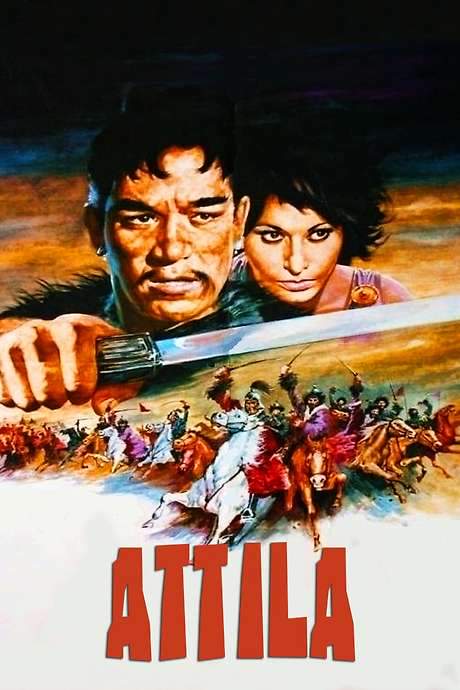



Attila Plot Summary
Read the complete plot summary and ending explained for Attila (1954). From turning points to emotional moments, uncover what really happened and why it matters.
Set in the late Roman Empire, the narrative grips you as a powerful clash of cultures and ambitions unfolds across 450-452 AD. The Huns, a fierce horde sweeping in from the Asian plains, press toward the wealthy western lands under the ruthless leadership of Attila Anthony Quinn. His name alone signals fire and thunder, a force that believes in conquest as a divine mission, and the surrounding world trembles at the prospect of facing him. Beside him, his brother Bleda Ettore Manni treads a more tempered line, advocating peace and balance, hinting at a split destiny within the Hun leadership.
On the Roman side, Flavius Aetius is the only man who has walked in both worlds. The Roman general, a man marked by years as a hostage among the Huns, carries an uneasy mandate from the aging Emperor Valentinian III to the Hun king Rua Christian Marquand. The political landscape is a tangle: Ravenna is a palace of party and decadence, while the state itself crumbles under neglect. Valentinian III, a child-king in name, is more preoccupied with feasts and theatrics than with the practical matters of an empire fraying at the edges. His mother, Galla Placidia Colette Régis, acts as the de facto ruler, trying to stitch together fragile loyalties before the empire collapses into chaos. Into this maelstrom steps Honoria Sophia Loren, Valentinian’s sister and a restless spirit who seeks to topple the old guard and seize control, seeking Aetius’s support to execute a coup. Yet Aetius remains bound by a solemn oath to serve the Empire, even at great personal cost, and refuses to swap loyalty for power, which earns him both respect and danger as he’s stripped of rank by the very leaders he serves.
Aetius’s return to Ravenna marks a turning point as the two great powers collide. The Huns, led by Attila’s uncompromising vision, push forward with a brutal display of force, while the Romans summon their legions to block the advance. The two camps collide on open plains before spilling into the Hun camp itself, a brutal dance of arrows, countercharges, and tactical feints. The battle is not merely a clash of metal and muscle but a clash of ideas: the Hun hunger for expansion against Rome’s stubborn hold on a crumbling world. In a decisive moment during the hunt that ushers in Attila’s sole rule, Bleda is slain when Attila orders his own bodyguard to unleash arrows at the pairs of leaders, a terrible revelation that hardens the Hun king and deepens the rift within his ranks.
As the Roman lines falter, Honoria slips away from the imperial court and seeks out the Hun camp, drawn by a dangerous mix of ambition and desperation. The tide of the war turns as the battle moves from a frontal assault to a more fluid struggle that spills into the heart of the Hun’s own encampment. The fate of the legions hinges on daring choices and brutal calculations, and the Romans find themselves fighting for survival rather than victory. Amid the carnage, a fateful moment arrives when Honoria is discovered in a nomad’s cart within the Hun lines and is killed, a brutal reminder of how fragile life and loyalty can be in such a volatile campaign.
The end of the immediate conflict comes with a devastating blow: Aetius is felled by an arrow through the neck, and the Roman resolve buckles as their leaders fall and fear takes hold. The survivors retreat, the Hun encampment burns, and the battlefield becomes a graveyard for a once-formidable army. The tragedy continues as Attila, already a conqueror with an unyielding spirit, learns of his own son Bleda’s death, a wound that leaves him emotionally unsettled and questioning the cost of endless bloodshed. The once indisputable conqueror begins to glimpse the price of bloodshed and the human cost of empire.
On the road toward Rome, Attila’s forces encounter a procession led by Pope Leo I, a moment that contrasts starkly with the brutality that preceded it. In a quiet conversation that unfolds in a stream’s shallow water, the Pope speaks with a calm authority that unsettles the Hun leader. “You can kill everybody…old people, women, children…” the Pope notes, and the implied judgment lingers in Attila’s mind. The words, spoken as a haunting echo, remind him that violence often returns as a boomerang. It is in this encounter that Attila experiences a turning point; a surge of conscience, a dawning realization that the path of conquest may not offer the lasting glory he imagined. The disembodied memory of his murdered brother Bleda surfaces, and the great warrior suddenly chooses a different course.
With the weight of that moral reckoning bearing down on him, Attila turns away from the gates of Rome and directs his horde back toward the Alps, choosing not to unleash destruction on a city that would suffer for generations to come. The journey becomes, in a sense, a pilgrimage from ruthless ambition to restraint, a transformation sparked by a moment of clarity in the harshest of landscapes. The encounter with the Pope leaves an indelible impression, a rare moment of mercy that reshapes a warlord’s destiny and the fate of two great empires.
In this sweeping film, the performances—woven together with political intrigue, battlefield ferocity, and moral crisis—paint a vivid portrait of an era defined by the collision of power and conscience. The story honors both the grandeur and the fragility of civilizations caught between tradition and tumult, showing how men like Attila and Aetius shape history not only through swords and strategy but through choices that echo far beyond the moments of battle. The clash culminates in a quiet decision that alters the course of Rome’s fate and casts a long shadow over the saga of the Hun and the empire they sought to mold in their image.
Attila Timeline
Follow the complete movie timeline of Attila (1954) with every major event in chronological order. Great for understanding complex plots and story progression.
Hun advance toward Germania
The Huns, led by Attila and his brother Bleda, advance their hordes toward the western Roman lands. The threat intensifies along the frontiers as the nomadic army prepares for a probable invasion. The scene sets up an imminent collision with Rome.
Envoys reach the Hun capital with imperial message
Aetius and his companion Prisco carry a message from Emperor Valentinian III to the Hun king Rua and travel to the Hun capital. They learn that Bleda and Attila are the new co-rulers after Rua's death, shaping a fragile tie between Rome and the Huns. The encounter establishes the political backdrop for later alliance and betrayal.
Bleda dies; Attila becomes sole ruler
Arriving at the Hun court, Attila's grip on power tightens when Bleda is killed during a hunt. Attila's bodyguard fires arrows at Bleda and his own protectors, allowing Attila to declare himself the sole leader of the Huns. Bleda had favored peace, but Attila's ascent signals a conquest-driven path for the tribes.
Aetius returns to Ravenna; a decaying empire
Aetius returns to the imperial capital of Ravenna and finds Valentinian III a boyish ruler absorbed in court pleasures. Galla Placidia, Valentinian's mother, acts as de facto ruler, steering the Empire's fragile politics. The looming Hun threat intensifies the sense that Rome is slipping apart.
Placidia grants Aetius military powers
Recognizing the crisis, Placidia grants Aetius full military powers to defend the Empire and hold the Hun advance at bay. He begins reorganizing legions and coordinating a counterstrategy. This empowerment marks a turning point in Rome's response to Attila.
Honoria seeks coup; Aetius refuses
Honoria, Valentian's sister, tries to enlist Aetius in a coup to seize power from Valentinian and Placidia. He refuses, bound by loyalty to the Empire and his oath of service. In retaliation, Valentinian and Placidia strip him of rank and temporarily exile him.
Honoria escapes to the Hun camp
Honoria slips away from the Imperial court and travels to the Hun camp to seek favor with Attila. She hopes to influence his plans or gain a throne through alliance with the Huns. The act intensifies the court's instability and the risk of Roman-Hun cooperation.
First major battle begins with a Hun feint
The battle opens with a frontal Hun cavalry assault designed to draw Roman legions out of their fortified position. Aetius orders a pursuit, charging his cavalry and infantry into the retreating Huns. The fighting spills into the Hun camp as the two sides clash amid tents and banners.
Honoria found dead in a nomad cart
During the confusion of the encounter, Honoria is found hiding in a nomad cart and is killed. Her death closes a volatile political subplot and alters the court's calculus. The event resonates through both camps as the true loyalties of Rome are tested.
Aetius slain by arrow; Roman morale collapses
Aetius is struck in the neck by an enemy arrow and dies, cutting off Rome's top commander at a critical moment. His death saps the Romans' will to fight and leads to disarray on the battlefield. The surviving legions begin to lose cohesion as the Hun pressure intensifies.
Romans retreat; Huns burn encampment
With their leadership decimated, the Romans retreat from the field while Hun forces burn the encampment behind them. The rout ends any immediate Roman resistance to Attila's invasion. The Hun victory consolidates Attila's momentum, though the campaign is far from over.
Battlefield moment: Attila's tribute to Bleda
On the battlefield, Attila is shown with his young son Bleda as the carnage unfolds. A wounded Roman archer fires a final shot that kills Bleda, a blow that deeply unsettles Attila and shatters any lingering zeal for conquest. The moment marks a painful turning point in the Hun campaign.
Pope Leo I confronts Attila
On the road to Rome, Attila encounters a procession led by Pope Leo I who speaks to him from a stream between the two armies. Leo warns that indiscriminate bloodshed will haunt him, echoing a moral rebuke that echoes beyond the battlefield. Attila listens to the pope's plea and weighs his choices.
Attila turns back; Rome spared for now
Moved by Leo's words, Attila pivots away from Rome and heads back toward the Alps. He abandons the invasion instead of conquering the city, offering Rome a temporary respite. The film closes on the uneasy peace that follows this moral turn.
Attila Characters
Explore all characters from Attila (1954). Get detailed profiles with their roles, arcs, and key relationships explained.
Attila (Anthony Quinn)
The Hun leader who unites the Hun horde and drives toward Rome with strategic brilliance. His ruthlessness is matched by moments of introspection after personal losses, culminating in a pivotal turn of conscience following a warning that violence has a lasting cost.
Flavius Aetius (Henri Vidal)
A Roman general with a keen sense of statecraft, he balances oath to the Empire with pragmatic diplomacy by leveraging an alliance with the Huns. He orchestrates military actions from Ravenna and fights to preserve the Western Empire, even as he faces mutiny and eventual death by an arrow.
Bleda (Ettore Manni)
Attila’s brother and co-ruler who initially leans toward peace. His untimely death during a hunt becomes a catalyst for Attila’s renewed, more expansive ambition and deepens the emotional weight of Attila’s later decisions.
Galla Placidia (Colette Régis)
Mother of Valentinian III and the de facto ruler of the empire, she navigates a collapsing state with political deftness. She grants Aetius expanded powers in a bid to stabilize the Empire and protect her lineage.
Honoria (Sophia Loren)
Valentinian III’s sister who seeks to reshape imperial rule through influence and alliances. Her pursuit of reform pulls her into the central power struggle, and she meets a violent end during the Hun campaign.
Valentinian III (Claude Laydu)
A childish emperor whose court parties mask an empire on the verge of collapse. His incapacity to govern directly intensifies political scheming at Ravenna and Rome, accelerating the collapse of imperial authority.
Prisco (Georges Bréhat)
Aetius’s trusted companion and courier, who carries messages and supports the general’s delicate diplomacy. His role underscores the importance of loyal, behind-the-scenes aides in high-stakes political-military games.
Attila Settings
Learn where and when Attila (1954) takes place. Explore the film’s settings, era, and how they shape the narrative.
Time period
450–452 AD
Set in the mid-5th century, the era is defined by a crumbling Western Roman Empire and shifting loyalties. Emperors and generals contend for control as threats from the Huns loom closer. The period is marked by political intrigue, military maneuvering, and the uneasy balance between conquest and survival.
Location
Ravenna, Rome, Hun camps on the Roman frontier, open plains of Germania, the Alps
The story unfolds around the Western Roman Empire’s heart at Ravenna, where the young Emperor Valentinian III’s court strains under looming collapse. It moves to Rome and the Hun camps on the frontier, then widens to the open plains where battles are fought and tactics are tested. The journey finally leads toward the Alps, reflecting a late antique world inching toward upheaval and change.
Attila Themes
Discover the main themes in Attila (1954). Analyze the deeper meanings, emotional layers, and social commentary behind the film.
👑
Power and Leadership
The film centers on competing claims to rule: emperors, generals, and warlords. Attila’s rise tests the boundaries between ruler, conqueror, and consensus-seeker. Aetius navigates court politics while trying to safeguard the Empire, illustrating how personal loyalty and strategic leadership shape history.
⚔️
War and Strategy
Strategic deception, battlefield maneuvering, and shifting alliances drive the plot. The Hun and Roman forces clash in a series of decisive moves, from frontier skirmishes to a full-scale confrontation. Outcomes hinge on courage, timing, and the ability to read rival intents.
🕊️
Conscience and Fate
Aetius and Attila are haunted by the consequences of violence and choice. The encounter with Pope Leo I and the death of Bleda force Attila to confront bloodshed’s cost. The film ties personal guilt to collective fate, suggesting ethical reckonings can alter empires’ trajectories.
🗺️
Diplomacy and Loyalties
Diplomatic maneuvering tests loyalties as Aetius brokers a tenuous alignment with the Huns. The political maneuvering within the imperial court—Honoria, Galla Placidia, and Valentinian—reveals how diplomacy can be as decisive as armed conflict. The balance between oath, pragmatism, and ambition shapes the empire’s course.

Coming soon on iOS and Android
The Plot Explained Mobile App
From blockbusters to hidden gems — dive into movie stories anytime, anywhere. Save your favorites, discover plots faster, and never miss a twist again.
Sign up to be the first to know when we launch. Your email stays private — always.
Explore the mobile appAttila Spoiler-Free Summary
Discover the spoiler-free summary of Attila (1954). Get a concise overview without any spoilers.
The late Roman Empire trembles as a storm of horse‑tread hooves rolls from the Asian steppes toward the heart of Italy. Attila, a name that already rings like thunder across the continent, commands a ferocious horde that sweeps aside every resistance in its path. The film opens on a world where the glitter of Roman marble meets the raw, wind‑blown expanses of the Hun frontier, setting a tone that is both grandly epic and unsettlingly intimate. The looming presence of a conquered empire and a relentless invader creates an atmosphere charged with anticipation, a clash of civilizations poised on the brink of collision.
On the opposite shore of this looming conflict stands a Rome that is as fragile as it is proud. Flavius Aetius, a seasoned general who once lived among the Huns, returns to a court where power is delegated to a child‑emperor, Valentinian III, whose indolence masks a crumbling authority. His mother, Galla Placidia, strives to hold the empire together, while the emperor’s sister, Honoria, burns with ambition that could reshape the balance of power. This web of politics, intrigue, and personal ambition fuels a tense backdrop, suggesting that the battle ahead will be fought not only on fields of steel but also within the corridors of power.
Against this tapestry of ambition and dread, the film hints at deeper questions of destiny and conscience. The arrival of the Huns’ massive warband at Rome’s gates promises a confrontation that will test the resolve of both the disciplined legions and the unyielding invader. A brief encounter with a solemn figure of faith, Pope Leo I, adds a quiet counterpoint to the mounting violence, suggesting that moral reckonings may be as decisive as swords. The stage is set for an epic showdown where culture, loyalty, and the weight of history converge, leaving the audience poised on the edge of an unforgettable clash.
Movies with Similar Twists and Themes
Uncover films that echo the narrative beats, emotional arcs, or dramatic twists of the one you're exploring. These recommendations are handpicked based on story depth, thematic resonance, and spoiler-worthy moments — perfect for fans who crave more of the same intrigue.


Featured on this page

What's After the Movie?
Not sure whether to stay after the credits? Find out!
Check out our other apps:

SAT Sphere
Build confidence for the Digital SAT.

Mori Atlas
Discover wild places worth protecting.

Luntero
Search smarter for a home in Amsterdam.

Plot Explained
Unravel movie endings and hidden clues.

Pokechamp
Dive into Pokémon data and battle logic.

Driving Theory
Get ready for your European theory test.

Movie Dust
Plan your next cinema trip with ease.

Musemap
Find art and culture as you travel.

Selkobase
Compare credentials before committing.

Local Manual
Turn an unfamiliar country into practical next steps.

Lernavi
Compare school systems before your next move.

GymRoam
Find a workout stop wherever your plans take you.
Explore Our Movie Platform
New Movie Releases (2026)
Famous Movie Actors
Top Film Production Studios
Movie Plot Summaries & Endings
Major Movie Awards & Winners
Best Concert Films & Music Documentaries
Movie Collections and Curated Lists
© 2026 What's After the Movie. All rights reserved.
Privacy Policy