
Barbarossa 2009

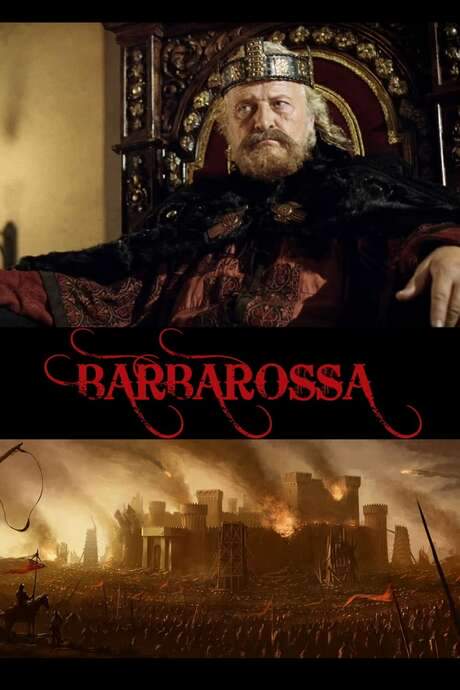
In 1100 Italy, the German emperor Frederick Barbarossa rules the northern territories and dreams of extending his power southward to recreate Charlemagne’s empire. Opposing him, Milanese youth leader Alberto da Giussano gathers a “Company of Death” of 900 men from across the north, vowing to drive out the emperor and restore freedom to their lands.


Does Barbarossa have end credit scenes?
No!
Barbarossa does not have end credit scenes. You can leave when the credits roll.
Meet the Full Cast and Actors of Barbarossa
Explore the complete cast of Barbarossa, including both lead and supporting actors. Learn who plays each character, discover their past roles and achievements, and find out what makes this ensemble cast stand out in the world of film and television.

Kasia Smutniak
Eleonora

F. Murray Abraham
Siniscalco Barozzi

Ángela Molina
Ildegarda di Binden

Rutger Hauer
Federico Barbarossa

Raz Degan
Alberto da Giussano

Emanuela Postacchini
Popolana
Antonio Cupo
Alberto dell'Orto
Gian Marco Tavani
Lorenzo della Pigna
Hristo Shopov
Rinaldo di Dassel
Riccardo Cicogna
Wibaldo
Cécile Cassel
Beatrice di Borgogna
Marius Chivu
Guidone
Elena Bouryka
Antonia
Vlad Rădescu
Mastro Guitelmo
Zoltan Butuc
Otto da Giussano
Alan O'Silva
Enrico il Leone
Karl Baker
Reinero da Giussano
Federica Martinelli
Tessa
Robert Alexander Baer
Alberto da ragazzo
Maurizio Tabani
Giovanni da Giussano
Claudiu Trandafir
giudice
Șerban Celea
Dignitary
Christo Jivkov
Gherardo Negro
Ștefan Velniciuc
Evandro
Vasile Albineț
Alcibide
Adrian Ștefan
Ottone
Dicu Aurel
ufficiale germanico
Thomas Davis
Lorenzo della Pigna ragazzo
Roxanna Ravenor
Soldier (uncredited)
Francesca Ruiz
Eugenie
Umberto Bossi
cameo
Monica Vallero
Popolana
Michele Russo
External Links and Streaming Options
Discover where to watch Barbarossa online, including streaming platforms, rental options, and official sources. Compare reviews, ratings, and in-depth movie information across sites like IMDb, TMDb, Wikipedia or Letterboxd.




Take the Ultimate Barbarossa Movie Quiz
Challenge your knowledge of Barbarossa with this fun and interactive movie quiz. Test yourself on key plot points, iconic characters, hidden details, and memorable moments to see how well you really know the film.
Barbarossa (2009) Quiz: Test your knowledge of the 2009 historical drama "Barbarossa".
Which actor portrays Emperor Frederick I Barbarossa?
Full Plot Summary and Ending Explained for Barbarossa
Read the complete plot summary of Barbarossa, including all major events, twists, and the full ending explained in detail. Explore key characters, themes, hidden meanings, and everything you need to understand the story from beginning to end.
Italy, 12th century. Northern Italy lies under the shadow of a German Emperor, the fierce Frederick I Hohenstaufen, better known as Barbarossa, Rutger Hauer. His grand aim is to reclaim and extend Charlemagne’s old empire, sweeping through Central and Southern Italy to unify the realm under a single rule. Yet in the north, a rival dream takes shape from the heart of Milan: a bold young leader named Alberto da Giussano, Raz Degan, has forged a formidable band—about 900 young men from different cities—into a loose, fearless force that longs to throw off foreign domination and restore freedom to Lombardy. This is the seed of a resistance that will test empires and shape a legend.
Barbarossa’s world expands further when, during a hunt, the Emperor is saved by a mysterious boy who introduces himself as Alberto da Giussano. In gratitude, Barbarossa gifts the youth an imperial dagger engraved with his own name, a symbol of the bond and the burden that will bind their fates together. A few years later, in Würzburg, the great seer Hildegard von Bingen, Ángela Molina, prophesies a troubling destiny: Frederick’s name will endure in memory for centuries, but a warning echoes through the lines of fate—the scythe that will bring defeat and water that will herald his death.
Back in Milan, the story widens as young Evandro, Ștefan Velniciuc, urges Alberto into action. The pair load goods onto a boat at the river, pursued by Lodigiani soldiers who claim the merchants must pay tolls for crossing their lands. In a brutal clash, Evandro slashes a soldier’s throat, and Alberto and his companions fight their way home, though Alberto is wounded in the fray. At home, two sisters—Tessa and Eleonora—offer a fragile calm, their faces bright with danger and desire as Eleonora, the brunette sister, steals a quick kiss from Alberto while he is still recovering.
Across the way, Milan’s leadership is tested. Two emissaries from Lodi arrive to plead for Barbarossa’s aid against the growing Milanese leverage, and a German emissary comes bearing a letter that names the Emperor’s will. But Milan’s cleric Gerardo—bold, even reckless—tramples the letter beneath his foot, and his ally Siniscalco Barozzi, F. Murray Abraham, is forced into a delicate game of loyalty and manipulation. Barozzi, clever and calculating, pushes Milan toward resistance even as the Emperor shows restraint—yet that restraint frays as Barozzi sees a city that may not bend.
The siege begins to take shape along the Adige River in Verona, where the Germans construct a new bridge and push their war machines forward. The Milanese respond with stubborn tenacity, and Barbarossa, angered by Verona’s boldness and Brescia’s brutal ruin, begins to assert his will with a hard hand. Eleonora, the sister of Alberto’s ally and love interest, becomes a point of tension as Barozzi’s schemes stir distrust and a dangerous love triangle begins to form around Tessa, a young woman whose future is glimpsed by the dagger she never wields. When Barozzi tries to press his claim to Tessa, she recoils from his cynical appetite for power, hinting at the precarious lines that will test both love and loyalty.
The siege intensifies. Alberto volunteers for dangerous tasks when Barozzi orders food sorties for Milan’s people; Barozzi dons a cruel calculus, exploiting the volunteers’ lives to sharpen his own grip on power. In a brutal moment, Barozzi uses a crossbow to strike down Ranero, Alberto’s own brother, a betrayal that steels Alberto’s resolve and sets in motion a vow of vengeance that will shape the war to come. After a night of grief, Alberto infiltrates Barbarossa’s camp and encounters the Emperor himself, who recognizes the gift of the dagger and, for a moment, offers a chance at mercy. Yet the war drums march onward, and Alberto returns to his father as the gates of Milan begin to bleed under pressure.
In Rome, Barbarossa, now crowned Emperor, faces the precarious blessing of a new papacy and the precarious plague that shadows his triumph. The Empress fears the mutability of loyalty and life in a city wracked by disease, while Eleonora—having survived a brutal era and formed a deeper bond with Alberto—begins to see a future beyond survival: a Lombard alliance that might stand against the Reich. In the mountains and monasteries of Lombardy, Alberto and his friends rally the towns, calling themselves the Company of Death and proclaiming their creed: “Death or freedom.” Eleonora becomes a symbol of resilience and the pair’s relationship deepens, even as Barozzi’s grip pulls at the threads of trust.
With a growing chorus of Lombard towns—Parma, Cremona, Padua, Ferrara—joining the resistance, Alberto travels to the Pontida Monastery to rally a united front. The once-fractured Lombard League now stands as a united force, a coalition that will test Barbarossa’s discipline and the imperial might of a trampling army. Eleonora, who has endured through fire and fear, supports the cause and helps weld the alliance that could finally break the invader’s grip. Tessa’s memory—her courage and brief, luminous presence—haunts the narrative as Alberto battles not just soldiers but the politics of power that Barozzi and others wield with ease.
The fields of Legnano become the crucible for the Lombard resistance. From two miles out, the German army under Barbarossa believes victory is theirs, but the Lombards have learned to fight smarter. The enemy’s cavalry is weakened by new tactics and the terrifying steel of the Lombard lance and spears. Barozzi tries to shatter Alberto by striking at his closest kin; in the clash that follows, Barozzi’s bravado falters as Alberto drives a knife into his throat, ending the treacherous menace and sealing a hard-won victory for Legnano’s defenders. Amid the smoke and dust, Eleonora emerges on the battlefield, wounded but alive, revealing that a substitution saved her life and that Barozzi’s cruelty has not gone unpunished.
In the aftermath, the Lombard victory is tempered by heavy costs and uncertain futures. Eleonora and Alberto’s bond grows stronger, and the Empress’s suspicions about Eleonora’s supposed witchcraft threaten to unravel the fragile peace. The Emperor’s siege tunnels are exposed by rain and flood, forcing Barbarossa to retreat toward Pavia, a retreat that may be as much strategic as fatal. His cousin Henry the Lion appears with a purse of coins instead of troops, signaling a weakening of imperial resolve and a shift in the balance of power. As Barbarossa contemplates a grim retreat, the Empress’s faith in divine protection sends her to demand mercy for Eleonora, a demand Barbarossa refuses, setting up a confrontation between power and mercy that will linger in memory.
On the battlefield and in the camp, Alberto’s voice becomes the organizing force behind a broader resistance. He molds reluctant towns into a single, stubborn front—an army that will stand against the Emperor’s oppression. The Lombard League’s revival culminates in Legnano’s triumph, a symbolic turning point that promises freedom to Milan and to the Lombard cities that have endured the Emperor’s rule. The war’s narrative closes with a solemn epilogue: Barbarossa reappears briefly at Pavia, then vanishes into legend, while fourteen years later he meets his fate on a distant riverbank in Anatolia, felled by a serpent’s bite. The final text confirms that Alberto da Giussano lived a long life with Eleonora, that the Company of Death dissolved, and that the Lombard towns ultimately won their freedom through unity and courage.

Discover Film Music Concerts Near You – Live Orchestras Performing Iconic Movie Soundtracks
Immerse yourself in the magic of cinema with live orchestral performances of your favorite film scores. From sweeping Hollywood blockbusters and animated classics to epic fantasy soundtracks, our curated listings connect you to upcoming film music events worldwide.
Explore concert film screenings paired with full orchestra concerts, read detailed event information, and secure your tickets for unforgettable evenings celebrating legendary composers like John Williams, Hans Zimmer, and more.


Barbarossa Themes and Keywords
Discover the central themes, ideas, and keywords that define the movie’s story, tone, and message. Analyze the film’s deeper meanings, genre influences, and recurring concepts.

Unlock the World of Movies with Our Comprehensive Wiki
Dive into our Movie Wiki for in-depth film encyclopedia entries, including cast biographies, production trivia, plot synopses, behind-the-scenes facts, and thematic analyses. Whether you’re researching iconic directors, exploring genre histories, or discovering hidden easter eggs, our expertly curated movie database has everything you need to fuel your cinematic passion.
Similar Movies To Barbarossa You Should Know About
Browse a curated list of movies similar in genre, tone, characters, or story structure. Discover new titles like the one you're watching, perfect for fans of related plots, vibes, or cinematic styles.








Quick Links: Summary, Cast, Ratings, More

What's After the Movie?
Not sure whether to stay after the credits? Find out!




Explore Our Movie Platform
New Movie Releases (2026)
Famous Movie Actors
Top Film Production Studios
Movie Plot Summaries & Endings
Major Movie Awards & Winners
Best Concert Films & Music Documentaries
Movie Collections and Curated Lists
© 2026 What's After the Movie. All rights reserved.